

New Puppy Checklist: What to Do Before and After You Bring Your Puppy Home
By Cal Hewitt · Published
Training
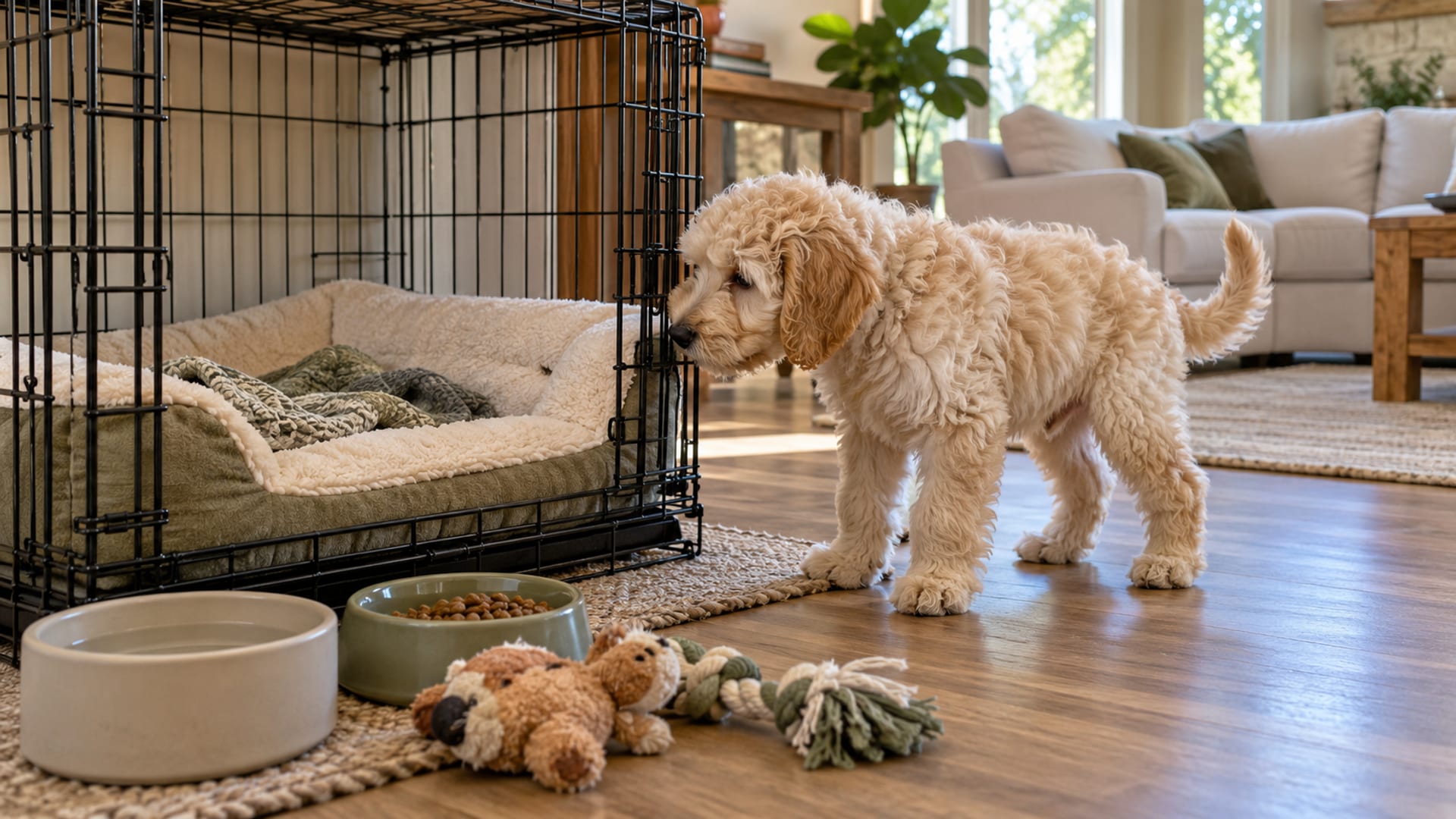
Before your puppy comes home, set up a safe home base, buy the basic supplies, remove hazards from the house and yard, book a vet appointment and gather the puppy's medical records. Once your puppy is in the door, keep the days quiet and predictable, supervise every meeting with children and pets, offer frequent potty breaks and let your puppy sleep a lot. Ask your veterinarian to set the vaccine, parasite and outdoor-exposure plan for your puppy's age, location and lifestyle, and start safe, reward-based socialization early instead of waiting for a magic "all shots done" date. Call the vet promptly for vomiting, diarrhea, lethargy or a puppy who stops eating.
Key takeaways
Tap a card to bring it forward.
- Set up a home base, gates, bedding, bowls, ID and cleaning supplies before pickup.
- Puppy-proof the house and yard at puppy level, and lock away medicines, chemicals and trash.
- Book the first vet visit for the first few days and bring every record you have.
- Vaccines and parasite prevention follow general guidelines; your vet sets your puppy's schedule.
- Safe socialization starts in the first three months, before every vaccine is finished.
- Call the vet the same day for repeated vomiting, diarrhea with lethargy, refusing food or a swallowed toxin or object.
I know a new puppy can feel like a lot at once. This list puts the urgent things first, then the decisions that can wait a few days.
What to set up and buy before pickup
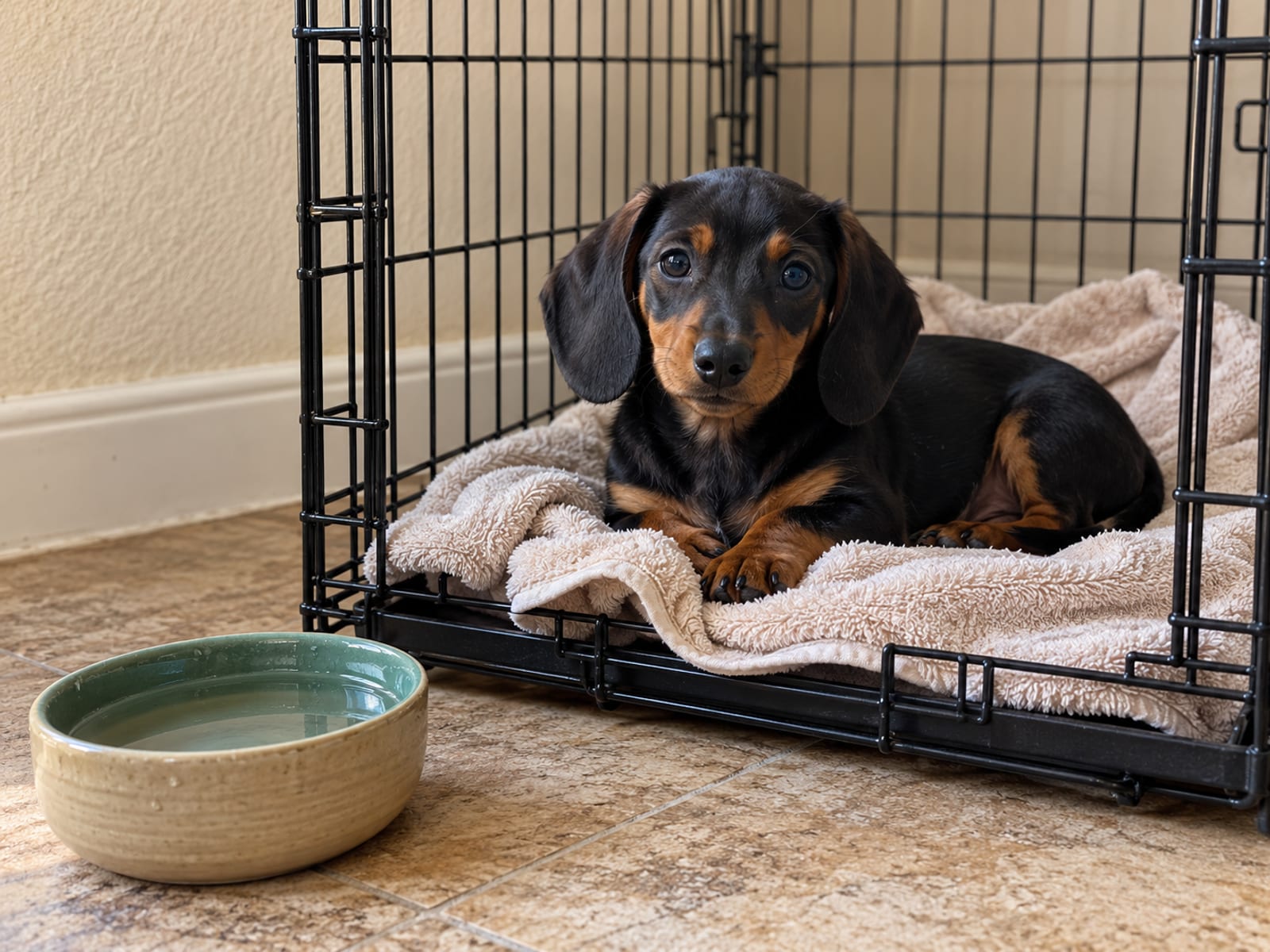
Start with a safe home base, a small area where your puppy rests and can be watched. A crate, an exercise pen or a gated corner all work. Then gather these supply types:
- A crate or other safe confinement area, plus gates or barriers.
- A washable bed, mat or blankets.
- A food bowl and a water bowl.
- The complete puppy food your puppy is already eating, so the first days stay familiar.
- A collar with an ID tag (add the rabies tag when it is issued), plus a harness and leash.
- Safe chew toys and age-appropriate enrichment toys.
- Pet-safe cleaning supplies, such as an enzymatic cleaner, and waste bags.
- A secure trash container.
- A brush or comb that suits the coat, nail-care supplies, a puppy toothbrush and dog toothpaste.
- A travel carrier or a secured seat restraint for the car.
- Your vet's number and an emergency vet's number, written where everyone can see them.
Two other tasks belong on the same day: book a first vet appointment and collect the paperwork, meaning adoption or transfer papers, vaccine and deworming records, and food information. For a step-by-step method, use our guide to crate training a puppy or adult dog. I won't repeat it here.
Pick the item types above in whatever suits your budget and your puppy's size, and price them locally.
How to puppy-proof the house and yard
Get down on the floor at puppy level and look under furniture, behind appliances and along baseboards. If you can reach it from there, your puppy can too. The ASPCA's puppy-proofing checklist is a good base, and these are the main fixes:
- Cover or secure electrical cords and dangling curtain pulls.
- Block stairways, balconies, crawl spaces and gaps behind appliances.
- Keep medicines in closed cabinets, and pick up any dropped pill right away.
- Lock away cleaners, laundry products, pesticides, rodent bait and car chemicals. The ASPCA warns that "pet-resistant" bait stations can still attract pets, so keep them out of reach.
- Keep food, candles and countertop items out of reach, and use a covered trash can.
- Remove coins, batteries, string, socks, small game pieces and children's toys that could be swallowed.
- Secure windows with screens and locks.
Plants and foods need their own pass. The ASPCA toxic plant list for dogs includes sago palm, azalea, tulip, aloe, amaryllis, dieffenbachia, pothos and philodendron, and it is not a complete list. Move or remove those plants, and check our "Can My Dog Eat" pages for any food you are unsure about.
Then walk the yard. Look for poisonous plants, compost, mushrooms, fertilizer, pesticides, holes, loose fencing and standing water. Fence off pools and hot tubs with a barrier; don't assume a puppy can swim or find the way out. Until the house and yard are reliably safe, keep your puppy supervised or confined.
If you think your puppy swallowed something toxic, call your veterinarian or ASPCA Poison Control at 888-426-4435 right away, and use only the product and amount they tell you to.

What happens at the first vet visit
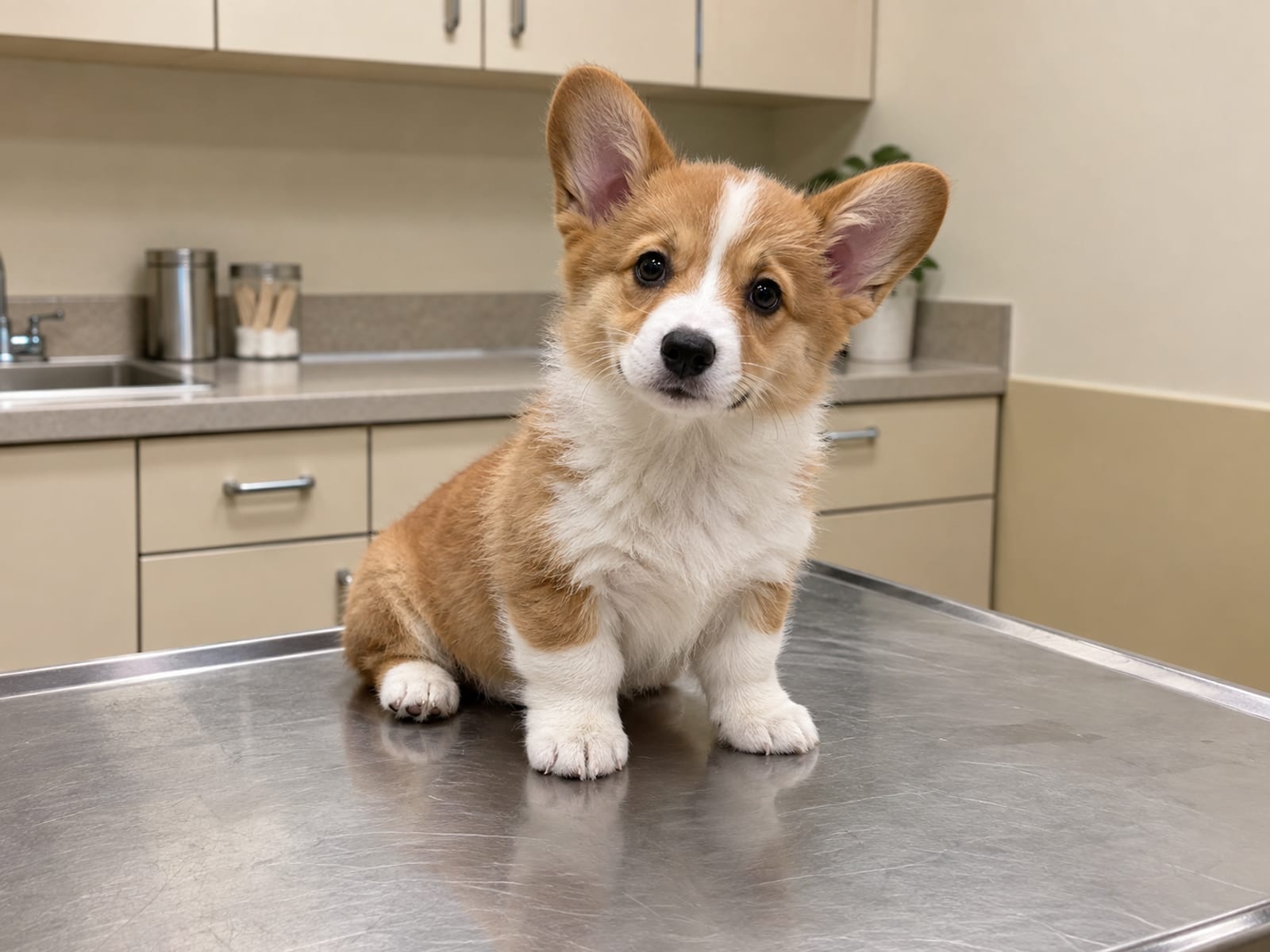
Schedule the first exam for the first few days after your puppy arrives, as the AVMA advises for new puppies. Bring:
- Adoption or transfer documents.
- Vaccine and deworming records.
- Food information.
- Any earlier exam, microchip or illness records.
- A fresh stool sample if the clinic asks for one.
- A written list of your questions and anything you have noticed.
Expect a physical exam, a weight and growth check, a look at the mouth and skin, and a talk about food and exercise. The visit can also cover fecal testing, a parasite plan, a vaccine review, microchip scanning or placement, and your questions about licensing, rabies law, spay or neuter timing and insurance. Write your questions down before you go; it is easy to forget them in the exam room.
Vaccines and parasite prevention: general guidelines your vet adapts
Treat everything in this section as general guidance to confirm with your veterinarian. Your puppy's age, records, health, location and exposure risk all change the plan.
The AAHA 2022 canine vaccination guidelines, updated in 2024, list core vaccines for distemper, adenovirus, parvovirus, leptospirosis and rabies. AAHA describes at least three combination doses between 6 and 16 weeks, given 2 to 4 weeks apart, for puppies under 16 weeks. Leptospirosis is two doses 2 to 4 weeks apart, starting at 12 weeks. Rabies timing follows the law where you live. Other vaccines, such as Bordetella, Lyme disease, canine influenza and rattlesnake toxoid, depend on lifestyle and geography.
The WSAVA 2024 guidelines start core vaccination at 6 to 8 weeks and repeat it every 2 to 4 weeks until 16 weeks or older. The dose at 16 weeks or later matters most, because the protection a puppy got from its mother has usually faded by then. So, a puppy is not fully protected after the first shot.
For parasites, CAPC describes deworming that starts at 2 weeks of age and repeats every 2 weeks until regular broad-spectrum parasite control begins. It also recommends at least four fecal exams in the first year, plus year-round parasite control and yearly heartworm testing. Our guides on heartworm in dogs and fleas and ticks on dogs go deeper.
Tap or hover a row to highlight it.
| Figure | What it means | Source |
|---|---|---|
| Figure6 to 8 weeks | What it meansCore puppy vaccination starts | SourceWSAVA 2024 |
| FigureEvery 2 to 4 weeks until 16 weeks or older | What it meansCore vaccine interval | SourceWSAVA 2024 |
| FigureAt least 3 combination doses between 6 and 16 weeks | What it meansPuppies under 16 weeks | SourceAAHA 2022, updated 2024 |
| Figure12 weeks | What it meansLeptospirosis series can begin | SourceAAHA 2022, updated 2024 |
| Figure2 weeks of age | What it meansDeworming starts | SourceCAPC, updated April 24, 2025 |
| FigureAt least 4 fecal exams | What it meansFirst year of life | SourceCAPC, updated April 24, 2025 |
How to socialize a puppy before every vaccine is finished
You do not have to keep your puppy shut away until the last shot. The AVSAB puppy socialization statement calls the first three months the main window for a puppy to get used to new people, animals, places, sounds, surfaces and handling, and says puppies should be socialized before they are fully vaccinated. The often-quoted "3 to 14 weeks" is an approximate window, not a hard deadline, so start early and keep going gradually.
AVSAB says puppy classes can start as early as 7 to 8 weeks when the puppy had at least one vaccine set at least 7 days before the first class, has had a first deworming and stays current during the class. Ask your vet which places are low risk where you live.
Safe socialization looks like this:
- Short, positive exposures.
- Healthy, appropriately vaccinated dogs and clean, controlled class spaces.
- No dog-heavy public areas that your vet advises against.
- Letting the puppy back away instead of forcing a greeting.
- Watching for fear, withdrawal or overstimulation.
- Pairing new things with food, play or another reward.
Socialization is not making your puppy greet everyone, and it is not free play with unknown dogs. If you want to read your puppy's signals, our guide to dog body language helps.
The first 24 hours, the first night and the first week
On the first day, take your puppy to the potty area first, then to the quiet home base. Limit access to one area at first, and offer water, the familiar food and a chance to rest. Introduce family members calmly, one at a time. Supervise every child interaction, and don't let children carry the puppy without an adult helping. Skip the stream of visitors. Keep resident pets apart or carefully managed, and read our guide to introducing dogs before the first meeting.
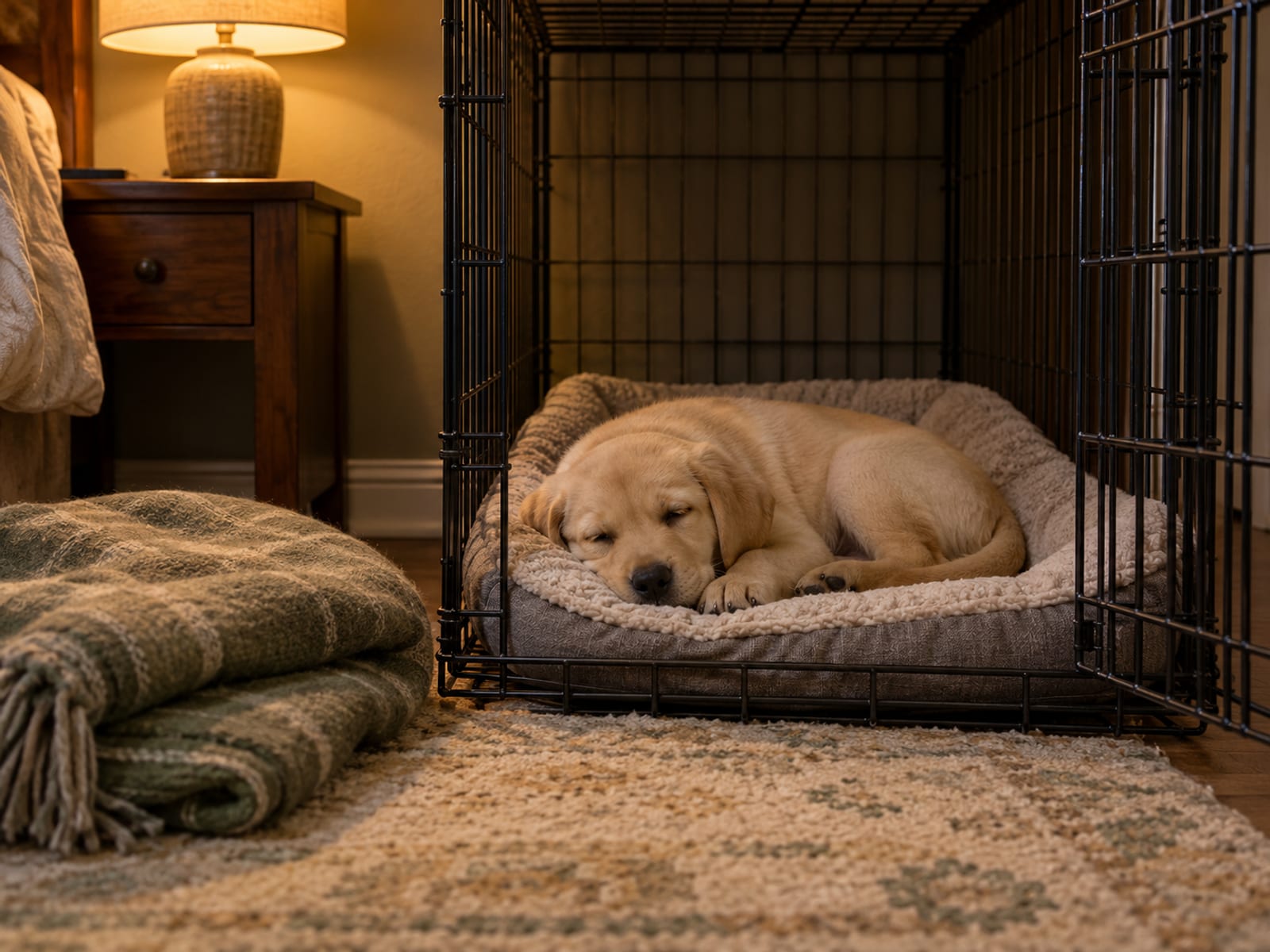
For the first night, use a steady bedtime. Put the crate or sleeping area near you if that helps your puppy settle. When your puppy needs to go out, take a quiet potty break and go straight back to bed without play. Some puppies cry for several nights, and some need overnight potty trips. Never punish crying or accidents.
Through the first week, keep meals, potty breaks, naps, play and quiet time predictable. The AKC reports that some young puppies sleep 16 to 18 hours a day, so plenty of naps is normal. It also says young puppies may need a chance to go out at least every 45 minutes while awake; treat that as a starting point, not a rule for every puppy, and use our puppy potty training schedule to fit your day. Add new people, sounds, surfaces and handling gradually. Skip long runs and repeated jumping. For biting, chewing and jumping, see puppy training tips.
Microchip, ID tag, license, insurance and spay or neuter decisions
None of these has to happen on day one, but do put them on the calendar.
- Microchip. Ask whether your puppy already has one, have it scanned and register it right away. Keep your phone number and address current. The AVMA says a microchip does not replace a collar with an ID tag, so use both.
- License. Dog licensing is local, and rules, fees and deadlines vary. Ask your city, county or animal-control office once you have the rabies and ID records.
- Insurance. Compare accident-only and accident-and-illness plans, and check deductibles, reimbursement, annual limits, waiting periods and exclusions. Insurers commonly exclude pre-existing conditions, so decide before a problem is on record. Our guide to pet insurance for dogs covers what to compare. Get quotes for your puppy's breed, age and location.
- Spay or neuter. No single age fits every dog. Ask your vet to consider sex, breed, adult size, health and your home. Large and giant breeds may mature later, and research has linked early sterilization to different health risks in some breeds. Until you decide, prevent accidental breeding with secure containment and supervision.
Signs that mean call the vet today
Call your veterinarian the same day for any of these:
- Repeated vomiting.
- Diarrhea with lethargy, appetite loss, vomiting or blood.
- Refusing food.
- Marked weakness, collapse or trouble standing.
- Abdominal pain or a bloated belly.
- Dehydration, fever or an unusually low body temperature.
- Blood in the stool or vomit.
- A suspected swallowed toxin, medicine or object.
- Symptoms that are getting worse in a young or incompletely vaccinated puppy.
Parvovirus most often affects puppies from about 6 weeks to 6 months. Cornell describes early lethargy, lower appetite and vomiting, followed by diarrhea that may contain blood or mucus, plus weakness, abdominal pain, fever and dehydration. Don't wait for bloody diarrhea before you call, because the early signs look like many other problems. Tell the clinic about the signs before you arrive, and keep the puppy away from other dogs. Read more in our guides on parvo in puppies, dog vomiting and dog diarrhea.
Reward-based training, and when to bring in a trainer or behavior professional
Start with rewards. The AVSAB humane training statement says evidence supports reward-based methods for all canine training, and that methods that use force, pain or fear should not be used. Teach your puppy what to do, arrange the environment to prevent mistakes and reward what you want. Our guides to positive reinforcement training and how to train a dog show how.
Bring in help when you cannot safely manage your puppy, fear or distress is growing, your puppy guards food or objects, a bite breaks skin, separation distress is severe, or training stalls despite careful practice. Also mention it to your vet, since behavior can have a medical cause.
Here is how the credentials differ:
- CPDT-KA and CPDT-KSA (CCPDT). Trainer credentials for manners, handling and puppy skills. CPDT-KA tests knowledge and requires at least 300 hours of training experience in the previous three years; CPDT-KSA adds a skills assessment.
- CBCC-KA (CCPDT) and IAABC Certified Dog Behavior Consultant. For complex problems such as fear, anxiety, aggression or phobias.
- IAABC Accredited Dog Trainer. For manners, life skills and prevention work.
- Board-certified veterinary behaviorist (ACVB). A veterinarian with specialty training, the right step for complex cases or a suspected medical link.
Ask any trainer what methods and tools they use, whether they use shock, prong or choke collars or physical force, what they do if your puppy is scared, and how they measure progress. Walk away from anyone who guarantees results or explains behavior by "dominance." Check any credential in the issuing group's directory. AVSAB does not endorse specific trainers, and neither do we.
Questions new puppy owners ask
Common questions from the first week:
Where should my puppy sleep the first night?
Put the crate or sleeping area near you, keep the routine quiet and take a brief potty break if your puppy wakes. Return to bed without play so waking up does not become a game.
What are the 7-7-7 rule and the 3-3-3 rule, and do they help?
These are informal rules of thumb for how long a dog takes to settle in, not veterinary guidelines. Use them as a nudge to be patient, and let your puppy's routine, sleep and vet's advice guide you instead.
What is the hardest month with a puppy?
It varies by puppy. The first days are usually the most tiring because of broken sleep and constant potty breaks. If you feel overwhelmed at any point, a steady routine, plenty of naps for your puppy and a call to your vet or a reward-based trainer can help.
Should I punish accidents or biting?
No. Reward what you want, manage the space so mistakes are less likely and follow our potty training and puppy training guides.
Your next step today
Pick one job and do it now: book the vet visit, or get down on the floor and puppy-proof one room. Then use our directory to find a veterinarian, an emergency vet and a reward-based trainer near you, and keep the numbers where the whole family can see them. I'm not a veterinarian or a trainer, so your vet's advice comes first on anything about your puppy's health.
Sources
- American Animal Hospital Association: AAHA 2022 canine vaccination guidelines
- American Kennel Club: AKC
- American Veterinary Medical Association: AVMA advises for new puppies
- American Veterinary Medical Association: AVMA
- American Veterinary Society of Animal Behavior: AVSAB humane training statement
- American Veterinary Society of Animal Behavior: AVSAB puppy socialization statement
- ASPCA: ASPCA toxic plant list for dogs
- ASPCA: ASPCA's puppy-proofing checklist
- capcvet.org: CAPC
- Cornell University College of Veterinary Medicine: Cornell
- wsava.org: WSAVA 2024 guidelines