

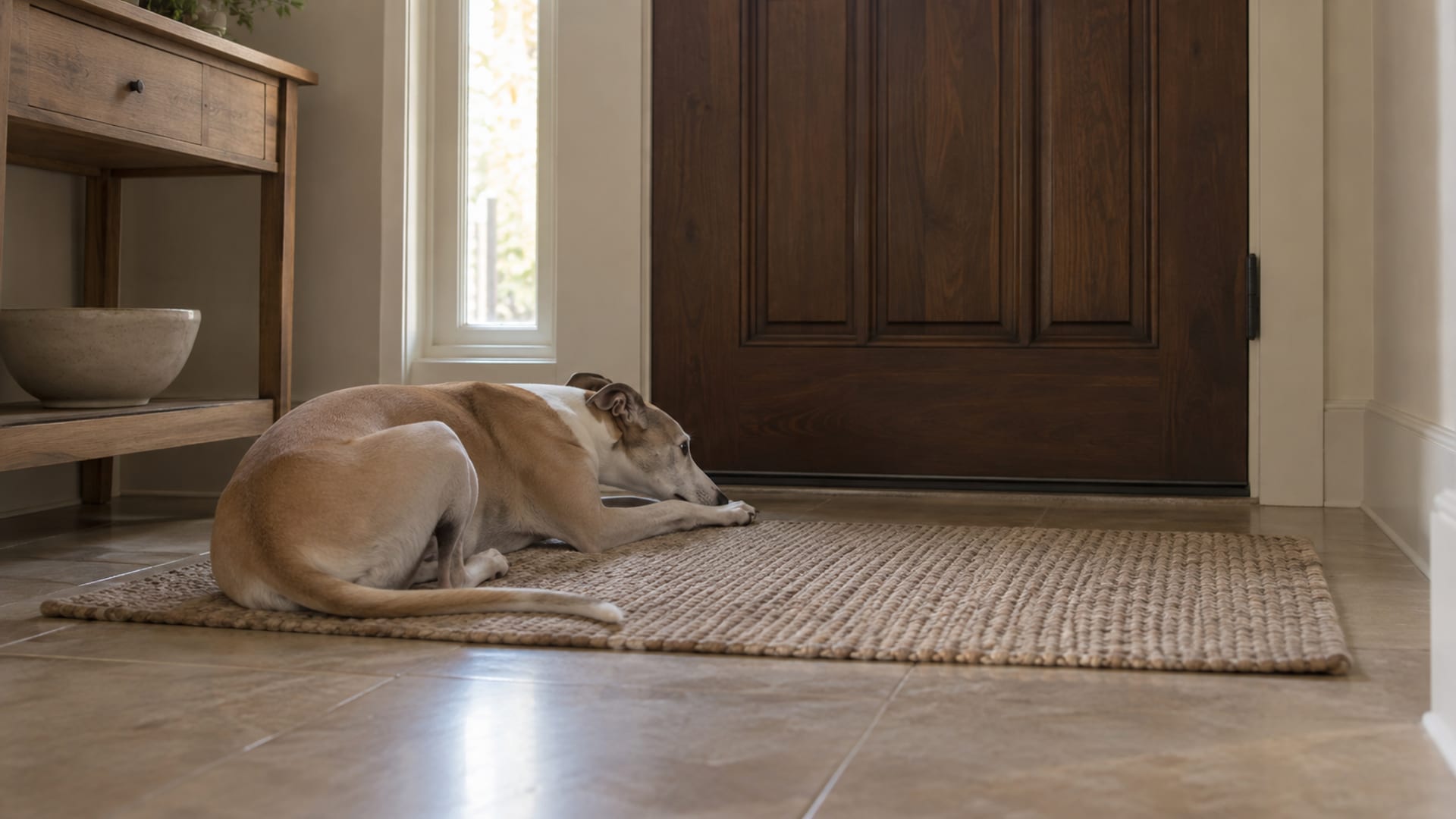
You come home to a scratched-up door frame, a puddle by the entrance, or a note from a neighbor about the howling. Maybe your dog starts pacing the moment you pick up your keys. Underneath it sits a harder question: is my dog miserable all day, could they hurt themselves, and is this my fault?
Start with what you can do today. Set up your phone or a pet camera before your next few ordinary absences, so you can see what really happens once you leave. Stop any scolding when you get home; punishment makes anxiety worse. And if your dog is hurting themselves, trying to break out through doors or windows, or panicking even when you step out for a minute, call your vet now rather than waiting.
The plan below follows guidance from the ASPCA, the American College of Veterinary Behaviorists (ACVB), the American Veterinary Society of Animal Behavior (AVSAB) and published veterinary research, linked in each section.
Key takeaways
Tap a card to bring it forward.
- Record your dog while you are out. Separation distress starts around your leaving and shows up as a cluster of stress signs.
- Chewing, accidents or barking alone can have other causes: boredom, a young dog chewing, house training gaps, noises outside or a medical problem.
- Do not punish. Distress is not spite, and punishment can make anxiety worse.
- Train with very short absences your dog can handle calmly, and add time only while they stay relaxed.
- There is no standard timeline. Moderate or severe cases often take many weeks of daily practice.
- Medication can help some dogs learn, and it is your vet's decision. Severe panic or self-injury needs veterinary help.
What to do first
- Film a few ordinary absences. Note when you left, when the first sign of stress appeared, what your dog did, where in the house, and whether anything outside set them off. Video is evidence for your vet or a behavior professional, not a diagnosis.
- Stop punishment. The ACVB's owner handout says there is no place for punishing a dog with separation anxiety. Clean up quietly and change the plan instead.
- Cut down long absences where you can. Every time your dog is left longer than they can cope with, they practice panicking. Working from home some days, a friend or family member your dog knows, a sitter, or another arrangement all help while you train.
- Do not assume a crate keeps them safe. The ASPCA and the ACVB warn that confinement can increase distress and frantic escape attempts in some dogs. If you use one, watch your dog in it on video first.
- Book a vet visit. Your vet can rule out medical causes before anyone puts a behavior label on it, especially for new accidents, a sudden change, or signs in an older dog.
Signs of separation anxiety
Separation distress is tied to your leaving or being gone. The ASPCA and the ACVB describe signs such as:
- Getting anxious at your departure cues: shoes, coat, keys or bag
- Barking, howling or whining after you leave
- Pacing, panting, drooling or trembling
- Vomiting
- Peeing or pooping in the house only when left alone
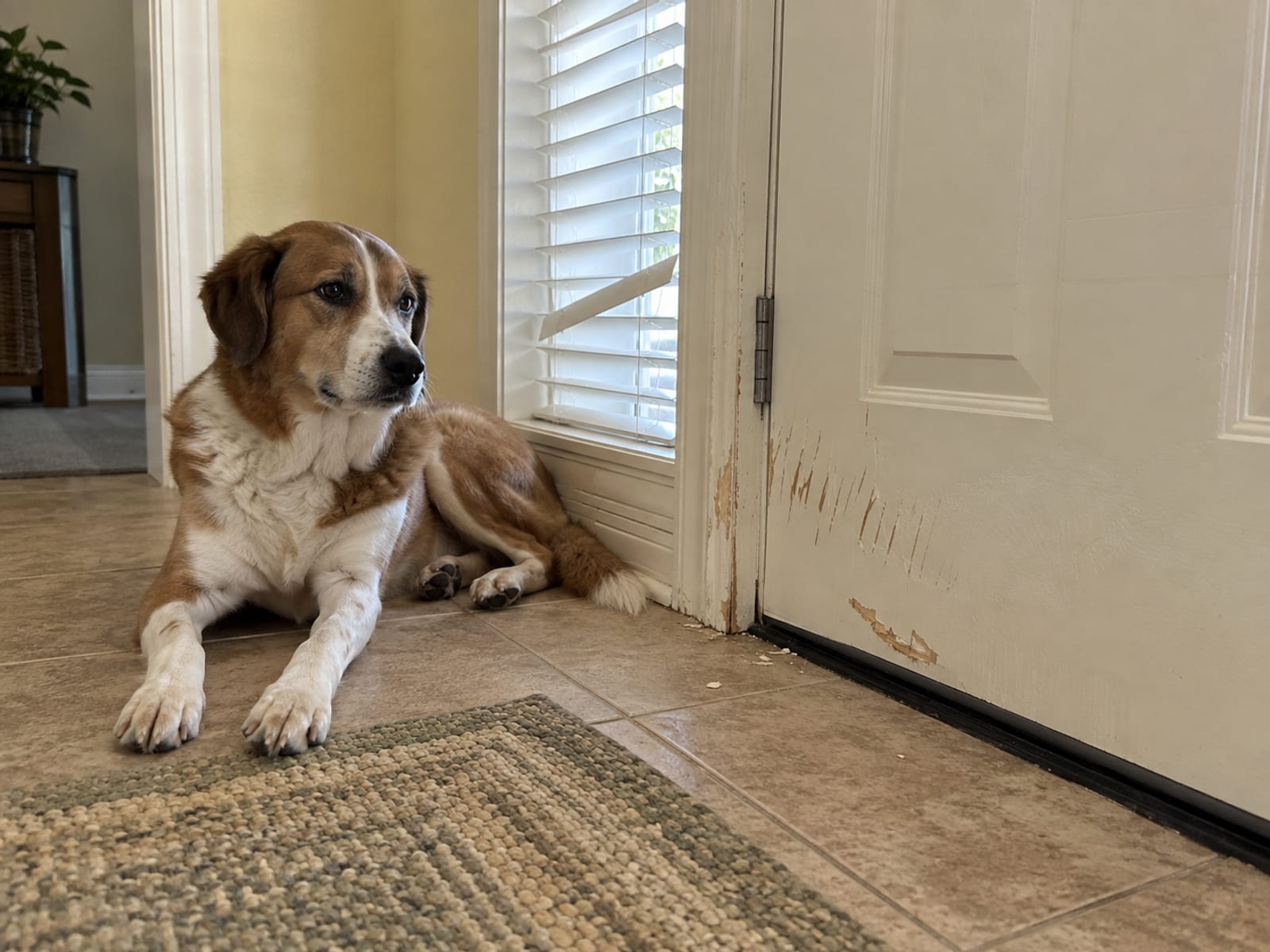
- Chewing, digging or scratching, especially at doors and windows, soon after you go
- Frantic attempts to escape, sometimes with self-injury
The ACVB handout notes it can also happen when you are home but your dog cannot get to you, such as behind a closed door. Damage aimed at doors and windows, and any self-injury, make it more urgent. If you want to catch the earlier, quieter signs before a full panic, dog body language walks through lip licking, yawning, freezing and the other small signals that come first.
Separation anxiety or something else?
One chewed cushion does not settle it. What matters is the pattern: when it happens, and whether your dog looks anxious. The ASPCA notes that a dog who is simply bored while alone usually does not look anxious.
Tap or hover a row to highlight it.
| What you see | Points toward separation distress | Points toward something else |
|---|---|---|
| What you seeChewing or damage | Points toward separation distressStarts soon after you leave, aimed at doors or windows, with panting, drooling or pacing | Points toward something elseA young dog who chews whether you are home or not; a dog who looks relaxed on camera (boredom) |
| What you seeAccidents | Points toward separation distressOnly when alone, along with other stress signs | Points toward something elseAlso when you are home (house training gap); small amounts on upright surfaces (marking); peeing during greetings; a new urinary problem |
| What you seeBarking or howling | Points toward separation distressStarts as you leave and keeps going | Points toward something elseSet off by noises, people or animals outside, and also happens when you are home |
| What you seeA sudden change in an older dog | Points toward separation distressPossible, but not assumed | Points toward something elsePain, hearing or sight loss, or changes in thinking. See your vet first |
If the accidents happen when you are home too, the problem may be house training rather than anxiety; Potty Training a Puppy covers that. Exercise and play improve a dog's welfare and may cut down ordinary boredom chewing, but they do not diagnose or cure separation anxiety. Researchers stress that similar-looking signs can have different causes, which is why a clinical history and observation matter, according to de Assis and colleagues. Any sudden behavior change is worth a vet visit, as Signs of a Healthy Dog explains.
Why it happens
No single cause has been proven, and it is rarely one owner mistake. The ASPCA links the start of separation problems with changes such as a new guardian or family, a new schedule, a move, or someone joining or leaving the household. It notes a link with adoption from shelters, while saying there is no conclusive evidence of exactly why dogs develop it.
Research has found possible links with early separation or trauma, where and when a dog was acquired, little early practice at being alone, general fearfulness and changes in routine, according to a 2014 review by Meneses. Findings on sex, breed and many owner factors are inconsistent. The 2024 Generation Pup study followed puppies and found early-life and management factors linked with separation-related behavior at six months, but that kind of study cannot prove cause, and breed findings vary between studies. Dogs of any breed and age can be affected. A senior dog who develops these signs late in life needs a medical check, since pain, sensory loss or changes in thinking can change behavior.
Getting through the workday while you train
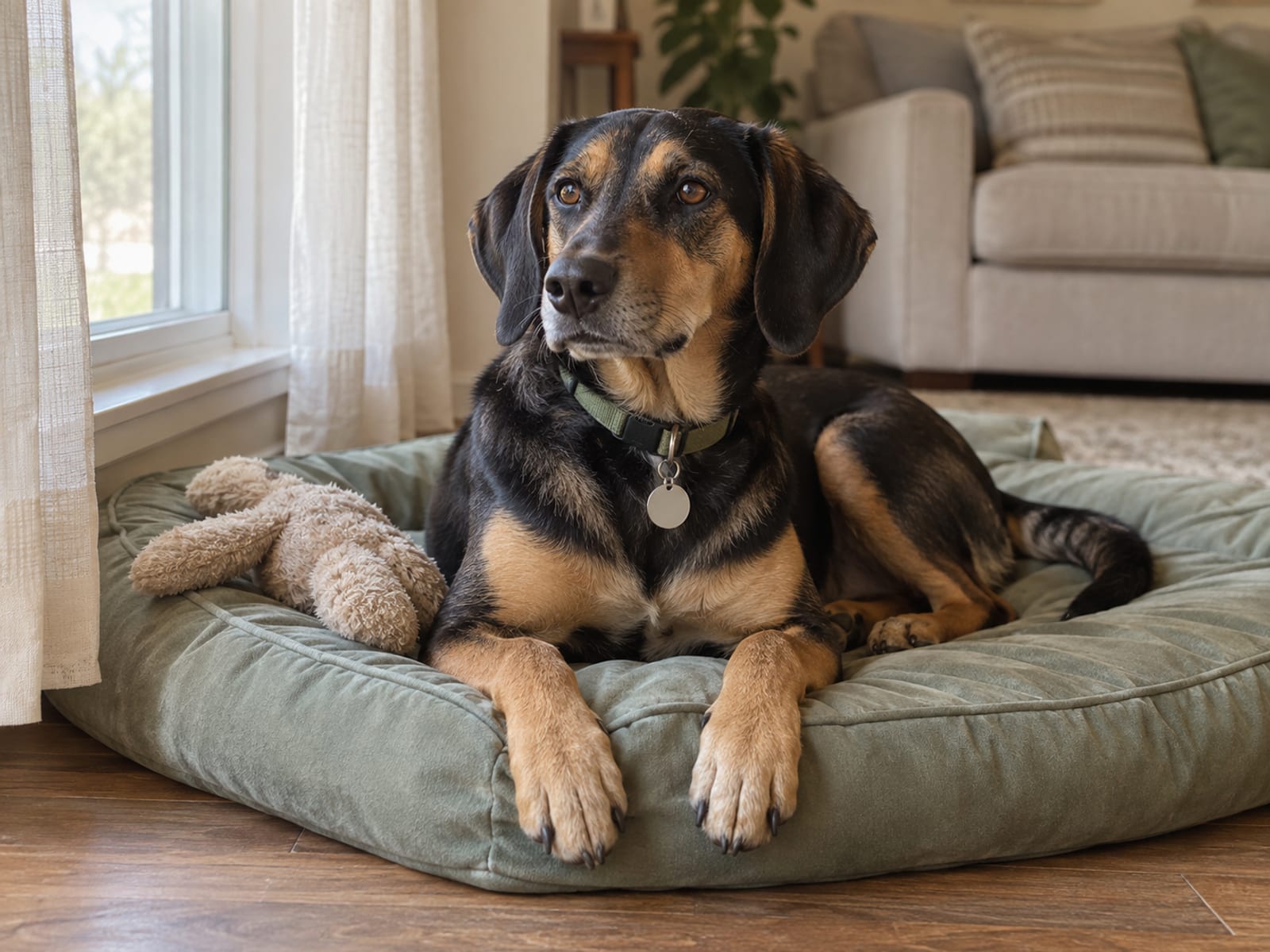
Training only works if your dog is not being pushed past their limit every day in between. Look at what is realistic for your household: a dog-savvy friend or relative, a sitter, a walker who breaks up the day, or daycare, if your dog is comfortable there. The DogServ directory lists walkers, boarding and other local services you can check out.
On crates: some dogs are genuinely relaxed in one, and for them it can stay part of the routine. For others, a crate adds panic and injury risk. Watch on video. If crating brings on heavier panting, drooling, frantic escape attempts or nonstop barking, stop using it when your dog is alone. Crate training explains how to introduce a crate kindly and how to tell crate distress from separation distress.
Teaching your dog to be alone, step by step
The method is called desensitization and counterconditioning: short, planned absences your dog can handle calmly, paired with something good, lengthened only while they stay relaxed. The ACVB describes starting with very short departures and lengthening them only at the pace your dog succeeds. The steps below follow the ASPCA and ACVB guidance.
- Find your starting point. Watch a recorded absence and note the first stress sign and how long it took to appear. Your practice sessions start shorter than that.
- Take the sting out of departure cues. If keys, shoes or your coat set your dog off, pick one up without leaving, in no set order, and then do something ordinary. Repeat until the cue stops predicting a stressful absence. The ASPCA describes doing this many times a day for many weeks.
- Practice being out of sight inside the house. Step behind an interior door for a moment, then use an exit that matters less to your dog. Come back before any sign of distress.
- Move to real absences of a second or two, if your dog stays calm. The ASPCA starts real absences at one to two seconds. Add time in small steps only when the video shows your dog relaxed, and mix easy repetitions in with harder ones rather than making every one longer.
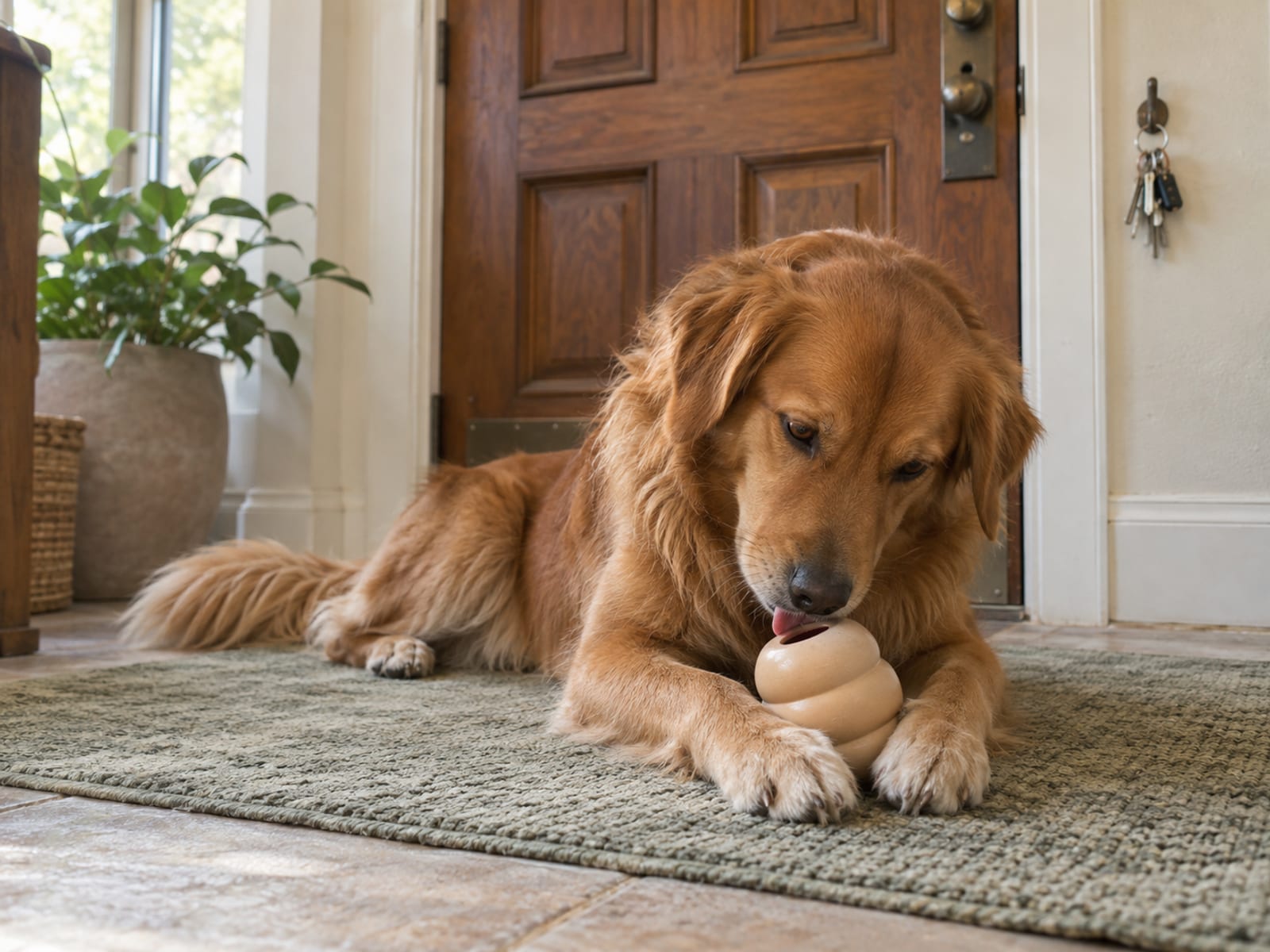
- Add food only if your dog will eat it. A stuffed food toy can help, but only if your dog actually eats it while you are gone. A dog too worried to eat is telling you the step is too hard.
- Leave a few minutes between repetitions, and wait until your dog is fully relaxed after you come back. Keep leaving and coming home low-key.
- Build time before adding anything new. Only then change one thing at a time: a different time of day, a different door, a different person leaving.
If panting, drooling, trembling, pacing, whining, refusing food, going at the door or an unusually frantic greeting shows up, go back to a length of absence your dog handled calmly. If it keeps happening, get help. Training builds on reward-based basics; positive reinforcement training explains the timing and rewards behind it, and How to Train a Dog covers the everyday setup.
What progress looks like
The ASPCA says there are no standard timelines, because dogs react differently. For moderate or severe cases, the ASPCApro guidance describes gradual short separations over many weeks of daily sessions. Track what you can see rather than counting days.
Signs of progress, in the order they tend to appear
Early
Less reaction when you pick up your keys, put on shoes or reach for your coat.
As practice builds
Longer calm stretches on camera, eating a food toy while you are gone, fewer stress signs and no damage at the door during planned practice.
Later
Calm through your ordinary leaving routine and through short real absences.
A setback means the next session should be shorter, not that your dog is being difficult. Each time, note how long your dog stayed calm, the first stress sign, how intense it was and how quickly they recovered. How severe it was at the start, how long your dog has been panicking, how often you cannot avoid leaving, other fears such as noise, medical problems and how consistently you can practice all change the pace.
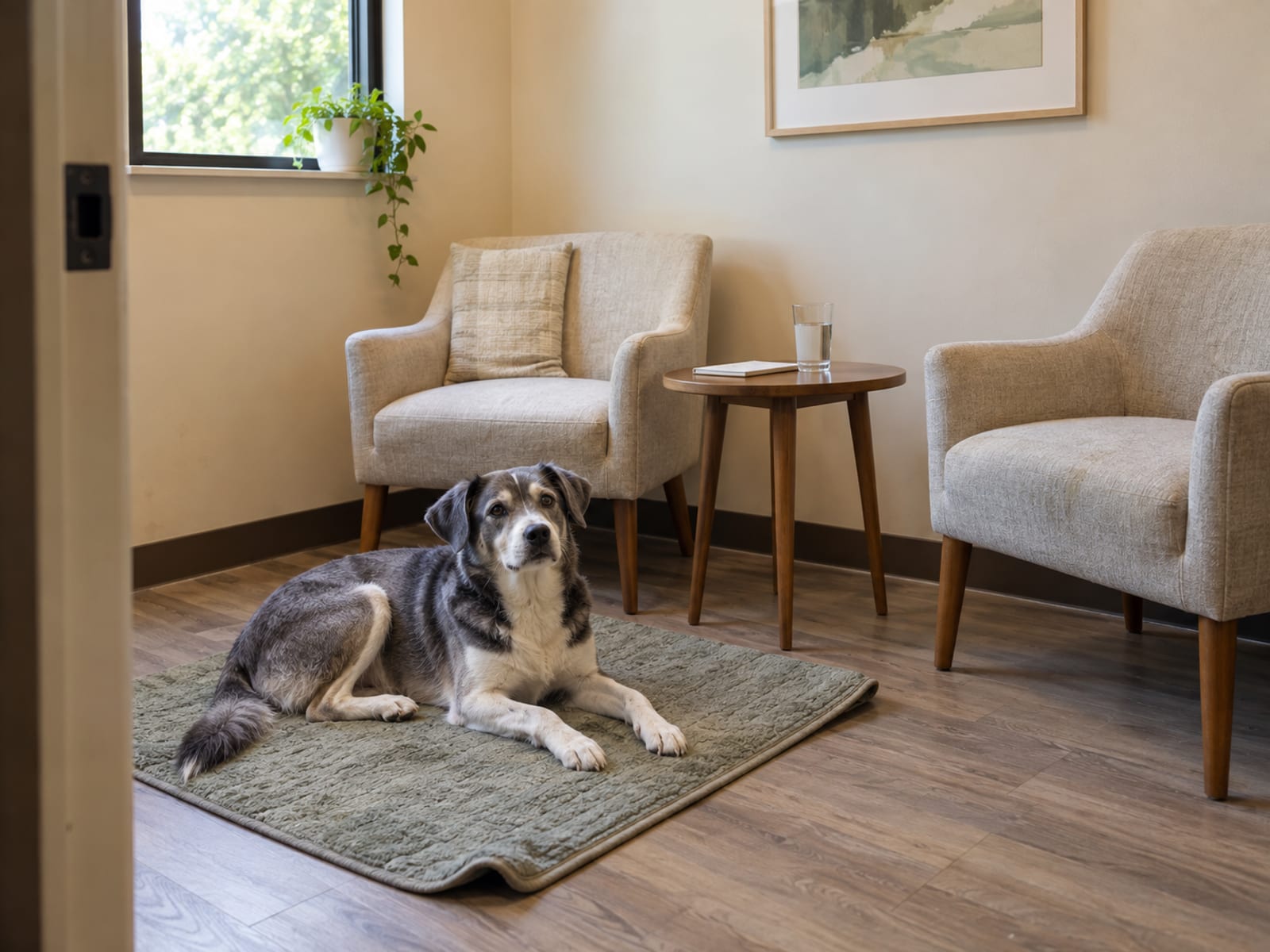
Where medication fits
Medication is a decision for your vet, and for some dogs it is part of what makes progress possible. The ACVB handout says treatment usually includes both medication and behavior modification, with the choice depending on how severe the problem is and whether there are other behavior issues. The ASPCA says medication can help some severely distressed dogs tolerate being alone so that training can move forward.
Using medication does not mean the training failed, and medication alone is not a guaranteed fix. The vet who prescribes it needs to examine your dog, check for other conditions and medicines, and follow up. Do not give your dog over-the-counter calming products, supplements, CBD or human medication in place of that visit. A veterinary behaviorist can diagnose medical contributors and decide whether medication belongs in your dog's plan, according to the ACVB.
Mistakes that make it harder
These are ordered by how much they get in the way of treatment, not by how often they happen.
- Punishing damage, barking or accidents when you get home. Clean up and adjust the plan. The ASPCA and the ACVB both say punishment can make anxiety worse. Dog training mistakes covers why after-the-fact correction backfires.
- Jumping ahead too fast. Adding too much time at once is a common mistake the ASPCA warns about. Use video and go back to the last calm length.
- Full-length absences during training. Arrange interim care where you can, so the only time alone is planned practice.
- Assuming every accident, chewed shoe or bark is separation anxiety. Film it and have your vet rule out other causes.
- Treating a crate as the cure. Keep it only if your dog is truly relaxed in it.
- Counting on exercise or a food toy to do the whole job. They support a plan; they do not replace one.
- Hiring a trainer who talks about dominance or "alpha," or uses punishment. AVSAB's position is that only reward-based methods should be used for training and behavior change.
Who to call: your vet, a trainer or a veterinary behaviorist
Start with your vet for a diagnosis and to rule out medical causes. Bring in help early if the distress is severe, getting worse, causing injury or escape attempts, affecting neighbors or your housing, comes with other fears, or makes it impossible to practice below your dog's limit.
Tap or hover a row to highlight it.
| Professional | What the credential means | When they fit |
|---|---|---|
| ProfessionalYour veterinarian | What the credential meansExamines your dog and rules out medical causes | When they fitFirst, for every case, and right away for sudden onset, accidents, injury or an older dog |
| ProfessionalCertified trainer (CCPDT CPDT-KA or CPDT-KSA) | What the credential meansCPDT-KA: passed a comprehensive exam and has at least 300 hours of training experience. CPDT-KSA adds a hands-on skills assessment | When they fitMild to moderate cases, coaching and video review, working alongside your vet |
| ProfessionalBehavior consultant (CCPDT CBCC-KA or IAABC CDBC) | What the credential meansCBCC-KA: for experienced consultants in complex behavior change. CDBC: three or more years working with complex cases, including fear and anxiety | When they fitModerate cases, or anxiety that comes with other fears |
| ProfessionalVeterinary behaviorist (DACVB) | What the credential meansA veterinarian board-certified in behavior | When they fitSevere or complex cases, self-injury, or when medication may be needed. Trainers and consultants cannot prescribe |
The CCPDT points out that dog training is an unregulated profession and lists dominance and punishment-based methods as red flags. The IAABC describes its CDBC credential for consultants working with complex cases. A credential does not prove someone specializes in separation problems, so ask:
- How do you assess my dog using video?
- How do you keep practice below my dog's limit?
- What do we do if my dog panics?
- Do you use reward-based desensitization and counterconditioning?
- Will you work with my vet?
- What results can you show, without promising any?
Walk away from anyone who guarantees results, talks about being the "alpha," or uses punishment or aversive tools.
Check what you learned
Quick check: separation anxiety
Questions about dog separation anxiety
How do I know whether it is separation anxiety or boredom?
Separation distress is tied to your leaving and usually comes with a cluster of stress signs like panting, drooling, pacing and howling. A bored dog may get into things but usually does not look anxious. Camera footage and a vet visit help tell them apart.
Can I leave a dog with separation anxiety in a crate?
Only if video shows your dog is truly relaxed in it. For some dogs, being confined increases panic, escape attempts and the risk of injury.
Does exercise fix separation anxiety?
Exercise and play support your dog's welfare and can help with boredom. On their own they do not replace a step-by-step plan for distress that starts when you leave.
Should I punish my dog for barking or destroying things while I am out?
Punishment can increase anxiety and make separation problems worse, according to the ASPCA and the ACVB. Clean up without a fuss and adjust the plan instead.
How long does separation anxiety training take?
There is no standard timeline. Moderate or severe cases often need many weeks of daily, gradual practice, at a pace set by how long your dog can stay calm.
Does a dog with separation anxiety need medication?
Sometimes, especially when the distress is severe enough to block learning. Whether to use it, and which one, is your vet's decision, usually as part of a plan that includes behavior work.
When should I call a veterinary behaviorist?
Ask your vet about one early for severe panic, self-injury, escape attempts, signs that start suddenly or in an older dog, other fears alongside it, or a plan that is not moving forward safely.
Where to start this week
Set up a camera and film your next ordinary absence. Watch it once, note the first sign of worry, and plan your first practice sessions shorter than that. Book a vet visit if anything on the video worries you. Small, calm steps now are what make longer absences possible later.
To find a vet or a reward-based trainer near you, search the DogServ directory. You can also reach me through the contact page.
Sources
- American College of Veterinary Behaviorists: ACVB
- American College of Veterinary Behaviorists: ACVB
- American Veterinary Society of Animal Behavior: AVSAB
- ASPCA: ASPCA
- ASPCApro: ASPCApro
- Certification Council for Professional Dog Trainers: CCPDT
- IAABC: IAABC
- PubMed Central: 2014 review by Meneses
- PubMed Central: de Assis and colleagues
- PubMed Central: Generation Pup study