

Why Do Dogs Sleep So Much: Normal Hours, Naps and When to Call the Vet
By Cal Hewitt · Published
Health
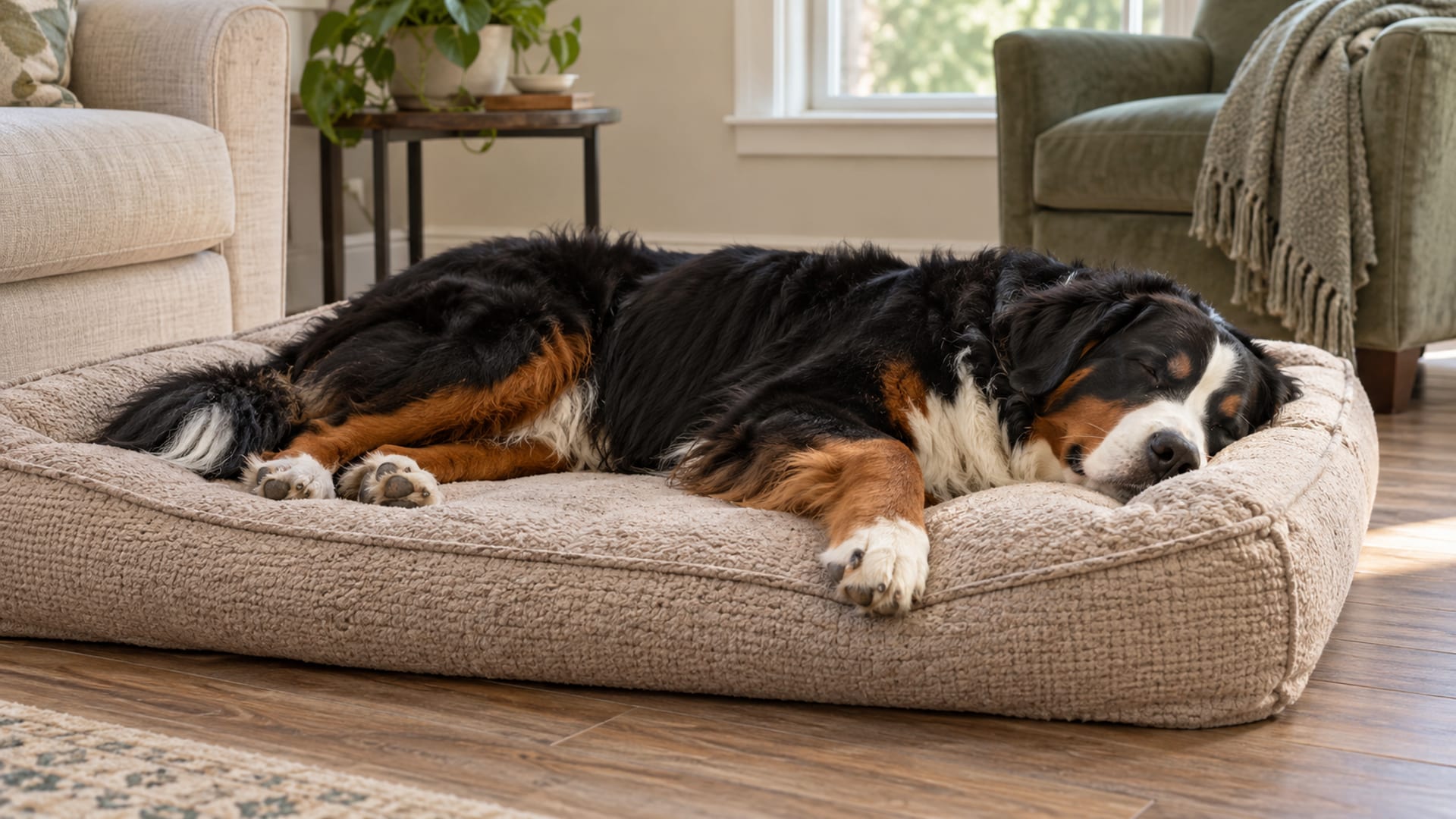
Most adult dogs sleep about 12 to 14 hours a day, often in several naps instead of one long stretch, according to the American Kennel Club. Puppies can need 18 to 20 hours, and older dogs often sleep more than adults. The number matters less than your dog's usual pattern. If your dog wakes easily, eats, plays and greets you like always, long naps are probably just how this dog is built. A sudden jump in sleep, weakness, a change in appetite or weight, pain, or pacing at night is worth a call to your vet. Pale or white gums, trouble breathing, collapse, seizures or being unable to stand mean emergency care today.
Key takeaways
Tap a card to bring it forward.
- Most adult dogs sleep about 12 to 14 hours a day; puppies may need up to 18 to 20, and seniors often sleep more than adults.
- These are ranges, not targets. A change from your own dog's normal pattern tells you more than any hour count.
- Dogs nap in several shorter periods, so a dog asleep in the afternoon is not a sign of trouble by itself.
- A dog that wakes easily, eats, plays and interacts is usually just sleeping the way dogs do.
- Sudden extra sleep, unwillingness to play, weakness or appetite and weight changes call for a vet visit within about a day.
- Pale or white gums, breathing trouble, collapse, seizures or being unable to stand are emergencies.
Is my dog sleeping too much, or sleeping normally?
Normally, in most cases, and here is how to check. Start with what your dog is like when awake. A dog who gets up when you come home, takes interest in food, goes out for walks and plays has told you most of what you need to know. Sleep is not a score your dog has to hit.
The AKC gives about 12 to 14 hours as a common adult figure, and VCA Animal Hospitals says many dogs spend at least half of the 24-hour day asleep, with individual dogs landing anywhere from about 10 to 14 hours. So, a dog who logs 10 hours and a dog who logs 14 can both be healthy. What should catch your attention is a change: a dog who used to meet you at the door and now stays on the bed, or one whose naps have gotten longer over a few days.
I would not use a fixed hour count as a cutoff that proves something is wrong. A routine that shifts, together with other signs, is what a vet will want to hear about.
How many hours do adults, puppies and seniors sleep?
Think in ranges. The figures below come from the AKC and VCA, and each one describes many dogs, not every dog.
Tap or hover a row to highlight it.
| Life stage | Commonly cited range | Source |
|---|---|---|
| Life stageAdult dog | Commonly cited rangeAbout 12 to 14 hours | SourceAKC |
| Life stageAdult dog, individual variation | Commonly cited rangeAbout 10 to 14 hours | SourceVCA |
| Life stagePuppy | Commonly cited rangeUp to 18 to 20 hours | SourceAKC |
| Life stageGeriatric dog | Commonly cited rangeAbout 12 to 15 hours | SourceAKC |
| Life stageSome large or giant dogs | Commonly cited rangeUp to about 18 hours | SourceAKC |
Puppies are the ones who surprise new owners. A young puppy can play hard, then drop asleep mid-toy, and that is normal during early growth. Let them rest. If you are planning your first weeks at home, our new puppy checklist covers the rest of the routine.
Older dogs are less tidy. Senior figures are less standardized than puppy figures, so treat 12 to 15 hours as a guide and watch for change. Large and giant dogs may sleep more, but there is no rule that says a big dog must sleep more than a small one. For more on this stage of life, read our senior dog care guide.
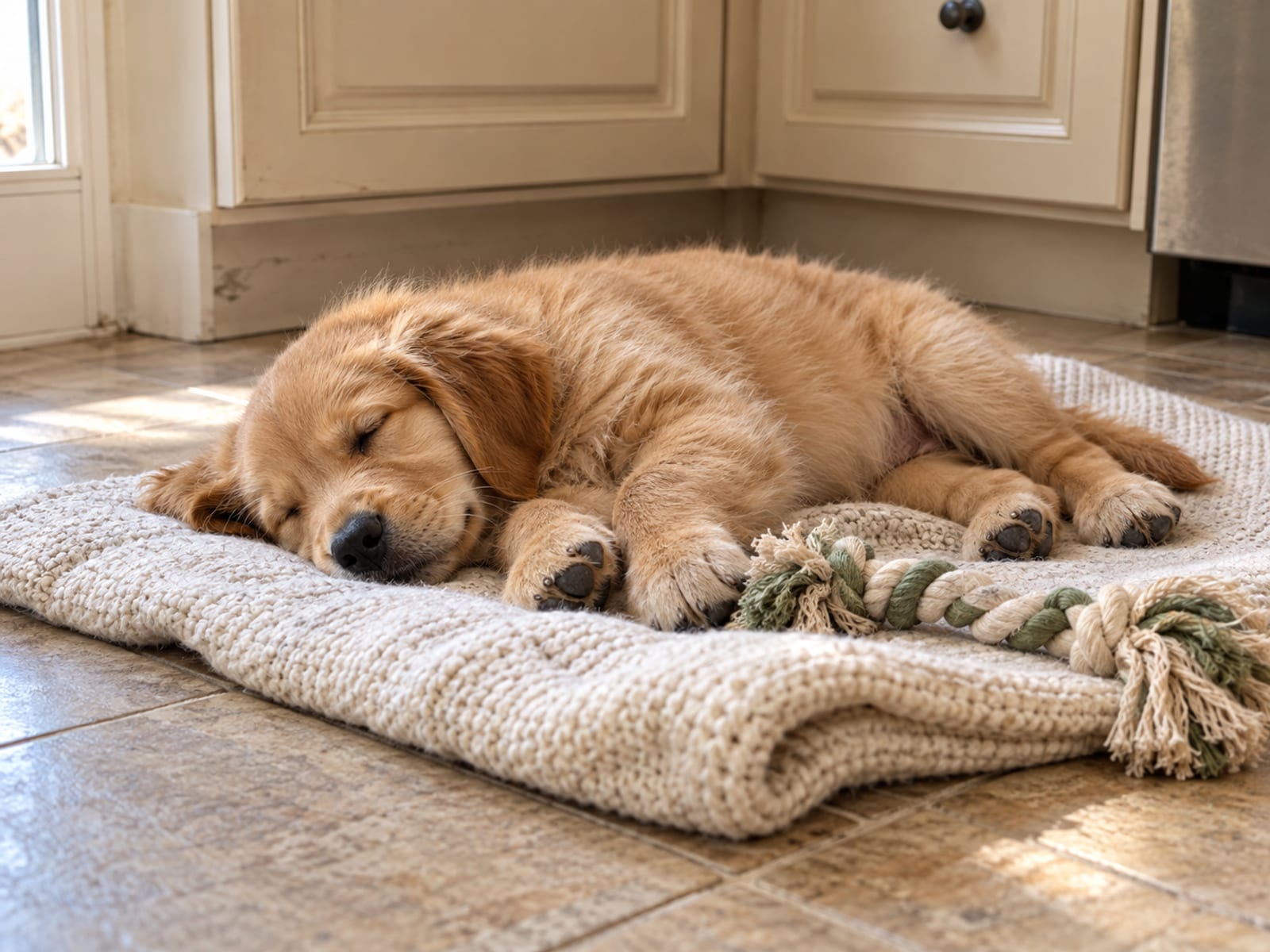
Why do dogs sleep in several naps instead of one long stretch?
Because dogs do not sleep like people. Most of us consolidate our sleep into one block at night. Dogs spread theirs across the day and night, which is why the AKC describes dogs as napping through the day in addition to sleeping at night.
That means a dog curled up at 2 p.m. is not behind on anything. Your schedule and your dog's schedule are simply different, and a dog is not sleeping "too much" because the house is awake and the dog is not. I would not try to claim an exact cycle length for dogs, because no single figure holds for every dog.
What you can use is the rhythm. A dog who naps several times a day, wakes when something interesting happens and gets up ready to go is showing a healthy rhythm. A dog who stays down through food, visitors and the leash coming off the hook is showing you something different.
What happens while a dog sleeps, and what are the twitches and sounds?
Dogs have two main kinds of sleep: REM sleep and non-REM sleep, which includes slow-wave sleep. In non-REM sleep, brain recordings show slower waves and short bursts called sleep spindles. A study summarized by ELTE in Hungary recorded more than 150 pet dogs during three-hour sleep sessions using noninvasive surface EEG, looking at how age, sex and reproductive status relate to those spindles.
A separate peer-reviewed ELTE study from 2021 followed 60 dogs aged 2 to 14 months, with an extended sample of 91 dogs aged 2 to 30 months. It looked at how sleep structure and brain activity change as young dogs age. It was not a study of how many hours each puppy should sleep, so please do not use it as a puppy sleep target.
Twitching, paw paddling and small sounds can happen during sleep, and they are common. If you want the full story on dreaming, read Do Dogs Dream? It also explains how to tell ordinary sleep movement from a seizure, which is the thing most owners are actually afraid of. If a dog is also sighing or huffing in the night, Why Do Dogs Sigh? will help.
What can change how much a dog sleeps?
Quite a few things, and several of them are ordinary.
- Age. Puppies need much more sleep, and older dogs often sleep more and may have changes in their sleep and wake pattern.
- Size and breed tendencies. Large and giant dogs may sleep more, but no single breed rule applies.
- Activity. How much physical and mental engagement a dog gets can change how much the dog rests.
- Routine and environment. Dogs may nap more when the house is quiet or little is happening.
- Weather. Many owners notice more resting in hot, cold or unpleasant weather. No standard hourly adjustment exists, so this is something to watch, not a number to apply.
- Discomfort and illness. Pain, arthritis, anemia, hormone disease and nerve conditions can change sleep or activity.
- Diet. Food affects energy and health overall, but there is no general sleep-hour rule based on diet alone.
Boredom comes up a lot. A bored dog can look flat and sleepy, but sleeping a lot does not prove a dog is bored. Look at the whole day instead: how much exercise, how much interaction, what there is to do, how the dog is eating. Our guides on how much exercise a dog needs and how often to walk your dog can help you judge that.
Sleepy or lethargic: how can I tell the difference?
A sleepy dog rests and then comes back to normal. A lethargic dog is low on energy even when awake. The difference shows up in how your dog responds, so test it gently. Call your dog's name or rattle the food bowl.
A sleepy dog wakes up, stretches, looks at you and shows interest. A lethargic dog may be slow to rouse, barely reacts, turns away from food, skips a walk he would normally love, or seems weak or stiff. VCA and the Merck Veterinary Manual both point owners to the same comparison: response to stimulation, appetite, play, mobility, bathroom habits and interaction.
Some conditions can cause low energy, but the signs are not specific enough for you to name one at home. The Merck Manual lists lethargy, less tolerance for exercise and weight gain without a matching rise in appetite among the signs of hypothyroidism, and loss of energy, weakness and poor appetite among the signs of anemia. You can read more in our articles on hypothyroidism in dogs and anemia in dogs, but your vet is the one who can sort out the cause. AVMA also lists sleeping more, playing less, stiffness, trouble standing and resisting touch among the possible signs of arthritis pain.
When should I call the vet about extra sleep, and what means emergency care today?
Start with the emergency list, because it is the part that cannot wait. Take your dog to an emergency vet now for any of these:
- Pale or white gums (the Merck Manual also lists pale or bluish gums)
- Fast or difficult breathing
- Collapse or loss of consciousness
- Seizures
- Severe weakness or being unable to stand
- Heavy bleeding
- Possible poisoning
- Severe pain or extreme lethargy
The ASPCA's emergency page lists many of the same signs, including pale gums, rapid breathing, a weak or rapid pulse, difficulty standing, loss of consciousness, seizures and excessive bleeding. If you are not sure whether what you see counts, call and describe it. Use our emergency vets directory to find one near you.
For less urgent changes, plan a visit within about a day. The Merck Manual lists sleeping more than usual with unwillingness to play as a reason to see a vet within 24 hours. The same goes for a sudden change in sleep, a change in appetite or weight, pain, altered bathroom habits or less interest in the family. These signs do not diagnose anything. They tell your vet where to look, and you can find a routine clinic in our vets directory.
Why is my older dog asleep by day and pacing at night?
This pattern deserves a veterinary look. AAHA describes canine cognitive dysfunction as an age-related brain condition. Its DISHAA checklist covers disorientation, changes in social interaction, sleep-wake changes, loss of house training or other learned behavior, changes in activity and anxiety. Daytime sleeping with restlessness at night is one of the common patterns, and AAHA reports cognitive impairment in approximately 14% to 22.5% of dogs older than 8 years.
AVMA lists the same kinds of changes: sleep-wake changes, more wandering, confusion, house-soiling, anxiety and repeated actions. It recommends talking with a veterinarian when they appear.
Night pacing is not stubbornness, and it does not prove dementia either. Pain, arthritis, hearing or vision loss, organ disease and nerve disease can look much the same. A vet visit usually starts with your history and a physical and neurologic exam, and may include lab work and urine testing. Advanced testing comes only when it is indicated. Write down when the pacing starts, how long it lasts and what else has changed, and bring your notes. To read more about the condition itself, see dog dementia.
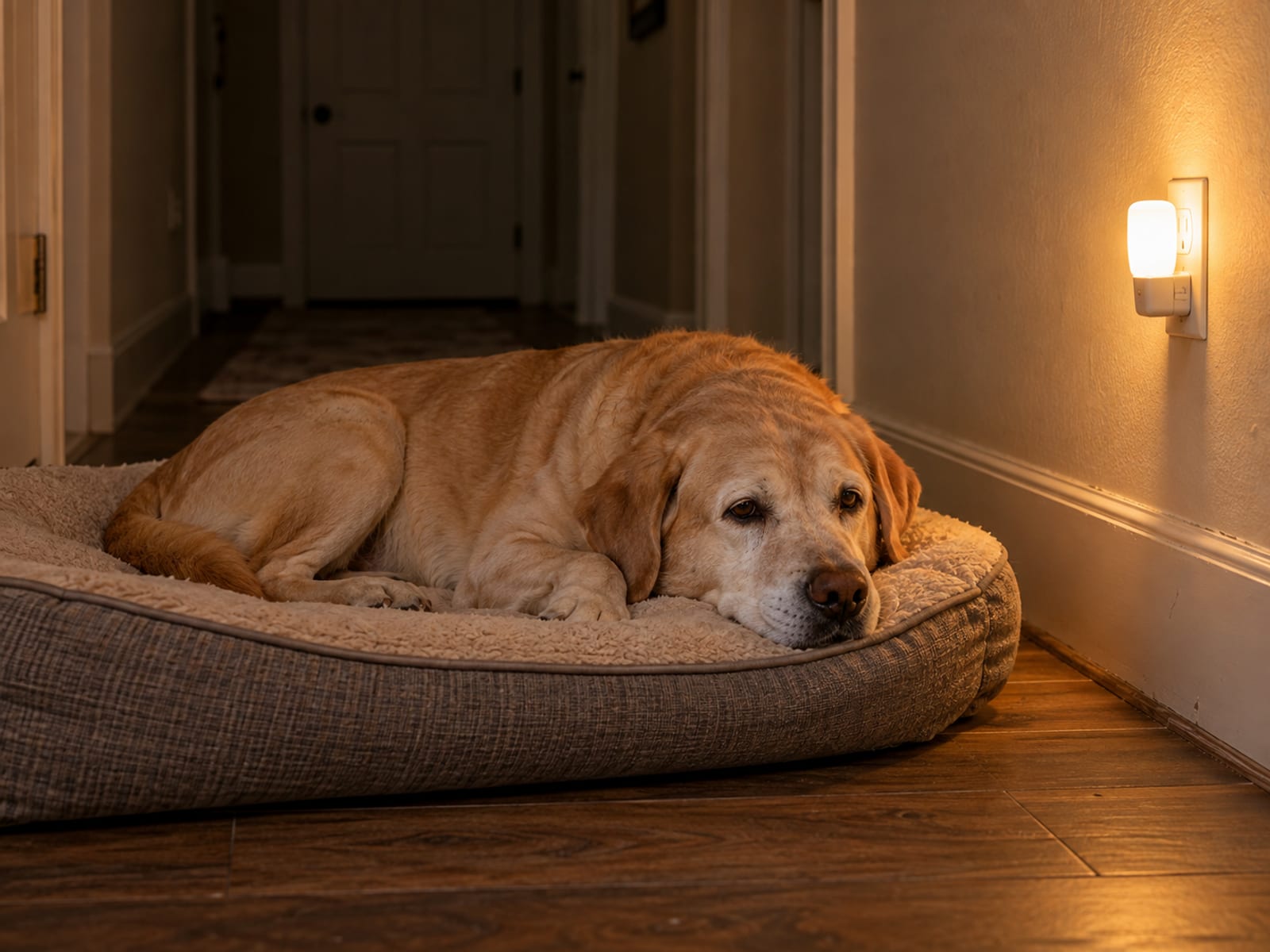
What can I do to help my dog rest well, and what should I watch?
A few simple habits help, and none of them require forcing anything.
- Keep a predictable daily routine.
- Give your dog a quiet, comfortable place to sleep.
- For older dogs, make the bed easy to reach, without stairs or slippery floors. AVMA mentions nonslip surfaces and new sleeping areas for senior pets.
- Match activity to age while your dog is awake. The AKC suggests regular gentle activity and quiet hours for seniors.
- Add gentle enrichment, such as social time, puzzles and toys.
- Never wear a dog out on purpose to make him sleep.
If your dog snores loudly, gasps or wakes repeatedly at night, arrange a vet discussion instead of relying on bed changes alone. Keep a short note of what you see, and use this checklist to watch:
- Did the sleep change suddenly?
- Does your dog wake and respond normally?
- Is appetite the same?
- Are drinking and urination normal?
- Is your dog still interested in play or walks?
- Is there weakness, pain, stiffness or trouble standing?
- Are the gums pink, not pale, white or blue?
- Is breathing easy?
- Is there pacing at night, confusion or house-soiling?
- Is there vomiting, diarrhea, bleeding, collapse, a seizure or possible poisoning?
Our dog body language guide can help you read signs of discomfort.
Quick check: dog sleep
Questions about how much dogs sleep
Three questions come up again and again, and each answer adds a detail from above.
Is it normal for a dog to sleep all day?
It can be. Many dogs spend at least half of the day asleep, and a dog who wakes normally, eats, plays and interacts may simply have normal sleep needs. A sudden change from your dog's usual pattern, or extra sleep with weakness or appetite changes, is the reason to call.
Are dogs who sleep a lot happy?
Sleep length alone does not tell you a dog's mood. Look at what your dog does when awake: eating well, showing interest in you and in walks, moving comfortably. Those are better clues than the hour count, and a dog who seems flat or withdrawn deserves a check with your vet.
Is my dog bored if he sleeps all day?
Not necessarily. Low stimulation can reduce activity, but sleep alone does not show boredom. Check his exercise, enrichment, appetite and interaction before deciding, and ask your vet if the change is new.
What is my next step?
If your dog is waking normally and acting like himself, keep a simple note of his sleep, eating and energy for a few days so you know his baseline. If you see a sudden change, a dog who will not play, or night pacing in an older dog, book a visit with a vet from our vets directory within about a day. And if you see pale gums, hard breathing, collapse or a seizure, go to an emergency vet now. I can tell you what to watch for, but only your vet can tell you why.
Sources
- American Animal Hospital Association: AAHA describes
- American Kennel Club: AKC
- American Kennel Club: AKC
- American Kennel Club: American Kennel Club
- American Veterinary Medical Association: arthritis pain
- ASPCA: ASPCA's emergency page
- elte.hu: study summarized by ELTE
- Merck Veterinary Manual: anemia
- Merck Veterinary Manual: hypothyroidism
- Merck Veterinary Manual: Merck Veterinary Manual
- PubMed Central: peer-reviewed ELTE study from 2021
- VCA Animal Hospitals: VCA Animal Hospitals