
Why Do Dogs Sigh? What It Means and When It Is a Sign to Call the Vet
By Cal Hewitt · Published
Health

Dogs often sigh when they settle into a comfortable spot, and that can fit relaxation or contentment. A sigh can also come with frustration, boredom, a bid for attention or stress, so the sound alone does not tell you what your dog feels. Look at the whole moment, starting with your dog's body language: a loose body, soft eyes, relaxed ears and easy breathing are reassuring. Restlessness, panting when your dog is not hot or active, reluctance to move or a change in appetite call for a vet appointment. Fast, labored, noisy or open-mouth breathing, blue or gray gums, weakness or collapse is an emergency, so go to an emergency vet now.
Key takeaways
Tap a card to bring it forward.
- A sigh right as your dog lies down, with a loose body and easy breathing, most often fits settling in.
- The same sigh can come with boredom, frustration, attention-seeking or stress, so check posture, eyes, ears, tail and what just happened.
- Sighing alone is not a typical pain sign. Sighing plus restlessness, stiffness, reluctance to move, panting when it is not hot or less appetite is a reason to call your vet soon.
- A resting dog breathes about 12 to 30 times a minute. Sustained fast or hard breathing is an emergency.
- Blue, gray or purple gums, collapse, marked weakness or a dog who cannot settle because breathing is hard means an emergency hospital now.
Why does my dog sigh when he flops down?
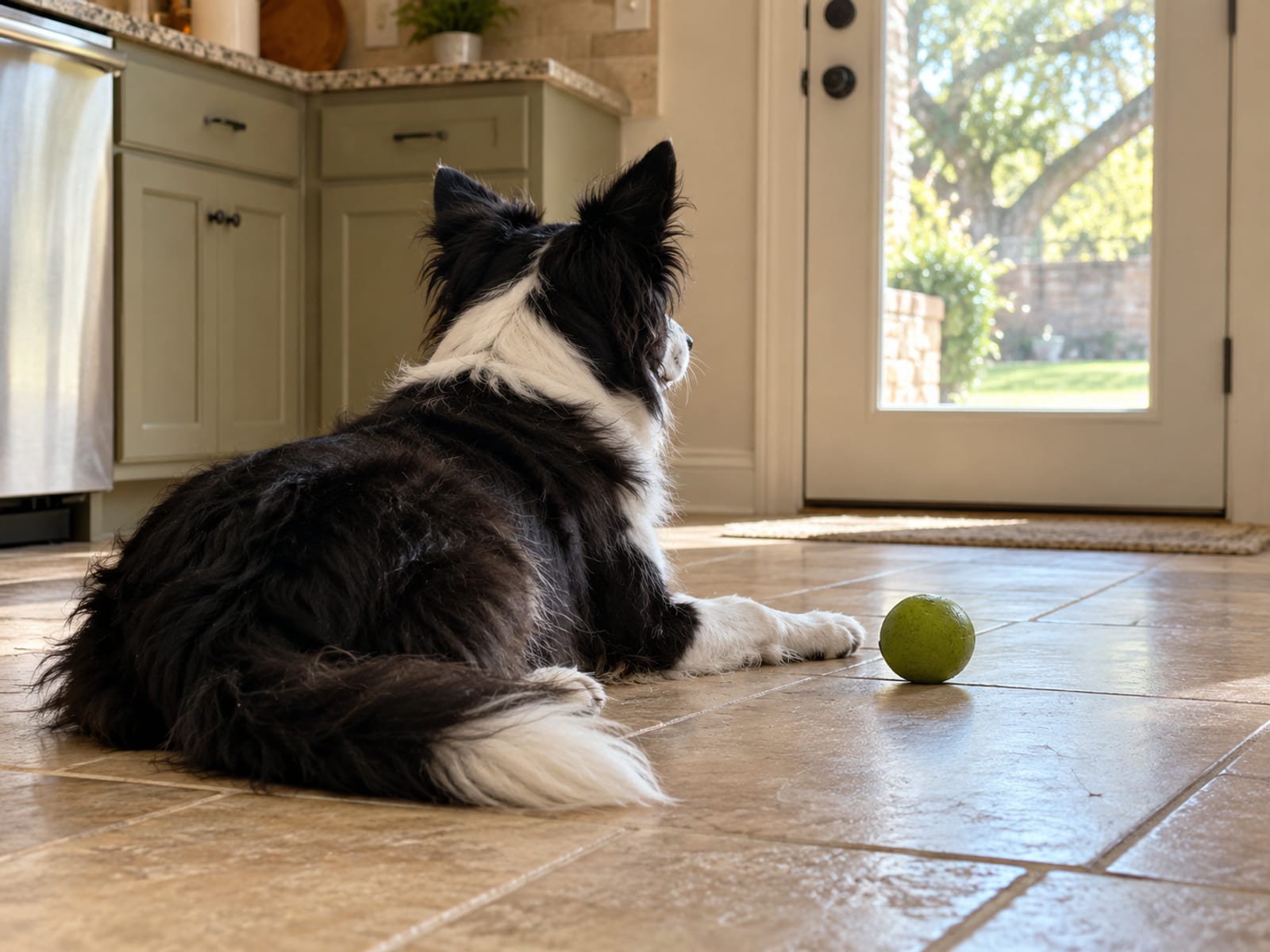
Most owners first notice a sigh at the moment a dog turns a circle, drops onto the bed and lets out a long breath. That is the situation where relaxation is the most common reading. Veterinary behaviorist Vanessa Spano, quoted by the American Kennel Club, says a dog's behavior should be read together with the environment and the dog's full body language. A sigh that comes while a dog curls up, goes limp and starts to drift off fits contentment.
I would not go further than that. A sigh is a sound, not a diagnosis. It does not prove your dog is happy, and it does not prove anything is wrong. What it does give you is a cue to look at the rest of the dog.
What else can a sigh mean?
The AKC describes several other situations where dogs sigh. An active dog with too little to do may sigh out of boredom or frustration, often while waiting for food, play, a walk or a door to open. If a sigh has been followed by petting or play a few times, some dogs learn it works and start sighing to get your attention. A sigh can also show up in a tense, chaotic setting along with yawning, lip licking, a tucked posture, trembling or heavy panting, and then it may be part of a stress response.
There is also a plain physical explanation. The AKC describes occasional deep breaths as a normal reflex that helps keep the air sacs in the lungs open, though it does not cite a dog-specific experiment for how often this happens. Some people also suggest a sigh works as a calming response or a way to release tension. Treat that as a theory, not a settled fact.
Research on dogs in stressful conditions points the same direction. In a 2000 study in Animal Welfare, Beerda and colleagues observed dogs living under different housing conditions. Sighing turned up in different welfare situations, and the authors cautioned that behavior can be misread when it is separated from its setting. That study does not show that a sigh from a pet dog on your couch means stress.
And "sad" is not a reliable conclusion from a sigh alone. Plenty of owners search for that word, and I understand why. Still, a long exhale on its own cannot tell you that.
How do I read the whole moment?
Start with what happened just before the sigh. Then look at the dog from nose to tail, because one cue never settles it. The ASPCA says to read body language as a set of signals, not one signal.
A sigh that fits relaxation usually comes with:
- a loose, resting body
- soft eyes
- ears in a neutral or relaxed position and a neutral tail
- a slightly open mouth or a relaxed face
- the dog choosing to lie down, stay near you or fall asleep
- quiet, easy breathing with no visible effort
A sigh that fits boredom or frustration is more likely when:
- the dog is active by nature and has had little exercise or enrichment
- the dog is waiting for food, play, a walk or access to something
- the dog keeps looking at you, the door or a toy
- the dog is physically comfortable but wants something to do
A sigh that fits stress or discomfort is more worrying when it comes with:
- a tucked tail, flattened ears, or a hunched or crouched posture
- lip licking, yawning, trembling, freezing, avoiding you or changing position again and again
- panting in a cool room when the dog has not been active
- stiffness, guarding, reluctance to move or pulling away
- loss of appetite or another sudden change from normal
If your dog sighs while you pet him, watch what he does next. If his body stays loose and he keeps leaning in, the sigh likely fits relaxation. If he turns away, stiffens, licks his lips, flattens his ears or tries to leave, stop and give him space. Our full guide to dog body language walks through these signals in more detail.
When is a sigh a reason to call the vet, and what should I record?
A sigh by itself is not a typical standalone sign of pain. Pain and illness tend to show up as a cluster, and AAHA's list of common pet pain signs and its emergency guidance give us the pieces to watch for. Talk to your vet soon if the sighing is new or frequent and comes with any of these:
- restlessness, pacing, circling or repeatedly changing position
- difficulty lying down or getting up
- reluctance to move, jump, climb stairs or walk, or limping and stiffness
- withdrawal, irritability or a sudden change in personality
- less appetite or less water, especially for more than a day
- panting when your dog is not hot or active
- lethargy or weakness
Before you call, write down what you can. Note what was happening just before each sigh, how long the pattern has gone on, and whether eating, drinking, sleeping and moving have changed. If the sound repeats, take a short video. A clip of a dog that seems fine at the clinic is often the most useful thing you can hand your vet. You can find clinics near you in our veterinarian directory.
If your dog also seems to be struggling to breathe, skip the appointment and go to the emergency section below.

Is it a sigh, panting, hard breathing or a reverse sneeze?
Owners sometimes call noisy or fast breathing a "sigh" because the sound is hard to name. The differences matter, so here is how each one looks.
A sigh is one deep breath in or one audible breath out, often as the dog settles. It should not involve obvious effort.
Heavy panting is rapid, open-mouth breathing. It is normal after exercise, in heat, with excitement or when a dog is stressed, but panting that does not match the situation can point to pain or illness.
Labored breathing shows effort. Look for fast breathing, the belly working hard, the head and neck stretched out, elbows held away from the body, wheezing, whistling, snorting, open-mouth breathing, or a dog who cannot lie down. Gums that turn blue, gray or purple, weakness and collapse are signs of respiratory distress, according to Cornell.
Reverse sneezing is a different thing again. VCA describes sudden, repeated inhalations through the nose with loud snorting, often while the dog stands still with the head and neck extended. Episodes last from several seconds to about a minute, and the dog is usually normal before and after. If your dog truly has trouble breathing, that is not a reverse sneeze, and it needs an emergency hospital.
Tap or hover a row to highlight it.
| Measure | Figure | Source |
|---|---|---|
| MeasureNormal resting breathing | FigureAbout 12 to 30 breaths a minute | SourceCornell, updated March 2025 |
| MeasureConcerning at rest | FigureContinuously more than 40 to 60 breaths a minute | SourceAAHA respiratory-distress guidance |
| MeasureReverse-sneeze episode | FigureSeveral seconds to about a minute, normal before and after | SourceVCA |
| MeasureAppetite or thirst down | FigureMore than a day warrants a vet visit | SourceAAHA |
To count breaths, wait until your dog is asleep or lying calmly and not panting. Count each rise and fall of the chest for 30 seconds, then double it.
Which signs mean an emergency vet now?
Go straight to the nearest emergency animal hospital for sustained breathing trouble, labored or noisy breathing, open-mouth breathing while at rest, blue, gray or purple gums, collapse, marked weakness, or a dog who cannot settle because breathing is hard. AAHA lists gasping, wheezing, excessive panting, noisy breathing and abnormal gum color as reasons for immediate attention. Call the hospital on the way so the team can get ready. Do not give any medicine unless a vet or poison-control professional tells you to.
What can I do if my dog seems bored or unsettled?
If boredom is a real possibility, meet the need. Offer a walk, time to sniff, a food puzzle, a safe toy or a short reward-based training session. Our guides on how much exercise a dog needs, how often to walk your dog and positive reinforcement training can help you plan the day.
If the signs lean toward stress, move your dog away from whatever is bothering him when that is safe, and lower the intensity of the situation. Then work on it gradually with rewards. The ASPCA's separation-anxiety guidance makes the same point for stress at being left alone: shorten the exposure when stress shows up and progress more slowly. For a dog who gets upset when you leave, see our page on dog separation anxiety.
One more step matters. If your dog stays unsettled, or the sighing is new, get a vet check before you assume boredom. A dog who cannot get comfortable may be hurting, and more exercise will not fix that.
What about puppies, older dogs and anxious dogs?
Puppies can sigh or make soft sounds during close contact and rest. The same rule applies: read the sigh with the body language and the breathing. Ongoing breathing trouble, poor appetite, weakness or being unable to settle is not normal puppy behavior, and it needs a vet.
Older dogs often sigh as they find a comfortable position, and age does not give the sigh a fixed meaning. A new increase in sighing along with stiffness, restlessness, reluctance to move, trouble getting up, a change in appetite or altered sleep deserves an appointment, because pain and other medical problems can first show up as a change in behavior. Our senior dog care guide covers what to watch for, and signs of a healthy dog gives you a baseline to compare against.
An anxious dog may sigh in a stressful place, especially with yawning, lip licking, a tucked tail, flat ears, trembling, pacing or heavy panting. Read the sigh as one part of that larger pattern, and help the dog with the steps above.
Questions owners ask about dog sighing
These are common questions, with short answers.
What does it mean when your dog sighs deeply?
Most often it fits settling in and relaxing, particularly when it happens as your dog lies down with a loose body. It can also come with boredom, frustration, attention-seeking or stress. Check posture, eyes, ears, tail and the situation before you decide.
Is a dog happy when it sighs?
It can fit contentment when your dog is loose, comfortable and breathing easily. The sound alone does not prove happiness, so look for the soft eyes and relaxed body that go with it.
Can boredom or stress make a dog sigh?
Yes to both. A sigh during inactivity or while waiting can go with boredom or frustration, so offer activity, sniffing or a food puzzle. A sigh with yawning, lip licking, trembling or avoidance points toward stress, so lower the pressure and give your dog room.
Is frequent sighing a sign of pain?
A sigh is not a typical standalone pain sign. Still, new or frequent sighing with restlessness, stiffness, reluctance to move, appetite change or trouble settling should be discussed with your vet, and a short video helps.
Is reverse sneezing the same as sighing?
No. Reverse sneezing is a burst of repeated inhalations through the nose with snorting, lasting seconds to about a minute. If your dog has trouble breathing, treat it as an emergency.
What is my next step?
Watch your dog the next few times he sighs and note what came right before. If the body is loose, the breathing is easy and he is settling, you most likely just heard a comfortable dog. If you see restlessness, panting when it is not hot, stiffness, less appetite or a new change in behavior, book a vet visit this week and bring a video. If breathing looks hard at any point, go to an emergency hospital now. I cannot promise what any single sigh means, but this order of steps keeps you on the right side of it. For more on reading your dog, start with our dog body language guide, or use the veterinarian directory to find a clinic.

Sources
- American Animal Hospital Association: AAHA's list of common pet pain signs
- American Animal Hospital Association: AAHA
- American Kennel Club: American Kennel Club
- ASPCA: ASPCA's separation-anxiety guidance
- ASPCA: ASPCA
- cambridge.org: Animal Welfare
- Cornell University College of Veterinary Medicine: Cornell
- VCA Animal Hospitals: VCA