

Why Do Dogs Bite? What to Do Right After a Bite and How to Prevent the Next One
By Cal Hewitt · Published , updated
Training

If your dog just bit someone, put the dog in another room or behind a closed door, without putting your hands near its mouth, and wash the wound with soap and water. Dogs usually bite when they feel afraid, threatened, in pain, startled, frustrated, or protective of food, toys, space or people, and a bite is a safety event, not a reason to punish the dog. Call your local animal control or health department about reporting and rabies, see a doctor for anything deep or serious, and then arrange a veterinary check and qualified behavior help.
Key takeaways
Tap a card to bring it forward.
- Separate the dog from people first, without reaching toward its mouth or into a fight.
- Wash the wound with soap and water, and get medical care for deep or serious wounds.
- Ask local animal control or the health department about reporting, rabies and observation.
- Dogs bite from fear, pain, guarding, startling, frustration or unsafe play; punishing a growl removes the warning, not the cause.
- Adults must watch children and familiar dogs closely, because most bites to young children come from dogs they know.
- The first professional step is a veterinary check, then a qualified behavior professional.
Your dog just bit someone: what do I do in the next hour?
I know this is a hard moment. You may feel frightened, guilty or angry, and all of that is normal. The next steps are the same either way, and they come first.
- Separate and contain the dog. Use a door, a gate or a leash. The CDC advises separating the dog without putting your hands near the mouth or into a dog fight. Never grab a collar or pull a dog out of a fight by hand.
- Clean a minor wound. Wash it thoroughly with soap and water, apply antibiotic cream, and cover it with a clean bandage.
- Press on a deep wound. Use a clean cloth. Call emergency services for bleeding that will not stop, faintness, weakness, extreme pain or loss of use of a hand or limb.
- See a doctor for deep or serious wounds, signs of infection, unknown rabies vaccination status, or when a tetanus shot may be out of date. Tell the provider it was a dog bite.
- Get your dog's rabies vaccination information ready for the doctor and for the authorities.
Nearly one in five people bitten by a dog needs medical attention, according to the CDC, so please do not treat a bite as too small to check. A vaccinated dog does not remove the need for medical or public-health advice.
What about rabies, reporting and quarantine?
Rules on reporting, quarantine and dangerous dogs change from place to place, so the person to ask is local. Call your local animal control, police non-emergency line or health department, and ask three things: whether this bite must be reported, whether your dog must be observed or quarantined and where, and what paperwork they need. Have your dog's rabies vaccination record in hand when you call.
The CDC's guidance for veterinarians commonly uses a 10-day observation period for a healthy dog, cat or ferret that exposed a person, coordinated with public-health authorities. Follow the instructions your local authority gives you. The CDC's rabies prevention page covers wound washing, rabies risk and medical advice, and the doctor who treats the wound will decide what treatment is needed.
If Spanish is easier for you or a family member, the CDC has rabies guidance in Spanish, and the AVMA has a bite-prevention brochure in Spanish that covers containing the dog, medical care, rabies information and reporting.

Why do dogs bite?
Almost every bite has a reason, and once you know the reason, you know what to change. Veterinary behavior sources from UC Davis, the ASPCA and the AKC describe these common causes:
- Fear or anxiety. A dog may bite to make a frightening person, animal or object go away. UC Davis says aggression is commonly rooted in fear or anxiety.
- Pain, illness or injury. A gentle dog may snap when touched or approached in the wrong spot.
- Guarding. Food, toys, chews, stolen objects, resting spots and even people can be things a dog protects. The ASPCA describes food guarding as a safety issue and warns owners not to attempt exercises alone when a bite is likely.
- Territorial or protective behavior. People entering the home, yard or car, or a dog defending puppies, a person or another dog.
- Startling. Waking a sleeping dog, touching it unexpectedly, looming over it, lifting it or cornering it.
- Frustration and redirected biting. A dog held back by a gate, crate, car or leash, or aroused by one target, may bite a nearby person or dog instead.
- Play or mouthing that turns unsafe. Puppy mouthing is often developmental. Adult play biting can injure people and can be hard to tell apart from aggression.
Some predatory sequences may come with none of the warning behavior you see in fear or guarding.
UC Davis says aggression is commonly rooted in fear or anxiety, and that force-based techniques can add to fear-based aggression. That matters for what you do next: confronting or punishing the dog raises the risk instead of lowering it.
What warning signs come before a bite, and what do I do when my dog growls?
Most dogs give signals first, though they can be subtle, can overlap, or can come just before contact. The ASPCA describes a common escalation:
- Lip licking, yawning, turning away, hiding, backing away or avoiding eye contact.
- Freezing, stiffening, crouching, "whale eye" (showing the whites of the eyes), hard staring or a tense face.
- Growling, barking, lifting the lip, showing teeth or snarling.
- Lunging, air snapping, snapping, nipping or biting.
Dogs do not always follow this order. Our article on dog body language shows what each of these looks like and how to read stress, fear and comfort.
A growl is information: your dog is uncomfortable, threatened, guarding or in pain. The AKC and the American Veterinary Society of Animal Behavior warn that punishing a growl can suppress the warning while the fear or discomfort stays. A dog that stops growling is not calmer; it is quieter. The ASPCA also notes that dogs that stop at showing teeth, growling or snapping are significantly safer to live with than dogs that bite, so you want the growl to stay.
So, when your dog growls, stop what you are doing, calmly create distance, and remove the trigger. Then write down what led up to it and share that with your veterinarian and behavior professional.
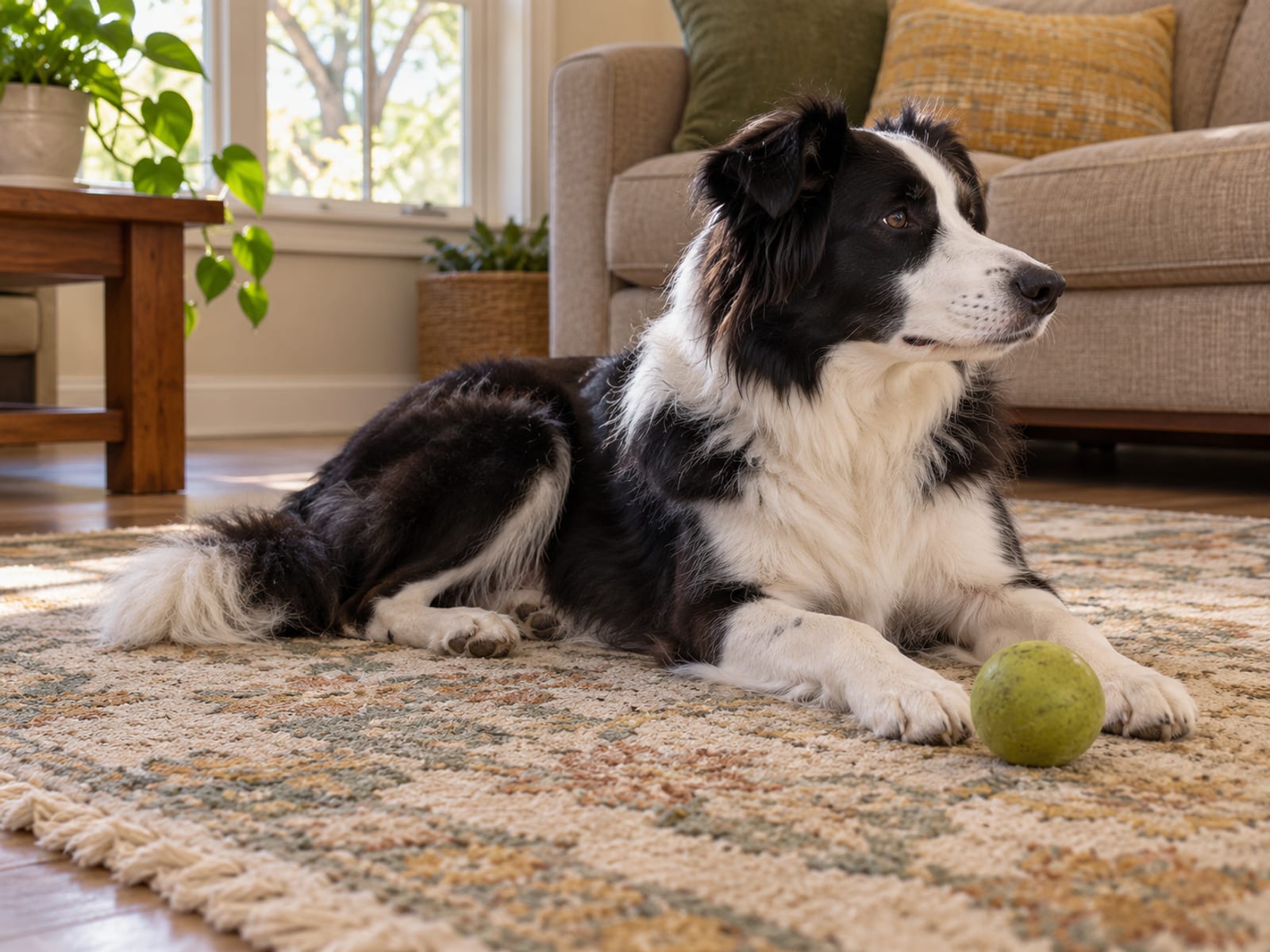
How do I keep children safe around a dog that knows them?
A friendly family dog can still bite a child. The CDC says children are more likely than adults to be bitten, their injuries tend to be more severe, and most bites to young children happen during everyday activities with a familiar dog.
Two studies show how it happens:
- In a veterinary behavior clinic series of 111 bitten children (Reisner et al., 2007), children under six were most often bitten in resource-guarding situations, and older children more often in territory-guarding situations. This was a referral-clinic sample, not a count of all bites.
- In a pediatric medical-record study (Bernardo et al., 2002), 82% of the dogs were familiar to the child, and the face, head and neck were the most common injury sites.
The rules that matter most:
- An attentive adult must be present whenever a child and a dog are together, including with your own family pet.
- Children never approach a dog that is eating, sleeping, resting, guarding an object or trying to leave.
- After a bite or a serious warning, keep the dog and children separated until a professional gives you a plan.
Breed alone does not tell you whether a dog will bite. The ASPCA says each dog must be viewed as an individual.
What do I do today while I arrange help?
You cannot fix this in a day, but you can make your home safer today.
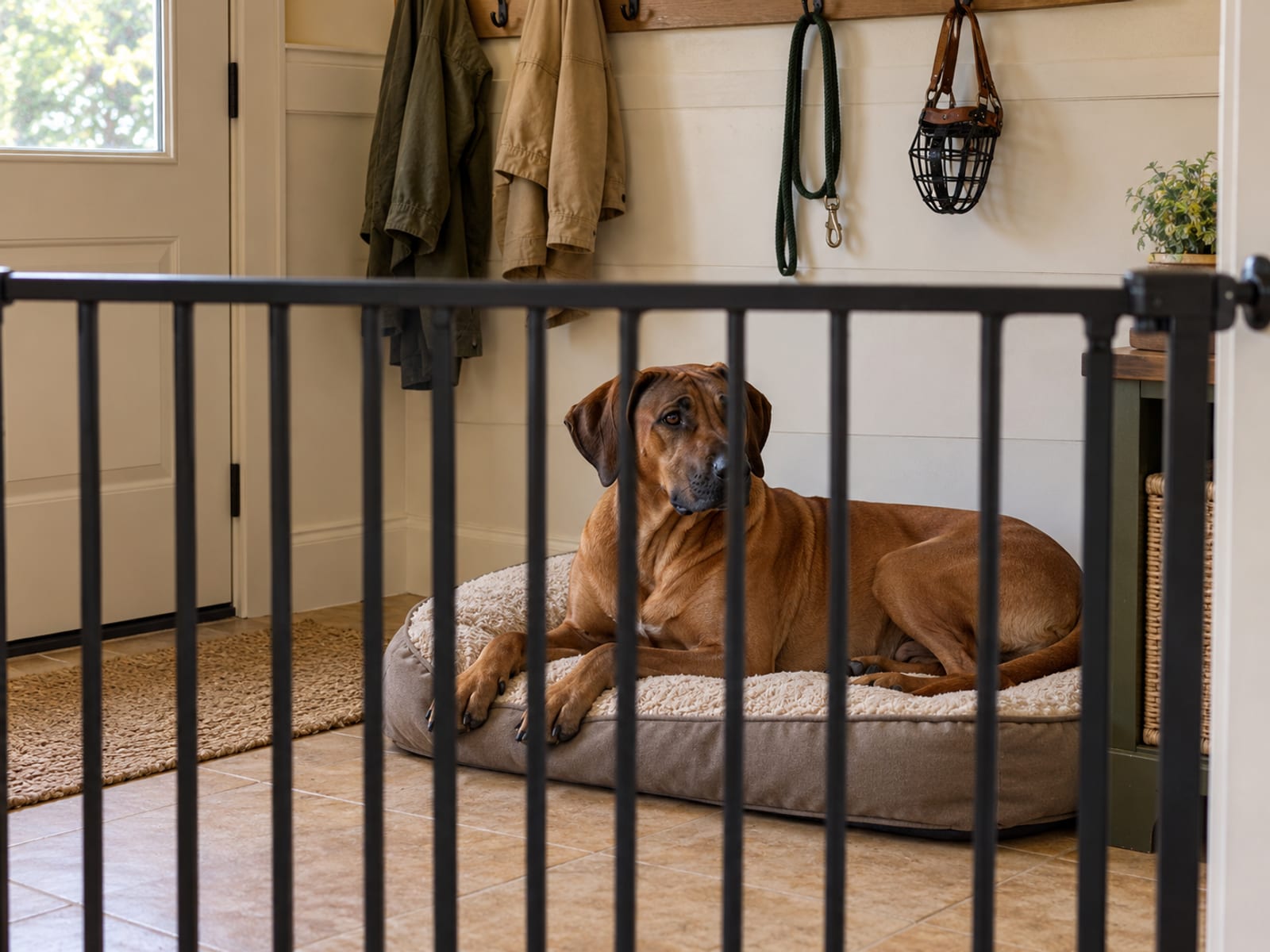
- Block the trigger. Use doors, baby gates, pens, crates, leashes or separate rooms. Keep visitors away from the dog unless a professional safety plan says otherwise. Our Halloween safety article has door-and-visitor tips that apply here too.
- Feed and move a guarding dog safely. Feed it alone behind a closed door, and do not reach for its food, toys or chews.
- Do not test the dog. Do not recreate the bite, provoke a reaction to film it, or take a chew away to prove a point. Virginia Tech warns that provoking or recreating aggression raises injury risk and can make the behavior worse. If you want a video for your professional, record only naturally occurring behavior from a safe distance.
- Do not use force. No grabbing collars, reaching into the mouth, intimidation or physical punishment.
- Consider muzzle training as a safety tool. The ASPCA and Virginia Tech describe a properly fitted basket muzzle as an added safety measure in selected situations. It must be introduced gradually with rewards, it does not replace separation, supervision or professional help, and it is never a way to force a dog into an interaction that frightens it. Ask your behavior professional to guide the training.
Why does a veterinary check come first?
Pain, illness, neurological problems and sensory changes can lower a dog's tolerance or make handling hurt. A vet should see the dog before you treat the biting as only a training problem. Call your regular vet, tell them about the bite and what led up to it, and ask for an exam. You can find vets and emergency vets in the DogServ directory.
A veterinary behaviorist is a veterinarian with advanced behavior training. According to the ASPCA, this person can evaluate medical and behavior factors together, build a safety and behavior plan, and coordinate medical care. The American College of Veterinary Behaviorists is the specialty for complex aggression, fear and medical-behavior cases.
How do I choose behavior help, and what do I ask?
Bring in a professional after any bite, repeated snap, serious growl, lunge, guarding that may lead to a bite, sudden behavior change, or behavior around a child. The ASPCA suggests a certified applied animal behaviorist (CAAB or ACAAB), a veterinary behaviorist, or a qualified certified professional dog trainer (CPDT) with aggression experience. Match the person to the problem:
- Veterinary behaviorist: bite history, serious aggression, a sudden change, suspected pain or illness, severe fear, or a complex case.
- CAAB or ACAAB: advanced academic and supervised behavior training.
- IAABC CDBC: a certified dog behavior consultant. See the IAABC credentials.
- CCPDT CBCC-KA: a behavior consultant credential that, per the CCPDT handbook, requires an exam, humane practices and 300 hours of consulting experience in the previous three years, 225 of them with fear, anxiety or aggression.
- CPDT: a trainer credential; confirm the trainer has handled aggression cases before you hire.
Ask:
- What cases like mine have you handled?
- What methods and equipment do you use?
- How will you keep people safe during the evaluation?
- Will you work with my veterinarian?
- What happens if my dog gets worse?
- What are your fees and follow-up arrangements?
- Can you show me your current credentials and references?
Walk away from anyone who promises a sure cure, blames every case on the dog wanting to be the boss, recommends intimidation or physical punishment, or asks you to provoke your dog. The AVSAB recommends reward-based training only, and says punishment can increase fear and aggressive events. DW Dog Training offers aggression-specific behavior help, and our training articles on positive reinforcement and how to train a dog cover the foundations.
Fees vary by location, specialist, appointment length and follow-up. Current examples: Virginia Tech lists a behavior consult at $300, Ohio State lists an appointment at $460 for up to two hours ($635 for inter-dog aggression), and Tufts lists a 90-minute new-client consultation at $605. Ask any provider for current fees before you book.
Tap or hover a row to highlight it.
| Provider | Fee | Detail |
|---|---|---|
| ProviderVirginia Tech | Fee$300 | DetailBehavior consult with take-home plan and one Zoom follow-up |
| ProviderOhio State | Fee$460 (up to two hours); $635 for inter-dog aggression | DetailDog behavior appointment |
| ProviderTufts | Fee$605 | Detail90-minute new-client consultation |

What does progress look like?
Nobody can promise you a result or a timeline, and I won't. What can be done depends on the trigger, how bad the bite was, how predictable it is, how often it happens, medical factors, your household setup and how well you can keep up the management.
Progress looks like fewer rehearsals of the behavior, earlier recognition of triggers, more distance tolerated before your dog escalates, better recovery afterward, and safer routines that everyone in the house follows. Ask your professional to set measurable goals for your dog, so you can see whether the plan is working.
Questions people ask about dog bites
Can you trust a dog after it bites?
Many dogs improve with careful management and an individualized behavior plan, but no professional can guarantee safety or a specific outcome. Until you have a plan, keep the dog separated from the person it bit and from children.
Should I punish my dog for growling?
No. Punishment can hide the warning without changing the fear or pain underneath, and it may raise the risk of a future bite. Back off, create distance, and note what triggered it.
Do dogs give a warning before they bite?
Often they do, such as lip licking, turning away, freezing, a hard stare, growling or lifting a lip. Some signs are subtle or come almost at once, so learn your dog's early discomfort signals.
Why do dogs bite family members?
Family dogs may bite during guarding, handling, resting, eating, play or restraint, or during interactions they find threatening or painful. The cause is worth finding, because it decides what to change at home.
When should I call a professional?
Call after any bite, snap, lunge, serious growl, or behavior around a child that worries you. A veterinary behaviorist is especially appropriate when pain, illness, severe fear or serious aggression may be involved.
Your next step
Today, keep the dog safely separated, make sure anyone bitten has had the wound cleaned and, if needed, seen a doctor, and call your local animal control or health department about reporting and rabies. Tomorrow, book a veterinary check and start looking for a qualified behavior professional. You love this dog, and asking for help is the responsible thing to do. Take the first call, and take it today.
Sources
- American Kennel Club: AKC
- American Veterinary Medical Association: bite-prevention brochure in Spanish
- American Veterinary Society of Animal Behavior: American Veterinary Society of Animal Behavior
- ASPCA: ASPCA
- ASPCA: ASPCA
- ASPCA: ASPCA
- ASPCA: food guarding
- cdc.gov: CDC's guidance for veterinarians
- cdc.gov: CDC's rabies prevention page
- cdc.gov: CDC
- cdc.gov: rabies guidance in Spanish
- Certification Council for Professional Dog Trainers: CCPDT handbook
- IAABC: IAABC credentials
- PubMed: pediatric medical-record study
- PubMed Central: veterinary behavior clinic series of 111 bitten children
- sas.vt.edu: behavior consult
- UC Davis School of Veterinary Medicine: UC Davis
- vet.tufts.edu: new-client consultation
- vmc.vet.osu.edu: appointment