
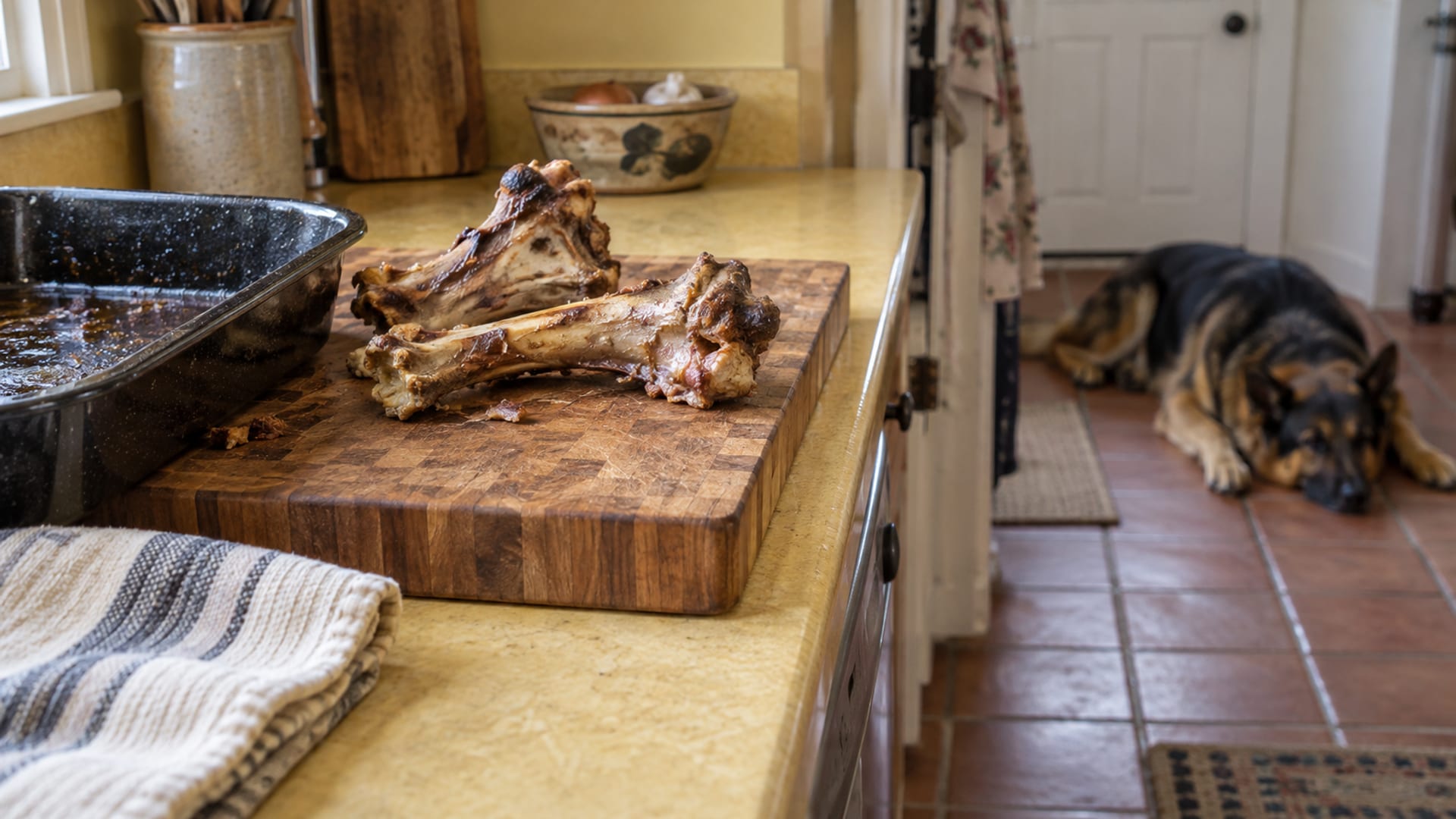
No, bones are a poor choice for a dog treat, cooked or raw. Cooked bones turn brittle and splinter, and raw bones can still cause choking, broken teeth, blockages, constipation and exposure to germs, according to the American Kennel Club and VCA Animal Hospitals.
If your dog already swallowed a bone or a chunk of one, call your vet for advice now, while your dog still looks normal. Head straight to an emergency clinic if your dog is choking, struggling to breathe, gagging over and over, drooling heavily or vomiting.
Key takeaways
Tap a card to bring it forward.
- Cooked bones of any kind splinter into sharp pieces. Never share them.
- Raw bones splinter less, but they can still choke, obstruct, break teeth and carry Salmonella or Listeria.
- Bones are the most common thing found stuck in a dog's esophagus.
- After a swallowed bone, call your vet. Do not try to make your dog vomit.
- Trouble can show up days later: vomiting, belly pain, straining or blood in the stool.
My dog swallowed a bone: what to do now
- Take away the rest of the bone, the plate or the trash bag, and keep other pets away from it too.
- Check for choking. Pawing at the mouth, gagging, retching with nothing coming up or labored breathing means an emergency clinic, right now.
- Work out what it was. Raw or cooked, which animal, roughly how big, whether it went down whole or in pieces, and when. Your dog's weight helps too.
- Call your vet. The AKC's advice after a cooked bone is to phone your vet or book an appointment to rule out serious problems.
- Skip home remedies. The AKC says not to induce vomiting, because sharp pieces can do more damage on the way back up. Hold off on bread, oil or medicine unless your vet tells you to give them.
- Keep watching for several days. A bone can take time to move through, so problems do not always show on day one.
A vet may examine your dog, take X-rays, and decide between watching at home, removing the bone with a scope, or surgery, as Merck Veterinary Manual describes for bones lodged in the esophagus.
Raw bones and cooked bones side by side
Tap or hover a row to highlight it.
| Question | Cooked bones | Raw bones |
|---|---|---|
| QuestionDo they splinter? | Cooked bonesYes. Cooking makes them brittle | Raw bonesLess likely, but they can still crack |
| QuestionChoking and blockage | Cooked bonesYes | Raw bonesYes |
| QuestionBroken teeth | Cooked bonesYes | Raw bonesYes, especially hard marrow and knuckle bones |
| QuestionGerms | Cooked bonesMostly killed by cooking | Raw bonesCan carry Salmonella, Listeria and E. coli |
| QuestionFat from meat and marrow | Cooked bonesOften, plus seasoning and salt | Raw bonesOften, especially rib and marrow bones |
| QuestionShould you give them? | Cooked bonesNo | Raw bonesOnly after talking it through with your vet, and still not risk-free |
Smoked, baked and dehydrated bones sold as chews belong with the cooked column. Drying and smoking make bone hard or brittle, so a label that says "natural" tells you nothing about how it breaks.
Bones by animal: chicken, turkey, pork, beef and more
The shape and size of a bone change how it breaks and how easily it goes down whole. Each of these pages covers one kind of bone in detail, raw and cooked:
Tap or hover a row to highlight it.
| Bone | Guide |
|---|---|
| BoneChicken wings, drumsticks, carcass | GuideCan dogs eat chicken bones? |
| BoneTurkey carcass, neck, leg | GuideCan dogs eat turkey bones? |
| BonePork chop, shoulder, knuckle | GuideCan dogs eat pork bones? |
| BonePork spare ribs and baby back ribs | GuideCan dogs eat pork rib bones? |
| BoneBeef, marrow and soup bones | GuideCan dogs eat beef bones? |
| BoneLamb chops and leg of lamb | GuideCan dogs eat lamb bones? |
| BoneHam bones and ham hocks | GuideCan dogs eat ham bones? |
| BoneFish bones | GuideCan dogs eat fish bones? |
| BoneT-bone, ribeye and other steak bones | GuideCan dogs eat steak bones? |
| BoneHam hocks in greens, beans and soup | GuideCan dogs eat ham hocks? |
| BoneOxtail, braised or in soup | GuideCan dogs eat oxtail? |
| BonePork neck bones cooked with greens | GuideCan dogs eat pork neck bones? |
| BoneSmoked turkey necks and wings | GuideCan dogs eat smoked turkey necks? |
| BonePig feet, pickled, boiled or as chews | GuideCan dogs eat pig feet? |
Why raw bones are still a gamble
Veterinary sources split on raw bones, and it helps to know where the line falls. The AKC describes a real debate: some raw-feeding supporters and some vets see raw meaty bones as acceptable because they splinter less, while others say the risks outweigh any benefit. VCA comes down on the side of avoiding bones altogether, raw or cooked. The CDC does not recommend raw pet food or treats, uncooked bones included, because of Salmonella and Listeria.
The germ risk reaches the people in your house too. When the FDA tested 196 raw pet food samples, 15 carried Salmonella and 32 carried Listeria monocytogenes. Homes with babies, older adults, pregnant people or anyone with a weak immune system have the most to lose from that.
The cautious answer, then: no cooked bones, and no raw bones unless your own vet has weighed them for your dog. If you do get that go-ahead, the AKC's precautions are a bone too big to swallow, no small or cut pieces, and watching the whole time. Even then, the risk does not go to zero.
Signs a bone is causing trouble
Right away, when a bone is stuck in the mouth, throat or esophagus: gagging, choking, coughing, drooling, swallowing again and again, bringing food back up, or labored breathing.
Over the next hours to days, as a piece moves further down: vomiting, not eating, tiredness, a sore or swollen belly, diarrhea, constipation, straining to poop, bloody stool, or not passing stool at all.
The AKC notes that some pieces pass in about 72 hours, though timing varies a lot. VCA warns that sharp fragments can pierce the gut and lead to peritonitis, which can be fatal. That is why a quiet first evening is good news without being the end of the story.
Small dogs have narrower throats. In a study of dogs with upper gut blockages, objects stuck in the esophagus turned up most often in small breeds, and they were usually bones or dried dog snacks. Puppies are small too, and they chew and gulp.
"My dog has chewed bones for years and been fine"
That can be completely true, and plenty of dogs have. It still does not make bones safe for that dog next time, or for the dog next door. Whether a bone passes depends on how big the piece was, how sharp, whether it was cooked, where it ended up, how the dog chews and swallows, and the size of the dog's throat and gut. A fragment that slips through one dog can lodge in another, and some problems only show days later. Years of good luck is real luck, and one stuck bone can still mean surgery.
Broth, bone meal, rawhide and other "bones"
- Bone broth: fine only when every bit of bone is strained out and it has no onion, garlic, heavy salt or a thick layer of fat.
- Bone meal: the ground powder in garden fertilizer and some supplements. Pet Poison Helpline notes that a large amount can clump into a mass in the stomach, and fertilizer versions may hold other chemicals. Call a poison line or your vet with the bag.
- Ground bone in a complete dog food: a different thing from a whole bone. It says nothing about giving your dog a leftover bone.
- Rawhide, dental and nylon "bones": made of hide, compressed ingredients, nylon or rubber. Read what the product is made of, and know that a swallowed chunk can still choke or block.
- Marrow bones: hard enough to break teeth, and marrow is fatty, which can upset the stomach or set off pancreatitis.
Cookouts and holiday meals are when most dogs get the chance, from grills, plates and trash bags. The AKC's cookout guide lists cooked bones among the foods to keep away from dogs, so bag the bones and take the trash out before dessert.
Check what you learned
Quick check
Questions about dogs and bones
Can dogs eat cooked bones?
No. Cooked bones are brittle and break into sharp shards that can cut the mouth, lodge in the throat, or block or pierce the gut. That holds for every kind of leftover bone, including smoked and grilled ones.
Are raw bones safe for dogs?
They are safer from splintering and not from much else. Raw bones can still choke a dog, crack teeth, cause blockages and constipation, and carry Salmonella or Listeria. Talk to your vet before giving one.
How long does it take a dog to pass a bone?
Some pieces pass in about three days, according to the AKC, but there is no fixed timeline. Your vet can tell you how long to watch your dog and what to watch for.
Are marrow bones better than other bones?
No. Hard marrow bones can fracture teeth, and the fatty marrow can cause an upset stomach or pancreatitis. VCA recommends avoiding bones in general.
Can puppies have bones?
Puppies are smaller and tend to chew and gulp, which raises the choking and blockage risk. Offer a chew toy made for puppies and ask your vet what suits your dog's size.
Should I make my dog throw up a bone?
No. Sharp pieces can injure the throat on the way back up. Call your vet and let them decide what happens next.
Sources
Checked September 24, 2026.
- American Kennel Club, Can Dogs Eat Bones? Be Careful Before Giving Your Pup a Bone
- American Kennel Club, What to Do if Your Dog Ate Chicken Bones
- American Kennel Club, Hazardous Cookout Foods for Dogs
- VCA Animal Hospitals, Why Bones Are Not Safe for Dogs
- Merck Veterinary Manual, Esophageal Foreign Bodies in Small Animals (updated September 2024)
- Centers for Disease Control and Prevention, Raw Pet Food
- U.S. Food and Drug Administration, Get the Facts! Raw Pet Food Diets Can Be Dangerous to You and Your Pet
- Leung and others, Prevalence and characteristics of foreign body-induced upper gastrointestinal obstruction in dogs
- Pet Poison Helpline, Top 20 Toxic Titans, Part II