
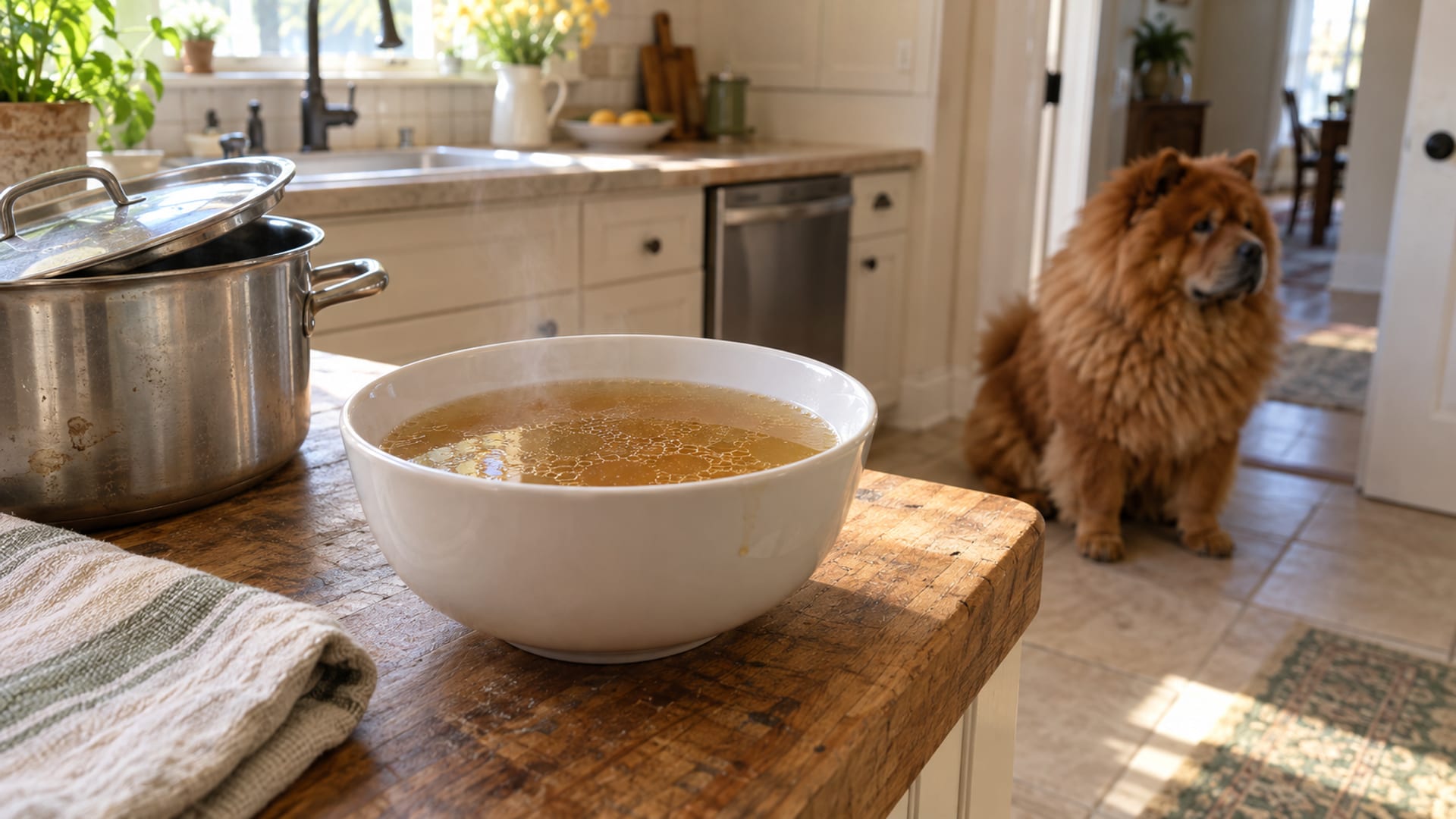
Yes, with caution. A small amount of plain beef broth, made from beef and water with no onion, garlic or added salt, is fine for most dogs; the risk comes from whatever else went into the pot.
Onion, garlic, chives and leeks can damage a dog's red blood cells, and bouillon cubes and soup bases can be very salty. If your dog just drank some, find the label or think back through the recipe. If it had onion or garlic in any form, was very salty or greasy, had bones in it, or your dog drank a lot for its size, call your vet or an animal poison control line tonight, before any signs show up.
Key takeaways
Tap a card to bring it forward.
- Plain broth made from beef and water, with no onion, garlic or added salt, is fine in a small amount.
- Onion, garlic, chives, leeks, shallots and their powders damage red blood cells, and cooking them into broth does not make them safe.
- Bouillon cubes, broth powders and soup bases pack in salt and dried seasoning.
- After a broth with onion or garlic, call before signs appear, because the anemia can take three to five days to show.
- Broth is an occasional extra over food and never a replacement for fresh water.
Your dog already drank some broth: what to do tonight
Work through these in order; each one answers a question your vet will ask.
- Find the label or the recipe. Onion and garlic powder can hide under "seasoning," "spices" or "natural flavors," so read the whole list and keep the package by the phone.
- Look for onion or garlic in any form. Fresh, cooked, dried and powdered all count, and a review in Frontiers in Veterinary Science found that cooking and processing do not remove the toxicity.
- Think about salt and grease. A mug of bouillon or a pan of gravy is a very different drink from plain homemade stock, and the AKC warns that too much salt can cause vomiting, diarrhea, tremors, fever, seizures and death.
- Check the bowl or pot for bones. Cooked bone pieces in leftover soup can cause choking, a blockage or an injury inside the gut; our page on Beef bones covers that case.
- Estimate how much your dog drank, and note the time. The ASPCA asks owners to record the amount and contact a vet or poison control, and the same bowl is a far bigger dose for a small dog.
- Call if any of the above applies, even when your dog seems fine. Damage from onion or garlic builds over days, and an early call gives the vet time to decide on blood tests or treatment.
A lick or two of broth you know was plain, unseasoned and low in fat, in an otherwise healthy dog, generally does not need a call. If you are unsure what was in it, treat it as unknown and call. If it were my dog, I would rather make that call and hear it was nothing.
Which broths are fine and which are a problem
The label, or your memory of the recipe, decides which of these groups a broth falls into.
Tap or hover a row to highlight it.
| Broth or form | What to check | Where it lands |
|---|---|---|
| Broth or formHomemade beef and water, strained, fat skimmed | What to checkNothing else added | Where it landsFine in a small amount |
| Broth or formStore-bought broth or stock, including low sodium | What to checkOnion, garlic, sodium, fat | Where it landsDepends on the label |
| Broth or formBouillon cubes, powder, concentrate, soup base | What to checkConcentrated salt and dried onion or garlic | Where it landsAvoid |
| Broth or formBroth cooked with onion, garlic, chives, leeks or shallots | What to checkAny of these, fresh or powdered | Where it landsAvoid, and call if your dog drank it |
| Broth or formGreasy broth or pan drippings | What to checkThe fat on top | Where it landsRemove the fat or skip it |
| Broth or formBroth with cooked bones | What to checkBone pieces | Where it landsTake every bone out |
| Broth or formRaw or uncooked stock | What to checkRaw animal product and bacteria | Where it landsAvoid |
Pieces of beef in the broth are generally fine when the meat is lean, fully cooked, boneless and unseasoned. Fat is the part to watch; Pet Poison Helpline lists high-fat foods as a pancreatitis risk. Products sold as "beef flavored" may hold little beef, so judge them by the ingredients.
How to share plain broth, and how much onion or garlic is a concern
If you want to pour a little over dinner, keep it to beef and water, with no onion, garlic, chives, leeks, shallots, spices, bones or added salt, and lift off the fat once it cools. The AKC treats plain bone broth as fine for dogs and separates it from products that carry onion, garlic or salt. Use a small splash now and then, never as a meal or in place of water. There is no standard serving by dog size, so ask your vet if you want a number for yours. With store broth, read the whole label; "low sodium" says nothing about onion or garlic, and "no added onion" says nothing about salt or fat.
The figures below come from research on onion and garlic themselves. They are grams of onion or garlic per kilogram of the dog's weight, and they cannot be turned into a safe amount of broth, because one pot holds far more onion than another.
Tap or hover a row to highlight it.
| Figure | What it describes | Source |
|---|---|---|
| Figure15 to 30 g of raw onion per kg | What it describesHas caused clinical signs in dogs | SourceMerck Veterinary Manual |
| Figure30 g of cooked onion per kg a day, for two days | What it describesCaused hemolytic anemia in the study dogs | SourceYamato et al. |
| FigureGarlic three to five times more toxic than onion | What it describesHow garlic compares | SourceMerck Veterinary Manual |
| FigureAbout 5 g of garlic per kg | What it describesCommonly reported dose; a fatal case happened below it | SourceFatal garlic toxicosis case report |
Powders are the bigger worry, since a spoonful of garlic powder or dried onion stands in for a lot of fresh bulb. When you call, have your dog's weight, the ingredient list or recipe, your best guess at how much was drunk, and the time.
Signs to watch for over the next several days
A small amount of plain, low-fat, low-salt broth may cause nothing at all. Too much broth, or a fatty or salty one, can bring vomiting, diarrhea, heavy thirst, dehydration, weakness or a sore belly.
Onion and garlic move more slowly. The Merck Veterinary Manual describes stomach upset first, then red blood cell damage starting within about 24 hours, methemoglobin at its highest around 72 hours, and red blood cells being destroyed, usually three to five days after exposure. Watch for:
- tiredness, weakness or a dog that quits early on walks
- poor appetite
- fast breathing or a racing heart
- pale gums, or a yellow tinge to the gums or eyes
- dark or bloody urine
- collapse
At worst, enough onion or garlic can lead to life-threatening anemia, kidney injury or death; the ASPCA names N-propyl disulfide as the compound in garlic behind the damage. A very salty broth can cause salt poisoning with seizures or coma, and a greasy one can set off pancreatitis.
Call right away for vomiting, diarrhea, weakness, pale gums, fast breathing, dark urine, yellowing, tremors, seizures, collapse or real belly pain.
My dog drank broth before and was fine
That happens, and I believe it. It still does not make every broth safe for every dog.
Harm depends on how much onion, garlic, salt or fat actually went down, and the same bowl is a much bigger dose per kilogram for a small dog. Form matters too; the Merck Veterinary Manual names dehydrated flakes, powders and dry onion soup mixes as common causes, which is what goes into cubes and soup bases. A plain broth last time and a seasoned one this time are two different exposures.
Timing can fool anyone, since a dog that looked fine the next morning may not yet have reached the point where anemia shows. And dogs differ; the authors of the fatal garlic case report point to repeated exposure and individual sensitivity as reasons one dog is harmed by an amount another handles. Your dog was fine that time, with that broth, and the next pot may not go the same way.
Stock, bouillon, gravy and other names for beef broth
Beef broth goes by many names, and they do not all hold the same thing. Concentrated products usually carry much more salt and seasoning.
- Stock and bone broth can be plain strained liquid or a store product with onion, garlic, salt or herbs, as the AKC notes.
- Consommé is often concentrated; Campbell's Latin America lists onion, garlic oil, salt, sugar and soy sauce in its beef consommé.
- Bouillon cubes and powder pack salt and dried onion or garlic tightly.
- Gravy and au jus carry pan fat and often onion or garlic from the roast.
- Caldo de res can mean clear broth or a whole soup with onion, garlic, vegetables, spices, bones and meat.
Check what you learned
Three quick questions on what decides the next step.
Quick check
Questions about dogs and beef broth
A few more that owners ask.
Can my cat have the same beef broth?
Be more careful with a cat. The Merck Veterinary Manual ranks cats as the species most sensitive to onion and garlic, ahead of dogs, so a seasoned broth is a bigger risk for them.
My dog is not eating or drinking much. Will broth help?
Some dogs like plain broth over their food. A dog that is not drinking enough or keeps turning down meals needs a vet visit, because broth does not treat dehydration or the reason behind a poor appetite.
Can a dog with pancreatitis have beef broth?
Dogs with pancreatitis, or a condition that calls for less fat or salt, should not get ordinary store broth or greasy homemade broth without their vet's diet plan. VCA Animal Hospitals describes fat restriction as part of care for dogs with high blood fats, which are linked to pancreatitis.
Do puppies and older dogs handle broth differently?
Puppies, seniors and dogs with past stomach trouble may handle rich or salty food poorly. Keep any broth plain and very small for them, and ask your vet first if your dog has a health condition.
Sources
Checked September 25, 2026.
- ASPCA, People Foods to Avoid Feeding Your Pets
- ASPCA, Toxic and Non-Toxic Plants: Garlic
- ASPCA, Be On the Lookout at Your Cookout
- Merck Veterinary Manual, Garlic and Onion (Allium spp) Toxicosis in Animals
- American Kennel Club, Bone Broth for Dogs
- American Kennel Club, Hazardous Cookout Foods for Dogs
- Pet Poison Helpline, Toxic & Hazardous Food Guide for Pets
- Frontiers in Veterinary Science, Household Food Items Toxic to Dogs and Cats
- Journal of Veterinary Medical Science, An experimental study of hemolysis induced by onion (Allium cepa) poisoning in dogs
- PubMed Central, Fatal Garlic (Allium sativum) Toxicosis in a Dog
- Campbell's Latin America, Beef Consomme
- VCA Animal Hospitals, Hyperlipidemia