
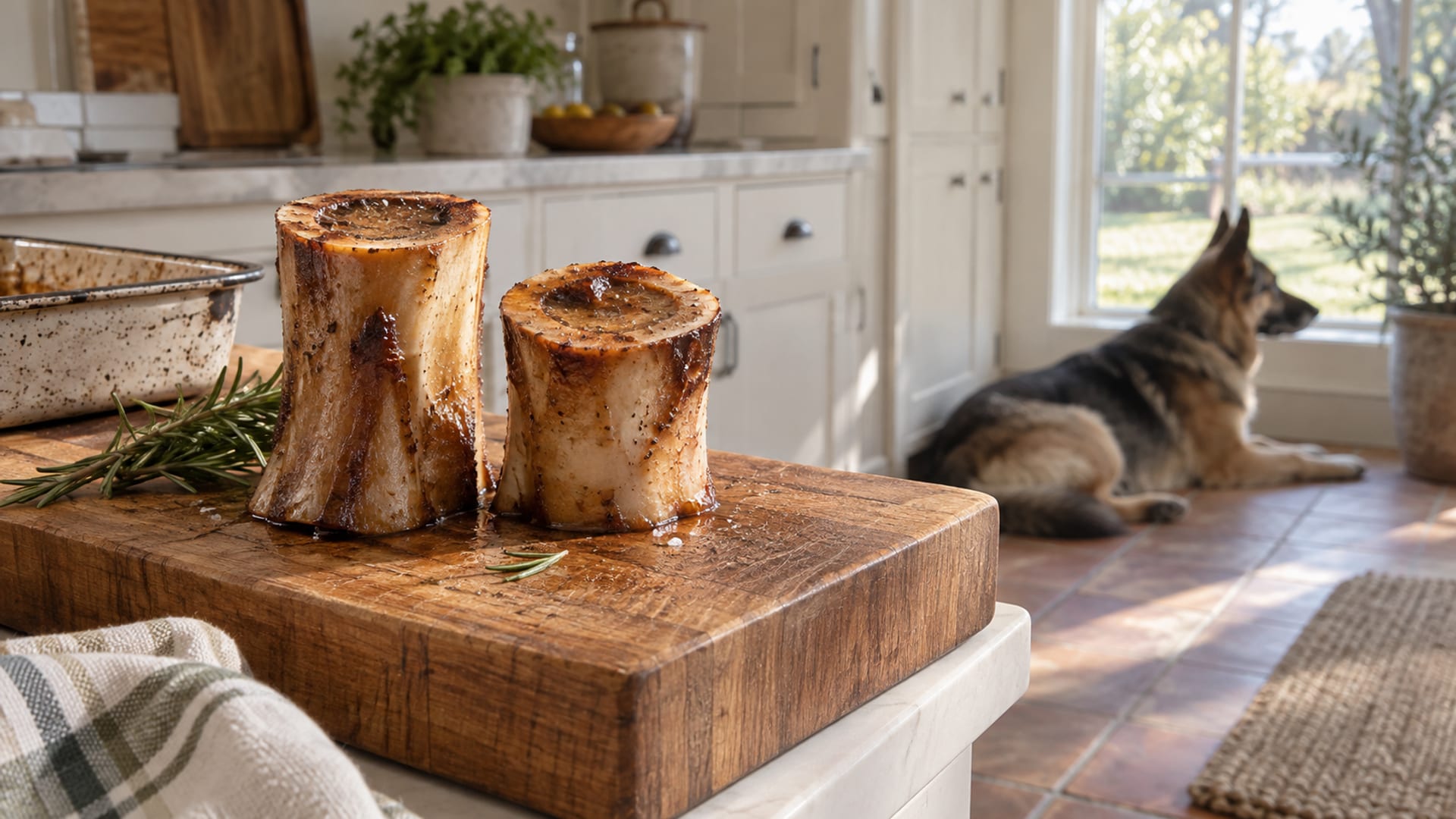
Cooked beef bones, no. Once a marrow, knuckle, rib or soup bone has been roasted, boiled, grilled, smoked or dried, it turns brittle and can break into sharp pieces, and VCA Animal Hospitals puts it in capitals: never feed cooked bones to pets. Raw beef bones are a caution item. Vets disagree about them, and a raw bone can still break a tooth, lodge in the throat, block the gut or carry bacteria.
If your dog has already swallowed some of a beef bone, call your vet today, even if they seem fine. The American Kennel Club advises a call or an appointment after any cooked bone so serious problems can be ruled out. Choking, trouble breathing or repeated gagging means go to an emergency vet now.
Key takeaways
Tap a card to bring it forward.
- Cooked, smoked, roasted, grilled, fried and dried beef bones can splinter. Keep them away from your dog.
- Raw beef bones are not risk-free: broken teeth, choking, blockage and bacteria are all possible.
- A swallowed piece of beef bone is a reason to call your vet today, signs or no signs.
- Choking, gagging, heavy drooling, repeated vomiting, belly pain or no stool means emergency care.
- Store-bought smoked knuckles and marrow bones have been cooked, so treat them like table bones.
Your dog already ate a beef bone: the next hour
What you do next depends on what went down and how your dog is acting right now.
Tap or hover a row to highlight it.
| What happened | What to do |
|---|---|
| What happenedChoking, pawing at the mouth, gagging, trouble breathing | What to doEmergency vet now. |
| What happenedSwallowed a piece of a cooked, smoked or store-bought bone | What to doCall your vet today, even if your dog looks normal. |
| What happenedSwallowed a chunk or the whole of a raw bone | What to doCall your vet today for advice. |
| What happenedChewed a raw bone, nothing seems missing, acting normal | What to doCheck the bone and your dog's mouth, then watch for the signs below. |
| What happenedThe bone had rub, sauce, onion or garlic on it | What to doCall, and tell the vet what the seasoning was. |
Before you call, gather four things: your dog's weight, whether the bone was raw, cooked, smoked or a packaged treat, roughly how much is missing, and when it happened. Keep the packaging if it came from a store. Holding off on home remedies until you have talked to the vet is the safe course.
The Merck Veterinary Manual says a dog with repeated vomiting, a tender belly or bowel movements that have stopped needs a veterinarian immediately. The vet may examine your dog and take X-rays, then decide between watching at home, removing the piece with a scope, a hospital stay or surgery.
Raw and cooked beef bones, form by form
Tap or hover a row to highlight it.
| Form | Verdict | Main problem |
|---|---|---|
| FormRaw marrow, knuckle, shank, femur, oxtail, rib or soup bone | VerdictCaution | Main problemBroken teeth, choking, blockage, bacteria |
| FormLeftover cooked bone (roast, stew, soup, steak, short rib) | VerdictAvoid | Main problemSplinters into sharp pieces |
| FormGrilled, barbecued or smoked bone | VerdictAvoid | Main problemCooked bone, often with salt, rub or sauce |
| FormPackaged smoked or roasted knuckle, femur or marrow bone | VerdictAvoid unless your vet says otherwise | Main problemHeat processed, hard, can still break and be swallowed |
| FormDried or dehydrated beef bone | VerdictCaution to avoid | Main problemHard enough to crack teeth, pieces can be swallowed |
| FormMarrow and fatty meat left on the bone | VerdictCaution | Main problemRich fat can upset the stomach and trigger pancreatitis in some dogs |
Cooking changes the bone. It makes it brittle and likely to splinter, and VCA lists what those pieces can do: choke a dog, cut the mouth, lodge in the esophagus, block the stomach or intestines, cause painful constipation or punch a hole in the gut. A hole lets gut contents leak into the belly, and VCA notes that the infection that follows can be fatal even with aggressive treatment.
A raw bone avoids the brittleness, but it keeps the other problems. Raw meat and bones may carry Salmonella, E. coli and Listeria, according to the FDA, and a dog can shed Salmonella in its stool while looking perfectly healthy. That puts children, pregnant people, older adults and anyone with a weak immune system in the house at risk too.
Why vets disagree about raw beef bones
The split is real, and it helps to see both sides before you decide anything.
- Some vets suggest raw meaty bones. The AKC reports that view and, for owners who go ahead, suggests a bone larger than the dog's muzzle, close supervision, and putting the bone in the fridge after 10 to 15 minutes. The same article describes the opposite view that dogs should get no bones at all, raw or cooked.
- Others advise against every bone. An emergency vet writing for VCA recommends against raw and cooked bones alike, and describes a dog that ended up in the clinic after one.
- The American Veterinary Medical Association discourages feeding dogs any animal protein that has not been through a process that kills germs, in its policy on raw and undercooked animal-source protein, because of the risk to pets and people.
- The dental evidence is narrow. A study in Beagles found that chewing on autoclaved beef bones reduced tartar in a controlled setting. It used sterilized bones in adult dogs, so it does not show that a raw bone from the butcher is safe dental care, and hard bones can still fracture teeth.
The cautious answer, then: skip cooked and processed beef bones entirely, and treat a raw bone as a decision to make with your own vet. The AKC's tips lower some of the risk. Size and supervision cannot stop a tooth from cracking or bacteria from spreading.
Signs to watch for after a beef bone
Tap or hover a row to highlight it.
| When | What you may see | What it can mean |
|---|---|---|
| WhenRight away | What you may seeCoughing, gagging, drooling, swallowing again and again, bringing food back up, trouble breathing | What it can meanA piece stuck in the throat or esophagus |
| WhenLater, with no set timing | What you may seeVomiting, not eating, diarrhea, tiredness, a sore belly | What it can meanA piece stuck in the stomach or intestines |
| WhenLater still | What you may seeStraining to poop, only small amounts or none at all, blood | What it can meanFragments packed in the colon, or injury to the lining |
Bones are the most common thing that gets stuck in a dog's esophagus, according to Merck. Further down, the timing depends on where the piece stops, how long it stays there and whether it blocks the gut completely, so there is no set number of hours after which you are in the clear. In one case VCA describes, a dog started straining after eating a bone and began vomiting the next day.
Any of the signs in the table is a reason to call. The emergency ones are choking, breathing trouble, pale or blue gums, collapse and vomiting that keeps coming.
"My dog chewed beef bones for years and never had a problem"
That happens, and for that dog it is true. Plenty of dogs gnaw a bone for years and nothing goes wrong. It still does not make the next bone safe, for that dog or for another one.
Whether a bone causes trouble comes down to details that change every time. Did the dog only scrape at it, or swallow a chunk? Did it splinter into a sharp shard or wear down smoothly? Was it raw or roasted? Is this dog a tiny terrier or a mastiff? VCA notes that some swallowed objects pass without a problem while others get stuck, and nobody can tell in advance which one it will be. Merck adds that young large-breed dogs are more likely than older dogs to end up with a blockage.
Some problems also stay hidden. A blockage can take a day or more to show, and a dog can carry Salmonella from a raw bone without looking ill at all. Years of good luck are real, and they are also exactly that.
Dogs that need extra care around beef bones
- Small dogs. A bone that a big dog can only gnaw may fit whole in a small dog's mouth. VCA suggests that anyone who gives a bone despite the risks pick one about the size of the dog's head, and the AKC says larger than the muzzle. Those are rules of thumb from each source. Neither one prevents harm.
- Dogs with a history of pancreatitis or on a low-fat diet. Marrow and fatty trimmings are a lot of fat at once, and the AKC links too much dietary fat to pancreatitis.
- Puppies and sick dogs. The AKC notes that puppies are better off with cooked food, and that dogs with pancreatitis, cancer or other illness may need cooked food too. That is a reason to leave raw bones out for them.
- Homes with vulnerable people. Raw bones bring Salmonella risk into the kitchen and onto the floor, per the FDA.
- Cats in the same house. Cats can choke on or get blocked by bones as well, so keep scraps away from them too.
Cookouts, soup bones and look-alikes
Cookouts are when most beef bones go missing. The AKC's Fourth of July safety advice names cooked bones among the scraps dogs grab at barbecues, and VCA lists barbecue bones among the foods that cause bowel blockages. Keep the platter out of reach while you cook and serve, and put the bones in a trash can your dog cannot open.
- Soup bones. A bone simmered in soup is a cooked bone, whatever it was when it went into the pot.
- Bone broth. Strained broth with no fragments is a separate question, though salt, onion and garlic in it still matter.
- Bone meal. Garden bone meal is a fertilizer. Pet Poison Helpline says a large amount can block the gut or cause pancreatitis, so call if your dog got into a bag.
- Other bones. Steak bones and lamb bones follow similar rules, and pork is covered in pork bones and pork rib bones. For poultry, see chicken bones and turkey bones. The guide to bones for dogs covers all of them together.
Check what you learned
Quick check
Questions about dogs and beef bones
Are raw beef marrow bones safe for dogs?
They carry less splinter risk than cooked bones, but they are not reliably safe. Raw marrow bones are hard enough to break teeth, can be swallowed in chunks and may carry bacteria. Some vets use them and others advise against all bones, so ask your own vet first.
Can beef bones clean a dog's teeth?
One controlled study in Beagles found less tartar after chewing sterilized beef bones. That result does not cover raw kitchen bones, and a hard bone can crack a tooth. Ask your vet about safer ways to keep teeth clean.
Can a beef bone cause constipation days later?
Yes. VCA explains that bone fragments can collect in the colon, causing painful constipation and scraping the colon and rectum. Straining with little or no stool after a bone is a reason to call.
Can puppies have beef bones?
The cautious answer is no. Cooked bones are off the list for every dog, and the AKC says puppies do better on cooked food, which leaves raw bones out as well. Ask your vet which chew suits your puppy.
My dog only licked the marrow out. Is that a problem?
Usually the bigger worry is the bone itself, so check that it is still whole. Marrow is very rich, though, and a lot of it can upset the stomach or bring on pancreatitis in a dog prone to it. Call your vet if vomiting, diarrhea or a sore belly follows.
Oxtail has its own page: can dogs eat oxtail.
Sources
Checked September 24, 2026.
- VCA Animal Hospitals, Why Bones Are Not Safe for Dogs
- VCA Animal Hospitals, Are Bones Your Dog's Most Dangerous Treat?
- VCA Animal Hospitals, Ingestion of Foreign Bodies in Dogs
- VCA Animal Hospitals, Top Five BBQ Foods That Cause Bowel Obstructions in Dogs
- American Kennel Club, Can Dogs Eat Bones? Be Careful Before Giving Your Pup a Bone
- American Kennel Club, How to Keep Your Dog Safe on July Fourth
- Merck Veterinary Manual, Esophageal Foreign Bodies in Small Animals
- Merck Veterinary Manual, Minor Injuries and Accidents
- U.S. Food and Drug Administration, Think Food Safety and Be Salmonella Safe
- American Veterinary Medical Association, Revised Policy on Raw or Undercooked Animal-Source Protein in Cat and Dog Diets
- Pinto and others, PLOS One, Evaluation of teeth injuries in Beagle dogs caused by autoclaved beef bones used as a chewing item to remove dental calculus
- Pet Poison Helpline, Bone Meal and Blood Meal