
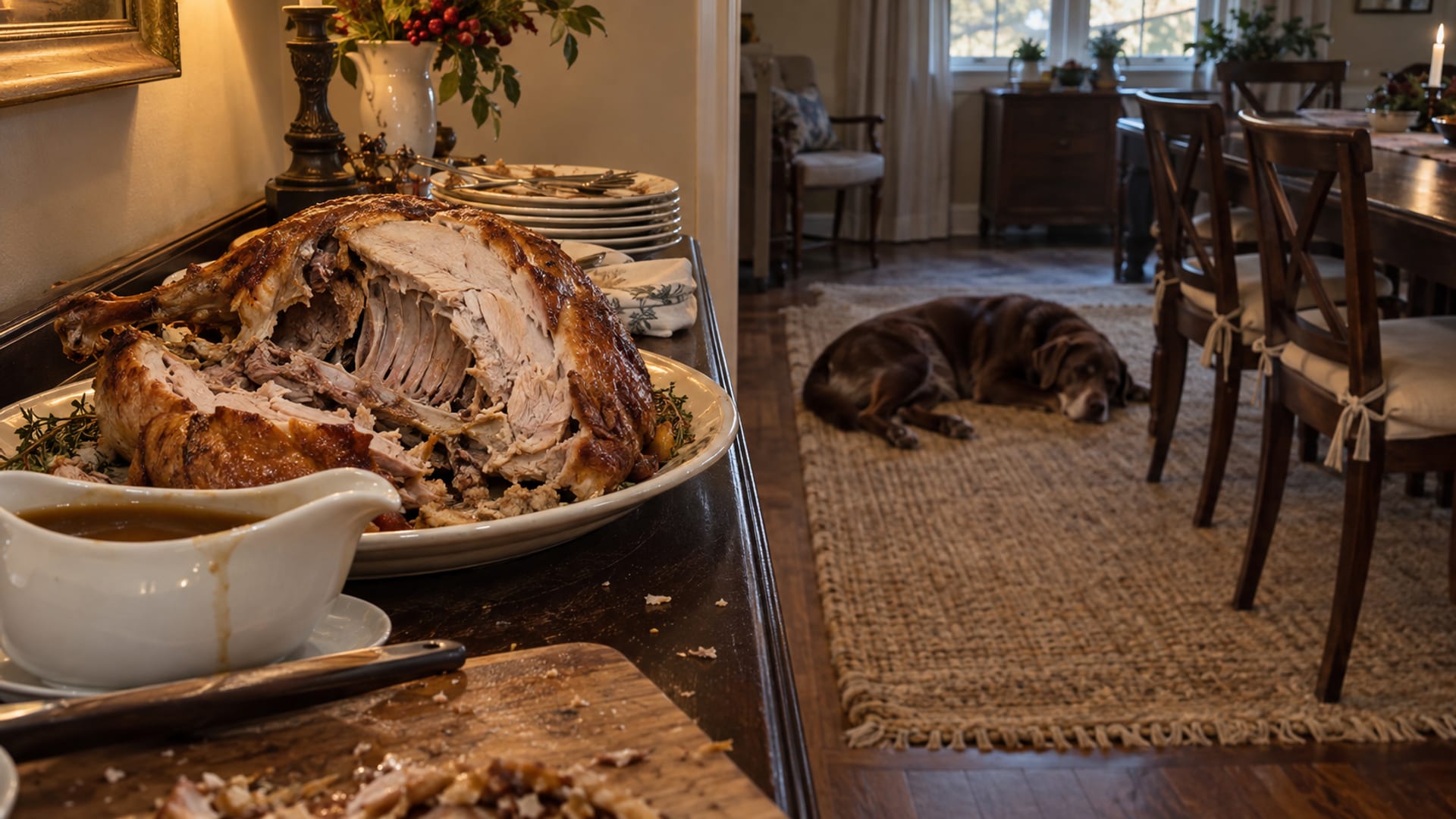
No. Cooked turkey bones are brittle, and the American Kennel Club warns they can cause choking, mouth injuries, blockages in the throat or intestines, tears in the gut, constipation and rectal bleeding, sometimes bad enough to need emergency surgery. Raw turkey bones are less brittle but still carry choking, tooth and bacteria risks.
If your dog swallowed a turkey bone or a big piece of one, call your vet now for advice, especially if it was cooked. Waiting for signs gives a blockage or a tear time to get worse. Choking, gagging or trouble breathing means an emergency clinic right away.
Key takeaways
Tap a card to bring it forward.
- Cooked turkey bones, from the carcass, wings, legs or neck, are brittle. Keep every one away from your dog.
- Raw turkey necks and bones splinter less but can still choke, break teeth and carry Salmonella.
- After a swallowed bone, call your vet. Do not induce vomiting or try home remedies.
- Signs of a blockage can take hours to days: vomiting, not eating, belly pain, straining.
- Skin, drippings, gravy and stuffing bring their own fat, salt, onion and garlic problems.
Your dog got into the turkey: what to do first
- Clear the counter and the trash. Holiday carcasses, roasting pans and platters usually hold more bones.
- Check breathing. Gagging, choking, coughing, drooling heavily or trying to swallow over and over can mean a bone is stuck high up. Go to an emergency clinic.
- Call your vet if you saw a cooked bone go down, or you cannot tell how big the piece was. For a raw bone, call if it was swallowed rather than just chewed, if the bone was big for your dog, or if any signs show up.
- Hold off on home fixes. No vomiting, no hydrogen peroxide, no bread or oil unless your vet directs it.
- Tell the vet what else was on the plate: skin, gravy, stuffing, onion, garlic, butter or brine.
A vet may check your dog's mouth and belly and use X-rays or ultrasound to find the bone. Merck Veterinary Manual notes that once a swallowed object is found, removing it with a scope or surgery is often advised, because it can block or perforate the gut.
Cooked and raw turkey bones, part by part
Tap or hover a row to highlight it.
| Form | Verdict | What to know |
|---|---|---|
| FormRoasted, baked or fried turkey bones and carcass | VerdictAvoid | What to knowBrittle; can splinter, choke, block or tear the gut |
| FormSmoked turkey leg bone | VerdictAvoid | What to knowCooked bone, usually salty and seasoned |
| FormWing, leg, neck or back bones from cooked turkey | VerdictAvoid | What to knowSame brittle cooked bone |
| FormRaw turkey neck, wing or back | VerdictCaution; ask your vet | What to knowSplinters less, but still choking, tooth and bacteria risks |
| FormDried or dehydrated turkey bones | VerdictAvoid | What to knowHard processed bone; no record of being safer than raw |
| FormPlain boneless cooked turkey meat | VerdictA little is fine | What to knowLean, fully cooked, no bones or seasoning |
The ASPCA says any turkey you share should be boneless and fully cooked, and calls poultry bones a major choking hazard. It also warns that raw or undercooked turkey can carry Salmonella.
Signs to watch after the holiday meal
Stuck high up, in the mouth, throat or esophagus: heavy drooling, gagging, trouble swallowing, bringing food back up, swallowing again and again, coughing or choking.
Further down, in the stomach or intestines: loss of appetite, vomiting, diarrhea, tiredness, belly pain or swelling, and in serious cases dehydration or shock. These can start hours to days after the meal, depending on where the piece lodges and whether it blocks the gut partly or fully.
Near the end of the gut: constipation, straining without passing anything, pain when trying to poop, or blood from the rectum. Merck describes poorly digested bone mixed with stool as one cause of this kind of blockage.
Call your vet for any of these. Blood in vomit or stool, a swollen belly, weakness, collapse or being unable to keep water down need care right away.
Young dogs are more likely to end up with a blockage from something they swallowed, and Merck says this is especially true of young large-breed dogs. Tiny dogs can be blocked by very small pieces. Dogs that eat anything they find are at higher risk simply because they swallow more.
Raw turkey necks and the raw-bone debate
Raw turkey necks come up a lot in raw feeding. The AKC notes that some owners use raw meaty bones such as turkey necks, and recommends talking through the risks and benefits with your vet. The World Small Animal Veterinary Association lists the risks of bones in raw diets as damage to the mouth and gut, blockages, broken teeth, constipation and perforation.
The germ side matters for your household as well as your dog. The FDA found Salmonella in 15 and Listeria monocytogenes in 32 of 196 raw pet food samples it tested, and says pets can carry and spread these bacteria without looking sick. Pregnant people, young children, older adults and anyone with a weak immune system are the most vulnerable.
People who favor raw bones sometimes point to small studies. One gave raw beef bones to eight adult Beagles for 12 or 20 days and saw less tartar with no broken teeth or blockages. That was beef, eight dogs and a few weeks, so it says nothing about turkey bones in a household dog over years. The cautious answer is to skip cooked turkey bones entirely and treat raw ones as a decision for you and your vet, with the risks on the table.
"Our dog always gets the turkey carcass"
Some families have done it for years, and that dog may never have had a problem. The good outcome is real. It came down to things that change every time: how much bone was actually swallowed and how much was just chewed, how big and sharp the pieces were, the dog's size and age, and where each piece went. A fragment that slides through one year can lodge the next, and a dog can seem normal for a while before vomiting or pain starts. A dog can also carry Salmonella from raw turkey without ever looking ill. This year, the carcass goes in a sealed bag in an outside bin.
Turkey leftovers that come with the bone
- Skin, drippings and butter: high in fat. The AKC warns that fat from turkey skin, butter or oil can cause pancreatitis.
- Gravy and stuffing: often made with onion, garlic and salt. See Can dogs eat onions? if those were in the mix.
- Brined or smoked turkey: extra salt on top of the bone risk.
- Turkey bone broth: a liquid, so the bone risk only applies if fragments were left in. Check it for salt, onion and garlic.
- Turkey jerky, tendons and turkey-flavored chews: commercial treats, which may contain no bone at all. Read the label.
Pet Poison Helpline lists turkey, ham and chicken bones left after carving among the holiday leftovers that tempt dogs, and warns they can break teeth, tear or block the intestines and carry bacteria. For bones from other animals, start at Can dogs eat bones?
Check what you learned
Quick check
Questions about dogs and turkey bones
Is a cooked turkey bone poisonous to dogs?
It has no poison in it. The danger is physical: a brittle bone can splinter, choke a dog, block the gut or cause a tear. Call your vet if your dog swallowed a bone or a piece of one.
Can dogs eat raw turkey necks?
They are not automatically safe. Raw necks contain bone, which can choke or block, and raw turkey can carry bacteria. Talk it over with your vet before giving one.
My dog ate a turkey bone and seems fine. Should I wait?
Call your vet anyway. Looking normal does not mean the bone has passed, and signs can depend on where it lodges and how long it stays there. Get urgent care for gagging, repeated vomiting, pain, tiredness, blood or straining.
Can I give my dog the bone from a smoked turkey leg?
No. It is a cooked bone, and smoked turkey legs usually carry a lot of salt, fat and seasoning as well.
Are turkey bones worse than chicken bones?
Both are cooked poultry bones that turn brittle and splinter, and the advice is the same for both. See Can dogs eat chicken bones? for the chicken version.
Should cats get turkey bones?
No. Cats face the same choking and blockage risks, and the ASPCA's holiday advice covers both cats and dogs.
Seasoning greens with smoked necks? See smoked turkey necks.
Sources
Checked September 24, 2026.
- American Kennel Club, Can Dogs Eat Turkey? Holiday Safety Tips for Pet Owners
- ASPCA Animal Poison Control, Thanksgiving Safety Tips
- Merck Veterinary Manual, Gastrointestinal Obstruction in Small Animals
- Merck Veterinary Manual, Constipation, Obstipation, and Megacolon in Small Animals
- World Small Animal Veterinary Association, Frequently Asked Questions and Myths
- U.S. Food and Drug Administration, Get the Facts! Raw Pet Food Diets Can Be Dangerous to You and Your Pet
- Australian Veterinary Journal, Raw beef bones as chewing items to reduce dental calculus in Beagle dogs, 2016
- Pet Poison Helpline, Holiday Party Dangers