

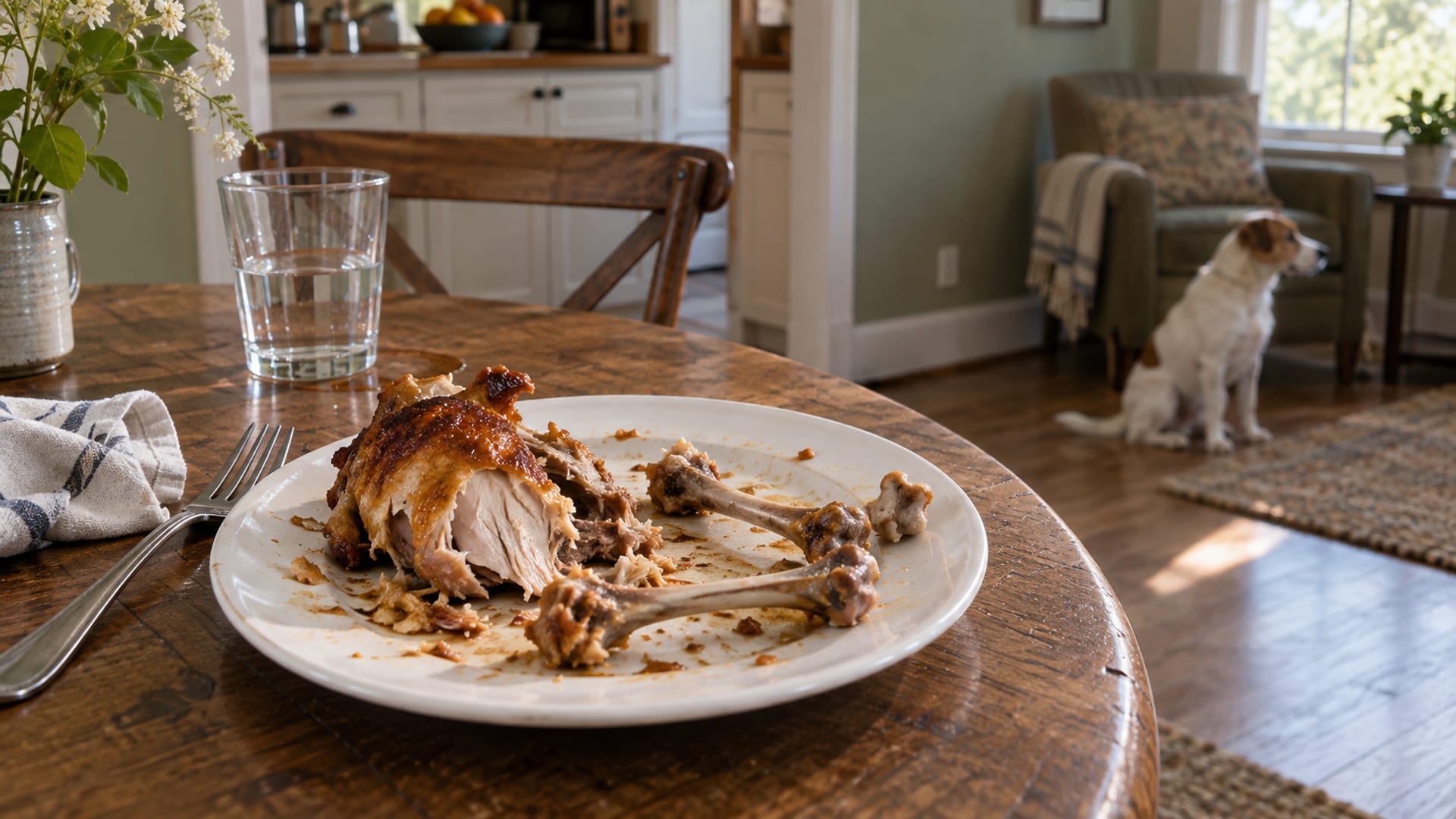
No. The American Kennel Club says plainly that chicken bones aren't safe for dogs. Cooked chicken bones are brittle and snap into sharp splinters that can choke a dog or puncture the digestive tract. Raw chicken bones break less easily, but they can still lodge in the throat and carry bacteria.
If your dog just ate a chicken bone, first make sure they are breathing normally and not choking. Then call your vet for guidance, and keep a close eye on your dog over the next few days. Do not try to make them vomit.
Key takeaways
Tap a card to bring it forward.
- Cooked chicken bones, from wings to rotisserie carcasses, splinter easily. Never share them.
- Raw chicken bones splinter less but can still choke a dog and carry Salmonella.
- Choking, gagging or trouble breathing means an emergency clinic now.
- After a swallowed bone, call your vet. Making a dog vomit can drag sharp pieces back up.
- Watch for vomiting, belly pain, straining or bloody stool for several days.
My dog ate a chicken bone: the first few minutes
The AKC's advice is to stay calm, check for immediate danger, call your vet, and watch closely for complications. In practice:
- Get the rest out of reach. Carcasses, wing baskets and trash bags tend to hold more than one bone.
- Look for choking. Pawing at the mouth, gagging, retching, drooling heavily or struggling to breathe means go to an emergency clinic right away.
- Leave the vomiting alone. The AKC warns that sharp fragments can cause more injury coming back up.
- Call your vet with the details: raw or cooked, how many bones or pieces, which part of the chicken, when, your dog's weight, and whether there was skin, breading, sauce or seasoning.
- Watch for days, not hours. Some pieces pass in about 72 hours, according to the AKC, though timing varies from dog to dog.
Your vet may examine your dog and take X-rays, then decide whether watching at home is enough or whether the bone needs to come out with a scope or surgery.
Raw and cooked chicken bones compared
Tap or hover a row to highlight it.
| Cooked chicken bones | Raw chicken bones | |
|---|---|---|
| Examples | Cooked chicken bonesRotisserie, roasted, fried, grilled, smoked, boiled, barbecue, wings, drumsticks | Raw chicken bonesRaw necks, backs, wings, drumsticks, carcass, raw bone-in chicken |
| Splintering | Cooked chicken bonesBrittle; splinter easily | Raw chicken bonesLess likely to splinter |
| Choking and blockage | Cooked chicken bonesYes | Raw chicken bonesYes |
| Bacteria | Cooked chicken bonesMostly killed by cooking | Raw chicken bonesSalmonella and Listeria possible |
| Extras to check | Cooked chicken bonesSkin, grease, breading, salt, onion or garlic in the seasoning | Raw chicken bonesHandling and cleanup, since germs spread to hands and counters |
| Verdict | Cooked chicken bonesNever | Raw chicken bonesNot recommended; ask your vet |
Dehydrated or freeze-dried chicken bones have no separate safety record. Treat them with the same caution as raw bones and do not assume drying makes them softer or safer.
Boneless chicken is a separate question. The AKC's chicken guide says plain, unseasoned, boneless chicken that has been roasted, poached, grilled or baked is fine to share. The same guide warns that cooked chicken bones splinter easily and can cause choking or puncture the gut.
Signs to watch for over the next few days
While a bone is in the mouth, throat or esophagus: drooling, gagging, trouble swallowing, bringing food back up, swallowing over and over, coughing or choking. Merck Veterinary Manual lists these as the signs of something stuck in the esophagus, and names bones as the most common culprit.
Once a piece moves into the stomach or intestines: vomiting, refusing food, tiredness, a swollen or painful belly, constipation or straining, and bloody stool. Any of these is a reason to call your vet the same day.
The worst outcomes are rare but serious. In a study of 125 dogs with something stuck in the esophagus, 15 developed a tear or hole there, and 5 of those tears involved bones. Dogs whose bone caused a hole had gone longer before seeing a vet: a median of 96 hours from eating the bone, against 24 hours for dogs without one. That gap is the reason to call early instead of waiting to see.
Why sources differ on raw chicken bones
On cooked chicken bones, the sources agree: do not give them. The disagreement is over raw bones and over what happens after a bone is swallowed.
The AKC calls raw bones less likely to splinter, while still warning about choking and bacteria. The FDA warns that raw poultry can carry Salmonella and that dogs and cats can shed it in their feces without looking sick, which puts the people who clean up after them at risk too.
After a bone is swallowed, not every case needs surgery. In a review of dogs treated for swallowed bones, vets chose to let 62 of 84 bones in the stomach digest on their own, about 74%. That choice came after a vet examined the dog and saw where the bone was. It supports calling your vet early, because the vet is the one who can safely say "wait."
The cautious answer: no chicken bones, raw or cooked, on purpose. If one goes down, call your vet promptly, and get emergency help for choking or any sign of illness.
"My dog has eaten chicken bones for years"
That happens, and plenty of dogs have gotten away with it. A bone that passes cleanly is a real outcome. It depends on things you cannot see from the dinner table: the size and shape of the piece, how many fragments there were, how the dog chewed, and where the pieces ended up. The same study that tracked esophageal tears found no link between a dog's body weight and the risk of a tear, so a big dog is not protected by size. Last time went well for that dog with that bone, and the next bone is a new roll of the dice.
Wings, rotisserie chickens and other chicken forms
- Rotisserie chicken carcass: cooked, often salted and seasoned. A carcass in the trash is one of the most common ways dogs get chicken bones.
- Wings and drumsticks from takeout: cooked bones plus breading, grease and sauce. Tell your vet what was on them.
- Chicken necks and backs sold for raw feeding: raw bone, with the bacteria risk above.
- Chicken meal and chicken by-product meal in dog food: ingredients in a formulated food. They carry none of the risks of a whole bone.
- Chicken bone broth: a liquid. It only matters here if bone fragments were left in it.
- Chicken-flavored chews: a manufactured product. Check what it is made of.
More on bones in general, including beef, pork and turkey, is in Can dogs eat bones?
Check what you learned
Quick check
Questions about dogs and chicken bones
What happens if a dog eats a cooked chicken bone?
Often the bone passes, but it can splinter and lodge in the throat, block the intestines or puncture the digestive tract. Call your vet for advice and watch for gagging, vomiting, belly pain, straining or bloody stool.
Can dogs eat raw chicken bones?
They splinter less than cooked ones, but they can still choke a dog and expose your dog and household to bacteria. Ask your vet before giving one.
How long does it take a dog to pass a chicken bone?
Some fragments pass in about 72 hours, according to the AKC. Timing varies, and a normal-looking dog can still have a piece stuck, so follow your vet's advice on how long to watch.
Should I give my dog bread after eating a chicken bone?
Only if your vet tells you to. The sources here advise against home remedies and against inducing vomiting. Call first.
Are chicken necks safe for dogs?
Raw chicken necks contain bone, so they carry the choking, blockage and bacteria risks of any raw bone. They are sold for raw feeding, which is a choice to make with your vet.
When is a chicken bone an emergency?
Choking, trouble breathing, repeated gagging, being unable to swallow, collapse or severe distress. Go to an emergency clinic for any of those.
Sources
Checked September 24, 2026.
- American Kennel Club, What to Do if Your Dog Ate Chicken Bones
- American Kennel Club, Can Dogs Eat Chicken?
- Merck Veterinary Manual, Esophageal Foreign Bodies in Small Animals
- U.S. Food and Drug Administration, Think Food Safety and Be Salmonella Safe
- Thompson and others, Likelihood and outcome of esophageal perforation secondary to esophageal foreign body in dogs, Journal of the American Veterinary Medical Association
- Doran and others, Outcomes of esophageal and gastric bone foreign bodies in dogs, Journal of Veterinary Internal Medicine