
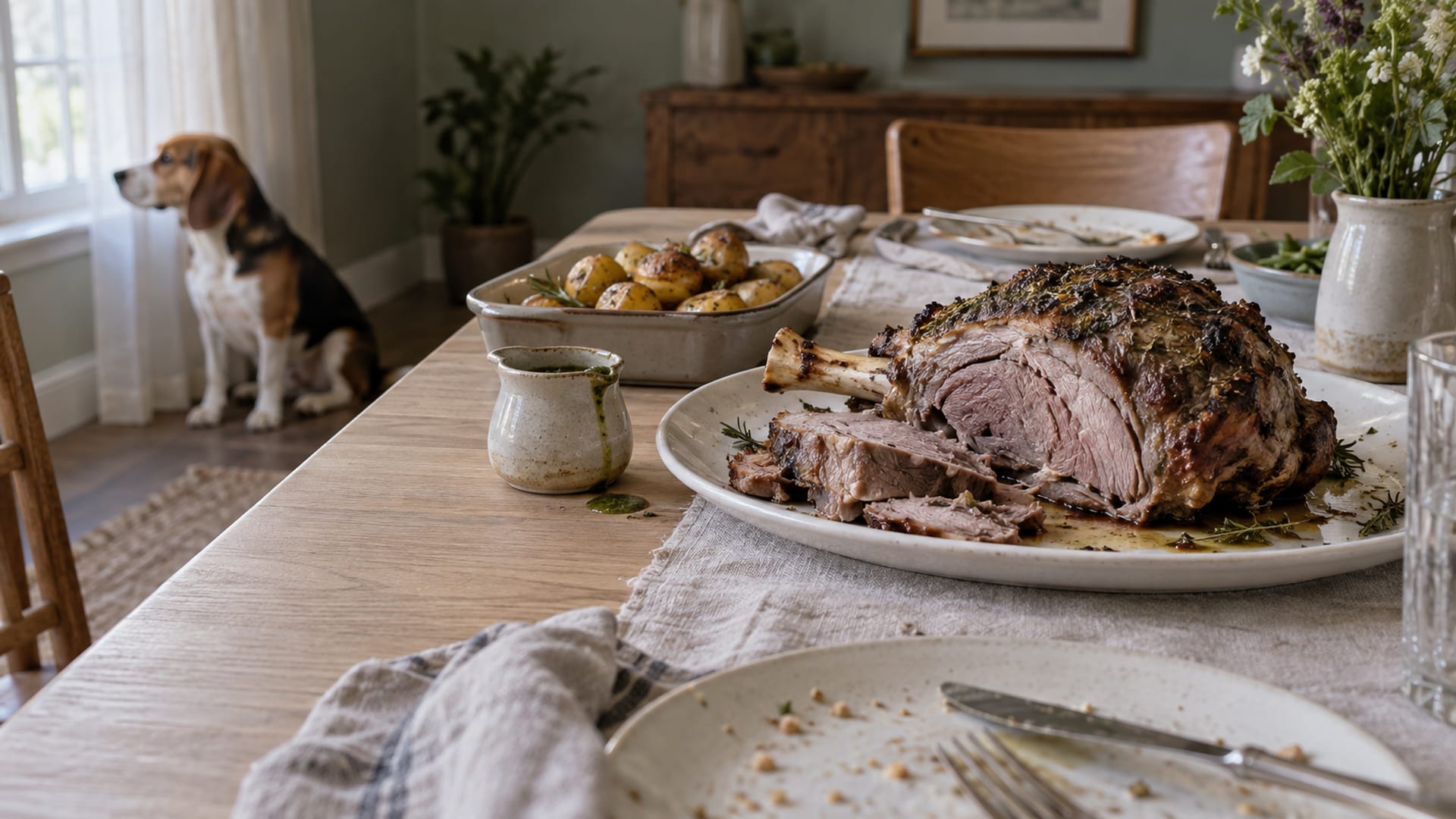
Keep cooked lamb bones away from your dog. The bone from a chop, a rack, a roast leg or a braised shank turns brittle in the heat, and the American Kennel Club says cooked bones splinter into shards that can choke a dog or badly damage the mouth, throat or intestines. Raw lamb bones are a caution item: the ASPCA warns that raw or undercooked bones can injure or block the digestive tract, sometimes badly enough to need surgery.
Did your dog already get one? For a cooked lamb bone, or any piece of a raw one that went down whole, phone your vet promptly for advice, even if your dog seems fine. If your dog is choking or struggling to breathe, head to an emergency clinic now.
Key takeaways
Tap a card to bring it forward.
- Cooked lamb bones, whether roasted, grilled, braised, smoked or fried, can splinter into sharp pieces.
- Raw lamb bones splinter less, yet they can still choke a dog, crack a tooth, block the gut or carry bacteria.
- Small chop and rib bones are easy to swallow whole; leg, shank and marrow bones are very hard on teeth.
- After a cooked lamb bone, call your vet even if your dog is acting normal.
- Fat, drippings and marrow on the bone add a pancreatitis risk for dogs prone to it.
First steps if your dog got a lamb bone
- Check the airway first. Choking, repeated gagging, pawing at the mouth or labored breathing is an emergency. Go to the nearest emergency vet. Do not reach blindly down the throat to fish it out.
- Work out what is missing. Was it a small chop bone or a big leg bone? Raw or cooked? Whole, or chewed into pieces? Was it seasoned, sauced or covered in drippings?
- Call your vet. The AKC's advice after any cooked bone is to call your veterinarian for advice or book a visit so serious problems can be ruled out. Do the same for a raw bone that was swallowed whole or in several pieces, or if you are unsure what went down.
- Hold off on home fixes. Hydrogen peroxide, medicine and food-based remedies can wait until a vet tells you to use them.
- Keep watching for the signs listed further down, and call again if anything changes.
The vet may look in the mouth, feel the belly and take images. Cornell University's College of Veterinary Medicine explains that a stuck object may need an endoscope or surgery to remove it, and that a section of damaged intestine sometimes has to be taken out.
Lamb bones cut by cut, raw and cooked
Tap or hover a row to highlight it.
| Cut | Raw | Cooked | What to know |
|---|---|---|---|
| CutChop or rib bone (rack of lamb) | RawCaution | CookedAvoid | What to knowSmall enough for many dogs to swallow whole |
| CutLeg or shoulder bone | RawCaution | CookedAvoid | What to knowLarge and very hard; can break teeth even raw |
| CutShank bone | RawCaution | CookedAvoid | What to knowVery hard; a cooked shank may carry fat and seasoning |
| CutNeck bone | RawCaution | CookedAvoid | What to knowCan be chewed apart and swallowed in chunks |
| CutMarrow bone | RawCaution | CookedAvoid | What to knowHard bone plus rich, fatty marrow |
| CutDried or packaged lamb bone chew | RawRead the label | CookedRead the label | What to knowStill a hard bone; may add salt, smoke flavor, onion or garlic |
| CutBoneless plain cooked lamb | RawA small taste is fine | CookedA small taste is fine | What to knowNo bone, no seasoning |
Every cooking method counts as cooked here. Boiling, roasting, grilling, smoking, barbecuing, slow cooking, frying, baking and pressure cooking all make the bone more brittle and prone to splintering, and the AKC and veterinary sources treat them the same way. The AKC's chief veterinarian, Jerry Klein, puts it simply in the club's cookout food guide: never give dogs cooked bones of any kind.
The meat is a separate question. The ASPCA's list of foods you can share includes small amounts of cooked meat with no bones and no seasoning. A few bites of plain roast lamb cut off the bone are a different thing from the bone itself.
Where the experts split on raw lamb bones
Two camps exist, and the AKC's article on steak bones describes both. Raw-feeding supporters say raw bones are digestible and less likely to splinter. The other view is that dogs should get no bones at all, raw or cooked, because the possible harm outweighs any benefit.
What raw does not fix:
- Mechanical harm. A raw bone can still be swallowed whole, lodge in the throat, block the gut or crack a tooth.
- Bacteria. The FDA says raw pet food is more likely to carry Salmonella and Listeria monocytogenes, which can sicken pets and the people who handle the food. When the FDA tested 196 raw pet food samples, 15 carried Salmonella and 32 carried Listeria. Those were commercial raw foods, not lamb bones, but the same germs can ride on any raw meat and bone.
- The household. Anyone who handles the bone, or the dog afterward, can pick up the same germs.
So, the cautious answer is to skip cooked lamb bones every time, and to talk to your vet before you ever hand over a raw one. Choosing raw lowers one risk, splintering, and leaves the rest in place.
Signs of trouble after a lamb bone
Tap or hover a row to highlight it.
| Where the problem is | Signs |
|---|---|
| Where the problem isMouth, throat or esophagus | SignsChoking, gagging, coughing, drooling, pawing at the mouth, trouble swallowing or breathing |
| Where the problem isStomach or intestines | SignsVomiting, not eating, tiredness, belly pain, diarrhea |
| Where the problem isColon and rectum | SignsStraining, hard dry stool, blood in the stool, no stool at all |
According to the Merck Veterinary Manual, bones are a known cause of constipation in dogs, with straining and firm, dry stool, and sometimes tiredness, poor appetite, vomiting and belly discomfort. There is no reliable clock for lamb bones. A piece can travel for a while before it lodges or scrapes, so a quiet first evening does not prove the bone passed safely.
Merck describes bones as foreign bodies that digest slowly and can block the gut anywhere from the esophagus to the colon, and a blockage can lead to perforation and shock. Get emergency care for choking, breathing trouble, retching that brings nothing up, vomiting that will not stop, a swollen or painful belly, weakness, collapse, blood in vomit or stool, or straining with nothing coming out.
"Our dogs always got the lamb bones after Sunday dinner"
Many families have done this for years, and the dogs were fine. That outcome is real. It is still luck of the draw more than a rule, and it does not carry over to the next bone or the next dog.
Here is what changes from one bone to the next:
- Whether it was swallowed. A dog that gnaws a leg bone for an afternoon is in a different spot from one that gulps a chop bone in two bites.
- How it breaks. Cooked bones splinter into shards, per the AKC. Raw ones are less likely to, though some still break sharp.
- The size of the dog. The AKC notes that big dogs can swallow relatively small bones whole, so size does not protect a large dog.
- How much went down. More pieces mean more chances for a blockage or constipation, and Merck lists bone mixed into stool as a cause of both.
- Timing. Signs can show up later, after the piece has moved further along.
None of these can be read from last year's dinner, which is why a clean record so far cannot promise the same result tonight.
Dogs at higher risk from lamb bones
- Small dogs and puppies. A chop bone is large compared with their throat and gut. Cornell advises keeping easily swallowed items, including small bones, away from dogs.
- Big dogs too. Size does not rule out swallowing a small bone whole, and a dog of any size can fracture a tooth on a hard leg or shank bone.
- Dogs with pancreatitis, high blood fats or a low-fat diet. Lamb fat, marrow and pan drippings are rich. The AKC links high-fat bones and fatty food to pancreatitis, so keep the scraps and the roasting pan out of reach.
- Cats. The ASPCA's warning about bones covers cats as well as dogs, and raw bones can pass germs to them too.
Roast dinners, grills and lamb look-alikes
Lamb shows up at spring holidays, Sunday roasts and backyard grills, and that is when bones go missing. The AKC suggests keeping bone-laden platters out of reach while you cook and serve, and keeping bones out of any trash can your dog can get into.
- Lamb bone broth is a different item from the bone. Strain out every fragment and watch the salt, onion and garlic.
- Bone meal is a ground garden or supplement product with risks of its own, so call your vet if your dog got into a bag.
- Nylon or rubber "bones" shaped like a lamb bone are toys, and whether one suits your dog depends on the product.
- Other bones. Beef follows the same raw versus cooked split, covered in beef bones and steak bones. Leftover ham bones and pork rib bones come from the same kind of holiday table. For every type in one place, see the dog bones guide.
Check what you learned
Quick check
Questions about dogs and lamb bones
Can my dog have a cooked lamb chop bone?
No. Cooked bones splinter into shards that can choke a dog or cut the mouth, throat or intestines, and a chop bone is also small enough to swallow whole.
Are raw lamb bones safe because they don't splinter?
Not reliably. The AKC says raw bones may splinter less than cooked ones, but the ASPCA warns they can still injure or obstruct the gut, and the FDA warns about bacteria in raw animal food. Ask your vet before offering one.
Can a dog break a tooth on a raw lamb leg bone?
Yes. The AKC notes that even raw bones harder than a tooth can fracture it. Leg, shank and marrow bones are among the hardest.
Can lamb fat or marrow give my dog pancreatitis?
It can be a concern, especially for a dog that has had pancreatitis before. The AKC lists high-fat bones and fatty foods as a pancreatitis risk. Keep fatty scraps, marrow and drippings off the menu.
Can my dog eat the lamb meat instead?
A small taste of plain cooked lamb with the bone, fat and seasoning removed is fine for most dogs, in line with the ASPCA's guidance on sharing cooked meat.
Sources
Checked September 24, 2026.
- American Kennel Club, Can Dogs Eat Bones? Be Careful Before Giving Your Pup a Bone
- American Kennel Club, Is It Safe for My Dog to Eat Steak Bones?
- American Kennel Club, Hazardous Cookout Foods for Dogs
- ASPCA Animal Poison Control Center, People Foods to Avoid Feeding Your Pets
- ASPCA, Sharing is Caring: Foods You Can Safely Share with Your Pet
- Cornell University College of Veterinary Medicine, Gastrointestinal Foreign Body Obstruction in Dogs
- U.S. Food and Drug Administration, Tips for Safe Handling of Pet Food and Treats
- U.S. Food and Drug Administration, Get the Facts! Raw Pet Food Diets can be Dangerous to You and Your Pet
- Merck Veterinary Manual, Disorders of the Stomach and Intestines in Dogs
- Merck Veterinary Manual, Gastrointestinal Obstruction in Small Animals