
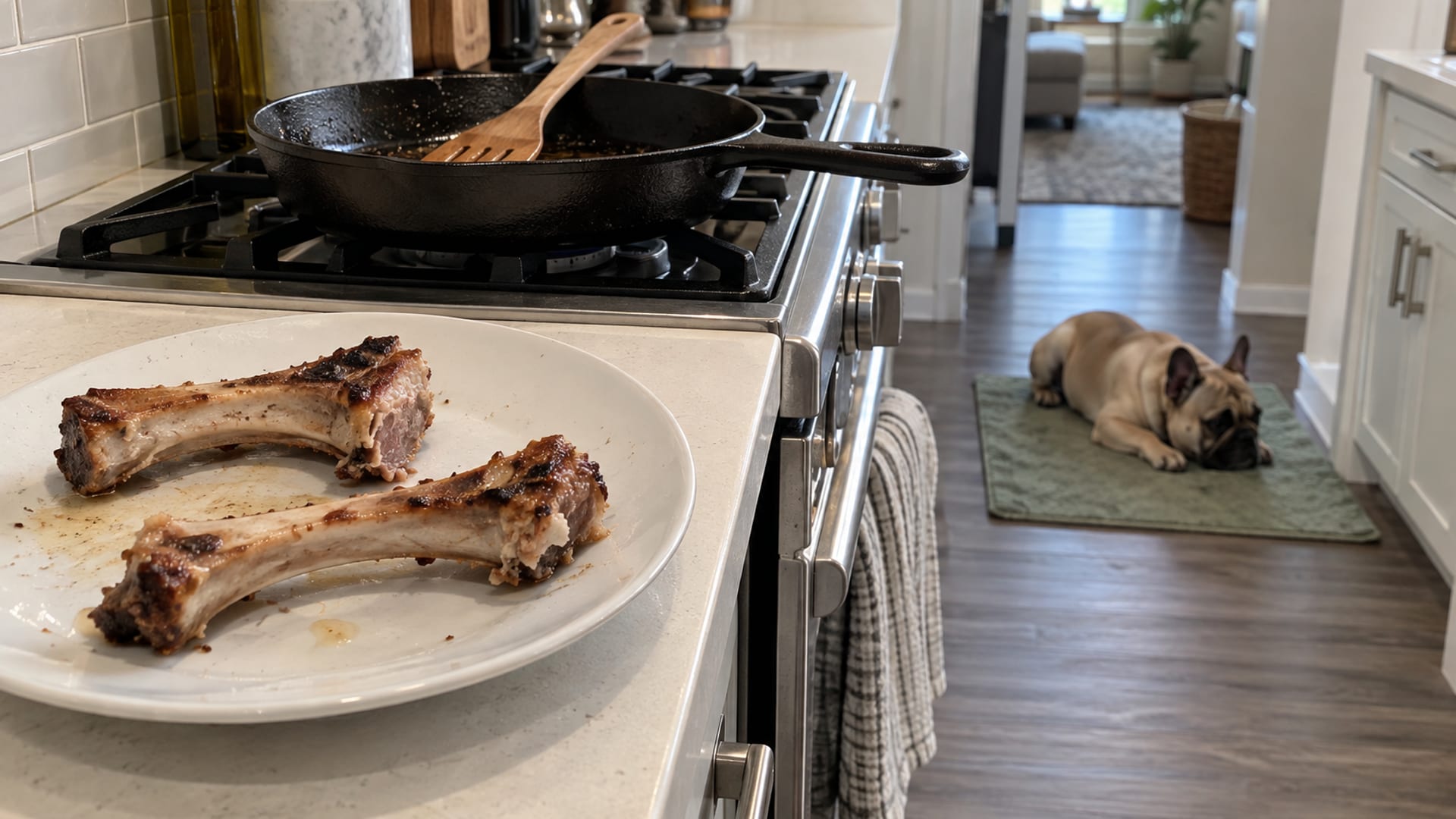
No. The American Kennel Club says pork bones, whether raw or cooked, are likely to splinter or crack, which can lead to choking, a blocked intestine, or damage to the esophagus or intestines. Cooked pork bones are the worst of the lot because cooking makes bone brittle.
If your dog swallowed a cooked pork bone, call your vet for advice now, even though your dog may look perfectly fine. The AKC's direction after a cooked bone is to call your vet or book a visit to rule out anything serious. If your dog is choking, gagging hard or struggling to breathe, go to an emergency clinic.
Key takeaways
Tap a card to bring it forward.
- Pork bones of every cut, raw or cooked, can splinter or crack. Keep them away from your dog.
- Cooked pork chop, shoulder, knuckle and roast bones are the most likely to break into shards.
- Raw pork bones can carry Salmonella, Listeria and E. coli, and they still choke and block.
- Fatty meat left on the bone can bring on pancreatitis in some dogs.
- After a swallowed bone, call your vet. Do not induce vomiting or pull at a stuck bone.
What to do if your dog already ate a pork bone
Tap or hover a row to highlight it.
| What happened | What to do |
|---|---|
| What happenedChoking, gagging, pawing at the mouth, trouble breathing | What to doEmergency clinic now |
| What happenedSwallowed a cooked pork bone or pieces of one | What to doCall your vet today, before signs start |
| What happenedSwallowed part of a raw pork bone | What to doCall your vet, especially for a small dog, a hard or broken bone, or an unknown amount |
| What happenedLicked or gnawed a bone and swallowed nothing you could see | What to doWatch closely, and call if any sign below appears |
| What happenedAte the fatty trimmings or drippings too | What to doMention the fat when you call; it adds a pancreatitis risk |
| What happenedAte barbecue, ham or seasoned leftovers | What to doTell your vet about the sauce, rub or cure, which may hold salt, onion or garlic |
VCA Animal Hospitals is clear that choking is an emergency needing immediate veterinary care. Do not try to pull a stuck bone out of the throat, and skip hydrogen peroxide, vomiting or medicine unless your vet tells you to.
Before you call, note which cut it was, raw or cooked, roughly how big, how many pieces, what time it happened, and your dog's weight. A vet may examine your dog and take X-rays, then remove the bone with a scope or surgery if it is lodged.
Raw pork bones and cooked pork bones
Tap or hover a row to highlight it.
| Cooked pork bones | Raw pork bones | |
|---|---|---|
| Cuts | Cooked pork bonesChop, shoulder, butt, neck, knuckle, pig feet, roast, ham hock | Raw pork bonesThe same cuts, uncooked |
| Cooking methods | Cooked pork bonesRoasted, grilled, smoked, braised, fried, pressure-cooked, barbecued | Raw pork bonesNone |
| Splintering | Cooked pork bonesBrittle; breaks into shards | Raw pork bonesLess brittle, but the AKC says pork bones still splinter and crack |
| Choking, blockage, broken teeth | Cooked pork bonesYes | Raw pork bonesYes |
| Germs | Cooked pork bonesMostly killed by cooking | Raw pork bonesSalmonella, Listeria and E. coli possible |
| Extras | Cooked pork bonesFat, drippings, sauces, rubs, salt | Raw pork bonesFat on the bone |
| Verdict | Cooked pork bonesNever | Raw pork bonesNot a treat to share |
Dried, smoked or freeze-dried pork bone chews are hard, processed bone. They carry the tooth, choking and blockage risks and have nothing showing they behave like a soft raw bone.
You may have read that a raw bone is fine if it is too big to swallow. The AKC applies that idea to large raw cow or bison bones, and in the same breath says no to pork bones. It does not turn into a safe size for a pork bone.
Signs that a pork bone is causing a problem
Straight away: choking, pawing at the mouth, gagging, drooling, labored breathing or obvious distress, when a piece lodges in the mouth, throat or esophagus.
Hours to days later: not eating, bringing food back up, vomiting, diarrhea, tiredness, a painful belly, straining to poop, bloody stool, or constipation when fragments collect in the colon. Merck Veterinary Manual notes that vomiting can be less obvious when the blockage sits further down the intestine, so a dog that is not vomiting can still be in trouble.
From the fat: vomiting, tiredness, diarrhea, loss of appetite, weakness and belly pain can also point to pancreatitis after fatty pork scraps.
The worst outcomes are a blocked airway, a tear in the esophagus or intestines, peritonitis, shock and surgery. VCA describes a bone that punctures the gut and causes peritonitis as potentially fatal.
Which dogs face more risk
Size and age both play a part. Merck says very small objects can block a small dog, and young dogs, particularly young large-breed dogs, are more likely to end up with a swallowed-object blockage. A 2025 study of dogs with upper gut blockages found small dogs made up most of the cases stuck in the esophagus, though it did not look at pork bones specifically.
For the fat, Merck's pancreatitis chapter reports that Miniature Schnauzers are overrepresented, with higher rates also reported in Yorkshire Terriers, Cocker Spaniels, Dachshunds and Poodles. Dogs with past pancreatitis, high blood fats or diabetes need extra care around fatty pork scraps.
"My dog has had pork bones before and nothing happened"
That can be true, and it happens a lot. VCA notes that many swallowed objects pass through without trouble, but not all of them. What decides it is the piece itself (a whole bone or a sliver, how sharp, how hard, cooked or raw), where it goes, whether it blocks the gut partly or fully, and the size of the dog. Fat and germs vary too: one fatty bite can pass unnoticed in one dog and bring on pancreatitis in another, and a dog can carry Salmonella from raw pork without looking ill. A quiet night after the last bone was a good result, and it still leaves the next bone a gamble.
Pork bones, ham bones, ribs and other pork chews
- Pork rib bones: small, fatty and often covered in sauce. See Can dogs eat pork rib bones?
- Ham bones and ham hocks: cured or smoked pork bone, with extra salt and fat. See Can dogs eat ham bones?
- Pork meat without the bone: a small amount of plain, lean, fully cooked pork is a different question. See Can dogs eat pork?
- Pig ears, snouts and pork skin: pork chews, but not bones. Pig ears can carry raw-style germs, and pork rinds are fatty and salty.
- Pork bone broth: a liquid, so the bone risk only applies if fragments were swallowed.
- Bone meal: ground bone, often in fertilizer. Pet Poison Helpline notes that a large amount can clump into a blockage.
Cookouts and barbecues are the usual setting: VCA's summer safety guide names barbecued ribs and steaks among the bones dogs get hold of at outdoor meals. For every other kind of bone, see Can dogs eat bones?
Check what you learned
Quick check
Questions about dogs and pork bones
My dog ate a cooked pork chop bone. Should I worry?
Call your vet for advice. Cooked bones can shatter into shards, and the AKC recommends a call after a cooked bone even if your dog seems normal.
Can dogs eat raw pork bones?
Skip them. They are less brittle than cooked bones, but they can still crack, choke a dog, block the gut, break teeth and carry Salmonella, Listeria or E. coli.
What signs mean a pork bone may be stuck?
Repeated vomiting, not eating, tiredness, belly pain, drooling, gagging, straining to poop or trouble breathing. Any of these needs urgent veterinary attention.
Can I just wait for the bone to pass?
Some bones pass, and some block or pierce the gut. Your vet can decide whether watching at home is reasonable for your dog and that bone.
Can dogs have pig feet or pork knuckles?
They are pork bones too, often cooked, smoked or salted. The same advice applies: keep them from your dog, and call your vet if one was swallowed.
Two cuts have their own pages: pig feet and pork neck bones.
Sources
Checked September 24, 2026.
- American Kennel Club, Can Dogs Eat Pork Bones?
- VCA Animal Hospitals, Why Bones Are Not Safe for Dogs
- VCA Animal Hospitals, Summer Fun and Follies
- Merck Veterinary Manual, Gastrointestinal Obstruction in Small Animals
- Merck Veterinary Manual, Pancreatitis in Dogs and Cats
- Leung and others, Prevalence and characteristics of foreign body-induced upper gastrointestinal obstruction in dogs, 2025
- Pet Poison Helpline, Top 20 Toxic Titans, Part II