
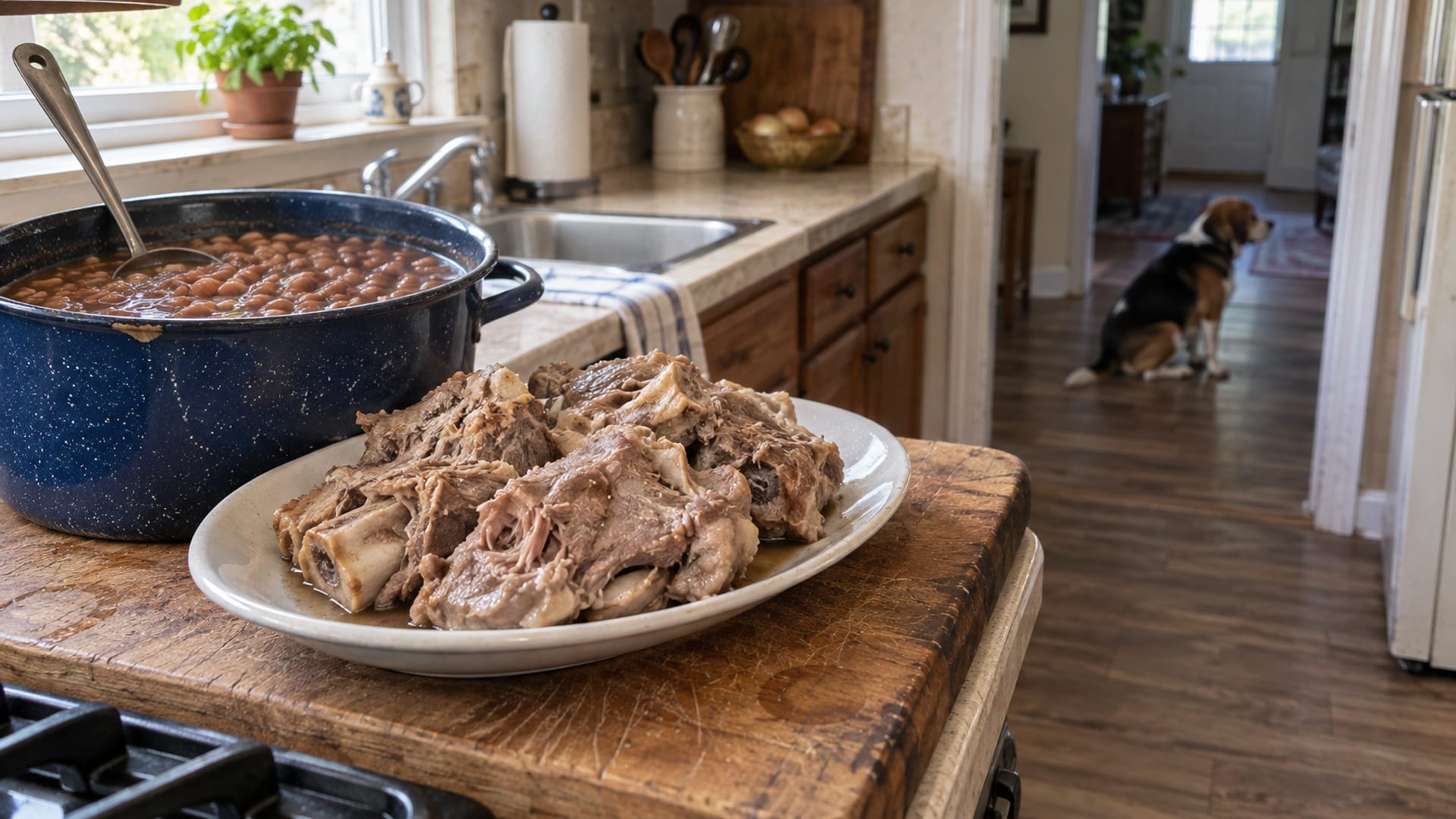
Keep pork neck bones away from your dog, the boiled ones from a pot of greens or beans and the raw ones from the meat case alike. The American Kennel Club says pork bones, raw or cooked, can splinter or crack, and a swallowed piece can choke a dog or damage or block the esophagus or intestines. The ASPCA warns that cooked bones in particular can splinter and seriously injure a dog.
If your dog already swallowed a neck bone or a chunk of one, call your vet today for advice, even if your dog looks completely normal. Head to an emergency clinic now for choking, trouble breathing, repeated retching or collapse.
Key takeaways
Tap a card to bring it forward.
- Boiled, smothered, smoked or fried, a cooked pork neck bone can splinter into sharp pieces.
- Raw neck bones still crack, choke and block, and raw pork can carry Salmonella, Listeria and E. coli.
- Neck bones are short, knobby vertebrae, and a big dog may swallow one whole.
- The fatty meat, skin and pot liquor are their own concern: fat, salt, and sometimes onion or garlic.
- A dog that looks fine after a neck bone can still get sick later. Call your vet.
Your dog grabbed a neck bone: what to do now
- Get the rest out of reach. The pot, the plate, the bone bowl and the trash.
- Look for choking. Gagging, pawing at the mouth, drooling, trying to swallow again and again, or struggling to breathe means an emergency clinic right away.
- Call your vet. "If your dog does ingest cooked bones, give your veterinarian a call for advice or schedule an appointment to rule out any serious outcomes," the AKC advises. For a raw bone, call if a piece went down, you do not know how much, or your dog is small next to the bone.
- Have the answers ready. Pet Poison Helpline asks callers for the dog's weight, what and how much was eaten, when, and any signs so far. Add whether the bone was raw, boiled or smoked, and what was in the pot.
- Do not make your dog vomit. Pet Poison Helpline's general advice is not to try it on your own, and a sharp or stuck bone makes that call one for a professional.
- Keep an eye on your dog for days, not just tonight.
A vet may examine your dog and take X-rays. Merck Veterinary Manual describes removing a swallowed object with a scope, with a small keyhole surgery or with open surgery, depending on where it sits.
Cooked neck bones and raw neck bones
Tap or hover a row to highlight it.
| Cooked (boiled in greens or beans, smothered, roasted, smoked, fried, pressure-cooked) | Raw | |
|---|---|---|
| Splintering | Cooked (boiled in greens or beans, smothered, roasted, smoked, fried, pressure-cooked)Yes, cooking makes bone brittle and prone to shattering | RawLess brittle, but the AKC says pork bone still splinters and cracks |
| Choking and blockage | Cooked (boiled in greens or beans, smothered, roasted, smoked, fried, pressure-cooked)Yes | RawYes |
| Broken teeth and constipation | Cooked (boiled in greens or beans, smothered, roasted, smoked, fried, pressure-cooked)Yes | RawYes |
| Germs | Cooked (boiled in greens or beans, smothered, roasted, smoked, fried, pressure-cooked)Mostly killed by cooking | RawSalmonella, Listeria and E. coli possible |
| Extras | Cooked (boiled in greens or beans, smothered, roasted, smoked, fried, pressure-cooked)Fat, salt, seasoning, pot liquor | RawFat on the bone |
| Share it? | Cooked (boiled in greens or beans, smothered, roasted, smoked, fried, pressure-cooked)No | RawNo |
Cooking style makes no difference to the bone. A neck bone that simmered all day in collards is still a cooked bone, and a smoked neck bone is cooked too, usually with salt and seasoning added.
Neck bones are pieces of spine: short and knobby, with joints, cartilage and meat attached, and sometimes a hole through the middle. The AKC notes that fairly small pork bones can be swallowed whole by large dogs, so a big dog is not safe from them just because of its size.
Some owners give raw bones for their dogs' teeth. A small study of eight Beagles given pieces of raw beef bone saw less tartar and no broken teeth or blockages during the study, but it used beef bone, ran for a short time and did not look at pork. The WSAVA says bones can break teeth, block the esophagus or intestines and cause constipation, and that feeding them does not lower the risk of gum disease or tooth loss.
The meat, the pot liquor and the fat
Neck bones are prized for the meat and flavor they give a pot, and that is where the rest of the risk sits.
- The meat picked off the bone. Plain pork meat is a separate question from the bone. See Can dogs eat pork? Picking the meat off never makes the bone itself safe to hand over.
- Fat, skin and drippings. The AKC's bone guide raises high fat as a pancreatitis concern, and pancreatitis can bring vomiting, tiredness, diarrhea and a lost appetite. How much fat a given neck bone carries varies, so go easy on anything greasy.
- Pot liquor and broth. With no bone fragments in it, the choking and blockage risk is gone. What stays is the fat, the salt, and any onion or garlic, which are toxic to dogs on their own. See Can dogs eat onions? and Can dogs eat garlic?
- Smoked neck bones. Often salted and seasoned on top of being cooked bone.
What trouble looks like, early and late
Early, when a piece lodges in the mouth, throat or esophagus: choking, gagging, drooling, repeated swallowing, distress, or trouble breathing.
Later, as a piece moves through the gut: not eating, bringing food back up, vomiting, diarrhea, tiredness, belly pain, or straining to poop and passing only small amounts. VCA Animal Hospitals lists that straining among the signs of a swallowed object. Bone fragments can also irritate the stomach and injure the colon and rectum on the way out, as VCA's bone safety page explains.
From the fat: vomiting, diarrhea, low energy and a poor appetite.
Merck says the signs depend on where the piece is, how long it has been there, and whether it blocks the gut partly or completely, and it gives no set timeline for bones. Merck also explains that a blockage can lead to a tear in the gut, shock and death without timely treatment, and faster when the blood supply to the bowel is cut off. That is why a dog that looks fine at bedtime still needs watching.
Go now for choking, trouble breathing, collapse, retching or vomiting that keeps coming, severe belly pain, marked tiredness, or blood in the vomit or stool.
"Our dogs always got the neck bones and they were fine"
In a lot of homes, the dog got the neck bones after Sunday dinner for years. That is a real memory, and it is true for those dogs. It just cannot promise the same for this dog and this bone.
VCA notes that some swallowed objects pass through the gut without a problem while others get stuck, and the outcome turns on the object's size, shape and where it lodges, plus the dog's own health. Two dogs can eat the same kind of bone and end up in very different places, and a problem may not show on the first day.
Raw bones add a quiet risk. The FDA says dogs and cats can carry Salmonella and pass it to people without looking sick, and UC Davis's veterinary nutrition team cites a study in which dogs shed bacteria for up to two weeks after a single contaminated raw-meat meal. A dog that seemed fine may still have been sharing germs with the family.
Dogs and people who need more care
- Small dogs. A neck bone is a big object next to a small throat and gut.
- Young, large-breed dogs. Merck says young dogs, especially large breeds, are more likely to end up with a swallowed-object blockage.
- Dogs that eat anything. Pica, and illnesses or medicines that make a dog constantly hungry, raise the risk.
- Dogs with past pancreatitis. Keep fatty pork, skin and drippings away. Pet Poison Helpline flags dogs with a pancreatitis history for extra concern after eating a large amount of bone meal.
- Dogs with cancer or a weak immune system. UC Davis notes a higher concern about illness from raw-food germs in these dogs.
- Cats in the house. Bones can block a cat's gut too, and cats can shed raw-food germs without looking ill.
- The people handling raw neck bones. When the FDA tested 196 raw dog and cat food samples, 15 carried Salmonella, 32 Listeria and 10 a harmful type of E. coli. The FDA warns that Listeria is most dangerous for pregnant people, the very young, older adults and anyone with a weak immune system. Wash hands, boards and bowls after raw pork.
Neck bones, rib bones, collar and other pork cuts
- Pork neck meat, collar or coppa: often boneless cuts. The bone risk only applies when bone is present.
- Pork rib bones: a different shape, often sauced. See Can dogs eat pork rib bones?
- Other pork bones: chops, shoulder and knuckle are covered in Can dogs eat pork bones?
- Ham bones and smoked pork: cured, salty and fatty. See Can dogs eat ham bones?
- "Raw meaty bone" products for dogs: a label does not remove the germ or choking risk.
- Chicken, turkey, lamb, beef or goat neck bones: "neck bones" at the store can mean any of these. Check which animal it was, then see Can dogs eat bones?
- Bone meal: ground bone, often in fertilizer. Pet Poison Helpline notes that a large amount can form a mass in the stomach.
The AKC suggests keeping platters with bones out of your dog's reach while you cook and set the table, which is when neck bones usually go missing. Once dinner is done, bag the bones and take them to an outside can.
Check what you learned
Quick check
Questions about dogs and pork neck bones
My dog swallowed a cooked pork neck bone. Is that an emergency?
Call your vet for advice today, since the AKC recommends a call after any cooked bone. Go to an emergency clinic now for choking, breathing trouble, repeated vomiting, belly pain, collapse or marked tiredness, because a blockage can become life-threatening.
Are raw pork neck bones safer than cooked ones?
They are less brittle than cooked bones, and the AKC still says raw pork bone can splinter and crack. Raw pork also brings a germ risk for your dog and your household, so raw neck bones are not a safe chew either.
Can my dog eat the meat off the neck bone?
Plain, unseasoned pork meat with no bone is a different question from the bone. Skip the fatty scraps, skin, drippings and seasoned meat, and never hand over the bone itself.
What if my dog only licked the bone or drank some of the broth?
A lick will not cause a blockage, though a raw bone can leave germs on your dog's mouth, your hands and the floor. Broth can be a problem if it holds bone fragments, a lot of fat or salt, or onion or garlic.
Can I give a smoked pork neck bone since it is already preserved?
No. Smoked means cooked, so the splinter risk stays, and smoking often adds salt and seasoning on top.
Sources
Checked September 24, 2026.
- ASPCA, Destructive Chewing
- American Kennel Club, Can Dogs Eat Pork Bones?
- American Kennel Club, Can Dogs Eat Bones? Be Careful Before Giving Your Pup a Bone
- Merck Veterinary Manual, Gastrointestinal Obstruction in Small Animals
- VCA Animal Hospitals, Ingestion of Foreign Bodies in Dogs
- VCA Animal Hospitals, Why Bones Are Not Safe for Dogs
- Pet Poison Helpline, What to Expect When You Call PPH
- Pet Poison Helpline, What Happens If a Dog Eats Raisins?
- Pet Poison Helpline, Top 20 Toxic Titans, Part II
- World Small Animal Veterinary Association, Raw Meat-Based Diets for Pets
- Marx and others, Raw beef bones as chewing items to reduce dental calculus in Beagle dogs, Australian Veterinary Journal, 2016
- FDA (US Food and Drug Administration), Think Food Safety and Be Salmonella Safe
- FDA (US Food and Drug Administration), CVM Issues Assignment to Collect Official Samples of Raw Foods for Dogs or Cats
- FDA (US Food and Drug Administration), FDA Cautions Pet Owners Not to Feed Performance Dog Raw Pet Food Due to Salmonella, Listeria monocytogenes
- UC Davis Veterinary Medicine, Nutrition Support Service, Frequently Asked Questions
- UC Davis Veterinary Medicine, Nutritional Management of Patients with Cancer