
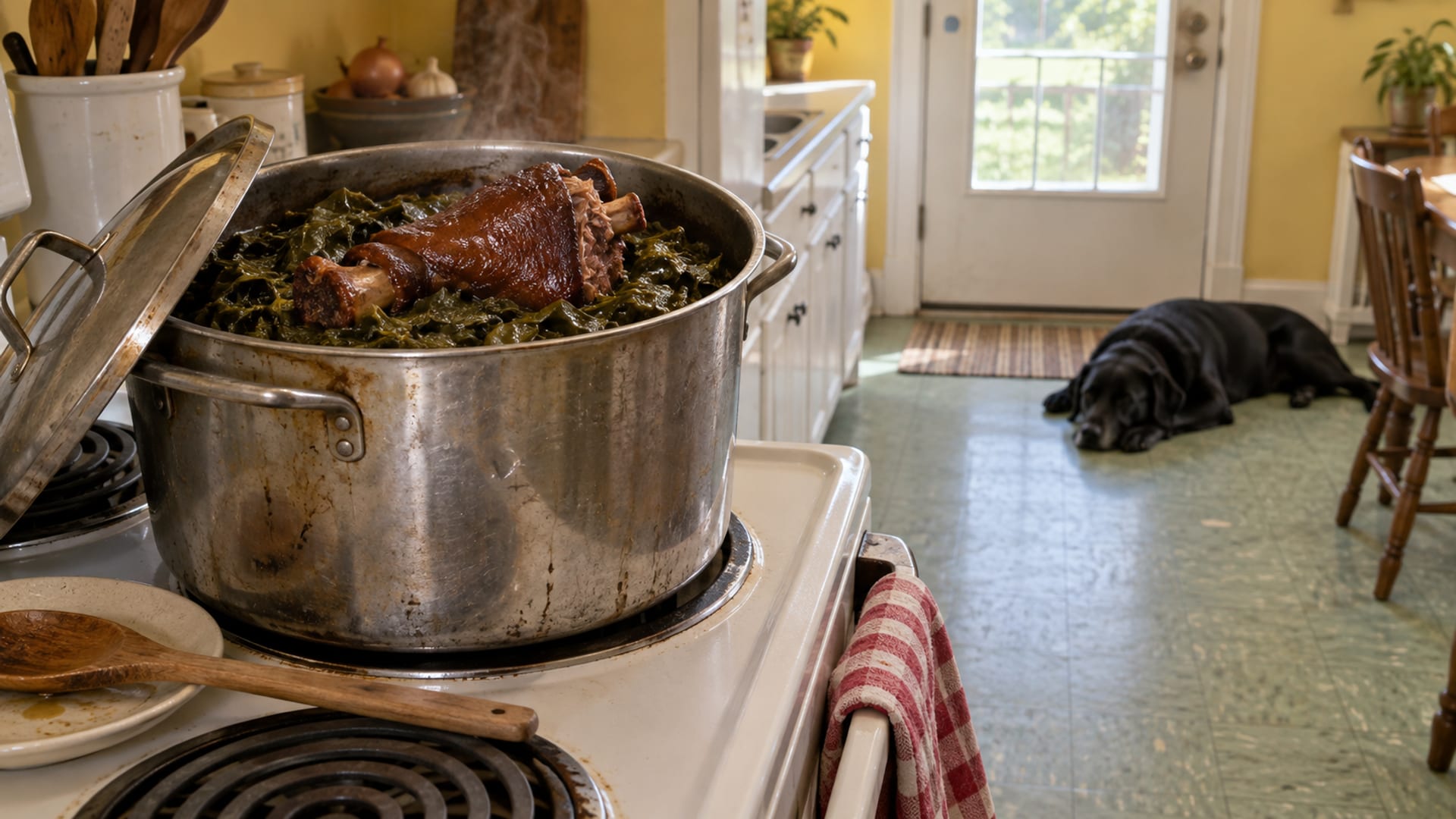
Keep ham hocks away from your dog, whether it is the smoked hock that simmered all afternoon in the greens or a raw one from the butcher case. The American Kennel Club says pork bones, raw or cooked, are likely to splinter and crack, which can choke a dog or damage and block the esophagus or intestines. The hock also brings fatty skin and a salty cure along with the bone.
If your dog already swallowed part of the hock bone, call your vet today for advice, even while your dog is acting like nothing happened. Choking, trouble breathing or gagging that keeps going means an emergency clinic right now.
Key takeaways
Tap a card to bring it forward.
- A ham hock is a pork bone wrapped in fatty skin, usually cured and smoked. Keep it off your dog's plate.
- Smoking and hours in the pot both count as cooking, and cooked bone is the kind that splinters.
- A raw hock can still choke, block the gut or crack a tooth, and it can carry Salmonella and Listeria.
- The skin, fat and pot liquor bring salt and a pancreatitis risk even without the bone.
- Drooling, vomiting, skipping meals or straining to poop after a hock: call your vet.
Your dog got into the ham hock: what to do first
Tap or hover a row to highlight it.
| What happened | Your next step |
|---|---|
| What happenedChoking, gagging over and over, pawing at the mouth, trouble breathing | Your next stepEmergency clinic now |
| What happenedSwallowed a cooked or smoked hock bone, or pieces of one | Your next stepCall your vet today, before any signs show |
| What happenedAte a whole hock, or you cannot find the bone | Your next stepCall your vet now |
| What happenedSwallowed part of a raw hock | Your next stepCall your vet, especially for a small dog or an unknown amount |
| What happenedAte the skin, fat or meat with no bone | Your next stepCall if your dog has had pancreatitis, or if a lot went down |
| What happenedLapped up greens, beans or pot liquor | Your next stepCheck the recipe for onion and garlic, and for bone pieces in the bowl |
Move the pot, the plate or the trash bag first, so your dog cannot go back for more. Then gather what the vet will ask about: whether the hock was raw, smoked or simmered, how much of it is missing, roughly when it happened, your dog's weight, and what else was in the pot. Keep the package or the recipe handy.
The AKC's guidance after a cooked bone is to call your vet for advice or book a visit to rule out anything serious. Do not make your dog vomit, and hold off on bread, oil or any home remedy unless your vet tells you to.
Raw, smoked and simmered hocks side by side
Tap or hover a row to highlight it.
| Raw hock (fresh or salt-cured) | Cooked hock (smoked, boiled, baked, pressure-cooked) | |
|---|---|---|
| Splintering | Raw hock (fresh or salt-cured)Less brittle, but the AKC says pork bone still cracks | Cooked hock (smoked, boiled, baked, pressure-cooked)Brittle; breaks into sharp shards |
| Choking and blockage | Raw hock (fresh or salt-cured)Yes | Cooked hock (smoked, boiled, baked, pressure-cooked)Yes |
| Broken teeth | Raw hock (fresh or salt-cured)Yes | Cooked hock (smoked, boiled, baked, pressure-cooked)Yes |
| Germs | Raw hock (fresh or salt-cured)Salmonella and Listeria possible | Cooked hock (smoked, boiled, baked, pressure-cooked)Mostly killed by cooking |
| Salt | Raw hock (fresh or salt-cured)Fresh hocks carry less; cured ones carry a lot | Cooked hock (smoked, boiled, baked, pressure-cooked)Usually cured and salty |
| Fat and skin | Raw hock (fresh or salt-cured)Yes | Cooked hock (smoked, boiled, baked, pressure-cooked)Yes, softened and easy to gulp |
| Share it? | Raw hock (fresh or salt-cured)No | Cooked hock (smoked, boiled, baked, pressure-cooked)No |
Ham hocks are commonly sold smoked and cured, and smoking is a way of cooking. A hock that comes out of a pot of black-eyed peas after a long afternoon looks soft, but the bone in the middle is still cooked bone.
The ASPCA advises against bones for dogs in general, because they can break teeth, lodge in the throat, block the airway, and irritate, block or pierce the digestive tract. The AKC does describe a large raw cow or bison bone, too big to swallow and chewed under supervision, as an option some owners use. That advice is about a big beef bone and does not carry over to a pork hock.
The pot liquor, the skin and the salt
A hock does its best work in the pot, and that is exactly where the other risks end up. Even with every bit of bone picked out, three things stay behind.
Fat. The skin, the fatty meat and the drippings are rich. Merck Veterinary Manual lists large amounts of table scraps among the risk factors for pancreatitis, which can bring vomiting, low appetite, tiredness, diarrhea, dehydration and belly pain. Severe cases can lead to organ failure.
Salt. Cured, brined and smoked hocks carry a lot of sodium. Merck's chapter on salt toxicosis describes vomiting within several hours of too much salt, then weakness, diarrhea, muscle tremors and seizures, and it is more dangerous when a dog cannot get to water. Merck puts the start of signs at roughly 2 to 3 grams of salt per kilogram of body weight. The salt in one hock depends on the cure, the brand and the recipe, so that figure cannot be turned into a safe number of bites. Leave fresh water out, and tell your vet if a lot of salty hock went down.
The rest of the recipe. Greens and beans often cook with onion or garlic, which are a separate problem for dogs. See Can dogs eat onions? and Can dogs eat garlic? if either was in the pot.
A spoonful of plain, strained pot liquor with no bone, onion or garlic is a much smaller worry than the hock itself. It is still salty and fatty, so it is not something to pour over the kibble.
Signs to watch for, and how long to keep watching
Right away, if a piece is stuck high up: choking, gagging, drooling, swallowing again and again, pawing at the mouth or labored breathing.
Over the next hours and days, as a piece moves down: vomiting, not eating, a sore belly, tiredness, straining to poop, only small amounts of stool, or bringing food back up. VCA Animal Hospitals says to call your vet if a dog that had a bone starts to drool, loses its appetite, vomits or strains to defecate. VCA also warns that bone fragments can lodge in the small intestine and cause a complete blockage needing surgery, and sharp ones can puncture the gut wall and cause a life-threatening infection.
From the fat and salt: vomiting, diarrhea, belly pain, weakness, heavy thirst, tremors or seizures.
There is no set timeline. A piece can move for a while before it lodges, so an ordinary first evening does not clear your dog. The Cornell University College of Veterinary Medicine treats a gut blockage as an emergency and notes that a torn intestine can lead to peritonitis or sepsis.
Go now, day or night, for trouble breathing, collapse, seizures, a swollen or painful belly, repeated vomiting, not keeping water down, blood in vomit or stool, or straining with nothing coming out.
"My dog has been getting the hock out of the greens for years"
Plenty of dogs in plenty of Southern kitchens have been handed the hock when the pot was done, and many of them were fine. That happened, and it is good news for those dogs. It still does not make the next hock safe.
Whether a bone passes depends on the size and shape of the piece, whether it splintered, how the dog chews and gulps, and how big that dog's throat and gut are. Cornell explains that a blockage forms when an object is too big to move through the stomach or small intestine, and VCA notes that some swallowed objects pass without trouble while others do not. The salt and fat change from one hock and one pot to the next too, and one dog's pancreas handles a rich meal that sends another dog to the clinic.
Some of the harm is also slow or silent. A blockage can take days to show, and the FDA says pets can carry and shed Salmonella or Listeria from raw food without looking sick. In a US study of dogs that tested positive for Salmonella, only 55% had diarrhea. Years of good luck are real, and the next hock is still its own roll of the dice.
Dogs that need extra care around a ham hock
- Small dogs and puppies. A hock piece that a big dog might pass is a much larger object in a small throat and gut. Cornell advises keeping easily swallowed items, small bones included, out of reach.
- Dogs prone to pancreatitis. Merck reports higher rates in Miniature Schnauzers, Yorkshire Terriers, Cocker Spaniels, Dachshunds, Poodles and sled dogs, and lists high blood fats as a risk factor. Dogs who have had pancreatitis before, or who eat a vet-prescribed low-fat diet, should not get hock skin or fat.
- Dogs with diabetes. The Cornell diabetic diet guide stresses low fat because pancreatitis can go along with diabetes.
- Dogs on a salt-restricted diet, such as for kidney disease. Ask your vet what applies to your dog.
- Cats in the same house. Bones, fat, salt and raw-meat germs are a problem for cats too.
- The people handling a raw hock. The FDA found Salmonella in 15 of 196 raw pet food samples and Listeria in 32. Wash hands, boards and bowls after raw pork, especially in a home with a baby, an older adult, a pregnant person or anyone with a weak immune system.
Pork hock, knuckle, shank and other names at the butcher counter
Ham hock, pork hock, pork knuckle and pork shank all point to the lower leg around the joint, and stores use the names loosely. The name matters less than one question: did your dog swallow bone?
- Smoked hock vs fresh hock: a smoked hock is cooked and nearly always cured. A fresh hock is raw, with less salt but raw-meat germs.
- Ham bones: the bone from a holiday ham carries the same cured-bone problems. See Can dogs eat ham bones?
- Boneless ham: a different question about salt and fat. See Can dogs eat ham?
- Other pork bones: chops, shoulder and neck bones are covered in Can dogs eat pork bones?
- Smoked bones sold as dog chews: a pet-aisle label does not make a bone safe to swallow. Check what it is made of and watch your dog with it.
Holiday tables and slow Sunday pots are when a hock tends to go missing. The Cornell holiday hazards guide warns that fatty, salty scraps can upset the stomach or bring on pancreatitis and that meat bones can splinter and break teeth. Once the hock comes out of the pot, put it straight into a lidded trash can. For every kind of bone, see Can dogs eat bones?
Check what you learned
Quick check
Questions about dogs and ham hocks
My dog ate a cooked ham hock bone. Is it an emergency?
It can become one. Call your vet today for advice, even if your dog looks normal, since a cooked bone can splinter, block or pierce the gut. Go to an emergency clinic now for choking, breathing trouble, repeated vomiting or a painful belly.
Is a smoked ham hock different from a cooked one?
Smoking is a kind of cooking, so a smoked hock has cooked, brittle bone. It is also usually cured, which adds salt, and it carries plenty of fat.
Can my dog eat a raw ham hock or raw pork hock?
Do not give one. Raw bone is less brittle, but it can still be swallowed in pieces, choke a dog, block the gut or crack a tooth, and raw pork can carry Salmonella and Listeria.
My dog only ate the skin and the fatty meat. Is that okay?
It is less dangerous than swallowing bone, and it is still not a good treat. Fatty scraps are a pancreatitis risk and cured hock is salty. Watch for vomiting, diarrhea or belly pain, and call your vet if they appear or if your dog has had pancreatitis.
Can I share the greens or beans the hock cooked in?
Only a little, only if there is no onion or garlic, and only after checking for bone pieces. Pot liquor is salty and fatty, so treat it as a rare taste at most.
Sources
Checked September 24, 2026.
- ASPCA, A Bone to Pick: One Dog Learns the Dangers of Marrow Bones
- American Kennel Club, Can Dogs Eat Pork Bones?
- American Kennel Club, Can Dogs Eat Bones? Be Careful Before Giving Your Pup a Bone
- Merck Veterinary Manual, Pancreatitis and Other Disorders of the Pancreas in Dogs
- Merck Veterinary Manual, Salt Toxicosis in Animals
- VCA Animal Hospitals, Summer Fun and Follies
- Cornell University College of Veterinary Medicine, Gastrointestinal Foreign Body Obstruction in Dogs
- Cornell University College of Veterinary Medicine, Diets for Diabetic Dogs
- Cornell University College of Veterinary Medicine, Holiday Hazards
- FDA (US Food and Drug Administration), FDA Cautions Pet Owners Not to Feed Performance Dog Raw Pet Food Due to Salmonella, Listeria monocytogenes
- FDA (US Food and Drug Administration), Get the Facts! Raw Pet Food Diets Can Be Dangerous to You and Your Pet
- Reimschuessel and others, Multilaboratory Survey To Evaluate Salmonella Prevalence in Diarrheic and Nondiarrheic Dogs and Cats in the United States between 2012 and 2014