
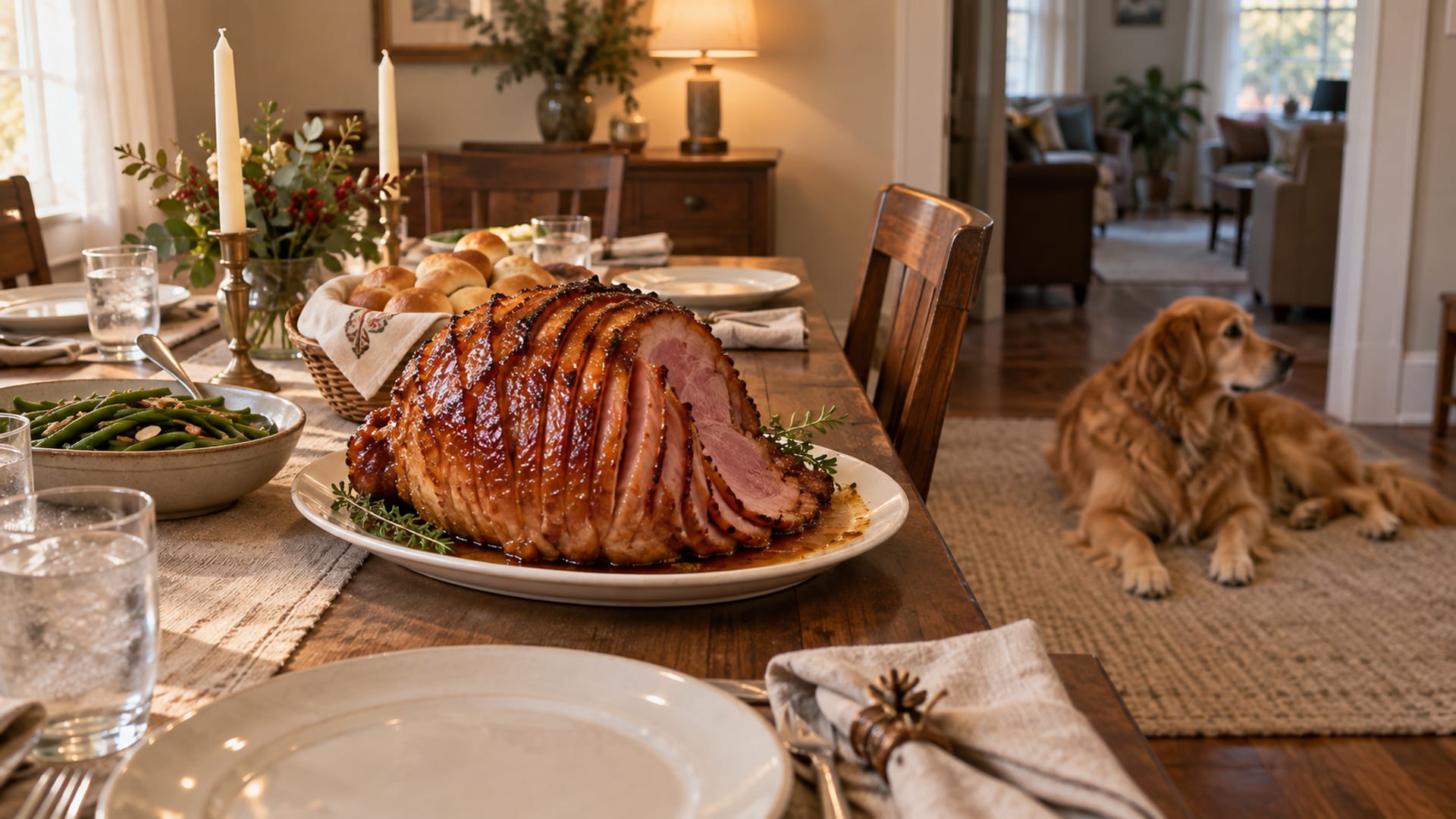
Only a little, and only the plain kind. A sliver of plain, boneless, fully cooked ham probably will not harm a healthy dog, according to the American Kennel Club, but ham is high in sodium and fat, so it makes a poor regular treat. The trouble usually comes from the bone, the drippings, a big portion, or raw and dry-cured hams.
If your dog grabbed one small slice, watch them for the rest of the day and make sure they can reach fresh water. If they got a bone, a pan of grease, most of a platter, or you cannot tell how much is gone, call your vet now.
Key takeaways
Tap a card to bring it forward.
- A sliver of plain, boneless, cooked ham is usually a watch-and-wait situation for a healthy dog.
- Ham is salty and often fatty. Keep it off the regular treat list.
- A ham bone, cooked or raw, can splinter, choke a dog or block the gut. Call your vet.
- A big or greasy helping raises the risk of salt poisoning and pancreatitis.
- Prosciutto, country ham, glazes and anything cooked with onion or garlic are worse than plain ham.
Your dog ate ham: the next step depends on what they got
Tap or hover a row to highlight it.
| What they got | What to do |
|---|---|
| What they gotOne small piece of plain cooked ham | What to doWatch them today and keep fresh water out. |
| What they gotSeveral slices, or any slice for a tiny dog | What to doCall your vet for advice. Have the package and your dog's weight. |
| What they gotA ham bone or ham hock | What to doCall your vet now, even if your dog is acting normal. |
| What they gotDrippings, grease, trimmed fat or skin | What to doCall your vet today. Fatty food can bring on pancreatitis. |
| What they gotRaw fresh ham, prosciutto, country ham or dry-cured ham | What to doCall your vet or a pet poison line and read them the label. |
| What they gotHam with glaze, gravy, onion or garlic | What to doCall. The other ingredients may matter more than the ham. |
If you think your dog ate a lot of salt, Pet Poison Helpline says to contact your veterinarian and the helpline right away. Before you pick up the phone, find the wrapper or label, and work out roughly how much went missing and when.
A missing bone is its own problem. VCA Animal Hospitals warns that cooked and raw bones can splinter into sharp points that pierce or block the digestive tract, so a ham bone is a same-day call even when your dog seems happy.
Go to an emergency vet right away for stumbling, trembling, seizures, collapse, retching that keeps coming back, choking or trouble breathing.
Which kinds of ham carry more risk
Tap or hover a row to highlight it.
| Form | For dogs | Why |
|---|---|---|
| FormPlain, boneless, fully cooked ham | For dogsA sliver now and then | WhySalty and fatty, but a small piece is probably not harmful |
| FormDeli ham and lunch meat | For dogsBetter skipped | WhySodium, fat, curing agents and seasoning vary by product |
| FormProsciutto, Parma, Serrano, country ham | For dogsSkip | WhyDry-cured and very salty; some are sold uncooked |
| FormFresh ham | For dogsNever raw | WhyIt is uncured pork that must be cooked first |
| FormFat, skin, drippings and glaze | For dogsSkip | WhyFat can trigger pancreatitis; glazes add sugar and seasoning |
| FormHam bone or hock | For dogsNever | WhyCan splinter, choke or block the gut |
| FormCooking liquid | For dogsSkip | WhySalt and fat are concentrated in it |
The USDA Food Safety and Inspection Service explains that fresh ham is uncured pork the cook has to finish, and that a cured ham is not always ready to eat. Curing uses salt, nitrates or nitrites, sugar and seasonings. Of those, the salt is the main poisoning concern with ordinary ham, according to the Merck Veterinary Manual.
How much ham is too much for a dog?
Sodium differs so much from one ham to the next that nobody can turn slices into a safe count. What is published is the amount of salt itself that causes trouble.
Tap or hover a row to highlight it.
| Source | Salt per body weight | 10 lb (4.5 kg) dog | 22 lb (10 kg) dog | 70 lb (32 kg) dog |
|---|---|---|---|---|
| SourceMerck: signs can appear | Salt per body weight2 to 3 g per kg | 10 lb (4.5 kg) dog9 to 14 g | 22 lb (10 kg) dog20 to 30 g | 70 lb (32 kg) dog64 to 96 g |
| SourcePet Poison Helpline: toxic dose | Salt per body weight1.5 g per lb (about 3.3 g per kg) | 10 lb (4.5 kg) dogabout 15 g | 22 lb (10 kg) dogabout 33 g | 70 lb (32 kg) dogabout 105 g |
| SourceMerck: can be fatal | Salt per body weightabout 4 g per kg | 10 lb (4.5 kg) dogabout 18 g | 22 lb (10 kg) dogabout 40 g | 70 lb (32 kg) dogabout 128 g |
These are grams of salt, which you cannot read straight off a ham label. Give your vet the label and your dog's weight so they can work it out for the ham your dog actually ate. The Pet Poison Helpline figure comes from its page Should You Give Salt to Your Dog?
A few things make the same ham riskier:
- A small dog. One slice is a much bigger dose per pound for a Chihuahua than for a Lab.
- No water. Merck ties salt poisoning most closely to too much sodium when a dog cannot drink enough.
- Dry-cured ham, grease and drippings. More salt or more fat in every bite.
- A dog with pancreatitis or kidney disease. VCA's guide to nutrition and pancreatic disease says dogs with pancreatitis often need less fat and no table scraps.
If you want to share a bite
Keep it to a sliver of plain, fully cooked, boneless ham with the fat and skin cut off, no glaze, no gravy and nothing seasoned with onion or garlic. The AKC gives no serving chart by size, so make the piece smaller for a smaller dog, and do not make it a habit. If your dog is on a low-fat or prescription diet, leave ham out entirely unless your vet says yes.
Signs to watch for after ham
Pet Poison Helpline lists these signs of too much sodium: vomiting, diarrhea, loss of appetite, heavy thirst, peeing more, tiredness, tremors and seizures. Merck adds weakness, stumbling and confusion. Salt poisoning can move fast, so do not wait to see whether mild signs pass.
Fat works on a slower clock. Vomiting, belly pain or refusing food in the days after a greasy meal is a reason to call, and VCA notes that severe pancreatitis can mean a hospital stay.
A bone shows up as gagging, retching, repeated vomiting, a sore belly, not eating or not passing stool.
"Our dog gets ham scraps every Christmas and has always been fine"
That can be completely true for your dog. Lots of dogs get a scrap of holiday ham and nothing happens. It is still not a rule you can count on, for a few reasons:
- The amount changes. A sliver is very different from half a platter.
- The dog changes. The same slice hits a small dog harder than a big one.
- The ham changes. Plain cooked ham is not the same as prosciutto, grease or a bone.
- Water matters. A dog shut in a room with no water handles salt worse.
- Pancreatitis is hard to predict. A review in the Journal of the American Veterinary Medical Association links it with table scraps, unusual food and getting into the trash, and the cause in any one dog is often never found.
- Signs can lag. A greasy meal can cause trouble days later.
So, share the sliver if you like, and keep the platter, the pan and the bone where your dog cannot reach them.
Turkey ham, pernil and other ham look-alikes
- Turkey ham: cured turkey thigh meat, per the USDA. The salt concern is the same.
- "Uncured" ham: often still cured, with natural sources of nitrate. The label word does not mean low salt.
- Honey ham and spiral ham: the glaze adds sugar and sometimes spices. Trim it off.
- Canned ham and ham steaks: sodium and fat vary a lot. Check the label.
- Gammon and cottage ham: cured pork cuts, and gammon may still need cooking.
- Ham salad and ham sandwiches: mayonnaise, sauces and often onion. Can dogs eat onions? explains why onion is the bigger worry.
- Ham-flavored dog treats: the flavor may not come from ham at all. Judge the whole label.
Check what you learned
Quick check
Questions about dogs and ham
How many slices of ham can a dog eat?
The salt in ham varies by product. The AKC's guidance is a small piece now and then. Think a sliver, and smaller for a small dog.
What three meats should dogs avoid?
Lists vary, but three come up for good reason. The AKC's pork guide says no to ham and bacon because of the salt and fat. Raw pork, including raw fresh ham, needs cooking first. And any meat on the bone carries the splinter and blockage risk.
Can dogs eat prosciutto?
Better not. Prosciutto and other dry-cured hams pack more salt into every slice, and some are sold uncooked. If your dog ate a lot, call your vet.
Can puppies eat ham?
The same rules apply, with extra care for size. A puppy is small, so a slice is a bigger salt dose for them than for a grown dog.
Can ham give a dog pancreatitis?
It can contribute. VCA lists a large fatty meal as a possible trigger, especially in dogs that have had pancreatitis before. A lean sliver is a very different exposure from the fat and drippings.
Is ham bad for cats too?
Cats can also get salt poisoning, according to Pet Poison Helpline, so the same caution applies.
Sources
Checked September 24, 2026.
- American Kennel Club, Can Dogs Eat Ham?
- American Kennel Club, Can Dogs Eat Pork?
- Merck Veterinary Manual, Salt Toxicosis in Animals
- Pet Poison Helpline, Salt
- Pet Poison Helpline, Sodium Toxicity Symptoms in Pets
- Pet Poison Helpline, Should You Give Salt to Your Dog?
- VCA Animal Hospitals, Toxic Household Hazards for Dogs
- VCA Animal Hospitals, Pancreatitis in Dogs
- VCA Animal Hospitals, Nutrition and Pancreatic Disease in Dogs
- USDA Food Safety and Inspection Service, Hams and Food Safety
- Lem and others, Journal of the American Veterinary Medical Association, High fat, high risk? Evaluating the strength of evidence linking dietary fat and pancreatitis in dogs