
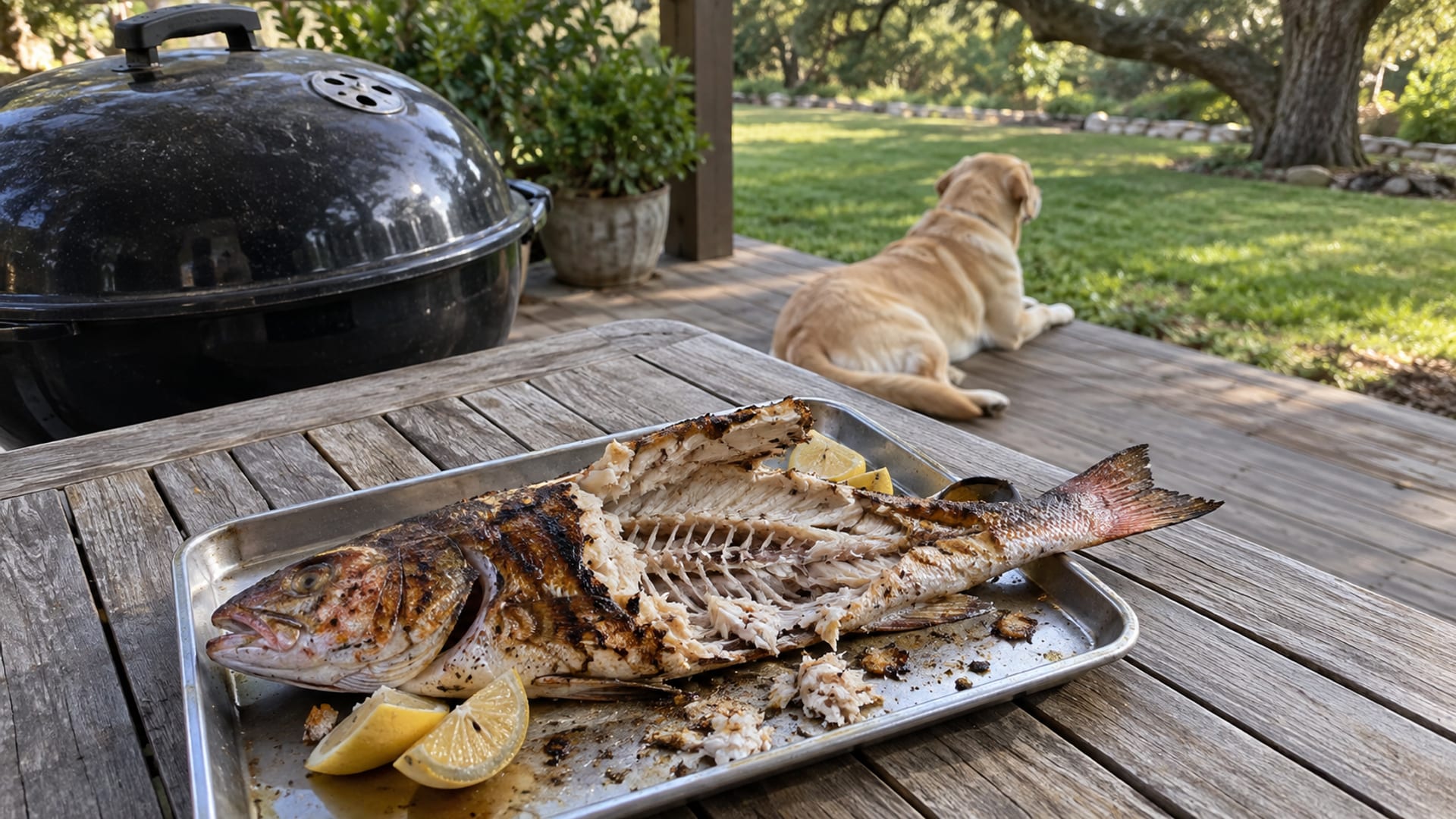
No, keep fish bones away from your dog. The American Kennel Club calls fish bones small, brittle and dangerous, able to lodge in the mouth, throat, stomach or intestines and even pierce an organ wall. Cooking makes them more likely to splinter. Raw bones are a little less brittle, but they can still get stuck, and raw fish can carry germs.
If your dog already swallowed fish bones, call your vet the same day, even if nothing seems wrong, since trouble from a swallowed bone can surface later. Choking or struggling to breathe is an emergency; VCA Animal Hospitals says choking needs immediate veterinary attention.
Key takeaways
Tap a card to bring it forward.
- Fish bones are thin and sharp. Cooked ones splinter more easily; raw ones can still lodge or pierce.
- A swallowed fish bone is a same-day call to your vet, with or without signs.
- Gagging, drooling, pawing at the mouth, repeated swallowing or trouble breathing needs care right away.
- Raw salmon or trout from the Pacific Northwest can also cause salmon poisoning disease, days later.
- Soft canned sardine bones are a narrow exception, and they say nothing about other fish bones.
Your dog swallowed fish bones: what to do today
- Look at the breathing first. Choking, gagging over and over, drooling, pawing at the mouth or trying to swallow again and again can mean a bone is stuck. Go to an emergency vet.
- Call your vet if your dog is breathing normally. Tell them the kind of fish, whether it was raw, cooked, fried or smoked, which parts (pin bones, spine, head, a whole fish) and roughly how many, and when it happened.
- Mention where raw fish came from. Raw or undercooked salmon, trout or a related fish from the Pacific Northwest brings a separate infection risk, covered below.
- Hold off on home remedies unless your vet tells you to use one. In its advice on swallowed bones, the AKC tells owners to contact their veterinarian for tailored advice.
Your vet may look in the mouth and throat, take X-rays or an ultrasound, and use an endoscope or surgery if a bone is stuck or has punctured the gut. Cornell University's College of Veterinary Medicine calls a blocked gut an emergency where fast help is critical.
Fish bones by type: raw, cooked, smoked and canned
Tap or hover a row to highlight it.
| Form | Verdict | Why |
|---|---|---|
| FormCooked pin bones, spine, head or whole cooked fish | VerdictAvoid | WhyCooking makes bones more brittle and likely to splinter |
| FormFried fish with bones | VerdictAvoid | WhyBrittle bones plus oil, which can upset the stomach or lead to pancreatitis |
| FormSmoked fish with bones | VerdictAvoid | WhyBones stay sharp; cold-smoked fish can carry Listeria |
| FormRaw pin bones, skeleton, head, spine or fins | VerdictCaution | WhyCan still lodge or pierce; raw fish can carry Salmonella, Listeria and parasites |
| FormDried or dehydrated fish bones and fish jerky with bones | VerdictCaution to avoid | WhyDrying leaves the bone hazard, and it does not kill every germ |
| FormCanned sardines or salmon with soft bones | VerdictCaution | WhySoft bones, but check the salt, oil and seasoning |
| FormPlain, fully cooked, boneless fish | VerdictFine in small amounts | WhySee can dogs eat salmon |
Smoked fish comes in two kinds. The CDC explains that cold smoking does not kill Listeria, while cooking does; shelf-stable smoked fish has been heat treated. Either one can still hold bones and a lot of salt. Dried fish treats have their own catch: the World Small Animal Veterinary Association notes that freezing, dehydrating and freeze drying do not kill all the bacteria in raw food.
About canned sardines. The AKC's list of human foods for dogs describes sardine bones as soft and digestible. The same club's fish article says fish for dogs should have no bones, and neither article gives a serving amount. So, treat the soft bones in canned sardines as their own case. Read the label for added salt, oil, onion or garlic, and keep pin bones, spines and whole cooked fish out of the bowl.
Raw fish and salmon poisoning disease
Raw fish carries a second risk, separate from the bones. In the coastal Pacific Northwest, raw or undercooked salmon, trout and related fish can carry a fluke that transmits a bacterium, and dogs that eat it can develop salmon poisoning disease. The Merck Veterinary Manual says signs usually start 5 to 7 days after the fish was eaten and can be delayed as long as 33 days. They include fever, weakness, loss of appetite, vomiting, diarrhea that may be bloody, dehydration and swollen lymph nodes. Without treatment, Merck reports that up to 90% of affected dogs can die within 7 to 10 days.
If your dog ate raw salmon or trout from that region, call your vet even if the bones were the only thing on your mind. The full picture is in can dogs eat salmon.
Anywhere, raw fish can also carry Salmonella and Listeria. The FDA says raw pet food is more likely to contain both and poses real risks to pets and the people who handle it.
Where the sources differ on raw fish bones
- AKC says fish for dogs should be boneless and calls fish bones dangerous, yet its food roundup describes sardine bones as soft. Its general bone articles also record a raw-bone view alongside the view that no bones should be fed.
- VCA lists choking, esophageal injury, blockage, constipation and perforation among the harms from bones, and names bacteria such as Salmonella, Listeria and E. coli on raw meat and bone.
- WSAVA points to broken teeth, blockage and constipation from bones, and says benefit to gum health from feeding bones has not been established.
- Pet Poison Helpline warns that cooked bones can splinter and cut, block or choke, and that raw fish from the Pacific Northwest can carry infected parasites.
Put together, the cautious answer is simple. Skip cooked fish bones. Do not feed raw fish bones on purpose either, since being less brittle leaves choking, blockage, tooth and germ risks in place. Canned sardine bones are a narrow case that does not stretch to other fish.
Signs to watch after fish bones
Tap or hover a row to highlight it.
| When | What you may see |
|---|---|
| WhenRight away | What you may seeChoking, gagging, coughing, drooling, repeated swallowing, bringing food back up, trouble swallowing or breathing |
| WhenLater, with no fixed timing | What you may seeVomiting, loss of appetite, belly pain, diarrhea, dehydration, tiredness |
| WhenLater still | What you may seeStraining to poop, blood in vomit or stool |
| When5 to 7 days after raw Pacific Northwest salmon or trout (up to 33) | What you may seeFever, weakness, not eating, vomiting, diarrhea that may be bloody |
The signs of a bone stuck in the esophagus, per Merck, include drooling, gagging, trouble swallowing, bringing food back up and repeated attempts to swallow. Further down the gut, timing depends on where a bone stops and how badly it blocks the way, which is why a quiet evening does not settle it. Call right away for any of these, and especially for blood, a swollen or painful belly, weakness or straining with no stool.
"My dog has eaten fish scraps for years and was fine"
Maybe your dog has cleaned up after every fish fry for years without a single problem. That can be true. It still does not prove the next skeleton will pass.
What changed each time was the bones themselves: how long and sharp they were, whether they were cooked brittle, how many went down, whether the dog chewed or gulped, and where each one ended up. Cornell notes that signs depend on how severe the blockage is, where it sits and how long it has been there. Merck explains that a bone stuck in the esophagus can sometimes be moved into the stomach and then be digested, passed or removed, which helps explain the good outcomes. It does not remove the chance of choking, blockage or a puncture next time.
Germs can hide too. According to the FDA, pets can carry Salmonella or Listeria and shed them in feces or saliva without looking sick. And salmon poisoning disease can show up weeks after the meal, long after anyone connects it to the fish.
Dogs at higher risk from fish bones
- Small dogs and puppies. A bone that a big dog passes can be large for a small throat or gut. Cornell's advice is to stop dogs getting at anything they could easily swallow, and it names small bones.
- Puppies and dogs with weak immune systems or other illness. The CDC lists them among the pets more likely to get sick from germs in raw food. The FDA adds that adult dogs with salmonellosis commonly have another infection or health problem at the same time.
- Dogs with a history of pancreatitis. Keep fried fish and fatty scraps away. The AKC says fish cooked in too much oil can lead to serious illness such as pancreatitis.
- Cats. Cats can swallow bones too, and raw fish germs affect them as well. Keep fish scraps and carcasses out of every pet's reach.
Fish fries, trash cans and look-alikes
Fish bones usually go missing from a plate, the counter, the grill tray or the trash after a meal. Wrap carcasses, heads and skins and get them into a lidded can right away, and clear plates before the dog can reach them.
- Fish hooks are a separate, sharp emergency with a barb and line attached. Call your vet.
- Shrimp, crab and lobster shells are shells, and they need their own answer.
- Fish meal and fish oil are processed products without whole bones, though what else is in them still matters.
- Other bones. For bones from meat, see chicken bones, beef bones, lamb bones and pork rib bones. The dogs and bones guide covers every kind.
Check what you learned
Quick check
Questions about dogs and fish bones
Can dogs eat cooked fish bones?
No. The AKC describes fish bones as small, brittle and dangerous, with the risk of lodging anywhere from the mouth to the intestines or piercing an organ wall. Cooking makes them splinter more easily.
Are raw fish bones safe because they don't splinter?
Not reliably. They can be less brittle than cooked bones, but VCA and WSAVA list choking, broken teeth, blockage, constipation and perforation among the risks, and the FDA says raw pet food is more likely to carry Salmonella and Listeria.
Can dogs eat canned sardines with the bones in?
The AKC calls sardine bones soft and digestible, so canned sardines are a different case from other fish bones. Choose sardines without added salt, oil or seasoning, and ask your vet how much suits your dog, especially if your dog has health problems.
What if a fish bone is stuck in my dog's throat?
Gagging, drooling, pawing at the mouth or swallowing over and over can mean a bone is stuck. Get your dog to a vet right away, since choking is an emergency.
Is raw salmon a separate risk from the bones?
Yes. In the Pacific Northwest, raw or undercooked salmon and trout can carry salmon poisoning disease, which usually shows up 5 to 7 days later and can be fatal without treatment. Call your vet if your dog ate raw salmonid fish from that area.
Sources
Checked September 24, 2026.
- American Kennel Club, Can Dogs Eat Fish?
- American Kennel Club, Which Human Foods Can Dogs Eat and Which Are Dangerous?
- American Kennel Club, What to Do if Your Dog Ate Chicken Bones
- VCA Animal Hospitals, Why Bones Are Not Safe for Dogs
- Cornell University College of Veterinary Medicine, Gastrointestinal Foreign Body Obstruction in Dogs
- Merck Veterinary Manual, Esophageal Foreign Bodies in Small Animals
- Merck Veterinary Manual, Salmon Poisoning Disease and Elokomin Fluke Fever in Dogs
- U.S. Food and Drug Administration, Tips for Safe Handling of Pet Food and Treats
- U.S. Food and Drug Administration, FDA Cautions Pet Owners Not to Feed Performance Dog Raw Pet Food Due to Salmonella, Listeria monocytogenes
- Centers for Disease Control and Prevention, How Listeria Spread: Pâté and Cold-Smoked Fish
- Centers for Disease Control and Prevention, Raw Pet Food
- World Small Animal Veterinary Association, Raw Meat Based Diets for Pets
- Pet Poison Helpline, Toxic and Hazardous Food Guide for Pets