
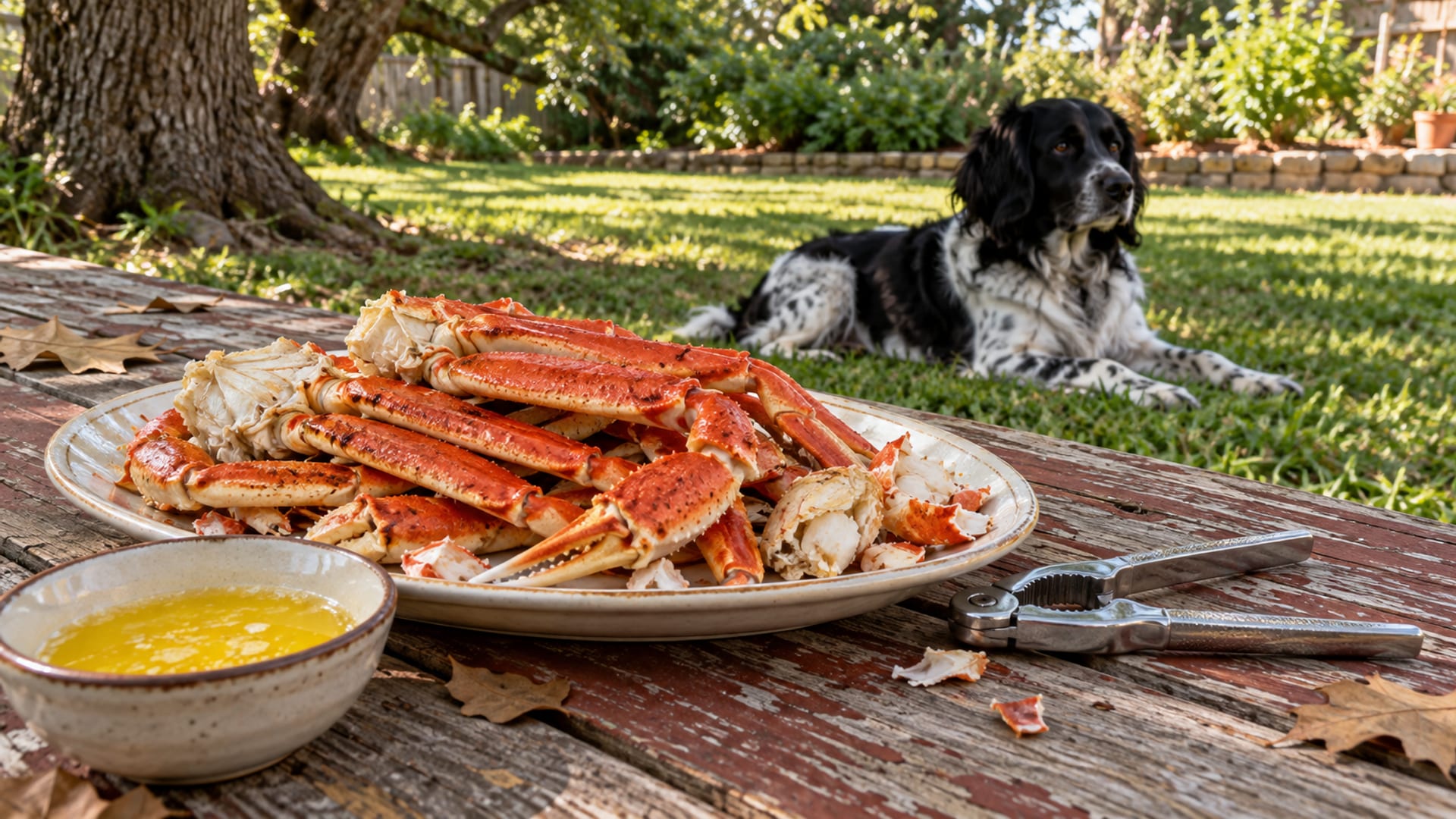
Crab shell is a caution item, and the plain answer is to keep it out of your dog's mouth. Shell is hard material that a dog cannot digest, so a piece can choke a dog, cut the mouth or gut, or block the intestine, and cooking or drying does not change that. If your dog just swallowed some, pick up the rest first, check that your dog is breathing easily, and then use the steps below to decide how fast to call. Crab meat with every bit of shell removed is a separate question.
Key takeaways
Tap a card to bring it forward.
- Crab shell is hard, sharp and indigestible in every form: raw, cooked, dried, whole or crushed.
- The danger is mechanical: choking, cuts in the mouth or gut, a blockage, and in severe cases a tear in the intestine.
- Call your vet promptly after any known swallowed piece, and go to emergency care for choking, trouble breathing, repeated vomiting, severe pain, blood, collapse or shaky, weak movement.
- Small dogs and puppies have less room for the same fragment.
- Shells and dead crabs from the beach carry an extra risk from marine toxins.
What to do if your dog already ate crab shell
Go through these in order.
- Take away the rest of the shell. Your dog can keep eating while you work out what happened, so clear the plate and check the trash.
- Check for choking and trouble breathing. Gagging, coughing, drooling and pawing at the mouth can mean a piece is stuck. The ASPCA calls for immediate emergency care for life-threatening signs, so go now if your dog is struggling to breathe.
- Write down the details. Note the kind of shell (leg, claw or body), whether it was raw, cooked, dried, seasoned or found outdoors, roughly how much, what time it happened and your dog's weight. The ASPCA says to gather exposure details before you call, and these are the answers a vet will ask for.
- Call your vet promptly for any known swallowed piece. That matters most when the piece was large, sharp or whole, or when you cannot tell how much went down. The same ASPCA page says to contact a veterinarian even when your dog seems fine, because waiting for signs can cost time.
- Go straight to emergency care for the serious signs. These are choking, trouble breathing, collapse, repeated vomiting, severe belly pain, blood, marked tiredness, being unable to poop, or shaky, weak or paralyzed movement. The Cornell University College of Veterinary Medicine treats a suspected blockage as an emergency that needs prompt veterinary care.
- Skip the home treatment. The Pet Poison Helpline says not to give home antidotes and not to induce vomiting unless a vet or the helpline tells you to. For a swallowed shell, a clinic is the right place, since a vet can check for injury or a blockage.
Which forms of crab shell are a problem
Every form of shell is hard, and some add their own worry.
Tap or hover a row to highlight it.
| Form | Risk | What to know |
|---|---|---|
| FormRaw shell | RiskAvoid | What to knowHard, indigestible pieces can choke, injure tissue or block the gut; raw whole crab may also carry contaminants or marine toxins depending on where it came from |
| FormCooked shell | RiskAvoid | What to knowCooking leaves the hard or sharp edges in place |
| FormDried shell | RiskAvoid | What to knowDrying does not make shell digestible and can make pieces brittle |
| FormCrushed or powdered shell | RiskDo not feed | What to knowFine powder may be less of a problem than big sharp pieces, but nothing shows it is safe for dogs |
| FormSoft-shell crab | RiskAvoid | What to knowStill a whole crab, and it is not a shell-free product |
| FormBeach-found or dead crab | RiskAvoid | What to knowPossible decay, contamination, parasites or marine toxins |
Shell is not a named poison in itself. The hazard is the physical one.
Why shell is dangerous, and when a few pieces matter less
The Merck Veterinary Manual describes swallowed foreign bodies as a cause of obstruction, tissue damage, perforation, shock and complications that can threaten life. A sharp piece can hurt the mouth, throat, esophagus, stomach or intestine on the way through. A blocked intestine can lead to a tear in the wall, infection of the belly lining and body-wide infection, which is why Cornell calls serious cases emergencies.
Crab shell has no amount that counts as safe to feed, so the plan is to keep it out of the bowl. Risk in an accident depends on fragment size, shape, quantity and where the piece ends up, and whether your dog chewed it into smaller bits. Weight alone does not predict how a shell fragment behaves, so when you call, give the dog's weight, what kind of shell and how much, and let the vet decide.
Small dogs and puppies have more to worry about. The Merck Veterinary Manual notes that very small objects can block small patients and that young dogs are more likely to have a foreign-body blockage. A history of stomach or gut disease, a prior blockage or pica (eating things that are not food) may change how a vet assesses the case, so mention any of those.
Shells on the beach
A shell or a dead crab on the beach has a second problem beyond the hard edges. A report in the Journal of Veterinary Diagnostic Investigation described fatal paralytic shellfish toxin poisoning in dogs that ate stranded marine animals, including crab, after winter storms in England. Vomiting started about 30 minutes after the dogs ate them, followed quickly by loss of muscle control and paralysis. That report involved contaminated marine animals rather than clean shell from a kitchen, but it is reason enough to call your vet right away if your dog eats a beach crab, any time of year.
Signs to watch for and when they show up
Right away, watch for gagging, choking, coughing, drooling, mouth pain, trouble swallowing, vomiting or trouble breathing. Those point to a piece in the throat or mouth, and trouble breathing needs emergency care.
A blockage can show up later. Watch for repeated vomiting, food coming back up, loss of appetite, belly pain, tiredness, diarrhea, straining or being unable to poop, and shock. The Merck Veterinary Manual says the signs vary with where the blockage sits, how long it has been there and whether it is partial or complete. In the worst cases a blockage can end in a torn intestine, infection, shock, emergency surgery or death, so a dog that is getting worse should be seen the same day.
Some small pieces pass without any signs, so a quiet first day is not a clear all-clear.
My dog ate crab shell before and was fine
I believe you, and plenty of owners have the same story of a dog that crunched through a crab leg and went on its way. That happened, in that instance. It is not a rule for the next dog, and a few things decide how it goes.
- The size of the pieces. A dog may have swallowed only small fragments that passed, or chewed the shell into smaller bits.
- The shape of the piece. A sharp, whole or large piece is a different exposure from a crumb.
- The dog's size. A larger dog may have more room for a fragment to pass, though no threshold has been set, and a small dog has less.
- Chance. Individual anatomy and luck affect whether a piece lodges or passes.
- Timing. Blockage signs depend on where the piece sits and how complete the block is, and some dangerous exposures start with no signs. The ASPCA says not to wait for symptoms after something potentially hazardous.
So, a dog that got through it once may have had a low-risk exposure or good luck, and that experience does not make shell safe for another dog.
Products and look-alikes
Plenty of things get called crab shell, and some are not shell at all.
- Crab legs often mean cooked meat still attached to shell, so the shell comes with the meat unless it is taken off first.
- Soft-shell crab is usually a crab caught soon after molting, when the outer shell is softer. It is still a whole crab with shell on it.
- Crab powder, crab meal and crustacean meal can be ingredients in animal feed or supplements. The full label and particle size matter, and these products cannot be treated as ordinary shell.
- Imitation crab, krab and surimi are processed fish, with no crab shell in them. Sodium, preservatives and seasonings vary by brand, so read the label on its own.
- Crab apples are fruit, with their own questions about seeds. See crab apples.
- Crabgrass is a lawn grass.
Serving crab meat after the shell is gone
If you want to share crab, take off every bit of shell first, and only then does it become the shell-free crab meat question. That question has its own page on this site, including how to prepare the meat and which versions to skip. Offer nothing raw, dried, powdered or whole as a treat.
Check what you learned
Quick check
Questions about dogs and crab shells
A few more questions that come up after the first scare.
Can dogs eat crushed or powdered crab shell?
Fine powder may pose less risk than big sharp pieces, but nothing shows it is safe for dogs, so do not serve it. If a supplement or feed lists crab or crustacean meal, read the full label and ask your vet about that product.
Does a bigger dog have less to worry about?
A larger dog may have more room for a fragment to pass, although no size threshold has been set for crab shell. A big dog can still choke or get a blockage, so a known swallowed piece still deserves a call.
How long should I watch my dog?
Keep watching for blockage signs, which can develop after the first hours, and call if vomiting repeats, appetite drops, the belly looks painful or your dog cannot poop. Your vet can tell you how long to watch for the piece your dog swallowed.
Can cats get into trouble with crab shell too?
Cats can also choke, get cut or have a blockage from shell. Merck notes that dogs swallow foreign bodies more often than cats do, but the shell hazard applies to both.
Sources
Checked September 30, 2026.
- Merck Veterinary Manual, Gastrointestinal Obstruction in Small Animals
- Cornell University College of Veterinary Medicine, Gastrointestinal foreign body obstruction in dogs
- Journal of Veterinary Diagnostic Investigation, McLellan et al., Fatal Canine Intoxications Linked to the Presence of Saxitoxins in Stranded Marine Organisms Following Winter Storm Activity
- Pet Poison Helpline, 24/7 Animal Poison Control Center
- ASPCA, What To Do If Your Pet Is Poisoned
- ASPCA, My Pet Ate Something! When Should I Seek Help?