

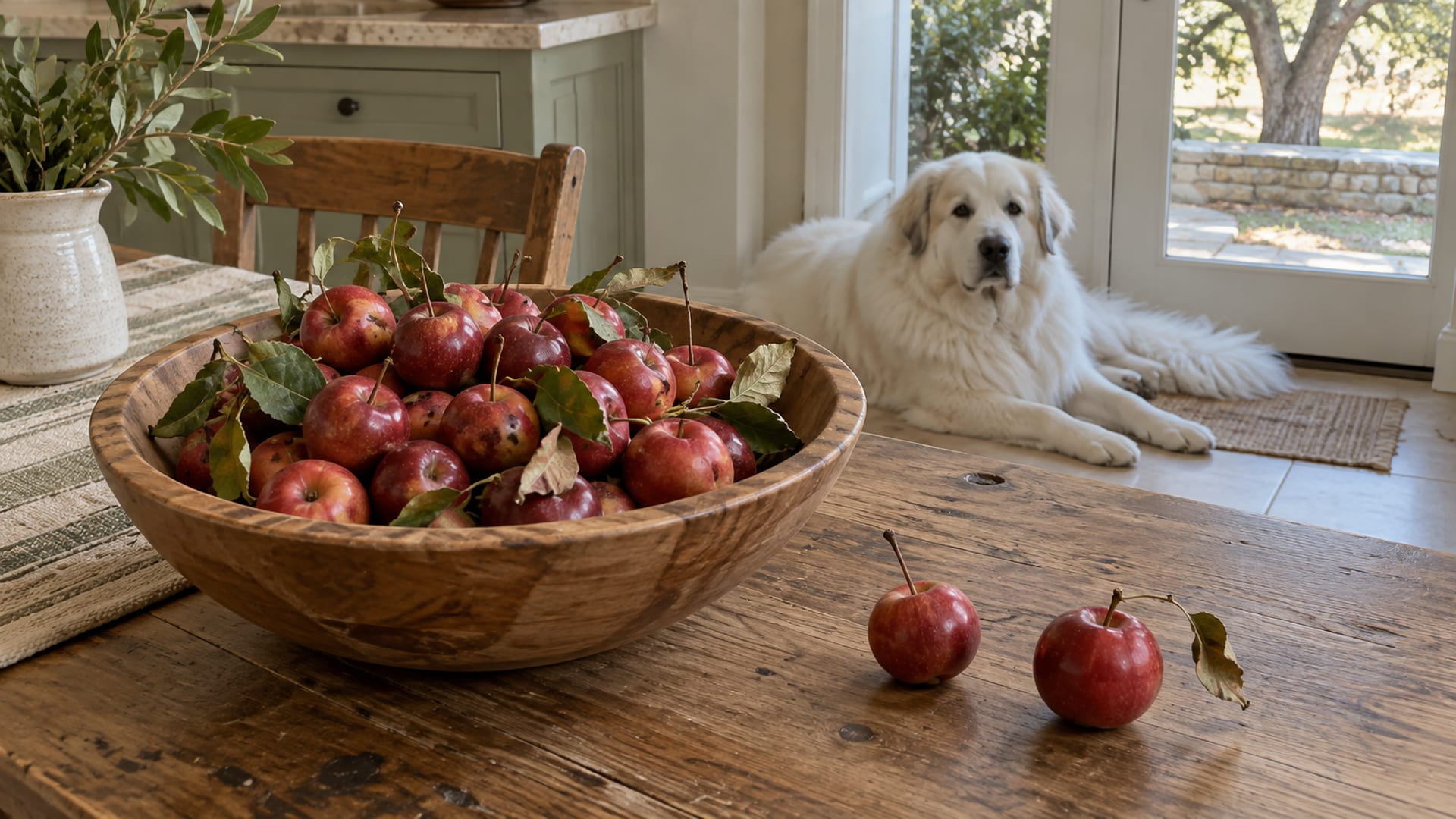
With care. A small bite of ripe crab apple flesh, with the seeds, core and stem taken out, is low risk, but the seeds, stems and leaves contain cyanogenic glycosides, compounds that can release cyanide, most of all when they are chewed, crushed or wilted. If your dog already ate some, work out which parts went down and how many, and call your vet or a pet poison line right away if seeds were chewed, leaves or stems were eaten, or your dog cleaned up a lot of fallen fruit.
The ASPCA lists apple, crabapples included, as toxic to dogs because the seeds, stems and leaves of *Malus sylvestris* contain those compounds. The Merck Veterinary Manual adds that the fleshy fruit generally holds very little of that material, and that severe poisoning in small animals is uncommon unless a large amount is eaten.
Key takeaways
Tap a card to bring it forward.
- A small amount of ripe, plain crab apple flesh with the seeds, core and stem removed is low risk.
- Seeds, stems and leaves carry cyanogenic glycosides, and chewing, crushing or wilting lets them release more cyanide.
- Call your vet or a pet poison line now for chewed seeds, leaves, stems, a lot of fruit, or a tree or product you cannot identify.
- Cyanide signs can start within 15 to 20 minutes to a few hours, so a dog that looks fine right after a big exposure still needs a call.
- Skip home treatment and medicines unless a vet or poison-control professional tells you to give something.
If your dog just ate crab apples, start here
Each of these answers is something the person on the phone will ask you for.
- Get your dog away from the tree and pick up what is left. Every extra fruit, leaf or stem your dog reaches makes the exposure bigger.
- Work out which parts were eaten. Flesh alone is a very different situation from seeds, leaves or stems, the three parts the ASPCA names as containing cyanide-forming compounds.
- Check whether the seeds were chewed or swallowed whole. The Merck Veterinary Manual explains that chewing or grinding a seed releases its cyanogenic compounds, while a seed swallowed whole is less likely to. Crushed cores and seed bits on the ground point to chewing.
- Estimate how many fruits are gone and note the time. The same number of seeds is a bigger dose for a small dog than a large one, and the clock matters because signs can start quickly.
- Keep a sample of the fruit, a leaf, or any packaging. The name crab apple covers many trees, so a sample helps confirm the plant is a *Malus*.
- Call right away if it was more than a nibble of flesh. The ASPCA advises calling its poison control or your local veterinarian as soon as possible. Chewed or multiple seeds, leaves, stems, a lot of fruit, an unknown tree or product, or any sign of illness are all reasons to call now. Give your dog's weight, what was eaten, roughly how much, when, and whether it was chewed.
- Hold off on home remedies and medicines. Treatment for cyanide exposure can involve oxygen, an antidote and close monitoring, which the Merck Veterinary Manual treats as clinical decisions, so let the vet or poison line say whether anything at home is appropriate.
A bite or two of ripe, seedless flesh from a tree you know, in a dog acting normally, generally calls for keeping it away and watching. If you found chewed cores in the grass and cannot tell how many, call first and clean up after.
Which parts of a crab apple are low risk and which are not
The part of the fruit, and what happened to it before your dog ate it, matters more than the name on the tree.
Tap or hover a row to highlight it.
| Part or form | Risk for dogs | Why |
|---|---|---|
| Part or formRipe flesh, raw, seeds and stem removed | Risk for dogsLow in a small amount | WhyFleshy fruit has little cyanogenic material |
| Part or formPeel | Risk for dogsPart of the fruit | WhyWash it first |
| Part or formCooked flesh, seedless | Risk for dogsProbably lower | WhyCooking does not make seeds, stems or leaves safe |
| Part or formSeeds | Risk for dogsAvoid | WhyRelease cyanide when chewed or crushed |
| Part or formCore | Risk for dogsRemove | WhyHolds seeds, can cause choking or a blockage |
| Part or formStems and leaves | Risk for dogsAvoid | WhyContain cyanogenic glycosides, worse when wilted |
| Part or formDried crab apple | Risk for dogsAvoid unless clearly seedless fruit only | WhyConcentrates sugar and may concentrate plant material |
| Part or formJuice, sauce, jam, jelly, cider, pie filling | Risk for dogsRead the label | WhyMay contain seeds, stems, sugar, spices, alcohol or xylitol |
| Part or formPowder or supplement | Risk for dogsAvoid unless ingredients and veterinary use are known | WhyNo reliable dog dose |
The ASPCA flags wilted leaves as a bigger concern than fresh ones The core is a separate problem: Pet Poison Helpline notes that apple cores and seeds can cause choking or a blockage, and a crab apple is small enough for a big dog to swallow whole.
Sharing crab apple flesh, and how much of the rest is a concern
If you want to share, confirm first that the tree is a *Malus*. Wash the fruit, cut the flesh off the core, and throw away the stem and every seed. Offer a small amount of plain flesh with nothing added. Pet Poison Helpline describes apples as fine raw or cooked once the core and seeds are out, and our entry on Apples covers the larger fruit. Leaves, stems, seeds, chewed cores, fruit from a tree you cannot name, and dried or sweetened products stay off the menu.
Nobody can give you a safe number of seeds or leaves. The Merck Veterinary Manual puts the approximate lethal oral dose of hydrogen cyanide at 2 mg per kilogram of body weight for most animal species. That figure is for the cyanide itself, and the amount of cyanide-forming material in a crab apple varies with the species, the plant part, ripeness, growing conditions and whether it was chewed, so it cannot be turned into a fruit count. Skip the math: call with your dog's weight and your best estimate of what was eaten, and let the poison line judge the risk.
Signs of cyanide poisoning and how soon they show up
According to the Merck Veterinary Manual, signs can begin within 15 to 20 minutes to a few hours after a dog eats toxic plant material. Watch for:
- fast breathing or trouble breathing
- a racing heartbeat
- drooling, watery eyes or vomiting
- muscle tremors or spasms
- staggering or weakness
- bright red or bluish gums
- seizures, collapse or a dog that seems dazed
Check your dog's gums now so you know what normal looks like. Bright red gums are among the signs the ASPCA lists for this plant.
Any of these signs after seeds, leaves or stems means going to a vet now. Severe cases can turn fatal within 30 to 45 minutes after signs begin, and animals still alive two hours or more after signs start may recover unless cyanide keeps being absorbed, according to the Merck Veterinary Manual. How long to watch a dog with no signs depends on what and how much it ate, so ask on the call.
My dog ate crab apples before and was fine
That happens, and I believe it. Plenty of dogs have grabbed a crab apple off the lawn and gone on with their day. It still is not a rule for this dog, and not every dog reacts the same way. A few things change the outcome from one time to the next:
- How much. The Merck Veterinary Manual says severe poisoning in small animals is uncommon unless large amounts are eaten, so one fruit and a whole fallen crop are different events.
- The dog's size. The same handful of seeds adds up to more per pound in a Chihuahua than in a Great Pyrenees.
- The part and how it was eaten. Flesh carries little cyanogenic material, a whole swallowed seed releases less than a chewed one, and wilted leaves are worse than fresh ones.
- The tree. Crab apples come from many *Malus* species and cultivars, and their cyanide-forming content varies.
- Timing. Signs can take a few hours, so a dog that looked fine five minutes later had not cleared the window yet.
That earlier afternoon was real. It just cannot tell you what is in whatever this dog chewed today.
Crab apple products and things that get mistaken for crab apples
"Crab apple" usually means a *Malus* fruit about 2 inches across or smaller, and the name covers wild trees, flowering ornamentals and many hybrids, according to University of Alaska Fairbanks Cooperative Extension. A few things get mixed up with them:
- Hawthorn. The name crabapple has occasionally been used for hawthorn, genus *Crataegus*. Its fruit needs its own assessment, so tell the vet which tree it came from.
- Unknown red berries. Small red fruit on an ornamental shrub may be something else. Take a photo or sample.
- Crab meat and crab-flavored treats. These have nothing to do with the tree and bring their own issues, such as seasoning, salt, fat and shell.
- Cider, jelly, jam, applesauce, pie filling, dried fruit and powders. The label decides the risk. Look for seeds, alcohol, spices and xylitol.
- Other fruit with cyanide-forming seeds or pits. If the tree turns out to be something else, see our entries on Apricots, Cherries and Plums.
Check what you learned
Three quick questions on the points that matter most tonight.
Quick check
Questions about dogs and crab apples
Owners with a crab apple tree nearby tend to ask these next.
Should I remove a crabapple tree if I have a dog?
Most owners manage the tree instead of cutting it down. Rake up fallen fruit through late summer and fall, and clear pruned or storm-broken branches before the leaves wilt. A dog that keeps going for the fruit may need the area under the tree fenced off during the drop.
Are crab apples dangerous for cats too?
Yes. The ASPCA lists apple, crabapples included, as toxic to cats as well as dogs, because of the same compounds in the stems, leaves and seeds. The same yard cleanup protects both.
My puppy ate a crab apple. Is that more serious?
Puppies have no special crab apple rule of their own, but size still counts: a small puppy gets a bigger dose per pound from the same seeds. Call with your puppy's weight, its age and what it ate.
Has crab apple poisoning been reported in animals?
A 1986 case report in the Veterinary Record, indexed on PubMed, describes suspected cyanide poisoning in two goats that ate crab apple leaves and fruit. It is a goat case with no dog dose attached, but it shows the plant has caused trouble in real animals.
Sources
Checked September 25, 2026.
- ASPCA Animal Poison Control Center, Toxic and Non-toxic Plants: Apple
- Merck Veterinary Manual, Houseplants and Ornamentals Toxic to Animals
- Merck Veterinary Manual, Cyanide Poisoning in Animals
- Merck Veterinary Manual, Cyanide Poisoning
- Pet Poison Helpline, Friendly Fall Foods
- University of Alaska Fairbanks Cooperative Extension Service, Crabapples
- Veterinary Record via PubMed, Suspected cyanide poisoning in two goats caused by ingestion of crab apple leaves and fruits