
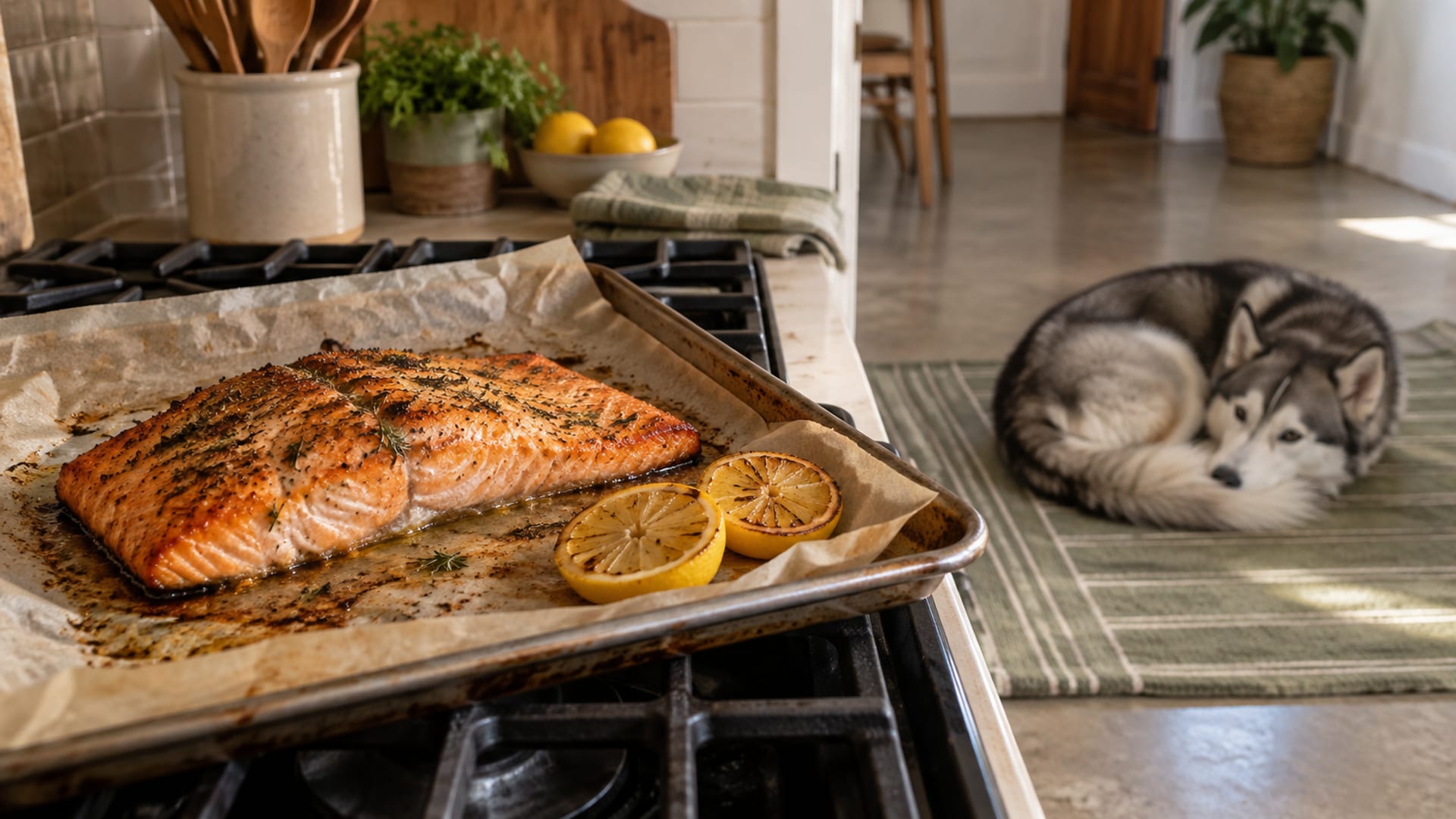
Yes, if it is cooked. Plain salmon that is fully cooked, cooled and completely deboned is fine for most dogs in small amounts, and the American Kennel Club recommends fish be served that way, with no oil or seasoning. Raw or undercooked salmon is a different story, because it can carry the organism behind salmon poisoning disease.
If your dog ate a flake of your baked salmon, there is nothing to do. If they ate raw salmon or raw trout, especially fish caught in the Pacific Northwest, call your vet today, even if your dog looks completely normal. Signs usually take about a week to appear, so there is no reason to wait for them.
Key takeaways
Tap a card to bring it forward.
- Plain, fully cooked, boneless salmon is fine as a small, occasional extra.
- Raw or undercooked salmon and trout can cause salmon poisoning disease, which can be fatal without treatment.
- Signs usually start around 6 to 10 days after a dog eats infected raw fish.
- Bones can choke a dog or block the gut. Remove every one.
- Smoked salmon, lox and gravlax may not be cooked and are salty. Skip them.
If your dog already ate salmon
Tap or hover a row to highlight it.
| What they ate | What to do |
|---|---|
| What they ateA bite of plain, cooked, boneless salmon | What to doNothing. A large helping may cause loose stool. |
| What they ateRaw or undercooked salmon, trout, sushi or sashimi | What to doCall your vet now, even if your dog seems fine. Say where the fish came from. |
| What they ateFish scraps, a carcass or bait from a river trip | What to doCall your vet. Treat it as a raw fish exposure. |
| What they ateSalmon bones, or a fish with a hook | What to doCall your vet. Watch for gagging, drooling or pawing at the mouth. |
| What they ateSmoked salmon, lox or gravlax | What to doCall if it was more than a small bite; it may be raw and salty. |
| What they ateSeasoned salmon, or a dish with onion or garlic | What to doCheck the recipe and call if onion, garlic or a lot of salt was in it. |
With raw fish, do not wait for signs. Washington State University's veterinary hospital calls salmon poisoning disease "a potentially fatal condition" and says signs generally show up within about six days. Tell your vet what kind of fish it was, where it came from, whether it was raw or cooked, how much your dog ate and when.
Go to an emergency vet right away if your dog is choking, cannot swallow, is struggling to breathe, or is weak, feverish and not eating after eating raw fish in the past couple of weeks.
Salmon poisoning disease, in plain terms
Despite the name, salmon poisoning is an infection. The Merck Veterinary Manual explains that a tiny fluke, *Nanophyetus salmincola*, lives in some salmon, trout and related fish, and the fluke can carry a bacterium, *Neorickettsia helminthoeca*. When a dog eats infected raw fish, the bacterium makes the dog sick. It is mainly a problem with fish from Pacific Northwest waters, and Merck reports no age, sex or breed that is more at risk.
The Oregon Veterinary Medical Association puts the usual onset at about 6 to 10 days after eating the fish, and says untreated cases are usually fatal. With veterinary treatment, dogs can start to improve within 24 hours, according to Merck. Signs to watch for:
- fever
- tiredness and weakness
- not eating
- vomiting and diarrhea
- weight loss and dehydration
- swollen lymph nodes
Raw fish exposure is not always obvious. A Los Angeles County public health advisory on four sick dogs describes exposure through raw fish, trout, fish scraps and carcasses, which means a riverbank, a cleaning table or the trash after a fishing trip all count.
*Salmonella* is a different germ with a similar name, and it has nothing to do with salmon poisoning disease.
Which salmon is fine, and which to skip
Tap or hover a row to highlight it.
| Form | For dogs | Why |
|---|---|---|
| FormFully cooked, plain, boneless flesh | For dogsYes, a small amount | WhyAKC's recommended way to serve fish |
| FormRaw or undercooked salmon | For dogsNo | WhyParasite and infection risk |
| FormRaw skin | For dogsNo | WhySame risk as raw flesh |
| FormCooked skin, plain | For dogsA little at most | WhyFatty |
| FormBones | For dogsNever | WhyChoking, mouth injury, blockage |
| FormSmoked salmon, lox, gravlax | For dogsNo | WhyMay be cured, not cooked; high in sodium |
| FormCanned salmon | For dogsPlain, in water, low sodium only | WhySkip oil, brine, sauce or seasoning |
| FormJerky, dried, freeze-dried | For dogsDepends on the product | WhyWas it cooked? Is it salted or seasoned? |
| FormSalmon oil | For dogsAsk your vet | WhyNo parasite risk, but a lot of fat |
| FormSalmon dog food or treats | For dogsRead the whole label | WhyJudge the product as a whole |
The FDA warns that bones can cause blockages in pets and that too much salt is a hazard. Those are the two things to watch with cooked salmon.
How much salmon to give, and how to prepare it
There is no salmon portion by dog weight from a veterinary source. Treat it as an occasional topper or treat on top of complete dog food, and keep portions small for small dogs.
- Cook it all the way through. Baked, poached or steamed.
- Cook it plain. No oil, butter, salt, garlic, onion, sauce or seasoning.
- Cool it and debone it. Flake it with your fingers to find the pin bones.
- For canned salmon, choose plain, packed in water and low in sodium.
PetMD points out that dogs with certain health problems may need to avoid oily or salty salmon. Ask your vet before sharing salmon if your dog has had pancreatitis, has kidney or heart disease, or eats a prescription diet.
"My dog has eaten raw fish at the river for years"
Some dogs do, and some never get sick. That can be true for your dog, and it is still not a rule. Not every fish carries the infected fluke. The fish may have come from outside the area where the parasite cycle happens, or it may have been a different kind of fish. Some of those fish may also have been cooked, which lowers the risk. And because signs take about 6 to 10 days and can look like a plain stomach bug at first, an earlier illness may not have been linked to the fish at all. After any raw salmon or trout, calling your vet is the safer habit.
Smoked salmon, canned salmon, salmon oil and trout
- Smoked salmon and lox: often cold-smoked or cured, so not fully cooked, and salty. Skip it.
- Gravlax: cured raw salmon. Same answer.
- Sushi and sashimi: raw fish. Call your vet if your dog ate some.
- Canned salmon: fine in a small amount if plain, packed in water and low sodium. Avoid versions packed in oil or brine.
- Salmon oil: does not carry the parasite risk, but it is concentrated fat and can upset the stomach. Ask your vet about dose and whether it suits your dog.
- Salmon jerky and freeze-dried salmon treats: check whether the product was cooked or properly processed, and look for salt and seasoning.
- Trout: a different fish that can carry the same fluke. Raw trout counts as a salmon poisoning risk.
- Salmon for people: the FDA's advice about eating fish lists salmon among its lower-mercury "Best Choice" fish for people. That guidance is written for human diets.
Check what you learned
Quick check
Questions about dogs and salmon
Can I feed my dog cooked salmon?
Yes. Cook it all the way through with nothing added, let it cool, and remove every bone. Give a small amount as an extra, not a meal replacement.
What fish can dogs not eat?
Skip raw or undercooked salmon, trout and related fish, especially from the Pacific Northwest. Pet Poison Helpline's food guide flags raw salmon from that region. Also skip smoked, cured, salted or seasoned fish, and any fish with bones left in.
How much salmon is okay for dogs?
A few small flakes as an occasional topper for a small dog, a bit more for a large one. No vet source sets a portion by weight, so keep it modest and keep complete dog food as the main meal.
Can dogs eat salmon skin?
Only if it is cooked and plain, and only a little, since it is fatty. Raw skin carries the same parasite risk as raw fish.
Can dogs eat canned salmon?
Yes, in a small amount if it is plain, packed in water and low in sodium. Check for bones and skip anything packed in oil or with seasoning.
Can cats get salmon poisoning disease?
Merck describes salmon poisoning disease as a disease of dogs and other canids, though a related illness, Elokomin fluke fever, affects a wider range of animals. Cats still should not get raw salmon, because of parasites, bacteria and bones.
Sources
Checked September 24, 2026.
- Merck Veterinary Manual, Salmon Poisoning Disease in Dogs
- Merck Veterinary Manual, Salmon Poisoning Disease and Elokomin Fluke Fever in Dogs
- Washington State University Veterinary Teaching Hospital, Salmon Poisoning
- Oregon Veterinary Medical Association, Salmon Poisoning Disease ("Fish Disease")
- Los Angeles County Department of Public Health, Animal Health Advisory: Salmon Poisoning Disease in four dogs
- American Kennel Club, Can Dogs Eat Fish?
- PetMD, Can Dogs Eat Salmon?
- US Food and Drug Administration, Potentially Dangerous Items for Your Pet
- US Food and Drug Administration, Advice about Eating Fish
- Pet Poison Helpline, Toxic and Hazardous Food Guide for Pets