
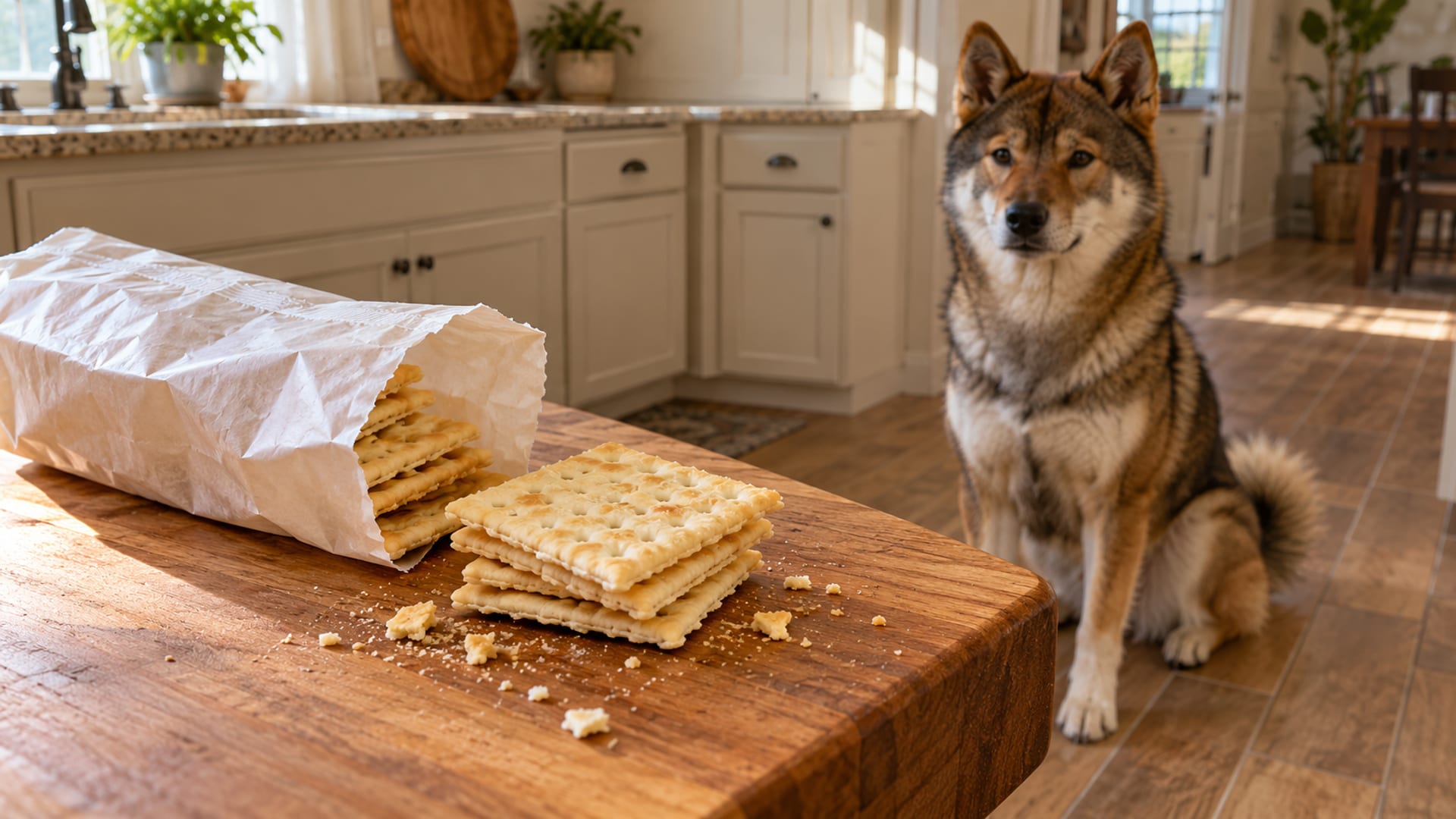
Crackers get a cautious yes. A small piece of a plain, baked, unseasoned cracker is low risk for a healthy dog, and the ingredient list decides whether a particular cracker stays that simple. Onion or garlic powder, xylitol, chocolate, raisins, macadamia nuts, a lot of salt and raw dough turn a cracker into a problem.
If your dog already got into the box, grab the package first. I'd want four answers ready for a vet or a poison line: which product and flavor, how many, how much your dog weighs, and whether any sign has started.
Key takeaways
Tap a card to bring it forward.
- A small piece of a plain, baked, unseasoned cracker is low risk for a healthy dog; the ingredient list is what changes that.
- Onion or garlic powder, xylitol, chocolate, raisins, macadamia nuts and a lot of salt make a cracker a reason to call.
- The same cracker is a bigger dose for a small dog, so your dog's weight belongs in every call.
- A dog who seems fine after onion or garlic crackers can still have delayed trouble.
- Raw cracker dough is a different hazard from a baked cracker.
What to do if your dog already ate crackers
The right answer depends on what was inside the package, so work through these in order.
- Read the full ingredient list. "Cracker" can mean a plain savory cracker, a sweet cookie, a snack with a toxic ingredient or raw dough. The ASPCA warns about onion, garlic, chives, grapes, raisins, macadamia nuts and raw dough, so look for those first.
- Write down how many, when, and what your dog weighs. The AKC explains that toxicity generally depends on the amount eaten relative to body weight, so a smaller dog can get sick from a smaller amount.
- Keep fresh water within reach. The Merck Veterinary Manual says salt toxicosis is less likely when a dog's normal salt-regulating mechanisms work and fresh water is always available.
- Call your vet or Pet Poison Helpline if the label lists xylitol, chocolate, raisins, grapes, macadamia nuts, alcohol, onion, garlic or a lot of salt; if the amount was large or unknown; if your dog is small, a puppy, medically fragile or had limited water; if it was raw yeast dough; or if any sign has started. The Pet Poison Helpline points out that the sooner a poisoning is addressed, the easier, less expensive and safer it is to treat.
- Go to an emergency vet right away for choking, collapse, a seizure, trouble breathing, repeated vomiting, tremors or wobbly walking. Those signs are for the clinic, not the couch.
- If it was a small amount of a plain cracker and your dog is acting normal, a poison call is usually not needed. Watch your dog through the day and call if anything changes. The AKC advises contacting a veterinarian or Pet Poison Helpline right away when a large amount of salt is suspected.
Which crackers are fine and which are not
"Crackers" is a whole product category, so the useful question is which kind your dog ate.
Tap or hover a row to highlight it.
| Type of cracker | What to check | Risk for a healthy dog |
|---|---|---|
| Type of crackerPlain baked cracker or saltine | What to checkSalt, fat and refined carbohydrate add up | Risk for a healthy dogLow in a small piece |
| Type of crackerWhole-wheat, multigrain, seeded, rice or gluten-free | What to checkThe whole ingredient list; seeds, grains and flour are not automatically toxic, but the product may carry extra salt, fat, onion, garlic or sweeteners | Risk for a healthy dogDepends on the label |
| Type of crackerFlavored crackers | What to checkOnion and garlic powder can damage red blood cells; cheese, butter and oils add fat | Risk for a healthy dogCaution |
| Type of crackerGraham crackers, animal crackers, sweet crackers | What to checkSugar and fat; chocolate, raisins, macadamia nuts or xylitol change the answer to avoid | Risk for a healthy dogCaution, or avoid |
| Type of crackerRaw cracker dough | What to checkRaw yeast dough can expand and produce alcohol in the stomach | Risk for a healthy dogCall right away |
| Type of crackerCracker crumbs | What to checkUsually fine if plain and small in quantity | Risk for a healthy dogLow |
Cooking at the factory removes the raw-dough problem, but it does not remove salt, onion, garlic, xylitol, chocolate, raisins or extra fat. The ASPCA identifies garlic as an Allium plant that is toxic to dogs and cats, and onion and chives belong to the same family. See onions and garlic for more.
Fat matters too. Texas A&M identifies a high-fat diet as a pancreatitis concern, so a dog with a history of pancreatitis should skip crackers made with cheese, butter or oil.
How to serve a plain cracker, and how much of the risky kind is a concern
If you choose to share one, the lower-risk choice is a small piece of a plain, baked, unseasoned cracker with no onion, garlic, xylitol, chocolate, raisins, macadamia nuts or alcohol. Break it into small pieces and offer it once in a while, because a dry piece swallowed whole can be a choking risk, most of all for a small dog. A dog with pancreatitis, diabetes, kidney disease, obesity, a food allergy or a prescribed diet needs a vet's word before any human snack.
Cracker recipes vary too much for one number to cover them. What matters is how much of a particular ingredient your dog ate. Salt is the one with published figures, and they describe grams of salt itself, so they do not convert into a count of crackers.
Tap or hover a row to highlight it.
| Amount of salt | What it means in dogs |
|---|---|
| Amount of saltAbout 2 to 3 g per kg of body weight | What it means in dogsClinical signs of salt toxicosis can appear |
| Amount of saltAbout 4 g per kg of body weight | What it means in dogsApproximate acute oral lethal dose |
For onion or garlic in a cracker, the risk depends on the plant, how it was prepared, how much there was and which dog ate it. So, when you cannot judge the amount, call with your dog's weight, the product and how much is missing from the package, and let the vet or poison line do the math.
Signs to watch for and when they show up
A plain cracker often causes nothing, or a mild stomach upset. These signs belong to bigger exposures.
- Salt. The Merck Veterinary Manual says too much salt may cause vomiting within several hours, followed by weakness, diarrhea, muscle tremors, wobbly walking, depression and seizures. Severe sodium excess can cause brain swelling, coma and death.
- Onion or garlic. The first sign may be stomach upset. The ASPCA says Allium plants can irritate the digestive tract and damage red blood cells, leading to anemia, and that damage can be delayed. A dog who looks fine right after eating them has not been cleared. Pale gums call for a vet.
- A hard piece stuck or swallowed whole. Gagging, coughing, trouble breathing, repeated swallowing, vomiting, belly pain, or being unable to keep food and water down.
My dog ate crackers before and was fine
I believe you, and it probably did go fine. Plenty of dogs have swiped a saltine off the floor with no trouble. That story is true for that dog on that day, and several things decide how any exposure goes.
- Amount. A single cracker carries far less of a harmful ingredient than a sleeve.
- Size. The AKC notes that toxicity generally relates to amount per body weight, so the same crackers are a different dose for a dog of another size.
- Form. A plain baked cracker is a different thing from raw dough or a cracker with onion, garlic, xylitol, chocolate, raisins or a lot of salt.
- Water. Merck ties salt toxicosis mainly to excess sodium when water is limited.
- The individual dog. Health and existing disease change how a dog handles the same food.
- Timing. Red blood cell damage from onion and garlic may not show for a while, so "fine that afternoon" is not the whole story.
So, the past experience is real, and the next cracker still deserves a glance at the label.
Crackers, cookies and look-alikes
Names cause a lot of the confusion, and a brand name does not tell you what is inside.
- Saltines, soda crackers, water crackers and cream crackers are related savory crackers, though recipes and salt levels differ. "Soda" names a cracker type and has nothing to do with a soft drink.
- Ritz-type and flavored snack crackers vary by flavor. See Goldfish crackers and Cheez-Its.
- Graham crackers are sweeter and often higher in fat than saltines; there is a page on graham crackers.
- Animal crackers are sweet cookies, and a cookie can hold chocolate, raisins, macadamia nuts or xylitol. See cookies, chocolate and grapes and raisins.
- Cracker meal, crumbs and dough may be processed ingredients or raw dough rather than a baked snack; see bread for the dough side.
Check what you learned
Three questions cover what matters most when a cracker is on the floor.
Quick check
Questions about dogs and crackers
These are the extra questions owners ask once the first answer is settled.
Can puppies have crackers?
A puppy is small, so the same piece works out to a bigger dose per kilogram. Puppies may also have less reserve than an adult dog, which is cautious practice rather than a published cracker rule. Calling your vet sooner is the safer habit if a puppy got into anything flavored.
What about crackers with cheese or peanut butter?
Cheese, butter and oils raise the fat and calories, and a filled cracker brings its own ingredient list, so read both halves of the label. There is more on peanut butter crackers. If your dog has had pancreatitis, ask your vet first.
Can a dog choke on a cracker?
It can happen. Crackers are dry and hard, and a large piece gulped whole can cause choking or block the digestive tract, most often in a small dog. Gagging, coughing or trouble breathing means an emergency vet now.
What if the label lists xylitol?
Treat it as an urgent poisoning exposure and call right away. Xylitol is an artificial sweetener that can cause dangerous low blood sugar and may injure the liver. Keep the package so you can read the ingredients and the amount to whoever answers.
Sources
Checked September 30, 2026.
- ASPCA, People Foods to Avoid Feeding Your Pets
- ASPCA, Garlic
- Merck Veterinary Manual, Salt Toxicosis in Animals
- American Kennel Club, Is Salt Bad for Dogs?
- Pet Poison Helpline, Poison Pantry
- Texas A&M University College of Veterinary Medicine, A Ruff Road: Navigating Pancreatitis in Dogs