

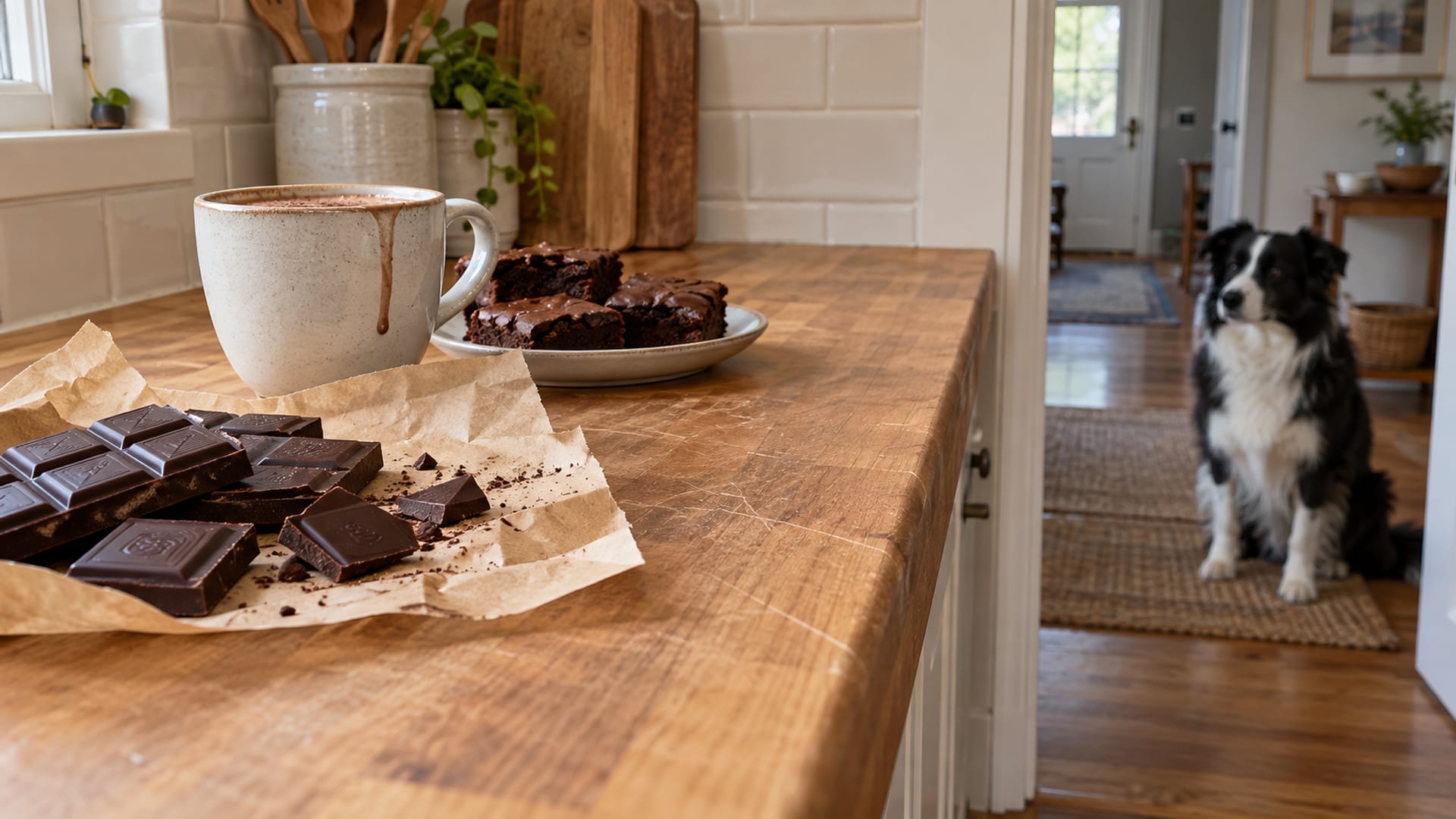
No. Chocolate contains theobromine and caffeine, and in dogs they can cause vomiting, restlessness, a racing or irregular heartbeat, tremors and seizures, according to the Merck Veterinary Manual. How sick a dog gets depends on three things: the type of chocolate, how much, and the dog's size, according to the ASPCA.
If your dog ate chocolate, call your vet, an emergency vet or a pet poison line now, with the wrapper in your hand. Do this even if your dog is acting normal, because signs often take several hours to start.
Key takeaways
Tap a card to bring it forward.
- Chocolate is toxic to dogs. Call a vet or poison line as soon as you find out.
- The darker the chocolate, the less it takes. Baking chocolate and cocoa powder are the strongest.
- Small dogs reach a dangerous dose from much smaller amounts.
- Signs usually start within 6 to 12 hours and can last a day and a half or longer.
- Check for raisins, macadamia nuts, xylitol or coffee in the treat, which add their own risks.
What to do right now
- Take the rest away and keep your dog away from the spot, including the trash.
- Grab the packaging. The ASPCA asks owners to find out the type of chocolate, how much is missing, and what was in it, such as fillings. The cacao percentage and net weight on a label help the vet work out the dose.
- Know your dog's weight and roughly when they ate it.
- Call with those details in front of you. Use your own vet, an emergency clinic, or a poison line from the box at the top, and they can tell you whether your dog needs treatment.
- Go in now if your dog is already vomiting a lot, pacing, shaking, breathing hard, has a racing heart, collapses or has a seizure.
Our Dog Toxin Dose Checker can estimate the dose from your dog's weight and the chocolate type, so you have a number ready for the call.
Why the type of chocolate matters most
The amount of theobromine and caffeine varies hugely between kinds of chocolate. Merck publishes these typical figures, and notes that the real content varies between cocoa beans and brands:
Tap or hover a row to highlight it.
| Chocolate | Per ounce (28 g) | How it compares |
|---|---|---|
| ChocolateWhite chocolate | Per ounce (28 g)about 1 mg | How it comparesVery little, but high in fat |
| ChocolateMilk chocolate | Per ounce (28 g)about 64 mg | How it comparesThe baseline |
| ChocolateSemisweet chips, sweet dark chocolate | Per ounce (28 g)150 to 160 mg | How it comparesMore than twice milk chocolate |
| Chocolate70% dark bar | Per ounce (28 g)about 308 mg | How it comparesNearly 5 times milk chocolate |
| ChocolateUnsweetened baking chocolate, 100% cacao | Per ounce (28 g)about 440 mg | How it comparesAbout 7 times milk chocolate |
| ChocolateCocoa powder | Per ounce (28 g)about 807 mg | How it comparesMore than 12 times milk chocolate |
For a dark bar with a cacao percentage on the label, Merck's method is to multiply 15.5 mg per gram by that percentage. The 70% row comes from that method.
How much chocolate is a problem for your dog's weight
Merck and the ASPCA Animal Poison Control Center use the same dose levels for theobromine plus caffeine:
- About 20 mg per kg of body weight: mild signs such as vomiting, diarrhea and thirst.
- 40 to 50 mg per kg: effects on the heart.
- 60 mg per kg or more: seizures.
The table below turns the first of those levels into amounts of chocolate, using Merck's figures above.
Tap or hover a row to highlight it.
| Chocolate | 11 lb (5 kg) dog | 22 lb (10 kg) dog | 44 lb (20 kg) dog | 77 lb (35 kg) dog |
|---|---|---|---|---|
| ChocolateMilk chocolate | 11 lb (5 kg) dog44 g (1.5 oz) | 22 lb (10 kg) dog87 g (3 oz) | 44 lb (20 kg) dog174 g (6.1 oz) | 77 lb (35 kg) dog304 g (10.7 oz) |
| ChocolateSemisweet or sweet dark | 11 lb (5 kg) dog18 to 19 g (0.65 oz) | 22 lb (10 kg) dog36 to 38 g (1.3 oz) | 44 lb (20 kg) dog71 to 75 g (2.6 oz) | 77 lb (35 kg) dog125 to 132 g (4.5 oz) |
| Chocolate70% dark bar | 11 lb (5 kg) dog9 g (0.3 oz) | 22 lb (10 kg) dog18 g (0.65 oz) | 44 lb (20 kg) dog37 g (1.3 oz) | 77 lb (35 kg) dog65 g (2.3 oz) |
| ChocolateBaking chocolate | 11 lb (5 kg) dog6.5 g (0.23 oz) | 22 lb (10 kg) dog13 g (0.46 oz) | 44 lb (20 kg) dog26 g (0.9 oz) | 77 lb (35 kg) dog45 g (1.6 oz) |
| ChocolateCocoa powder | 11 lb (5 kg) dog3.5 g (0.12 oz) | 22 lb (10 kg) dog7 g (0.25 oz) | 44 lb (20 kg) dog14 g (0.5 oz) | 77 lb (35 kg) dog25 g (0.9 oz) |
Twice the amount in any cell reaches the level where Merck reports heart effects, and three times reaches the seizure level. Read the table this way:
- Less than the amount shown does not mean safe. Chocolate content varies by brand, the amount eaten is usually a guess, and individual dogs react differently.
- Merck notes that severe signs and death can happen at doses well below the lethal range it reports, which is 100 to 200 mg per kg.
- Young dogs, older dogs and dogs with health problems should be treated more cautiously, according to Pet Poison Helpline.
- Brownies, cookies, truffles and filled candy do not fit this table. You cannot work out the chocolate in them from the total weight, so give the vet the product name and how much is gone.
Signs of chocolate poisoning, and how long they last
Merck says signs usually start within 6 to 12 hours; Cornell's vet school gives a range of 2 to 12 hours.
Tap or hover a row to highlight it.
| Stage | What you may see |
|---|---|
| StageEarly | What you may seeVomiting, diarrhea, extra thirst, a swollen belly, restlessness |
| StageAs it gets worse | What you may seeHyperactivity, peeing more, wobbling, stiff muscles, tremors |
| StageSevere | What you may seeSeizures, an abnormal heart rhythm, overheating, collapse, coma |
Theobromine leaves a dog's body slowly. Merck puts its half-life in dogs at 17.5 hours, and some of it is reabsorbed from the gut, which is why signs drag on. Cornell says signs typically last 12 to 36 hours and can go longer in severe cases, and Merck notes that severe signs can last up to 72 hours.
"My dog ate chocolate before and was fine"
That happens, and it usually comes down to what kind and how much. A big dog that ate two squares of milk chocolate may be far below the level in the table. The same dog getting into a bag of baking chocolate, or a small dog eating a dark bar, is a different situation. Chocolate content varies between brands, dogs vary in how they react, and the signs can take hours to show, so a dog that looked fine at bedtime may not have been fine by morning. Each time is its own call, with the new wrapper in hand.
Brownies, coffee beans, mulch and other chocolate items
- Brownies and chocolate cake: a generic store-bought brownie in USDA data has about 23 mg of theobromine plus caffeine per ounce. Homemade and bakery brownies made with cocoa or dark chocolate can have much more.
- Chocolate chip cookies: the chocolate varies too much by recipe to count from the number of cookies. Tell the vet the brand or recipe and how many.
- Chocolate-covered coffee beans: one USDA record puts them at about 342 mg of theobromine plus caffeine per ounce, most of it caffeine. That is more than a 70% dark bar.
- Cacao nibs and cocoa beans: nibs are broken cocoa beans, which Pet Poison Helpline lists at 300 to 1,500 mg of theobromine per ounce. Call with the bag.
- Cocoa bean mulch: Merck gives about 255 mg per ounce, though some mulch has had the theobromine removed. Check the bag and call.
- White chocolate: very little theobromine, but the fat can trigger pancreatitis, according to the ASPCA.
- Chocolate-covered raisins and trail mix: raisins can cause kidney failure. Can dogs eat grapes? explains why.
- Sugar-free chocolate: may contain xylitol, which is dangerous for dogs (ASPCA).
- Wrappers and foil: can cause a blockage on top of the chocolate.
Holidays bring a rise in cases. Pet Poison Helpline reported a 12% jump in calls during Halloween week, and the ASPCA sees more cases around Valentine's Day, many involving chocolate. Keep Easter baskets, Christmas stockings and gift boxes up high and out of reach.
Check what you learned
Quick check
Questions about dogs and chocolate
Will one chocolate chip hurt a dog?
It depends on the chip and the dog. Semisweet chips carry more than twice the theobromine and caffeine of milk chocolate, so check the bag's net weight and chip count, and compare with the table above for your dog's weight. If you are unsure, call your vet or a poison line with the numbers.
How long after eating chocolate will a dog get sick?
Usually within 6 to 12 hours, according to Merck, and sometimes as early as 2 hours. Signs can last 12 to 36 hours or longer.
What is the survival rate for dogs that eat chocolate?
There is no single figure, because the outcome depends on the dose for the dog's weight. A small amount of milk chocolate in a large dog often stays below the level where even mild signs show, while dark or baking chocolate can reach the seizure level in small amounts. Call as soon as you know, before signs start.
How do I flush chocolate out of my dog's system?
There is no safe home method. Call your vet or a poison line: they decide whether your dog needs treatment and what kind, based on the dose.
Is white chocolate safe for dogs?
It is very low in theobromine, but it is high in fat and can bring on pancreatitis. Check it for other ingredients and call your vet if your dog ate a lot. The white chocolate entry covers it in detail.
How much chocolate can kill a dog?
Merck reports a lethal range of 100 to 200 mg per kg of theobromine plus caffeine, and warns that deaths have happened at much lower doses. For a 10 kg dog, 100 mg per kg is about 1,000 mg, which is around 65 g of baking chocolate or 2.3 oz. Do not wait to get anywhere near that before calling.
Sources
Checked September 24, 2026.
- Merck Veterinary Manual, Chocolate Toxicosis in Animals
- ASPCA Animal Poison Control Center, Chocolate Intoxication (Tox Brief)
- ASPCA, What to Do If Your Pet Gets into Chocolate
- ASPCA, Is This Safe? Our Top Five Most Commonly Asked Questions about Pets
- ASPCA, Valentine's Day Safety Tips
- Cornell University College of Veterinary Medicine, Chocolate Toxicity: What Should I Do If My Dog Eats Chocolate?
- Pet Poison Helpline, Can Dogs Die from Eating Chocolate
- Pet Poison Helpline, Veterinarians Warn Pet Owners About Halloween Dangers
- USDA Agricultural Research Service, National Nutrient Database, Release 28: Candies, dark chocolate coated coffee beans
- USDA FoodData Central, Cookies, brownies, commercially prepared