

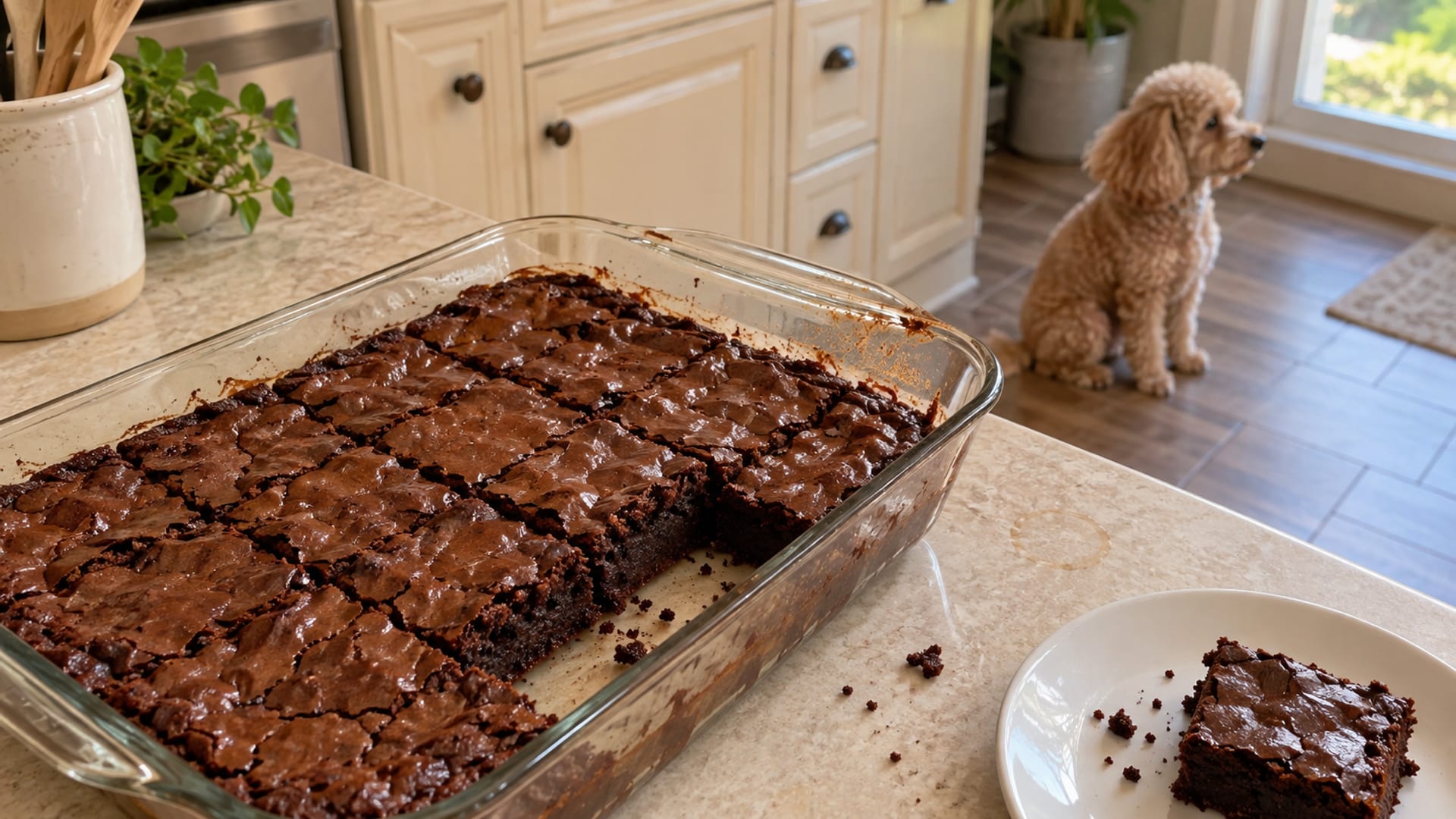
Chocolate brownies are toxic to dogs. If your dog ate or licked any brownie, call your vet, an emergency vet or a pet poison line now, even if your dog looks completely normal, and keep the package, label or recipe beside you for the call.
The danger is theobromine and caffeine, two stimulants in chocolate that the Merck Veterinary Manual says can affect the stomach, heart and nervous system, sometimes badly enough to threaten a dog's life. How serious one brownie turns out to be depends on the kind of chocolate in it, how much your dog ate, how big your dog is, and whether it held xylitol, raisins, macadamia nuts, cannabis or a wrapper. If you do not know all of that yet, call anyway.
Key takeaways
Tap a card to bring it forward.
- Any brownie your dog ate is a reason to call a vet or pet poison line now, before signs appear.
- Brownies made with cocoa powder, baker's chocolate or dark chocolate carry far more theobromine and caffeine than milk or white chocolate ones.
- Chocolate signs usually start 6 to 12 hours after eating, while THC from a pot brownie can show within 30 minutes to an hour.
- Sugar-free, raisin, macadamia nut and cannabis brownies each bring a separate danger on top of the chocolate.
- A brownie is never a treat for a dog, so pans, batter and edibles belong where your dog cannot reach them.
What to do right now if your dog ate a brownie
If it were my dog, I would make the call before sweeping up a single crumb.
- Call your vet, an emergency vet or a pet poison line. The ASPCA and Pet Poison Helpline both advise calling right away after chocolate, even when the dog seems fine, since signs are often delayed.
- Keep the package, label or recipe. Pet Poison Helpline says the ingredient list and product name help them judge the exposure, and the ASPCA asks owners to note fillings such as raisins or macadamia nuts.
- Work out roughly how much is gone. One square off a plate and a whole pan off the counter lead to very different advice, so count what is missing, check the floor and the dog bed for crumbs, and note the time.
- Have your dog's weight ready. The same brownie is a bigger dose for a small dog, and the ASPCA points out that less chocolate can be a problem for smaller dogs.
- Check the label for extras. Look for sugar-free, xylitol, birch sugar, raisins, macadamia, or anything that says THC, cannabis or marijuana, and look for a missing wrapper or foil.
- Follow the plan you are given. Merck lists monitoring, emptying the stomach, fluids and heart or nerve medicines as possible treatments, chosen by the vet.
Which brownies are the most dangerous
The type of chocolate matters as much as the size of the piece. Pet Poison Helpline lists chocolate baked goods, brownies included, among its hazards, and time in the oven does not reliably remove theobromine or caffeine.
Tap or hover a row to highlight it.
| Brownie or part | Main concern |
|---|---|
| Brownie or partCocoa powder or baker's chocolate brownies | Main concernThe most concentrated theobromine and caffeine |
| Brownie or partDark or semisweet chocolate brownies, chips or chunks | Main concernHigh stimulant content per bite |
| Brownie or partMilk chocolate brownies or frosting | Main concernLower concentration, still a chocolate exposure |
| Brownie or partWhite chocolate brownies | Main concernVery little theobromine; fat and sugar can upset the stomach or lead to pancreatitis |
| Brownie or partRaw brownie batter or mix | Main concernThe same chocolate hazard as baked, plus raw eggs and flour |
| Brownie or partSugar-free brownies | Main concernMay contain xylitol, which can drop blood sugar fast and injure the liver |
| Brownie or partBrownies with raisins | Main concernPossible kidney injury |
| Brownie or partBrownies with macadamia nuts | Main concernNerve and stomach signs |
| Brownie or partPot, weed or THC brownies | Main concernTHC poisoning in addition to the chocolate |
| Brownie or partWrappers, foil or packaging | Main concernChoking or a blocked gut, mainly in small dogs |
Frosting, ganache and filling count as chocolate too, judged by the chocolate that went into them. Our Grapes and raisins, Chocolate and White chocolate entries go further into each of those.
How much brownie is too much for a dog
There is no serving size for brownies. The American Kennel Club says chocolate should never be fed as a treat, and recipes change too much from kitchen to kitchen to plan around any amount.
What vets do have are numbers for methylxanthines, the family that includes theobromine and caffeine. Merck gives these approximate doses for dogs, per kilogram of body weight:
Tap or hover a row to highlight it.
| Dose per kg of body weight | What may happen |
|---|---|
| Dose per kg of body weightAbout 20 mg/kg | What may happenMild signs such as vomiting, diarrhea and increased thirst |
| Dose per kg of body weightAbout 40 to 50 mg/kg | What may happenEffects on the heart |
| Dose per kg of body weight60 mg/kg or more | What may happenSeizures |
| Dose per kg of body weight100 to 200 mg/kg | What may happenReported lethal dose for half of dogs; Merck warns severe signs and death can occur at lower doses |
Merck also lists how much each type of chocolate holds, which is why a cocoa-heavy brownie worries a vet more than a milk chocolate one:
Tap or hover a row to highlight it.
| Chocolate | Approximate mg per gram |
|---|---|
| ChocolateCocoa powder | Approximate mg per gram28.5 |
| ChocolateUnsweetened baker's chocolate | Approximate mg per gram15.5 |
| ChocolateSemisweet and sweet dark chocolate | Approximate mg per gram5.3 to 5.6 |
| ChocolateMilk chocolate | Approximate mg per gram2.3 |
| ChocolateWhite chocolate | Approximate mg per gram0.04 |
Those are chocolate numbers. A brownie's dose cannot be worked out reliably without the recipe, the chocolate type, the amount eaten and the dog's weight, and dogs react differently even at the same dose. Merck puts about 1 ounce of milk chocolate per pound of body weight in the potentially lethal range. A study in the Journal of Small Animal Practice of 156 chocolate-eating events in dogs found calculated theobromine doses from 0.8 to 303 mg/kg, with a median of 22.4 mg/kg. With a spread that wide, the call is where the math gets done, using your recipe and your dog's weight.
Signs to watch for and when they start
According to Merck, signs of chocolate poisoning usually begin within 6 to 12 hours and can include:
- vomiting, diarrhea and a swollen belly
- drinking and peeing more than usual
- restlessness, pacing or hyperactivity
- fast breathing and a racing heart
- wobbly walking, trembling or tremors
- a high body temperature
- seizures, collapse or coma in severe cases
High blood pressure and an abnormal heart rhythm are hard to see at home. Pet Poison Helpline notes that dogs clear theobromine slowly, so a dog can get worse over time instead of better. In the worst cases, Merck describes death from heart rhythm problems, overheating, breathing failure or severe nerve damage, and a high-fat brownie can also set off pancreatitis.
A pot brownie runs on a faster clock. Pet Poison Helpline says THC signs may show within 30 minutes to 1 hour and can last up to 24 hours, depending on the dose and product. The University of Illinois College of Veterinary Medicine lists sleepiness, stumbling, dilated pupils, dribbling urine, an abnormal heart rate, tremors and seizures, with the edible's chocolate, raisins, xylitol and fat adding their own trouble.
My dog ate a brownie before and was fine
Maybe your dog once snatched a brownie off the coffee table, threw up once and was fine by morning. I believe that happened. It still does not make brownies safe for the next dog, or for the same dog with a different pan.
The amount eaten may have stayed below the dose that causes signs. A bigger dog gets a smaller dose per kilogram from the same square. A milk chocolate boxed mix holds far less theobromine than a brownie made with cocoa powder or baker's chocolate. ASPCA Animal Poison Control points to the amount, the dog's size and individual sensitivity, and Merck adds that susceptibility varies from dog to dog. Signs can also start hours later, after everyone has gone to bed, when extra thirst or restlessness is easy to miss. No two brownies and no two dogs are the same, so the last time is not a guide for this time.
Brownie products, look-alikes and keeping them out of reach
The label tells you more than the name does. Brownie bites, Cosmic Brownies, fudge brownies, protein brownies and packaged snack cakes are shapes and brands, and their ingredient lists can reveal the chocolate type, xylitol, raisins, macadamia nuts, caffeine or cannabis. "Chocolate-flavored" does not say how much cocoa is inside.
On sugar-free brownies, xylitol can also appear as birch sugar or wood sugar. A carob brownie is not a chocolate exposure, though it can still be high in fat and sugar, so the whole ingredient list matters. Pot, weed, THC and marijuana brownies, and any cannabis edible, mean possible cannabis exposure alongside the chocolate. Cocoa mulch in the garden also contains methylxanthines, even though nobody bakes with it. For brownies with nuts, our Nuts entry sorts through the common ones.
A study in Veterinary Record found dogs' chocolate exposures climb around Christmas and Easter, and the AKC names Halloween as another common time, which is why Halloween candy has its own entry. Push the pan to the back of the counter or into the oven with the door shut, keep batter bowls off low tables, put wrappers in a lidded trash can, and store edibles in a closed container up high, above nose level for the tallest dog in the house.
Check what you learned
Three questions on the points that matter most.
Quick check
Questions about dogs and brownies
A few more situations owners ask about.
Is a white chocolate brownie safe for my dog?
White chocolate holds very little theobromine, so classic chocolate poisoning is unlikely from it. The fat and sugar can still upset the stomach or lead to pancreatitis, and a sugar-free version may contain xylitol. It is still not a treat, so call if your dog ate a lot or the label lists xylitol.
Are brownies worse than a plain chocolate bar?
It depends on the recipe. An older Pet Poison Helpline page says one or two bites of brownie are less likely to cause poisoning than baker's chocolate or a whole milk chocolate bar. A brownie is harder to judge, though, because it can hide cocoa powder, xylitol, raisins, nuts or cannabis that a plain bar would not.
Does a puppy, senior dog or pregnant dog need help faster?
Pet Poison Helpline recommends extra caution for puppies, older dogs, pregnant dogs and dogs with health problems, and asks their owners to call right away. A dog with a history of pancreatitis may also react more to a rich, high-fat brownie, so mention that history on the call.
Can brownies hurt my cat too?
Cats are sensitive to theobromine as well. The ASPCA notes that cats rarely eat much chocolate because they cannot taste sweetness, but a cat that ate brownie needs the same call.
What if my dog ate the wrapper or foil too?
Mention it on the call. Wrappers and packaging can cause choking or block the intestines, especially in small dogs, and that changes what the vet watches for alongside the chocolate.
Sources
Checked September 25, 2026.
- Merck Veterinary Manual, Chocolate Toxicosis in Animals
- ASPCA, What to Do If Your Pet Gets into Chocolate
- ASPCA Animal Poison Control Center, Is This Safe? Our Top Five Most Commonly Asked Questions about Pets
- Pet Poison Helpline, Chocolate Are Toxic To Pets
- Pet Poison Helpline, Chocolate Is Poisonous To Dogs
- Pet Poison Helpline, What happens if my dog eats chocolate?
- Pet Poison Helpline, My Dog Ate Chocolate, What Should I do?
- Pet Poison Helpline, My Dog Ate Marijuana Brownies
- American Kennel Club, Can Dogs Eat Chocolate?
- Journal of Small Animal Practice, Chocolate ingestion in dogs: 156 events
- Veterinary Record, Heightened risk of canine chocolate exposure at Christmas and Easter
- University of Illinois College of Veterinary Medicine, Marijuana and Pets Should Not Mix