

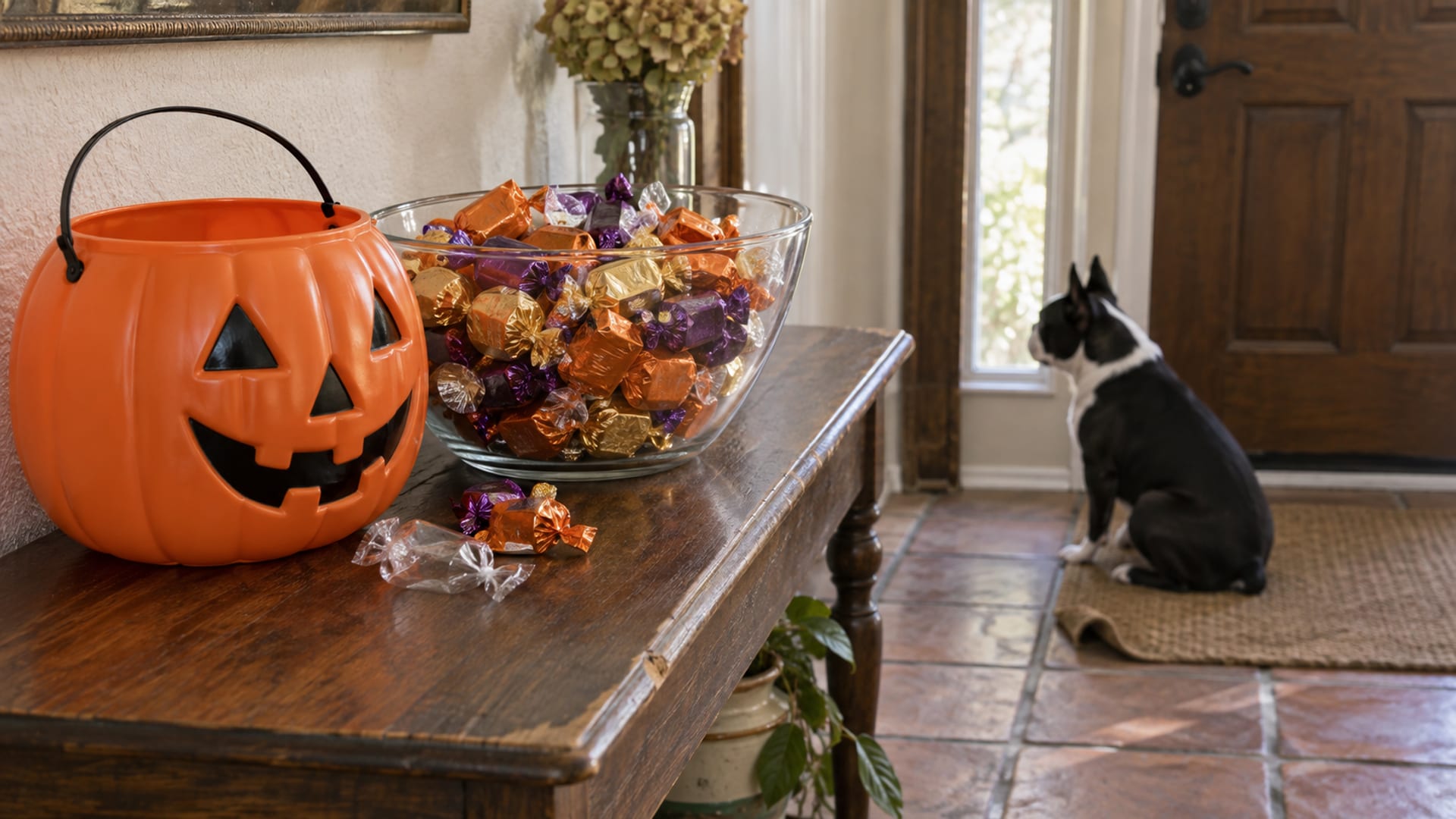
Halloween candy should stay out of your dog's reach, and some of it is an emergency. If your dog got into chocolate, sugar-free candy or gum, or anything with raisins, call your vet, an emergency vet or a pet poison line now, even if your dog seems fine. Do the same if you cannot tell what they ate or how much.
The ASPCA puts it simply: collect the evidence. Grab the wrappers and the bag so whoever you call can see what the candy was, what was inside it, and how much is missing.
Key takeaways
Tap a card to bring it forward.
- Chocolate can poison a dog, and dark and baking chocolate are the strongest.
- Sugar-free candy, gum and mints can contain xylitol, which can drop a dog's blood sugar within an hour.
- Chocolate-covered raisins and trail mix can cause kidney injury.
- Wrappers, foil and lollipop sticks can choke a dog or block the gut.
- Plain sugar candy usually means an upset stomach, but read the label before you decide it is plain.
Your dog ate Halloween candy: what to do first
- Move the dog and the candy apart. Pick up the bowl, the bag and any wrappers on the floor.
- Gather the evidence. Keep the wrappers and packaging, and count what is missing if you can.
- Read the ingredients. Look for chocolate or cocoa, xylitol (also sold as birch sugar or wood sugar), raisins, macadamia nuts, coffee or alcohol.
- Note your dog's weight and roughly when they ate it.
- Call your vet, an emergency vet or one of the poison lines at the top of this page. The American Kennel Club says the first job is working out what type and how much candy your dog ate, and it calls for an immediate vet visit when xylitol may be involved.
For chocolate, our dog toxin dose checker estimates the dose from your dog's weight and the chocolate type, so you have a number ready for the call.
Which Halloween candy is the real danger
Tap or hover a row to highlight it.
| Candy or ingredient | What it can do | When signs usually start |
|---|---|---|
| Candy or ingredientChocolate bars and chocolate candy | What it can doVomiting, restlessness, racing heart, tremors, seizures | When signs usually startWithin 6 to 12 hours |
| Candy or ingredientDark, semisweet or baking chocolate, cocoa | What it can doThe same, from a smaller amount | When signs usually startWithin 6 to 12 hours |
| Candy or ingredientSugar-free candy, gum and mints with xylitol | What it can doLow blood sugar, weakness, collapse, seizures; liver damage | When signs usually start30 minutes to 1 hour; liver injury over 12 to 24 hours |
| Candy or ingredientChocolate-covered raisins, raisin snacks | What it can doKidney injury | When signs usually startVomiting within 6 to 12 hours; kidney failure within 24 to 48 hours |
| Candy or ingredientCandy with macadamia nuts | What it can doWeakness, wobbly walk, vomiting, tremors | When signs usually startVaries |
| Candy or ingredientCoffee-flavored or alcohol-filled candy | What it can doCaffeine or alcohol poisoning | When signs usually startVaries |
| Candy or ingredientWrappers, foil, cellophane, lollipop sticks | What it can doChoking, gut irritation, blockage | When signs usually startGagging right away; blockage signs later |
| Candy or ingredientHard candy | What it can doChoking; large amounts can clump in the gut | When signs usually startVaries |
| Candy or ingredientCaramel, nougat and creamy fillings | What it can doUpset stomach, pancreatitis in some dogs | When signs usually startVaries |
| Candy or ingredientPlain sugar candy, no risky ingredients | What it can doUpset stomach | When signs usually startHours |
Chocolate. The Merck Veterinary Manual explains that chocolate contains theobromine and caffeine, and the darker the chocolate, the more it holds. Milk chocolate has less, but a small dog can still eat enough of it. White chocolate has very little, though its fat and fillings can still cause trouble. Can dogs eat chocolate? goes through the types and amounts.
Xylitol. This sweetener shows up in sugar-free candy, gum and mints, and sometimes in peanut butter fillings and baked goods not sold as sugar-free. Merck's section on xylitol reports that as little as 0.1 g per kg of body weight has caused dangerously low blood sugar and liver damage in some dogs. Pet Poison Helpline notes that the amount of xylitol varies widely by brand and flavor, so the label on the pack in your hand matters more than any general rule.
Raisins. The Merck grape and raisin chapter links grapes, raisins and Zante currants to sudden kidney injury in dogs, with no amount that can be called safe. Can dogs eat grapes? covers what happens next.
Wrappers. The AKC's Halloween safety guide warns that wrappers and hard candy can cause choking and blockages. A dog that eats the whole bag often eats the packaging too.
Signs to watch for in the next day or two
- vomiting or diarrhea
- restlessness, pacing, panting or a racing heart
- drinking and peeing more than usual
- trembling, wobbling or a seizure
- weakness, sleepiness or collapse
- gagging, repeated swallowing, belly pain or straining to pass stool
Some of these can wait hours to show. Chocolate signs often start 6 to 12 hours after the candy, the ASPCA notes that liver damage from xylitol can develop over 12 to 24 hours, and raisin kidney injury can take a day or two. A dog who looks fine at bedtime is not yet in the clear, which is why the call comes first.
"My dog ate a whole bag of candy last Halloween and was fine"
That happens, and it was a real outcome. It depended on things that change from bag to bag: which candy it was, how much chocolate was in it and how dark, whether any of it was sugar-free, and how big your dog was at the time. Merck notes that dogs vary in how sensitive they are to the stimulants in chocolate, and the dose of xylitol changes from brand to brand. A bag of plain sugar candy and a bag of dark chocolate look the same on the floor. Treat each night as its own case and call when you are not sure.
Safer ways to include your dog in Halloween
- Dog treats: a treat made for dogs is the better pick for trick-or-treat night. Check the ingredients for xylitol anyway.
- Plain pumpkin: plain cooked or canned pumpkin, not pie filling. See can dogs eat pumpkin?
- Plain popcorn: air-popped with nothing on it. See can dogs eat popcorn?
- Peanut butter: only a brand with no xylitol. See can dogs eat peanut butter?
- Plain peanuts: unsalted, in small amounts. See can dogs eat peanuts?
For other candy you may have in the house, see can dogs eat candy canes?, can dogs eat jelly beans? and can dogs eat marshmallows?
Keep the candy bowl up high, and put trick-or-treat bags away as soon as the kids get home. Check the yard and the trash the next morning too, since dropped candy and wrappers are easy to miss.
Check what you learned
Quick check
Questions about dogs and Halloween candy
Can a dog eat one piece of Halloween candy?
It depends on the piece. A small plain sugar candy usually causes little more than an upset stomach. One piece of dark chocolate, sugar-free gum or a chocolate-covered raisin can matter, especially for a small dog.
What Halloween candy is most dangerous for dogs?
Chocolate, especially dark and baking chocolate, anything sugar-free that contains xylitol, and candy with raisins. Candy with coffee, alcohol or macadamia nuts is also on the list.
How long after eating candy will a dog get sick?
Xylitol can cause signs within 30 minutes to an hour. Chocolate often takes 6 to 12 hours. Raisins can cause vomiting within 6 to 12 hours and kidney failure within a day or two.
Are candy wrappers dangerous for dogs?
Yes. Wrappers, foil, cellophane and lollipop sticks can cause choking or a blockage in the gut, even when the candy itself was harmless. Call your vet if your dog swallowed several.
My dog ate candy and is shaking. Is that an emergency?
Yes. Trembling after candy can point to chocolate or xylitol. Take your dog to an emergency vet now and bring the wrappers.
Sources
Checked September 25, 2026.
- ASPCA, What to Do If Your Pet Gets into Chocolate
- ASPCA Animal Poison Control Center, People Foods to Avoid Feeding Your Pets
- Merck Veterinary Manual, Chocolate Toxicosis in Animals
- Merck Veterinary Manual, Hepatotoxins in Small Animals
- Merck Veterinary Manual, Grape, Raisin, and Tamarind Toxicosis in Dogs
- Pet Poison Helpline, Halloween Safety Tips for Pets
- American Kennel Club, What to Do if Your Dog Ate Candy
- American Kennel Club, Halloween Dog Safety Tips: Candy, Costumes and Hazards