

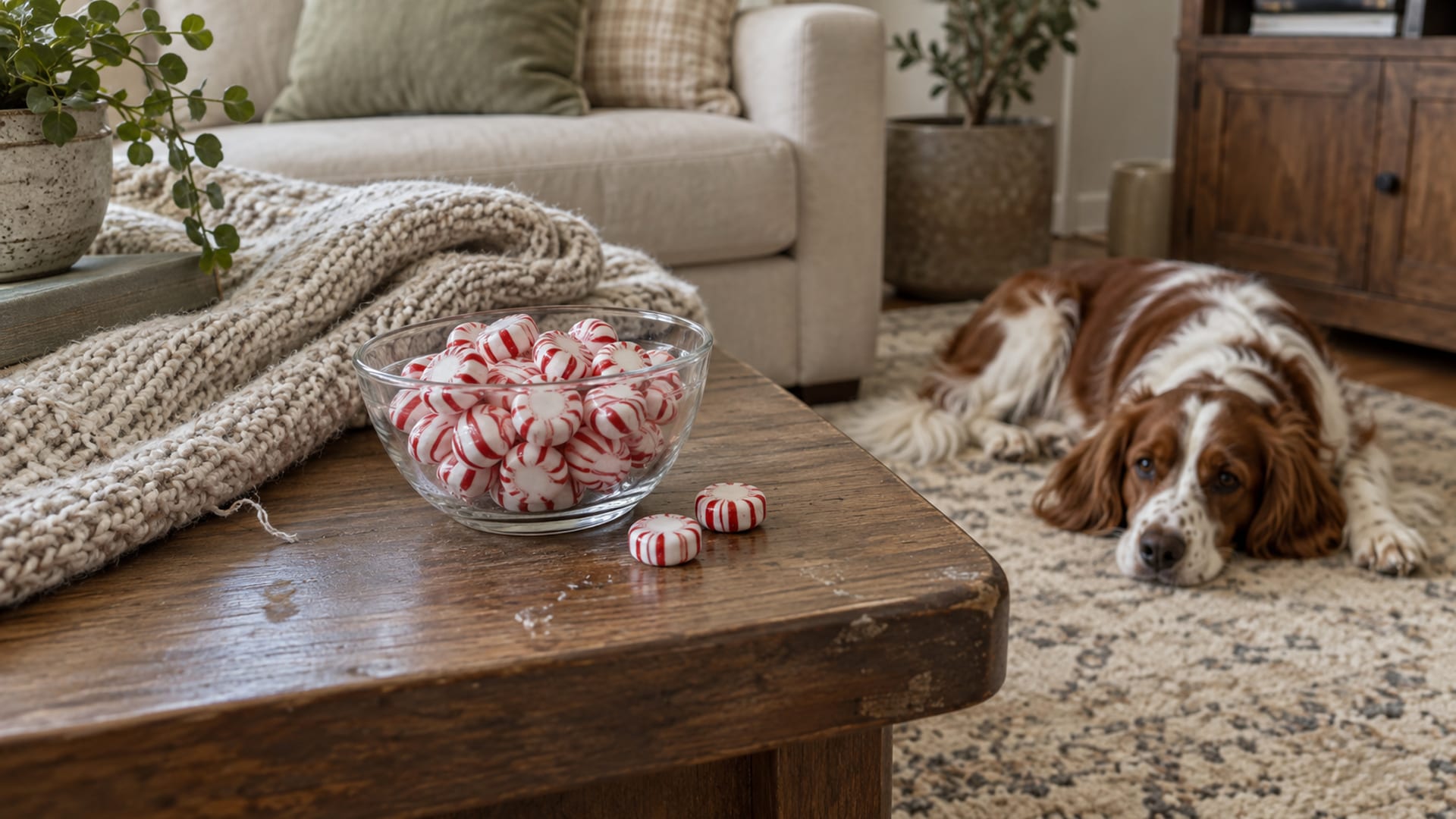
Peppermint candy is a caution item, and the first thing to find out is whether it was sugar-free. One ordinary sugar peppermint is low risk for most dogs, though it can upset the stomach and a hard piece or swallowed wrapper can choke a dog or block the gut, while a sugar-free peppermint or mint may contain xylitol, a sweetener that can drop a dog's blood sugar fast and injure the liver.
If your dog has already emptied the candy dish or chewed open a tin of breath mints, find the bag or tin and read the ingredients for xylitol. The ASPCA's updated xylitol warning tells owners to contact a veterinarian or its Animal Poison Control Center whenever a dog gets into a product that has xylitol or could have it. Call even if your dog is acting normal. Plain sugar peppermints with no xylitol give you more room: count what's missing, look for the wrappers, and keep an eye on your dog.
Key takeaways
Tap a card to bring it forward.
- Sugar-free peppermints, breath mints and lozenges may contain xylitol. Check the label for xylitol, birch sugar or wood sugar.
- Possible xylitol means a call right away, even if your dog seems fine, because liver signs can show up hours to days later.
- A plain sugar peppermint usually means an upset stomach at most, but hard pieces and wrappers can choke a dog or block the gut.
- Small dogs, puppies, several candies at once and swallowed wrappers all raise the level of concern.
- Peppermint candy stays off the treat list, sugar or sugar-free.
What to do if your dog already ate peppermint candy
An empty candy bowl makes it hard to think in order, so these steps follow the order your vet will ask about things.
- Find the package and hold on to it. The ingredient list tells you whether you're dealing with sugar or xylitol, and the vet will want the exact product name. For loose starlight mints, dig out the bag they came in.
- Read the label for xylitol, birch sugar or wood sugar. All three names mean the same sweetener, and "sugar-free" on the front of the pack doesn't tell you which sweetener is inside.
- Count what's gone and note the time. The Merck Veterinary Manual measures xylitol risk by how much a dog eats per kilogram of body weight, so the count, the time and your dog's weight are the first facts anyone will need.
- Look for every wrapper. Check the floor, the dog bed and the couch cushions. A wrapper you can't find may be inside your dog, where it can cause choking or a blockage.
- Call if xylitol is possible, the amount is unknown, or wrappers went down. Pet Poison Helpline advises getting veterinary care as soon as possible when a dog eats peppermint candy, and a possible xylitol exposure needs that call even while your dog looks well.
- Skip home remedies and human medicine. What helps depends on exactly what was eaten, so let the vet or poison line decide on treatment.
If the label shows ordinary sugar and no xylitol, your dog ate one or two pieces, and every wrapper is accounted for, things are less urgent. Watch your dog for the rest of the day. It still makes sense to call for a puppy, a small dog, a large amount, a missing wrapper or any sign that something is off.
Which peppermint candies and mint products carry the most risk
Peppermint shows up in a lot of forms around the house, and the sweetener, the coating and how concentrated the peppermint is make most of the difference.
Tap or hover a row to highlight it.
| Product | Main concern | What to do |
|---|---|---|
| ProductStarlight mints and other hard sugar peppermints | Main concernStomach upset, choking, blockage from hard pieces or wrappers | What to doCount pieces and wrappers; call for small dogs, puppies or missing wrappers |
| ProductSoft peppermints and peppermint puffs | Main concernMay be sugar-based or sugar-free | What to doRead the label for xylitol first |
| ProductSugar-free peppermints, breath mints and lozenges | Main concernMay contain xylitol | What to doCall right away if xylitol is listed or you can't check |
| ProductChocolate-covered mints and peppermint bark | Main concernChocolate adds its own toxic compounds | What to doCall and mention the chocolate |
| ProductPeppermint oil or extract | Main concernConcentrated oil with a higher toxicity risk | What to doCall with the bottle in hand |
The peppermint flavor itself is the smallest part of the problem. The Merck Veterinary Manual's section on herbal medicine identifies peppermint as *Mentha piperita* and lists mild stomach upset, nausea and vomiting when it's swallowed. Concentrated oil is another matter. According to Merck's page on essential oil toxicoses, concentrated oils can affect the gut, nervous system, breathing, liver or kidneys.
Chocolate-covered mints bring a second hazard, and our Chocolate entry covers that part. Candy canes raise the same label and wrapper questions and have their own Candy canes entry. Peppermint tea without xylitol, caffeine or other additives is a separate product from candy, so see our Tea entry if that's what your dog got into.
How much peppermint candy is a problem
Published toxic doses exist only for xylitol, and they're measured against the dog's weight. Peppermint candy as a whole has no toxic dose, because recipes differ by brand and many packs don't say how much xylitol each piece holds.
Tap or hover a row to highlight it.
| Xylitol eaten | What can happen | Source |
|---|---|---|
| Xylitol eatenBelow 100 mg/kg (0.1 g/kg) | What can happenLow blood sugar has been reported in some dogs | SourceMerck Veterinary Manual |
| Xylitol eatenMore than 100 mg/kg (0.1 g/kg) | What can happenLow blood sugar may occur | SourceMerck Veterinary Manual |
| Xylitol eatenMore than 500 mg/kg (0.5 g/kg) | What can happenRisk of liver damage | SourceMerck Veterinary Manual; Schmid and Hovda case report |
Those figures come from the Merck Veterinary Manual and a case report by Schmid and Hovda about a dog that went into liver failure after eating xylitol. The first row matters most: dogs have had low blood sugar below the usual 100 mg/kg mark. Since you rarely know how much xylitol each mint held, skip the math and give the vet your dog's weight, the number of pieces and the product name.
Because the dose is counted per kilogram, a handful of sugar-free mints is a much bigger exposure for a small dog than for a large one. Puppies may have a harder time with low blood sugar, although no separate puppy threshold has been set, so any xylitol exposure in a puppy is a call.
As for sharing, peppermint candy gives a dog nothing it needs, and no veterinary source offers a serving size. Sugar adds empty calories that dogs with diabetes, obesity, pancreatitis, liver disease or a touchy stomach are better off without. If you like handing your dog something while you have a mint, use one of its regular treats.
Signs to watch for over the next few days
Xylitol works in two waves, while sugar candy and wrappers cause trouble of a different kind.
With xylitol, the first signs can begin within about 30 minutes to an hour, according to the American Kennel Club and Merck. Low blood sugar can look like vomiting, weakness, tiredness, staggering, poor coordination, tremors, collapse, seizures or coma. Liver injury can follow 8 to 12 hours later, and the ASPCA notes liver signs can appear two or three days after the dog ate the product. Watch for loss of appetite, vomiting, diarrhea, low energy, yellow gums or eyes, or bleeding problems. At its worst, xylitol poisoning ends in liver failure or death, which is why the call comes before the signs.
With plain sugar peppermints, mild stomach upset is the expected result. Gagging, pawing at the mouth or trouble breathing right after eating points to choking. Over the next day or two, repeated vomiting, a painful or tight belly, low energy or trouble passing stool can point to a blockage from a hard piece or wrapper, and each of those needs a vet.
My dog ate peppermints before and was fine
That happens, and I believe it. A dog raids a bowl of holiday mints, nothing comes of it, and next time it's natural to relax. The outcome was real for that dog on that day. It just doesn't predict this time, for a few reasons.
- The candy may have had no xylitol. A sugar peppermint and a sugar-free one can look identical, and recipes differ even between candies with the same flavor.
- The dose per kilogram was different. A larger dog, or one that ate only a piece or two, took in less for its size.
- Dogs respond differently. The review Household Food Items Toxic to Dogs and Cats describes real variation in how individual dogs react to xylitol.
- Some damage shows up later. A dog that seems fine in the first hour can still develop liver signs over the next few days.
For today's candy, the label and the count are what matter.
Other products that contain xylitol or get mixed up with peppermint candy
Many items that cause the same worry aren't sold as candy. The ASPCA points to chewing gum, breath mints, toothpaste, lozenges, vitamins and some medicines as places xylitol turns up, so if your dog got into a purse or bathroom drawer, check those labels too.
"Mint" can mean peppermint, spearmint or another mint flavor, and fresh or dried leaves are a different question from candy; our Mint entry covers the plant. Pennyroyal, *Mentha pulegium*, is a separate plant, and Merck describes concentrated pennyroyal preparations as toxic to the liver. Pet Poison Helpline's page on mint and dogs separates ordinary mint products from the xylitol risk. Around the holidays, peppermints often sit mixed in with other sweets, and our Halloween candy entry helps when the bowl held a bit of everything.
Check what you learned
These three questions cover what matters most if your dog gets into mints again.
Quick check
Questions about dogs and peppermint candy
These come up once the first call is made or the label turns out fine.
What if my dog swallowed a wrapper but didn't eat the candy?
The wrapper is still a foreign object and can cause choking or a blockage on its own. Call your vet, especially for a small dog or more than one wrapper, and watch for vomiting, belly pain, low energy or trouble passing stool.
Is a sugar-free mint a better choice for a dog with diabetes?
A sugar-free mint is the riskier choice, because xylitol triggers a big release of insulin in dogs and can drop blood sugar to dangerous levels. Sugar candy isn't a good fit for a diabetic dog either, so neither belongs on the treat list.
Why do peppermint candy calls go up around the holidays?
Pet Poison Helpline ties peppermint candy exposures to Halloween and Christmas, when candy bowls sit at nose height and guests leave mints in coat pockets. A high shelf for the dish and zipped bags for visitors keep the candy out of reach.
Are cats at the same risk if they got into the mints too?
Cats react differently. The ASPCA says cats aren't known to develop the low blood sugar and liver failure that xylitol causes in dogs. Merck notes, though, that cats are more sensitive than dogs to some essential oils, so peppermint oil is a real concern for a cat.
Sources
Checked September 25, 2026.
- Pet Poison Helpline, Can Dogs Eat Peppermint Candy
- Pet Poison Helpline, Can Dogs Have Peppermint Candy
- Pet Poison Helpline, Mint and Dogs
- ASPCA, Updated Safety Warning on Xylitol: How to Protect Your Pets
- ASPCA, Xylitol: The Sweetener That Is Not So Sweet for Pets
- Merck Veterinary Manual, Xylitol Toxicosis in Dogs
- Merck Veterinary Manual, Toxicoses From Essential Oils in Animals
- Merck Veterinary Manual, Herbal Medicine in Veterinary Patients
- American Kennel Club, What to Do if Your Dog Ate Candy
- Schmid and Hovda, Acute Hepatic Failure in a Dog after Xylitol Ingestion
- Peer-reviewed review, Household Food Items Toxic to Dogs and Cats