

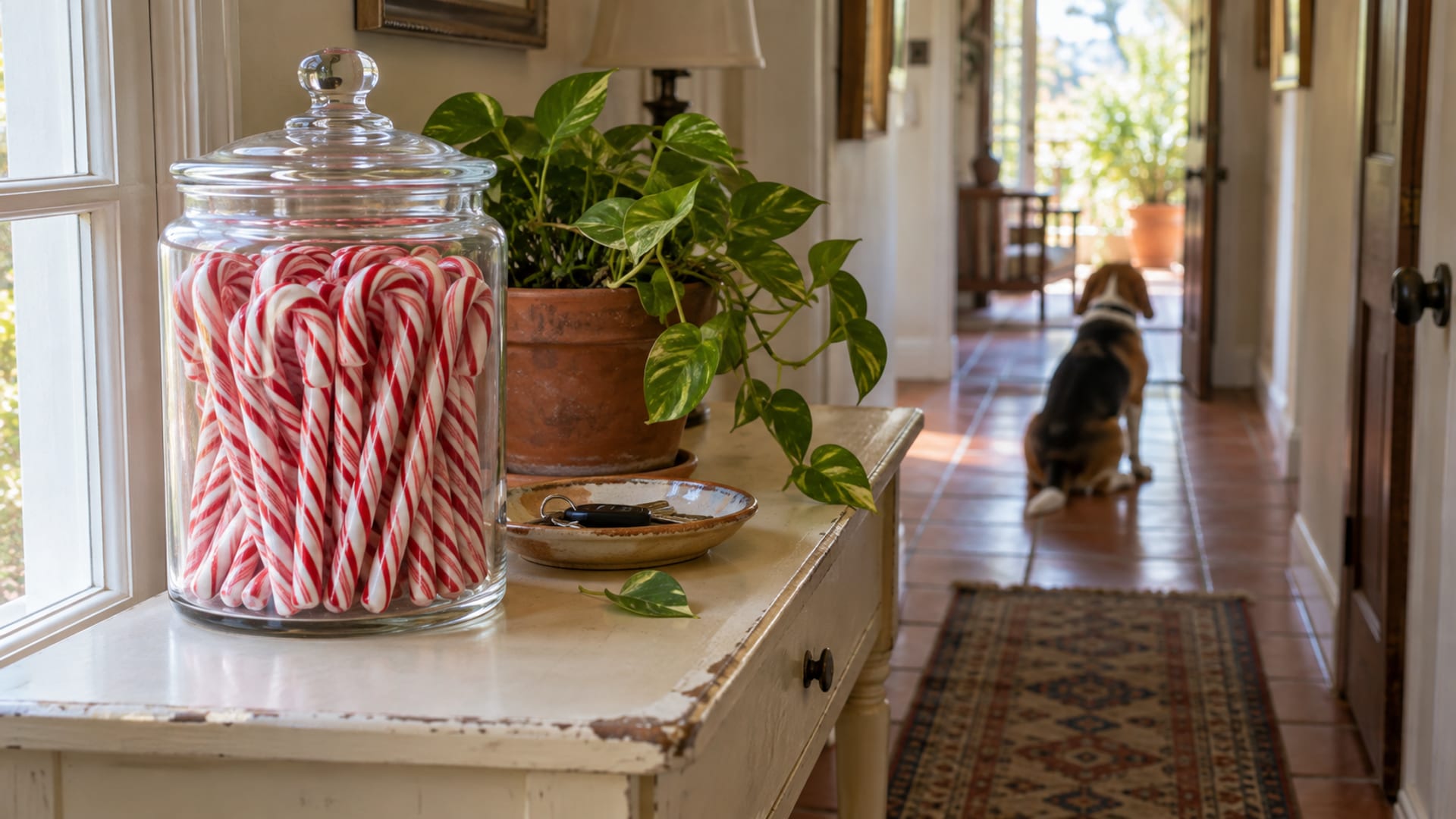
A lick or a small piece of an ordinary candy cane made with sugar is unlikely to poison your dog. The two real dangers are the label and the shape: some sugar-free candy is sweetened with xylitol, which the FDA warns is dangerous for dogs, and hard candy pieces or a swallowed wrapper can choke a dog or block the gut, according to the AKC.
Find the box or wrapper and read the ingredients now. If it says xylitol, birch sugar, wood sugar or birch bark extract, or you cannot tell what was in it, call your vet, an emergency vet or a pet poison line right away.
Key takeaways
Tap a card to bring it forward.
- A small piece of a regular sugar candy cane is rarely a poisoning, though it can upset the stomach.
- Sugar-free canes may contain xylitol, also listed as birch sugar or wood sugar. That is a call-now situation.
- Xylitol can drop a dog's blood sugar within an hour and can damage the liver a day or two later.
- Big hard chunks and plastic wrappers can choke a dog or block the gut.
- Chocolate-dipped canes and holiday treats bring their own risks, so read every label.
My dog ate a candy cane: check the label first
Tap or hover a row to highlight it.
| What your dog ate | Next step |
|---|---|
| What your dog ateA lick or small piece of a regular sugar cane, no wrapper | Next stepWatch for vomiting or diarrhea. No call needed if your dog stays normal. |
| What your dog ateA sugar-free or "no sugar added" cane, or one with xylitol, birch sugar or wood sugar | Next stepCall your vet or a poison line now, before any signs. |
| What your dog ateA cane with no label, or you are not sure which kind | Next stepCall now and treat it as possible xylitol. |
| What your dog ateSeveral whole canes, a large hard chunk, or the plastic wrapper | Next stepCall your vet for advice, and watch for choking, repeated vomiting or belly pain. |
| What your dog ateA cane dipped in chocolate, or a holiday candy with raisins or alcohol | Next stepCall your vet or a poison line with the package. |
When you call, have the package, your dog's weight, roughly how much is gone and when it happened. Pet Poison Helpline asks owners who suspect xylitol to call a vet or its line as soon as possible.
Why a sugar-free candy cane is an emergency
In dogs, xylitol sets off a fast release of insulin that drops blood sugar, and higher amounts can injure the liver, according to the Merck Veterinary Manual.
- Merck links more than about 0.1 gram per kilogram of body weight with low blood sugar.
- It links more than about 0.5 gram per kilogram with severe liver injury or liver failure.
- A review of hypoglycemia in dogs reports low blood sugar at doses as low as 0.03 gram per kilogram in some dogs.
Those are amounts of xylitol, and a candy cane's label rarely says how much xylitol it holds. Pet Poison Helpline notes that the amount varies widely from product to product. That is why the advice is to call for any sugar-free cane, and why a small dog has the least room for error.
Hard pieces and wrappers
Even a regular cane has a physical risk. The AKC warns that hard candy and wrappers can get stuck in the throat or the digestive tract. The risk is highest when a dog swallows a long piece whole, and a plastic sleeve is not food at all.
Signs of a blockage include:
- vomiting again and again
- not wanting to eat
- belly pain or a tight belly
- low energy
- being unable to keep food or water down
Any of those means a call to your vet. Choking or trouble breathing means go now.
Signs of xylitol poisoning, and when they show
Tap or hover a row to highlight it.
| When | What you may see |
|---|---|
| WhenOften within 10 to 60 minutes, sometimes delayed 12 to 18 hours | What you may seeLow blood sugar: vomiting, weakness, tiredness, wobbling or staggering, collapse, seizures |
| When4 to 12 hours | What you may seeLiver values can rise on a blood test before your dog looks sick |
| When24 to 48 hours | What you may seeSigns of liver injury: vomiting, low energy, yellow gums or eyes, unusual bleeding |
Timing from Merck. The FDA says signs can appear within 20 minutes. Low blood sugar caught early may settle with prompt treatment; severe liver injury can be fatal. That delay before the liver signs is the reason to call even when your dog seems fine.
"My dog ate a candy cane last Christmas and was fine"
That happens, and it is a true story about that dog and that cane. Most likely it was a regular sugar cane with no xylitol, or a small piece, or a bigger dog. Sugar-free canes differ from brand to brand, and Merck describes a wide range in how individual dogs handle xylitol. Low blood sugar can also come late, and liver trouble may only show on blood work a day or two later. So, last year's cane tells you little about this year's, especially if this one is sugar-free.
Peppermint candy, mints and other holiday look-alikes
- Peppermint flavor in an ordinary sugar cane is missing from the hazards the sources list, which are xylitol, hard pieces, wrappers and added ingredients.
- Peppermint essential oil is a separate, concentrated product. Do not judge it by the candy.
- Sugar-free mints, gum and candy are products the FDA names as places xylitol can turn up. Treat them like a sugar-free cane. Sugar-free peanut butter can hold it too; see can dogs eat peanut butter?.
- Chocolate-covered peppermint adds chocolate's own danger. See can dogs eat chocolate?
- Holiday baking with raisins brings a kidney risk. See can dogs eat grapes?
- Candy cane-shaped dog treats are a different product. Read their ingredients like any other treat.
- Brand names do not settle anything on their own. Recipes differ between products, so the ingredient list is what counts.
The FDA's holiday safety advice includes mints and candy, so keep stockings, gift baskets and candy bowls up high through the season.
Check what you learned
Quick check
Questions about dogs and candy canes
Can a dog eat one regular candy cane?
A small amount of a regular sugar cane is unlikely to cause poisoning, but keep it off the treat list. Hard pieces and the wrapper can choke a dog or block the gut.
What if the candy cane was sugar-free?
Look for xylitol, birch sugar, wood sugar or birch bark extract on the label. If any is there, or you cannot check, call your vet or a poison line right away.
How fast does xylitol poisoning start?
Low blood sugar can start within 10 to 60 minutes, though some products delay it by 12 to 18 hours.
What if my dog swallowed the wrapper?
A wrapper can lodge in the throat or gut. Call your vet for advice and watch for choking, repeated vomiting, belly pain, not eating or low energy.
Is peppermint poisonous to dogs?
The sources name xylitol, hard pieces, wrappers and add-ins such as chocolate as the dangers in a candy cane. Plain peppermint flavor is absent from that list.
Are candy canes dangerous for cats?
Merck notes that cats are not at risk for xylitol's low blood sugar or liver injury. Candy and wrappers can still upset a cat's stomach or cause a blockage.
Sources
Checked September 24, 2026.
- Merck Veterinary Manual, Xylitol Toxicosis in Dogs
- U.S. Food and Drug Administration, Paws Off Xylitol; It's Dangerous for Dogs (consumer update) and Paws Off Xylitol; It's Dangerous for Dogs (animal health literacy page)
- U.S. Food and Drug Administration, Keep Your Dogs and Cats Safe From Holiday Hazards
- American Kennel Club, What to Do if Your Dog Ate Candy
- Pet Poison Helpline, Xylitol Is Toxic To Dogs
- PubMed Central, Hypoglycemia in dogs: Causes, management, and diagnosis