
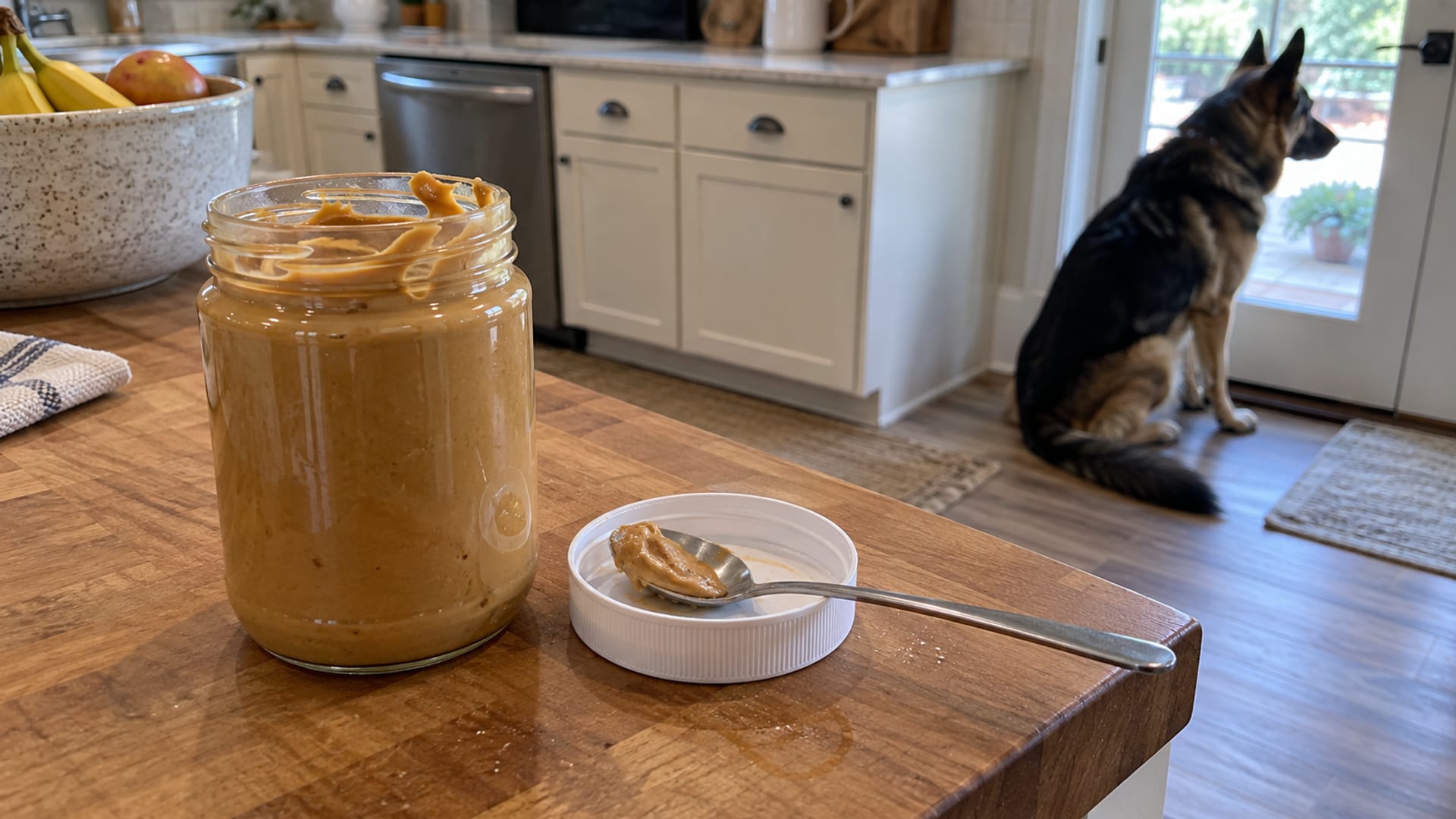
Yes, in small amounts, when it has no xylitol. The American Kennel Club says most peanut butter is safe for dogs fed in moderation. The one to watch for is peanut butter sweetened with xylitol, a sugar alcohol also listed as birch sugar, which can drop a dog's blood sugar fast and damage the liver.
If your dog just licked the spoon or raided the jar, grab the jar and read the ingredients. No xylitol: watch for an upset stomach, especially after a large amount. Xylitol, birch sugar, or a sugar-free label you cannot check: call your vet or a poison line right away, even if your dog seems fine.
Key takeaways
Tap a card to bring it forward.
- Plain peanut butter with no xylitol is fine for most dogs in small amounts.
- Xylitol, also sold as birch sugar or wood sugar, is poisonous to dogs.
- Low blood sugar from xylitol can start within 10 to 60 minutes.
- Peanut butter is high in fat and calories: about 100 calories a tablespoon.
- Read the label every time, including on powdered and "natural" jars.
If your dog already ate peanut butter
Start with the label. It decides everything that follows.
Tap or hover a row to highlight it.
| What the label says | What to do |
|---|---|
| What the label saysPeanuts, maybe salt or oil, no xylitol | What to doWatch for vomiting or diarrhea; call your vet if they keep up |
| What the label saysXylitol, birch sugar or wood sugar anywhere in the list | What to doCall your vet or a poison line now |
| What the label saysSugar-free, keto or low-carb, and you cannot see the ingredients | What to doTreat it as xylitol and call now |
| What the label saysChocolate, cocoa or mocha flavor | What to doCall your vet; chocolate brings its own danger |
| What the label saysA big amount of plain peanut butter | What to doCall your vet, especially if your dog has had pancreatitis |
For a xylitol product, the ASPCA says to call its poison control center if your dog is acting normal, and to take your dog to a vet immediately if signs have started. Bring the jar with you and tell the staff the product contains xylitol.
Go straight to an emergency vet if your dog is weak, wobbly, trembling, collapses or has a seizure after eating any peanut butter.
What makes xylitol so dangerous for dogs
In dogs, xylitol sets off a large release of insulin, which pulls blood sugar down fast. The Merck Veterinary Manual explains that larger amounts can also injure the liver and upset blood clotting.
Tap or hover a row to highlight it.
| Dog's weight | Low blood sugar (above about 0.1 g xylitol per kg) | Liver injury (above about 0.5 g per kg) |
|---|---|---|
| Dog's weight10 lb (4.5 kg) | Low blood sugar (above about 0.1 g xylitol per kg)about 0.45 g of xylitol | Liver injury (above about 0.5 g per kg)about 2.3 g of xylitol |
| Dog's weight22 lb (10 kg) | Low blood sugar (above about 0.1 g xylitol per kg)about 1 g of xylitol | Liver injury (above about 0.5 g per kg)about 5 g of xylitol |
| Dog's weight50 lb (23 kg) | Low blood sugar (above about 0.1 g xylitol per kg)about 2.3 g of xylitol | Liver injury (above about 0.5 g per kg)about 11.5 g of xylitol |
| Dog's weight80 lb (36 kg) | Low blood sugar (above about 0.1 g xylitol per kg)about 3.6 g of xylitol | Liver injury (above about 0.5 g per kg)about 18 g of xylitol |
Thresholds from Merck. These are grams of xylitol itself, and jars often do not say how much xylitol they hold, so you cannot turn a spoonful into a dose at home. A review in The Canadian Veterinary Journal reports low blood sugar at doses as low as 0.03 g per kilogram. Being under a number in this table is no reason to wait.
Small dogs get a bigger dose from the same lick. A tablespoon that a large dog might shrug off can be a serious exposure for a toy breed.
Signs to watch for, and when
- After plain peanut butter: vomiting, diarrhea or a sore belly, usually from the fat. In a dog prone to pancreatitis, a big helping can lead to vomiting, belly pain, tiredness and not eating.
- After xylitol: the AKC says low blood sugar can show up 10 to 60 minutes after eating it. Look for weakness, tiredness, stumbling, poor coordination, vomiting, trembling, collapse or seizures.
- Later, after a larger xylitol dose: liver injury can follow, with worsening tiredness, vomiting, yellow gums or eyes, or unusual bleeding. Merck notes that dogs with severe liver damage have a guarded outlook.
That delay is why a dog who looks normal an hour after xylitol still needs a vet check.
How much plain peanut butter to give
The AKC puts peanut butter at about 100 calories per tablespoon and keeps treats to 10% of a dog's daily calories. Keep it to a small smear for most dogs and even less for a small one.
- Pick a peanut butter with a short list: peanuts, maybe salt. Unsalted is better.
- Skip anything with xylitol, birch sugar, chocolate, cocoa or a honey-roasted flavor.
- A thin layer inside a chew toy goes further than a spoonful.
- If your dog has had pancreatitis, is overweight or has diabetes, ask your vet first.
Using peanut butter to hide pills is common. Check that the jar is xylitol-free, and confirm with your vet that the medicine can be given with food.
"My dog gets peanut butter every day and is fine"
That can be true for your dog and your jar. It says less than it seems about the next jar. Brands and recipes change, and the sugar-free version on the next shelf may carry xylitol while the regular one does not. The amount matters too: xylitol harm depends on the dose for the dog's weight, so the same spoonful weighs very differently on a Yorkie and a Labrador. And some dogs handle rich food better than others. A daily habit is a good reason to read the label on every new jar.
Look-alikes and label traps
- "Natural" peanut butter can still hold added ingredients. Read the full list.
- Sugar-free, keto, low-carb or "no sugar added" labels do not name the sweetener. Look for xylitol, birch sugar or wood sugar.
- Powdered peanut butter can carry added sugar, salt or sweeteners. Same label check.
- Chocolate peanut butter spreads and peanut butter cups add chocolate. See our entry on chocolate.
- Peanuts themselves have their own entry: can dogs eat peanuts?
- Almond, cashew and other nut butters come from tree nuts and each needs its own check.
The ASPCA notes that xylitol does not harm people or cats this way; dogs are the ones at risk.
Check what you learned
Quick check
Questions about dogs and peanut butter
Can dogs eat peanut butter every day?
A small amount of xylitol-free peanut butter can fit, but it is rich, and the AKC keeps all treats to 10% of daily calories. Smaller and less often suits most dogs better.
How do I know if peanut butter has xylitol?
Read the full ingredient list for xylitol, birch sugar or wood sugar. Sugar-free and keto products are the ones to check most closely.
Can I use peanut butter to give my dog pills?
Yes, if the jar has no xylitol and your vet says the medicine can go down with food.
Is crunchy or smooth peanut butter better for dogs?
Either is fine in a small amount. A big sticky lump can be hard for some dogs to swallow, so spread it thin.
Can puppies have peanut butter?
A tiny taste of xylitol-free peanut butter is fine for most puppies. Keep it very small, because the fat can upset a young stomach.
Sources
Checked September 24, 2026.
- American Kennel Club, Can Dogs Eat Peanut Butter?
- American Kennel Club, How to Help Your Dog Lose Weight
- ASPCA, Updated Safety Warning on Xylitol: How to Protect Your Pets
- Merck Veterinary Manual, Xylitol Toxicosis in Dogs
- Idowu and Heading, The Canadian Veterinary Journal, Hypoglycemia in Dogs: Causes, Management, and Diagnosis