
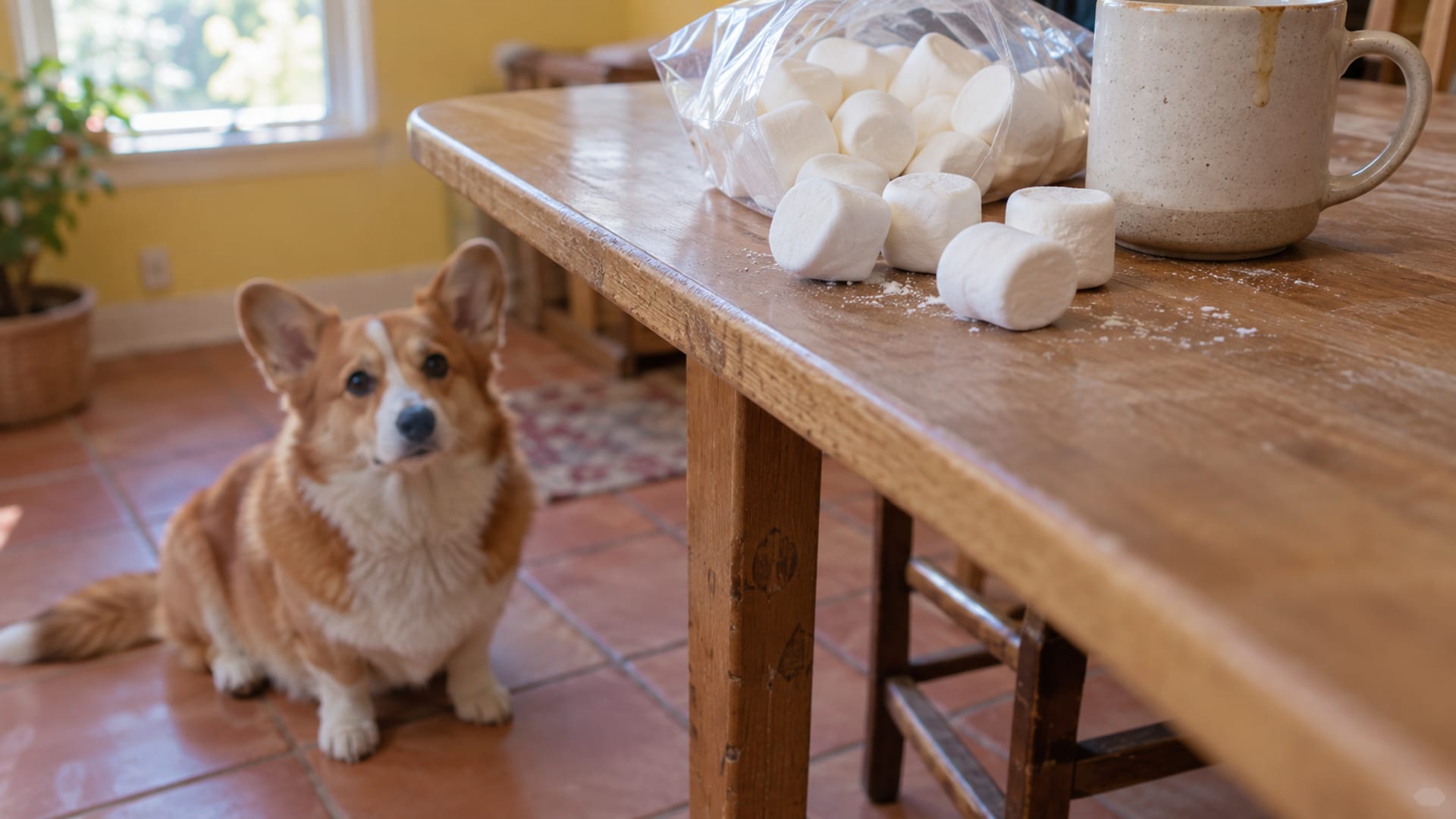
Better not. Marshmallows are made mostly of sugar and corn syrup, offer almost nothing nutritionally, and several at once can upset a dog's stomach, according to the AKC. The bigger danger is xylitol, a sweetener in some sugar-free products that can drop a dog's blood sugar fast and damage the liver, according to the Merck Veterinary Manual.
If your dog just ate marshmallows, find the bag and read the ingredients. If xylitol is listed, or the bag says sugar-free and you cannot confirm what is in it, call your vet or a poison line now, before any signs appear. One plain marshmallow in a healthy dog usually just calls for watching.
Key takeaways
Tap a card to bring it forward.
- Plain marshmallows are not poisonous, but they are sugar with almost no nutrition.
- Xylitol in a sugar-free marshmallow is an emergency. Call right away, even if your dog seems fine.
- Xylitol signs can start within 30 minutes or hold off for 12 to 18 hours.
- Big, sticky marshmallows and swallowed wrappers can choke a dog or block the gut.
- S'mores and hot cocoa bring chocolate into it, and campfire skewers are a hazard of their own.
My dog ate marshmallows: what to do now
- Find the package and read the ingredient list. Xylitol is the word to look for. "Sugar alcohol" is a category name, so it can mean xylitol or another sweetener; look for the ingredient named in full.
- If xylitol is listed, or you cannot rule it out, call now. Pet Poison Helpline's advice is to call your vet or its line "as soon as possible" if you suspect a xylitol product. UC Davis gives the same advice.
- Work out how many and when, and have your dog's weight ready.
- Check for anything else in the treat: chocolate, raisins, macadamia nuts or caffeine. Can dogs eat grapes? explains why raisins matter.
- Look for wrappers and skewers. A swallowed wrapper or stick is its own reason to call.
- For one or two plain marshmallows, watch for choking, vomiting, diarrhea or weakness.
Call right away, whatever the marshmallow was, if your dog is choking, keeps vomiting, turns weak or wobbly, collapses, trembles or has a seizure. Call too if they ate a lot, you do not know how many, or your dog is very small or has diabetes.
How much xylitol is a concern
Plain marshmallows have no toxic dose of their own; the concern with them is sugar, an upset stomach and choking. Xylitol does have one. Merck reports low blood sugar at xylitol doses above about 0.1 grams per kilogram of body weight, and severe liver failure above about 0.5 grams per kilogram, according to the Merck.
Tap or hover a row to highlight it.
| Dog's weight | Low blood sugar reported above | Liver failure reported above |
|---|---|---|
| Dog's weight10 lb (4.5 kg) | Low blood sugar reported aboveabout 0.45 g of xylitol | Liver failure reported aboveabout 2.3 g of xylitol |
| Dog's weight22 lb (10 kg) | Low blood sugar reported aboveabout 1 g | Liver failure reported aboveabout 5 g |
| Dog's weight50 lb (23 kg) | Low blood sugar reported aboveabout 2.3 g | Liver failure reported aboveabout 11.5 g |
| Dog's weight70 lb (32 kg) | Low blood sugar reported aboveabout 3.2 g | Liver failure reported aboveabout 16 g |
The table is in grams of xylitol, the sweetener itself. Pet Poison Helpline notes that the amount of xylitol varies widely from product to product, so a count of marshmallows cannot be turned into grams at home. Dogs also react differently: a review of low blood sugar crises describes liver failure from xylitol as unpredictable from dog to dog. Call and let the poison line do the math with the label in hand.
Signs to watch for, and when
Tap or hover a row to highlight it.
| When | What you may see |
|---|---|
| WhenFrom 30 minutes, sometimes delayed 12 to 18 hours (xylitol) | What you may seeVomiting, weakness, tiredness, stumbling, collapse, seizures |
| When4 to 12 hours (xylitol) | What you may seeLiver values can rise on a blood test before your dog looks sick |
| When24 to 48 hours or later (xylitol) | What you may seeSigns of liver injury |
| WhenWhile digesting several plain marshmallows | What you may seeVomiting, diarrhea, not eating, a sore belly |
Timing from Merck. With plain marshmallows, the AKC notes that stomach trouble lasting more than a day or two can raise concern for pancreatitis, so call your vet if it does not clear. In the worst xylitol cases, published reports describe liver failure, bleeding problems and deaths, according to Dunayer and Gwaltney-Brant, 2006.
Plain, mini, toasted and sugar-free: what changes
Tap or hover a row to highlight it.
| Type | Main concern | What to do |
|---|---|---|
| TypeRegular marshmallows | Main concernSugar, upset stomach | What to doCheck the label anyway |
| TypeMini marshmallows | Main concernStill sugary; small enough to inhale or swallow badly | What to doWatch for coughing or gagging |
| TypeLarge or jumbo | Main concernChoking or a blockage | What to doWatch for gagging and repeated vomiting |
| TypeToasted or roasted | Main concernSame sugar and choking concerns; heat does not make xylitol safe | What to doLook for the skewer |
| TypeSugar-free | Main concernPossible xylitol | What to doRead the label and call if it is listed |
| TypeFluff, creme, cereal treats, cocoa toppings | Main concernThe whole recipe | What to doCheck for xylitol, chocolate and raisins |
| TypeMarshmallow root (Althaea officinalis) | Main concernA herbal supplement from a plant | What to doAsk your vet before giving any |
"My dog ate marshmallows at every campfire growing up"
A lot of families have that story, and it happened. Those dogs came through fine. A few reasons it did not go badly then, and why it may go differently now:
- The recipe. If those were regular marshmallows made from sugar, corn syrup and gelatin, there was no xylitol in them. A sugar-free bag is a different product.
- The dog's size. A big dog eating two marshmallows gets a much smaller dose for its weight than a small dog eating the same two.
- The individual dog. Xylitol reactions vary from one dog to the next, and liver failure in particular is hard to predict.
- Delayed signs. Low blood sugar can hold off 12 to 18 hours, and liver damage can show a day or two later, long after the campfire.
- Missed signs. A dog that was a little wobbly or off its food that night may have been sick without anyone noticing.
Read the bag each time. The label on the one in your pantry is the only thing that tells you which kind you have.
S'mores, hot cocoa and other marshmallow treats
- S'mores: chocolate plus a marshmallow, often with a skewer or wrapper nearby. Chocolate carries its own risk, and can dogs eat chocolate? covers it.
- Hot cocoa with marshmallows: chocolate and caffeine, plus any sweetener in the mix.
- Cereal treats, frosting and marshmallow candy: sugar at minimum. Check sugar-free versions for xylitol.
- Halloween and holiday candy bowls: Pet Poison Helpline lists candy and sweets, especially those with xylitol, among holiday hazards.
- Vegan or gelatin-free marshmallows: the same label check applies.
Check what you learned
Quick check
Questions about dogs and marshmallows
Which marshmallows have xylitol?
Some sugar-free marshmallow products do. "Sugar-free" on the front does not prove xylitol is inside, and "sugar alcohol" does not either, so the ingredient list has to name it. If you cannot tell, call.
Are Jet-Puffed marshmallows okay for dogs?
Go by the ingredient list on the bag you have. A brand name tells you less than the label does, because recipes differ by flavor and country. Regular marshmallows made from sugar, corn syrup and gelatin are not poisonous, though they are still a poor treat. If the variety is sugar-free, look for xylitol.
My dog ate one plain marshmallow. Is that poisoning?
No. One plain marshmallow is sugar, and a healthy dog usually needs only watching. Check the label to be sure it has no xylitol, and watch for choking or an upset stomach.
Can dogs eat marshmallow root?
Marshmallow root comes from the Althaea officinalis plant and is sold as an herbal supplement. It is a different product from the candy, so ask your vet before giving it.
Can a dog with diabetes eat marshmallows?
No. The AKC names dogs with diabetes or weight problems as poor candidates for sugary treats like marshmallows.
Is xylitol dangerous to cats?
Merck says cats are not at risk for the low blood sugar and liver injury xylitol causes in dogs. Plain marshmallows are still sugar with little nutrition and a choking risk for a cat.
Sources
Checked September 24, 2026.
- American Kennel Club, Can Dogs Eat Marshmallows? Are Marshmallows Bad for Dogs?
- Merck Veterinary Manual, Xylitol Toxicosis in Dogs
- Pet Poison Helpline, Xylitol Is Toxic To Dogs
- Pet Poison Helpline, Halloween Dangers
- UC Davis School of Veterinary Medicine, Xylitol Poisoning in Dogs
- Dunayer EK and Gwaltney-Brant SM, Acute hepatic failure and coagulopathy associated with xylitol ingestion in eight dogs, Journal of the American Veterinary Medical Association, 2006
- Pathophysiology and aetiology of hypoglycaemic crises, peer-reviewed review article