

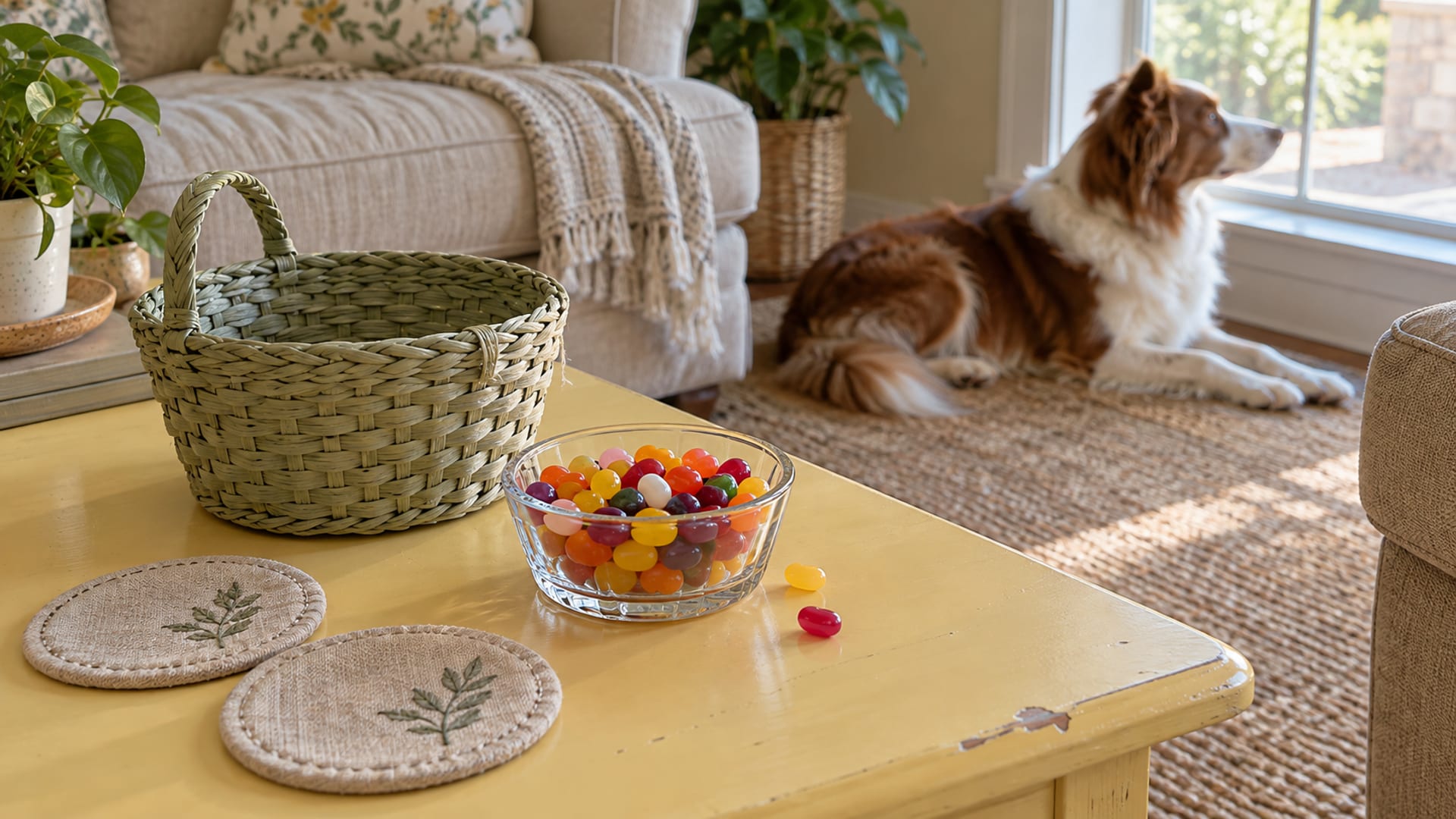
A handful of ordinary jelly beans is unlikely to poison your dog, though it can bring on vomiting or diarrhea. Pet Poison Helpline warns that jelly beans and gummy candies can cause significant stomach upset and, depending on the amount, a blockage. The kind to worry about is sugar-free, because it may contain xylitol.
If your dog just got into jelly beans, find the bag. If the ingredients list xylitol, birch sugar, wood sugar or birch bark extract, or the bag says sugar-free and you cannot read the list, call your vet, an emergency clinic or a poison line right away, as the FDA advises. If they were regular sugar jelly beans and no wrapper or plastic egg went down with them, keep an eye on your dog for the rest of the day.
Key takeaways
Tap a card to bring it forward.
- Regular jelly beans are sugar candy. A few may cause vomiting or diarrhea.
- Sugar-free jelly beans may contain xylitol, which can crash a dog's blood sugar and damage the liver.
- Xylitol can also be listed as birch sugar, wood sugar or birch bark extract.
- Jelly-bean-shaped vitamins and melatonin are supplements. Call with the label.
- Wrappers and plastic Easter eggs swallowed with the candy can block the gut.
My dog ate jelly beans: what to check first
- Read the bag. Look for xylitol, birch sugar, wood sugar or birch bark extract. "Sugar-free" alone does not tell you which sweetener was used.
- Make sure it was candy. Some supplements come shaped like jelly beans. The NIH supplement label database lists a product sold as "Melatonin 5 mg Jelly Bean." A supplement needs a call with its label.
- Look for what else went down. Count missing wrappers, and check for chewed plastic eggs or packaging.
- Estimate how many and when, and have your dog's weight ready.
- Call now if xylitol is listed or you cannot rule it out, if it was a supplement, if the amount is large or unknown, or if packaging was swallowed.
Call right away, whatever the candy, for vomiting, weakness, wobbling, collapse, seizures, choking, trouble breathing, belly pain or straining without passing stool.
How much xylitol is dangerous
The Merck Veterinary Manual gives two reference points for xylitol, the sweetener itself:
Tap or hover a row to highlight it.
| Dog's weight | Low blood sugar reported above about | Severe liver injury possible above about |
|---|---|---|
| Dog's weightPer pound | Low blood sugar reported above about45 mg of xylitol | Severe liver injury possible above about227 mg of xylitol |
| Dog's weight10 lb (4.5 kg) | Low blood sugar reported above about450 mg | Severe liver injury possible above about2,270 mg |
| Dog's weight25 lb (11 kg) | Low blood sugar reported above about1,125 mg | Severe liver injury possible above about5,675 mg |
| Dog's weight50 lb (23 kg) | Low blood sugar reported above about2,250 mg | Severe liver injury possible above about11,350 mg |
These are amounts of xylitol, not numbers of jelly beans. A label may not say how much xylitol each piece contains, so you cannot count candies down to a safe figure. Call instead. The same handful is a much bigger dose for a small dog than a large one. In a review of 192 dogs that ate xylitol, DuHadway and others found outcomes varied widely and called for more research to tie doses to results.
Signs, and how fast they come
Tap or hover a row to highlight it.
| What your dog ate | What you may see | When |
|---|---|---|
| What your dog ateRegular sugar jelly beans | What you may seeVomiting, diarrhea, belly discomfort, not wanting to eat | WhenNo set timing has been published |
| What your dog ateXylitol: low blood sugar | What you may seeVomiting, weakness, tiredness, wobbling, collapse, seizures | WhenWithin 30 minutes, or delayed up to 12 to 18 hours (Merck) |
| What your dog ateXylitol: liver injury | What you may seeBlood tests can show liver changes early; outward signs come later | WhenChanges in 4 to 12 hours; clinical injury may take 24 to 48 hours |
| What your dog ateWrappers, eggs or a big wad of candy | What you may seeRepeated vomiting, belly pain, refusing food, straining | WhenWhenever it lodges |
The FDA puts the start of low blood sugar at 10 to 60 minutes in its consumer guidance, and Merck allows for longer delays with some products. Either way, a dog who looks fine an hour after eating xylitol still needs the call.
"My dog ate half an Easter basket of jelly beans and was fine"
That happens, and it is real for that dog and that basket. It is not a rule for jelly beans. Those were probably regular sugar candies, and candy made with sugar is a very different exposure from candy made with xylitol. The amount matters, and a larger dog takes the same pile more easily than a small one. Wrappers may have passed without a problem that time. And with xylitol, signs can hold off for hours while the liver trouble shows even later. In a report on eight dogs with liver failure after eating xylitol, Dunayer and Gwaltney-Brant describe serious illness and deaths. Severe liver injury also does not follow the dose neatly, so one uneventful exposure says little about the next. Read the bag every time, since the next basket may hold a sugar-free bag.
Gummies, jelly and other look-alikes
- Gummy bears, fruit snacks and gelatin snacks: separate products with their own ingredients. Pet Poison Helpline lists candies, jams and gelatin snacks among the products that can contain xylitol.
- Other sugar-free sweeteners: maltitol, sorbitol, lactitol and erythritol also show up in sugar-free candy. Xylitol is the one with established serious danger to dogs.
- Jelly and jam: spreads, not candy. Sugar-free versions can contain xylitol too.
- Vitamin and melatonin jelly beans: supplements. Call with the label.
- Chocolate or raisins in the mix: each is a danger of its own. See Can dogs eat chocolate? and Can dogs eat grapes?
- Jelly Belly and other brands: the answer depends on the exact product. Check the ingredients of the bag your dog ate.
- Marshmallows: another Easter candy with the same xylitol question. See Can dogs eat marshmallows?
- Beans you cook: a different food entirely. Can dogs eat beans? covers them.
Check what you learned
Quick check
Questions about dogs and jelly beans
My dog ate one regular jelly bean. Is that an emergency?
Usually not. If the label shows no xylitol or other harmful ingredient and no packaging went down, one ordinary jelly bean is a low-risk exposure. Watch for vomiting, diarrhea or unusual behavior.
My dog ate sugar-free jelly beans. What should I do?
Check the label for xylitol, birch sugar, wood sugar or birch bark extract. If any is listed, or you cannot tell, call your vet, an emergency clinic or a poison line right away.
How much xylitol is dangerous to a dog?
Merck reports low blood sugar above about 100 mg per kilogram (45 mg per pound) and possible severe liver injury above about 500 mg per kilogram (227 mg per pound). Those are xylitol amounts, not candy counts.
How soon do xylitol symptoms appear?
Low blood sugar can start within 30 minutes or be delayed up to 12 to 18 hours. Liver injury may not show until 24 to 48 hours.
Can dogs eat Jelly Belly jelly beans?
It depends on the product. Regular candy is sugar your dog does not need, and any sugar-free or supplement version needs a label check for xylitol.
Are jelly beans dangerous for cats?
Merck states that cats are not at risk for the low blood sugar or liver injury xylitol causes in dogs. A cat can still get sick from other ingredients, medicine, packaging or choking.
Sources
Checked September 24, 2026.
- U.S. Food and Drug Administration, Paws Off Xylitol; It's Dangerous for Dogs
- Merck Veterinary Manual, Xylitol Toxicosis in Dogs (updated June 2025)
- Pet Poison Helpline, Easter Dangers To Pets
- Pet Poison Helpline, Xylitol Is Toxic To Dogs
- NIH Office of Dietary Supplements, Dietary Supplement Label Database, Melatonin 5 mg Jelly Bean
- DuHadway and others, Retrospective evaluation of xylitol ingestion in dogs: 192 cases (2007 to 2012), Journal of Veterinary Emergency and Critical Care
- Dunayer and Gwaltney-Brant, Acute hepatic failure and coagulopathy associated with xylitol ingestion in eight dogs, Journal of the American Veterinary Medical Association, 2006