
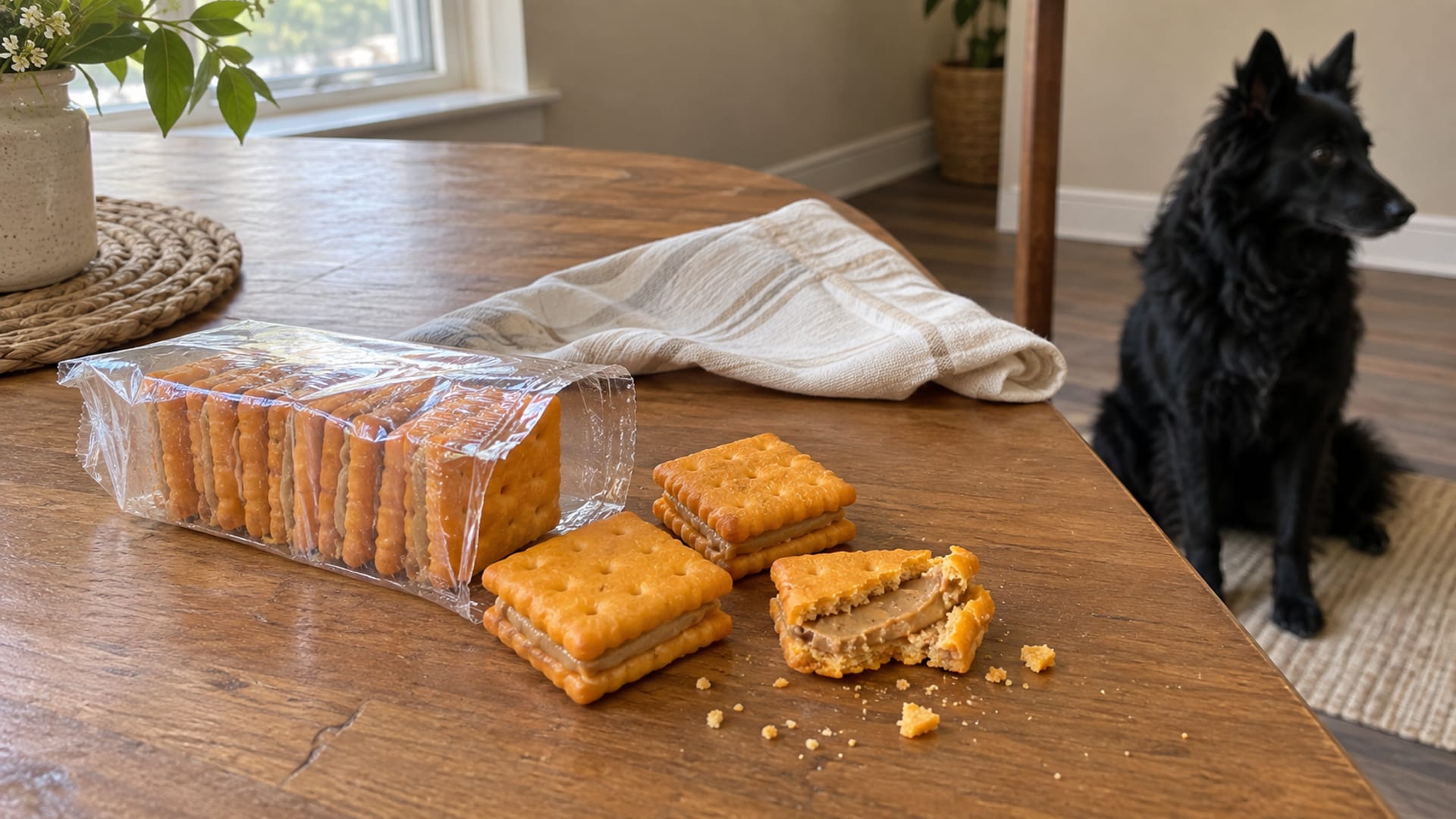
Peanut butter crackers are a caution food for dogs: one small piece of an ordinary cracker with no xylitol is usually low risk for a healthy dog. The first thing to do is pick up the package and read the ingredients for xylitol, birch sugar or wood sugar, and for chocolate, raisins, macadamia nuts, caffeine, onion or garlic.
If your dog already ate some, a plain cracker with none of those ingredients usually means watching your dog at home. Xylitol on the list, a sugar-free snack you can't check, or a whole pack gone from a lunch bag means calling your vet or a pet poison line now, even if your dog looks normal.
Key takeaways
Tap a card to bring it forward.
- One small piece of an ordinary peanut butter cracker without xylitol is usually low risk for a healthy dog.
- Read the label for xylitol, birch sugar and wood sugar first; any of them means call right away.
- Chocolate, raisins, macadamia nuts, caffeine, onion or garlic bring their own hazards.
- Salt, fat and calories keep these crackers an occasional bite at most, and dogs with pancreatitis or on a low-fat diet should skip them.
- A swallowed wrapper or plastic sleeve is a choking and blockage risk of its own.
If your dog already ate peanut butter crackers
When a snack pack goes missing from a backpack, the wrapper is the first thing I'd go looking for, because it holds the answers the vet will ask for.
- Find the package and read the full ingredient list. Xylitol is what turns a salty snack into an emergency, and the ASPCA notes it can also be listed as birch sugar or wood sugar. Pet Poison Helpline points to other label names too, such as birch sap and birch bark extract.
- Call right away if any of these fit. The ASPCA tells owners to call a vet or its poison control center when a product has xylitol or could have it, even if the dog is acting normal. Call now if:
- xylitol, birch sugar or wood sugar is on the label, or xylitol is possible
- the crackers were sugar-free and the package is gone, so there's no label to check
- you don't know how many were eaten, or a whole pack is missing
- your dog is small, a young puppy, elderly or already medically fragile
- your dog ate a lot of salty crackers and hasn't had much water
- the crackers contained chocolate, raisins, macadamia nuts, caffeine, onion or garlic
- your dog is vomiting, weak, staggering, trembling or collapses
- Have four things ready: the package, the amount, the time and your dog's weight. Xylitol and salt both act by dose per kilogram of body weight, so the person on the phone needs all four. If your dog has signs and needs to be seen, the ASPCA asks you to bring the packaging.
- Look for the wrapper. If the plastic sleeve or pieces of the box are missing, tell the vet, since swallowed packaging can cause choking or a blockage whatever the crackers contained.
- Skip home remedies. Don't give salt, medication or anything else unless a vet or poison line tells you to; the Merck Veterinary Manual warns that table salt given at home can itself cause salt poisoning.
- Keep watching for the next several hours. Xylitol signs can start within minutes and salt signs within hours.
Which crackers are lower risk and which are not
These can be sandwich, filled, protein, gluten-free or homemade crackers, and the ingredient panel is what sets them apart.
Tap or hover a row to highlight it.
| What your dog ate | Risk | Why |
|---|---|---|
| What your dog ateOrdinary cracker, regular peanut butter | RiskCaution | WhyLow concern in a small amount; salt, fat and sugar vary |
| What your dog ateSugar-free or reduced-sugar cracker | RiskAvoid unless the label rules out xylitol | WhySome sugar-free peanut butter has xylitol |
| What your dog ateMade with xylitol | RiskToxic | WhyCan crash blood sugar and harm the liver |
| What your dog ateChocolate, raisin, macadamia, onion or garlic versions | RiskAvoid | WhyThe added ingredient is its own hazard |
| What your dog ateHeavily salted cracker | RiskCaution | WhySalt poisoning at high amounts, worse with little water |
| What your dog ateUnsalted cracker | RiskCaution | WhyStill processed and high in calories |
| What your dog ateCrumbs or one small bite | RiskLower exposure | WhyStill read the label |
| What your dog ateWrapper or plastic sleeve | RiskAvoid | WhyChoking or blockage |
| What your dog ateRaw dough | RiskCall your vet | WhyA different problem from a baked cracker |
Baking doesn't remove xylitol, salt or fat. Raw dough is its own case: the Merck Veterinary Manual explains that yeast dough can keep rising and fermenting in the stomach and can produce alcohol, so call if your dog ate dough before baking.
How much is safe, and who should skip them
The ASPCA says peanut butter can be shared in small quantities but points out that it's high in fat. VCA Animal Hospitals calls peanut butter a high-calorie, high-fat treat that can contribute to pancreatitis when dogs get too much of it. Add two salted crackers and you have a snack that fits as an occasional small piece for a healthy dog, never a daily treat.
The serving size on the pack is set for people, so it won't help here. The AKC suggests keeping all treats to about 10 percent of daily calories, and a cracker sandwich uses that up fast in a small dog.
Dogs with pancreatitis, or a history of it, should skip them, and VCA recommends avoiding high-fat treats for any dog on a low-fat diet. The VCA guide to nutrition and pancreatic disease treats low-fat feeding as part of managing the condition. The AKC also suggests asking your vet first if your dog has diabetes or food sensitivities.
For the risky ingredients, every brand mixes salt, fat and sweetener differently, so there's no toxic dose for the cracker itself. The figures below are for the ingredients.
Tap or hover a row to highlight it.
| Ingredient | Figure | What it means | Source |
|---|---|---|---|
| IngredientXylitol | FigureAs low as 30 mg/kg | What it meansLow blood sugar in some dogs | SourceHypoglycemia review, PMC |
| IngredientXylitol | FigureMore than 100 mg/kg | What it meansRisk threshold for low blood sugar | SourceASPCA, as cited in veterinary literature |
| IngredientXylitol | FigureAbout 500 mg/kg | What it meansRisk threshold for liver damage | SourceASPCA, as cited in veterinary literature |
| IngredientSalt | FigureAbout 2 to 3 g/kg | What it meansSigns of salt poisoning | SourceMerck Veterinary Manual |
| IngredientSalt | FigureAbout 4 g/kg | What it meansAcute lethal dose | SourceMerck Veterinary Manual |
| IngredientPeanut butter fat | FigureNo set figure | What it meansStomach upset, weight gain, pancreatitis | SourceVCA Animal Hospitals |
A peer-reviewed review on hypoglycemia in dogs reports the 30 mg/kg figure, and the salt figures come from the Merck Veterinary Manual. These numbers are for the vet to work with, never a reason to wait. Most packages don't say how much xylitol they hold, and a small dog gets a much bigger dose per kilogram from the same crackers than a large one. If you can't tell how much your dog got, call and give the weight and the number of crackers missing.
Signs to watch for, and when they show up
With an ordinary cracker and no xylitol, a small amount often causes nothing. A bigger or fattier helping can bring vomiting, diarrhea, belly discomfort, tiredness or, in some dogs, pancreatitis.
The Merck Veterinary Manual describes salt poisoning starting with vomiting within several hours, which may move on to weakness, diarrhea, tremors, a wobbly walk, seizures, brain swelling, coma or death.
Xylitol moves faster. Pet Poison Helpline says signs may start within 10 to 60 minutes, sometimes as early as 10 to 15. Watch for:
- vomiting
- weakness or unusual tiredness
- staggering or poor coordination
- trembling
- collapse, seizures or coma
In a 2009 study of xylitol in dogs, blood sugar began dropping about 30 minutes after the dose. Pet Poison Helpline notes that xylitol can also lead to acute liver failure, with liver signs delayed by hours or days. The worst realistic outcome is fatal low blood sugar, liver failure or both, so a xylitol exposure needs a call before any signs appear.
My dog ate them before and was fine
That happened, and plenty of dogs have finished off a dropped cracker with no trouble. It just isn't a rule for every dog, and a few things explain the difference:
- The amount. A crumb is a tiny dose; a whole pack is a different exposure.
- The dog's size. A Lab and a Chihuahua sharing one cracker get very different doses per kilogram.
- The product. That earlier cracker probably had no xylitol, and may have held less salt or fat.
- The individual dog. Dogs respond differently, and not every exposure shows.
- Missed signs. Mild stomach trouble can pass unnoticed, especially overnight.
- Delayed damage. The ASPCA warns that xylitol can harm the liver later, so a normal first hour doesn't prove a dog is safe.
Your dog's experience was real. The label on today's package is what decides today's answer.
Look-alike snacks and label names
A few names on the shelf look close to peanut butter crackers but carry different risks.
- "Sugar-free," "no sugar added," "keto" and "low-carb" crackers. These may use xylitol or another sweetener. Erythritol isn't known to harm dogs the way xylitol does, but find the exact sweetener on the label.
- Different kinds of "peanut butter." Regular, reduced-fat, powdered and dog-specific peanut butters differ in fat, salt, sweetener and calories. Our Peanut butter entry covers the jar itself.
- Peanuts and macadamia nuts. Macadamia nuts are a separate dog toxin, so a mixed "nut" cracker needs a closer look. See Peanuts and Nuts.
- Peanut butter cookies. Cookies may contain Chocolate, raisins, caffeine or xylitol, so treat them as their own product. See Grapes and raisins if raisins are listed.
- Other crackers. Goldfish crackers, Graham crackers and Cheez-Its each have their own entry.
Check what you learned
A quick check on the main points.
Quick check
Questions about dogs and peanut butter crackers
These come up once the first scare passes.
Can puppies have a bite of a peanut butter cracker?
Puppies have less body mass, so the same cracker gives them a larger dose per kilogram and less room for error. A treat made for puppies is the easier choice, and any puppy that ate a sugar-free or unknown cracker needs a call.
Are keto or protein peanut butter crackers riskier?
They can be, because low-carb and high-protein snacks often swap sugar for another sweetener. The front of the pack won't say which one. If you can't identify it in the ingredients, treat it as possible xylitol.
What if my cat ate one?
The ASPCA describes xylitol as a danger to dogs, not to cats. Salty, fatty processed crackers still aren't a good cat snack, and a swallowed wrapper is a choking or blockage risk for a cat too.
My dog seems fine an hour later. Can I stop watching?
For a plain cracker, a normal dog after an hour is a good sign, though salt signs can take several hours. If xylitol was possible, liver problems can show up hours or days later, so follow the vet's plan for monitoring and bloodwork.
Sources
Checked September 25, 2026.
- ASPCA, Updated Safety Warning on Xylitol: How to Protect Your Pets
- ASPCA, Sharing is Caring: Foods You Can Safely Share with Your Pet
- Pet Poison Helpline, Sickeningly Sweet Xylitol Toxicity in Dogs
- Pet Poison Helpline, Xylitol Dog Poisoning: Brief Guide
- Pet Poison Helpline, Xylitol Is Toxic To Dogs
- Merck Veterinary Manual, Salt Toxicosis in Animals
- Merck Veterinary Manual, Drugs Used to Control or Stimulate Vomiting in Monogastric Animals
- Merck Veterinary Manual, Yeast and Bread Dough
- VCA Animal Hospitals, Treats to Skip and Treats to Share with Your Pet
- VCA Animal Hospitals, Dog Treats
- VCA Animal Hospitals, Nutrition and Pancreatic Disease in Dogs
- American Kennel Club, Can Dogs Eat Peanut Butter? Pet-Safe Peanut Butter
- PMC, Hypoglycemia in dogs: Causes, management, and diagnosis
- Journal of Veterinary Pharmacology and Therapeutics, Experimental acute toxicity of xylitol in dogs