

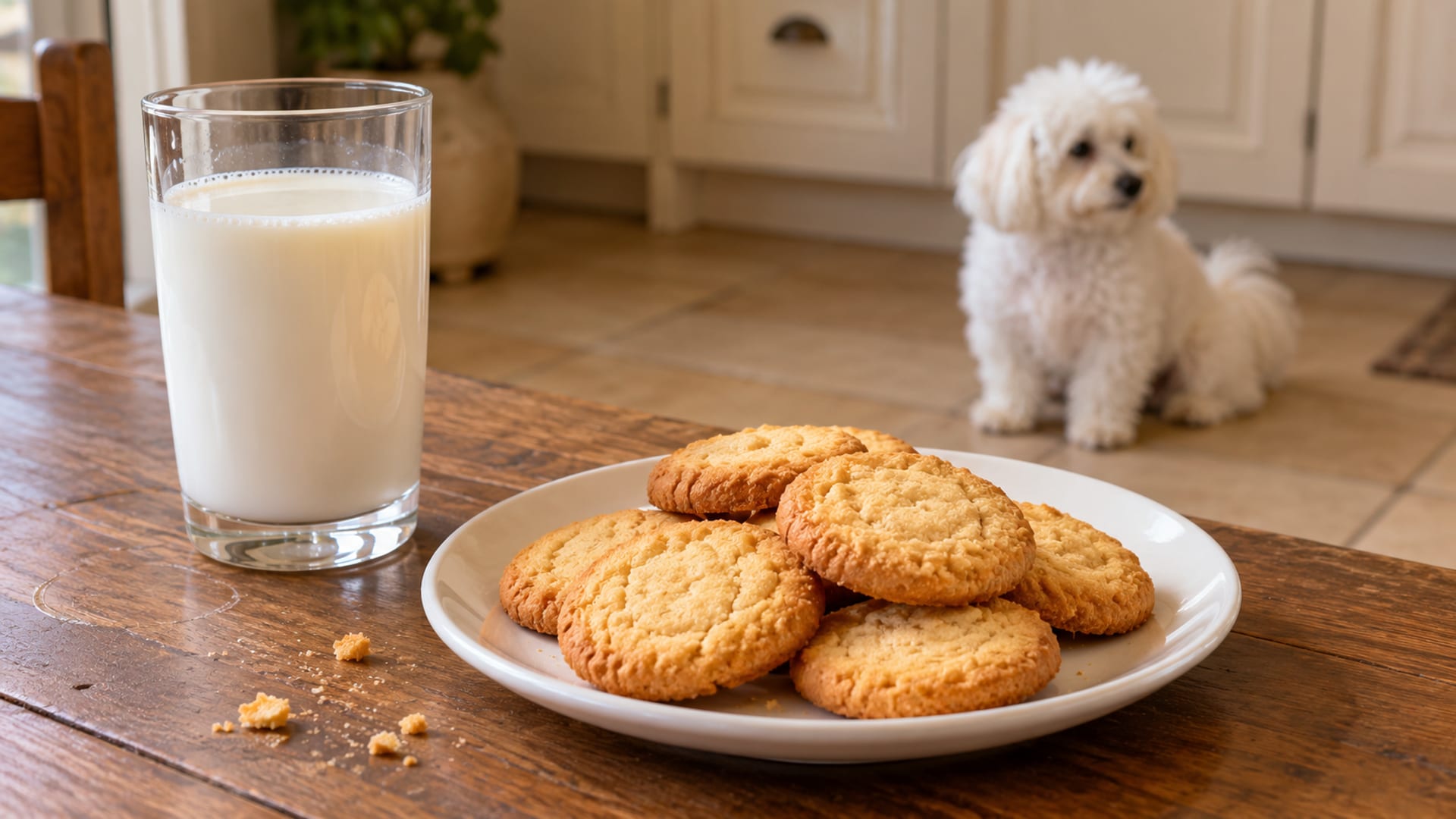
Human cookies are not a routine treat for dogs, and the recipe decides how worried to be. A small piece of a cookie you know is plain may do nothing worse than upset the stomach. Chocolate, raisins, sugar-free sweetener (xylitol), macadamia nuts, coffee and alcohol are the ingredients that turn a cookie into a call to the vet, and the AKC says human bakery items are not good for dogs in general.
Key takeaways
Tap a card to bring it forward.
- Cookie is not one food. A plain cookie and an oatmeal-raisin or sugar-free cookie are very different risks.
- Chocolate, raisins, xylitol, macadamia nuts, coffee and alcohol are the ingredients to act on.
- Do not wait for signs if you think xylitol, raisins, chocolate or macadamia nuts were in it.
- Have the cookie type, the amount, the time and your dog's weight ready before you call.
- Human cookies are not a treat to hand out regularly, even the plain ones.
What to do right now if your dog ate a cookie
The next few minutes go better with a short order of steps, and each one gives the vet or poison line something they will ask for.
- Take the rest of the cookies away and keep the box, wrapper or recipe. The ingredient list is the first thing the Pet Poison Helpline says to have ready.
- Read the ingredients for chocolate, cocoa, coffee, raisins, currants, sugar-free sweetener, macadamia nuts and alcohol. A homemade batch, a gift tin or a torn wrapper with no label counts as unknown.
- Write down which cookie it was, how many your dog ate, what time, and how much your dog weighs. A small dog gets a bigger dose per pound from the same cookie, so the weight changes the answer.
- Call your vet or a pet poison line right away if any of those ingredients were in it or you cannot tell. The ASPCA advises contacting a vet or poison control immediately after a suspected exposure, and that includes before any signs show.
- If you are certain it was a small amount of plain cookie and your dog is otherwise healthy, watch for vomiting, diarrhea or belly discomfort. Call anyway if the amount, the recipe or your dog's weight is uncertain.
- Do not give medicine or try a home fix. Do what the vet or poison line tells you.
Which cookies are a problem and which are not
Most of the danger sits in what is baked into the cookie, so the table sorts cookies by what they contain, using the details from the Pet Poison Helpline.
Tap or hover a row to highlight it.
| In the cookie | Risk | What to do |
|---|---|---|
| In the cookiePlain baked cookie, nothing toxic | RiskLow in a small amount; may cause stomach upset, extra calories, or pancreatitis from sugar and fat | What to doWatch your dog; call if the amount or recipe is uncertain |
| In the cookieChocolate, cocoa or coffee | RiskPoisoning from theobromine and caffeine | What to doCall now |
| In the cookieRaisins or oatmeal-raisin | RiskCan cause acute kidney injury | What to doCall now |
| In the cookieSugar-free | RiskMay contain xylitol: low blood sugar and liver failure | What to doCall now until the sweetener is confirmed |
| In the cookieMacadamia nuts | RiskNeurologic signs and high body temperature | What to doCall now |
| In the cookieRaw cookie dough | RiskMay carry raw eggs, raw flour, or yeast that produces alcohol | What to doCall and describe the dough |
| In the cookieDog cookies made for dogs | RiskSuitable if free of toxic ingredients; still count as calories | What to doFine as a treat within limits |
Baking does not undo any of this: cooking or drying does not reliably remove chocolate's stimulants, xylitol, raisins or macadamia toxicity.
How much cookie is a concern, and what a small taste looks like
For a plain human cookie, there is no set amount by dog size to hand out. If you decide on a small taste anyway, confirm first that it has no chocolate, cocoa, coffee, raisins, currants, xylitol, macadamia nuts, alcohol or unsafe toppings. The habit is where the trouble starts: human cookies are high in sugar and fat, and fat-rich treats can trigger pancreatitis in dogs that are prone to it.
A dog-specific cookie made for dogs is the better choice. The VCA guideline is that treats stay under 10 percent of a dog's daily calories, with tighter limits for dogs on a prescription diet or with pancreatitis, diabetes, obesity or allergies.
For the risky cookies, there is no single number for "a cookie," because every recipe is different. The figures below are published for the individual ingredients, so use them to see why the vet will ask about your dog's weight and the exact recipe.
Tap or hover a row to highlight it.
| Ingredient | Published figure | Source |
|---|---|---|
| IngredientChocolate (theobromine and caffeine) | Published figureMild signs around 20 mg/kg; heart effects around 40 to 50 mg/kg; seizures at 60 mg/kg or more | SourceMerck Veterinary Manual |
| IngredientXylitol | Published figureAbout 0.1 g/kg can cause low blood sugar; about 0.5 g/kg can cause liver damage | SourcePet Poison Helpline |
| IngredientRaisins | Published figureMore than one grape or raisin per 4.5 kg of body weight may carry enough tartaric acid to risk the kidneys; the amount varies a great deal | SourceMerck Veterinary Manual |
| IngredientMacadamia nuts | Published figureSigns at about 2 g/kg in one educational source; the exact mechanism is not defined | SourcePet Poison Helpline |
Those figures are per ingredient, and a cookie does not list them. So, call, give your dog's weight and describe the cookie and how many, and let the vet or poison line work out the risk.
Signs to watch for and when they show up
The timing depends on what was in the cookie, and it can be later than most owners expect, so keep watching even if the first hour is quiet.
- Plain cookie: vomiting, diarrhea, belly discomfort, or nothing at all. Fat-rich cookies can set off pancreatitis, with vomiting that keeps coming, belly pain, diarrhea and a dog that will not eat.
- Chocolate: signs usually start within 6 to 12 hours, according to the Merck Veterinary Manual. They include vomiting, diarrhea, thirst, restlessness, a racing heart, tremors and seizures. Severe cases can be fatal.
- Xylitol: low blood sugar most often shows up within 1 to 2 hours, and rarely as late as 12 hours, per the Pet Poison Helpline. Look for vomiting, weakness, wobbling, tremors, collapse and seizures. Liver injury can appear over the following days.
- Raisins: vomiting or diarrhea commonly begins within 6 to 12 hours. The Merck Veterinary Manual says the kidneys can stop making urine within 24 to 72 hours, and once that happens the outlook is poor.
- Macadamia: lethargy, vomiting, a raised body temperature, tremors, stiff joints and weak back legs, according to the Pet Poison Helpline.
Call right away for any vomiting, weakness, tremors, wobbling, collapse, seizures, trouble breathing, a high temperature, severe restlessness or belly pain.
My dog ate a cookie before and was fine
That happened, and I believe it. Plenty of dogs have swallowed a cookie and had nothing to show for it. It still does not make cookies safe for every dog, because several things about that one time could have been different.
- The amount may have been under what causes trouble for that ingredient.
- A larger dog gets a smaller dose per kilogram than a small one.
- That cookie may have had little or no chocolate, xylitol, raisin or macadamia in it, or it may have been white chocolate, which has far fewer of chocolate's stimulants than dark or baking chocolate.
- Dogs differ in how sensitive they are, and the Merck Veterinary Manual notes that individual differences matter with chocolate.
- Xylitol amounts vary from product to product, and raisins vary in how much tartaric acid they carry.
- Some harm shows up late. Xylitol liver injury and raisin kidney injury can trail the meal by days.
So, the next cookie could be a different recipe, a smaller dog or a bigger dose, and that is where the risk comes from.
Cookie types and look-alikes
Names on a package can point the wrong way, so here is what the common ones mean for a dog.
- Chocolate chip and double chocolate: treat them as a chocolate exposure. The type of chocolate and the amount matter. "Chocolate-flavored" can still mean cocoa powder, and the stimulant content varies by product. White chocolate has very little compared with dark or baking chocolate, but it is still high in fat and sugar.
- Oatmeal cookies: oatmeal alone is not the issue, but an oatmeal-raisin cookie carries raisins and gets handled like grapes and raisins. "Currants" can mean Zante currants, which are dried grapes and count as a raisin risk, or true currants from the Ribes family, which Merck says have not been linked to kidney injury. If the label just says currants, treat it as raisins until you know.
- Sugar-free and "no added sugar": these words do not mean xylitol-free, and the amount of xylitol may not be listed clearly. Treat any of them as a xylitol risk until you have the ingredient list.
- Raw cookie dough: it can hold raw eggs, raw flour and yeast, and unbaked yeast dough can swell and produce alcohol in the stomach. Dough with alcohol in it is its own problem; see alcohol.
- Holiday and store-bought cookies: a tin can hold chocolate, raisins, currants, xylitol, alcohol or a lot of fat in one box. Read each cookie, not the tin.
- Dog cookies and dog biscuits: a different product from a human cookie, though the label and ingredients still count.
Check what you learned
Three questions on the parts that matter most when a dog gets into the cookie tin.
Quick check
Questions about dogs and cookies
These come up after the first scare passes.
Can dogs eat one plain cookie?
A small amount of a cookie you have confirmed is plain is less worrying than one with a toxic ingredient. The AKC still advises against human bakery items as regular treats. A dog-specific cookie fits better and keeps to the calorie limit.
What if my dog ate a chocolate chip cookie?
Find out what kind of chocolate it was and how much, then call your vet or a poison line with your dog's weight. Chocolate signs can take 6 to 12 hours to appear, so a calm first hour does not settle it.
What if my dog ate an oatmeal-raisin cookie?
Call your vet or a poison line, even if your dog seems fine. Raisin trouble can start with vomiting hours later, and the kidney damage can build over the next one to three days.
Are dog cookies okay?
Dog cookies can work as treats if the ingredients suit your dog. Keep them under 10 percent of daily calories, and ask your vet first if your dog has pancreatitis, diabetes, allergies, obesity or a prescription diet.
Sources
Checked September 29, 2026.
- American Kennel Club, Recipe: Birthday Coming Up? Bake Your Dog a Treat!
- ASPCA, The Poisons We Pack
- Merck Veterinary Manual, Chocolate Toxicosis in Animals
- Merck Veterinary Manual, Grape, Raisin, and Tamarind Toxicosis in Dogs
- Pet Poison Helpline, What If My Dog Ate a Cookie
- Pet Poison Helpline, Xylitol in Products
- Pet Poison Helpline, Xylitol
- Pet Poison Helpline, Macadamia Nuts
- Pet Poison Helpline, Can Dogs Have Macadamia Nuts?
- VCA Animal Hospitals, Dog Treats