

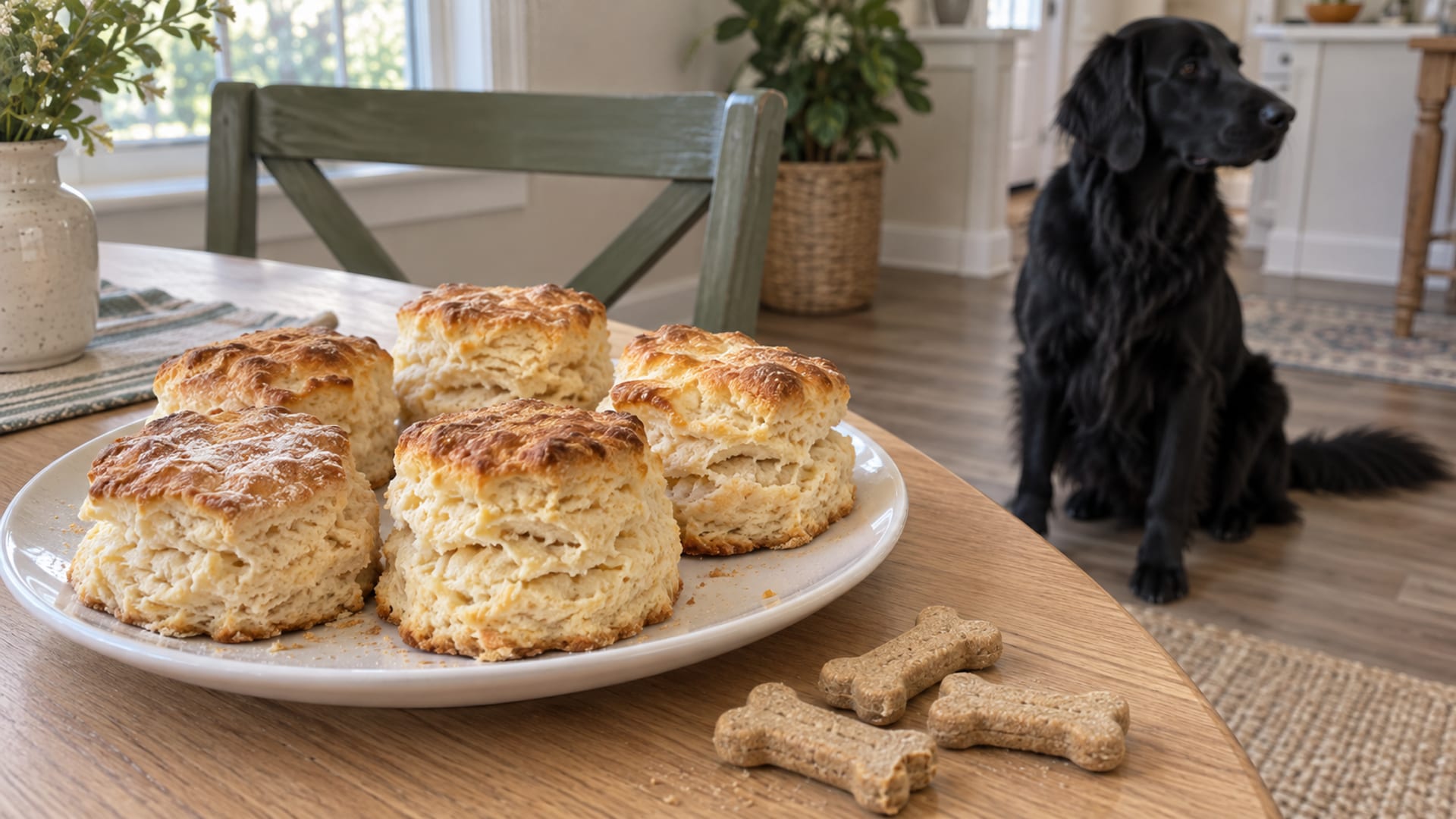
Yes, with caution. A small piece of a plain, fully baked biscuit or a plain dog biscuit is usually low risk, and the ingredient label decides the rest: xylitol, chocolate, raisins, macadamia nuts or raw yeast dough make it a call to your vet right now.
If your dog already ate one, find the package or recipe first. A plain buttermilk biscuit off a plate usually means watching at home; a sugar-free, chocolate or raisin biscuit, raw dough, an unknown biscuit or a whole box means a phone call, even if your dog looks fine.
Key takeaways
Tap a card to bring it forward.
- A small bite of a plain, fully baked biscuit or a plain dog biscuit is usually low risk.
- Xylitol, chocolate, raisins, macadamia nuts, onion, garlic or raw yeast dough mean call now.
- Sugar-free, keto and diabetic-friendly biscuits can contain xylitol.
- A big portion of buttery biscuits or biscuits and gravy can upset the stomach and may contribute to pancreatitis.
- Kidney injury after raisins and liver injury after xylitol can show up after the first day.
What to do if your dog just ate a biscuit
Work through these in order, with the package in your hand if you can find it.
- Move the rest out of reach and keep the wrapper. The ASPCA says the first thing to do is collect any remaining packaging, since the ingredient list is what your vet will ask about.
- Read the label for the ingredients that change the answer. Look for xylitol, chocolate or cocoa, raisins, grapes, currants, macadamia nuts, alcohol, onion and garlic, all listed by Pet Poison Helpline as kitchen hazards for dogs.
- Note what kind of biscuit it was, how many are gone, your dog's weight and the time. The same biscuit is a bigger dose for a small dog, and the time tells your vet which signs could still be coming.
- Call now if any of those ingredients are listed. Call the same way if you can't tell what was in it, if your dog ate a lot, or if your dog seems sick. The ASPCA and Pet Poison Helpline both advise calling right away for a possible poisoning, before symptoms appear.
- Skip home remedies and medicine. Wait for your vet to tell you what, if anything, to give.
- For a small plain piece, keep watch. Look for vomiting, diarrhea or a sore belly over the next few days, and call if any of it starts.
Which biscuits are low risk and which call for a vet
"Biscuit" can mean a flaky Southern biscuit, a cookie from a British-style tin, a cracker or a bone-shaped treat from the pet aisle. What it's made of tells you far more than its shape.
Tap or hover a row to highlight it.
| Biscuit | Risk | What to do |
|---|---|---|
| BiscuitA few plain dog biscuits | RiskLow | What to doWatch for an upset stomach |
| BiscuitA whole box of dog biscuits | RiskHigher | What to doCall your vet about the amount |
| BiscuitA small piece of plain buttermilk biscuit | RiskLow | What to doWatch at home |
| BiscuitSeveral buttery biscuits, or biscuits and gravy | RiskCaution | What to doCall if vomiting, belly pain or low energy start |
| BiscuitCheddar or savory biscuits | RiskDepends on the label | What to doCall if onion or garlic is listed |
| BiscuitChocolate or cocoa biscuits | RiskHigh | What to doCall now |
| BiscuitRaisin, currant or fruit biscuits | RiskHigh | What to doCall now |
| BiscuitSugar-free, keto or low-carb biscuits | RiskHigh until xylitol is ruled out | What to doCall now if it's listed or you can't check |
| BiscuitMacadamia nut biscuits | RiskHigh | What to doCall now |
| BiscuitRaw biscuit dough | RiskHigh | What to doCall now |
Buttermilk biscuits and biscuits and gravy. Plain baked biscuits have nothing toxic in them, but many are heavy on butter, salt and fat, and gravy adds more. The American Kennel Club recommends only small, plain portions of human food without salt, sugar, oil or butter, and the Merck Veterinary Manual lists large amounts of table scraps among suspected causes of pancreatitis. If the gravy or a cheddar biscuit had onions or garlic, call; Pet Poison Helpline notes both can damage red blood cells.
Sweet, chocolate and raisin biscuits. Cocoa carries theobromine and caffeine, which the Merck Veterinary Manual links to stomach, heart and nerve problems; our chocolate entry has more. Pet Poison Helpline warns that raisins in baked goods can cause kidney failure, and our grapes and raisins entry explains why.
Sugar-free, nut and raw-dough biscuits. The ASPCA warns that xylitol can drop a dog's blood sugar fast and injure the liver, so treat sugar-free and keto biscuits as risky until the label rules it out. Macadamia nuts can cause illness even in small amounts, per Pet Poison Helpline; our nuts entry covers the rest. Raw yeast dough can expand in the stomach and produce alcohol, so call if your dog ate any.
A box of dog biscuits. Plain dog biscuits are fine as occasional treats fed by the package guidance, but a whole box is a lot of calories and fat at once, and hard pieces swallowed whole can choke a dog or get stuck in the gut. Call your vet about the amount.
Sharing a plain biscuit, and how much of a risky one matters
To share, pick a plain biscuit that's fully baked and cooled, skip the butter, jam and gravy, and give a small, bite-sized piece. The American Kennel Club suggests small portions of bread-type foods because the calories add up. With dog biscuits, follow the package feeding guidance and keep treats a small part of the day's food.
Recipes vary too much for a safe number of biscuits to exist. The published figures belong to the ingredients, per kilogram of the dog's weight:
Tap or hover a row to highlight it.
| Ingredient | Reported figure | Source |
|---|---|---|
| IngredientXylitol, low blood sugar | Reported figureAbout 0.03 to 0.1 g/kg | SourceDunayer report; xylitol liver failure case report |
| IngredientXylitol, liver damage | Reported figureAbout 0.5 g/kg | SourceXylitol liver failure case report |
| IngredientTheobromine and caffeine (chocolate) | Reported figureDose that kills half of dogs about 100 to 200 mg/kg; severe signs and death can occur lower | SourceMerck Veterinary Manual |
| IngredientRaisins and grapes | Reported figureKidney damage after at least 3 g/kg of dry matter; much lower doses also reported | SourceEubig and colleagues; grape and raisin case series |
| IngredientMacadamia nuts | Reported figureNo reliable toxic dose; small amounts can cause illness | SourcePet Poison Helpline |
You rarely know how much xylitol or cocoa is in one cookie, so call with your dog's weight, the product name and your best count.
Small dogs get a bigger dose from the same bite. The Merck Veterinary Manual reports pancreatitis more often in Miniature Schnauzers, Yorkshire Terriers, Cocker Spaniels, Dachshunds, Poodles and sled dogs, so buttery biscuits are a bigger concern for them and for any dog that has had pancreatitis. Dogs with diabetes, obesity, kidney or liver disease or a sensitive gut may need to skip rich biscuits; ask your vet.
Signs to watch for over the next few days
What you see depends on what was in the biscuit, and some signs take days.
- Plain biscuits: often nothing, or brief vomiting, diarrhea, gas, thirst or belly discomfort.
- A big, fatty portion: the Merck Veterinary Manual lists vomiting, belly pain, low energy, poor appetite and diarrhea as signs of pancreatitis; severe cases can lead to organ failure.
- Xylitol: low blood sugar can come on quickly, with weakness, wobbling, tremors, collapse or seizures, as the ASPCA describes. Liver damage can follow later, with vomiting, refusing food, yellow gums or eyes, or bleeding.
- Chocolate: signs commonly begin within several hours, per the Merck Veterinary Manual, including vomiting, restlessness, a racing or irregular heartbeat, tremors and seizures.
- Raisins: vomiting may come early, and kidney injury can develop over the following days, with less urine and tiredness, as a case series on grape and raisin poisoning documents.
- Macadamia nuts: weakness, vomiting, tremors, fever and trouble with the back legs commonly appear within hours, per Pet Poison Helpline.
- Raw dough: a swollen or painful belly, vomiting, wobbling, low body temperature or trouble breathing.
Call right away for repeated vomiting, collapse, tremors, seizures, a swollen belly, trouble walking or breathing, yellowing, or much less peeing than usual.
My dog ate biscuits before and was fine
That very likely happened, and plenty of dogs have eaten a dropped biscuit with no trouble. It still doesn't hold for every biscuit and every dog:
- Amount and size. A crumb is not half a pan, and the same biscuit is a much bigger dose for a small dog.
- What was in it. Last time might have been a plain dog biscuit; this time it could be a sugar-free cookie or raw dough.
- The dog. The Merck Veterinary Manual notes that dogs vary in how they react to chocolate, and the grape and raisin case series shows some dogs getting sick after far smaller amounts than others.
- Timing. Kidney and liver injury can appear after the first day.
Your dog's good outcome was real. It was one dog and one biscuit, and the next time can go differently.
Biscuit look-alikes and labels to read
The name on the package won't tell you what's inside.
- British-style biscuits. Digestives, tea biscuits and shortbread are cookies: butter, sugar, and sometimes chocolate or fruit.
- Crackers. We have separate entries for Graham crackers, Cheez-Its and Goldfish crackers.
- Dog cookies, dental biscuits and training treats. Recipes differ by brand, so read the ingredients.
- Sugar-free, keto, low-carb and diabetic-friendly. Any of these can mean xylitol.
- Sultana, currant, fruit and fruitcake. All can carry grape-family fruit.
- Carob. It isn't cacao, but a carob biscuit can still contain other risky ingredients.
- Close cousins. Plain bread and cornbread raise the same questions about butter, salt and add-ins.
Check what you learned
Three quick questions before the biscuit tin goes back on the counter.
Quick check
Questions about dogs and biscuits
These tend to come up once the first worry has settled.
Can puppies have biscuits?
Biscuits made for puppies are fine fed by the package guidance. A human biscuit is a bigger dose for a small body, and puppies choke on hard pieces more easily, so break treats into small bits.
My dog is pregnant or nursing and ate a chocolate biscuit. Does that change anything?
It does. The Merck Veterinary Manual notes that the stimulants in chocolate can cross the placenta and pass into milk, so call your vet even for a small amount.
My cat got into the biscuits too. Is that a problem?
It can be. Pet Poison Helpline lists chocolate, xylitol, raisins, macadamia nuts, alcohol and yeast dough as hazards for cats too, and the Merck Veterinary Manual notes cats get pancreatitis as well. Call your vet about the cat separately.
My dog has had pancreatitis before. Can he have a bite of biscuit?
Ask your vet before sharing anything buttery. The Merck Veterinary Manual flags high-fat food as a concern with pancreatitis and notes diabetes can follow the chronic form.
Sources
Checked September 25, 2026.
- ASPCA, What to Do If Your Pet Gets into Chocolate
- ASPCA, Before You Start Your Holiday Baking, Learn More about a Common Sweetener That's Dangerous to Dogs
- Pet Poison Helpline, Pantry of Poisons
- Pet Poison Helpline, Dog Chocolate Toxicity Calculator
- Pet Poison Helpline, Can Dogs Eat Raisins? Emergency Guide
- Pet Poison Helpline, Are Macadamia Nuts Safe for Dogs to Eat?
- American Kennel Club, Which Human Foods Can Dogs Eat and Which Are Dangerous?
- American Kennel Club, Can Dogs Eat Bread?
- Merck Veterinary Manual, Pancreatitis and Other Disorders of the Pancreas in Dogs
- Merck Veterinary Manual, Chocolate Toxicosis in Animals
- K. Dunayer, Hypoglycemia Following Canine Ingestion of Xylitol-Containing Substances
- PubMed Central, Acute Hepatic Failure in a Dog after Xylitol Ingestion
- Journal of Veterinary Diagnostic Investigation, Canine Renal Pathology Associated with Grape or Raisin Ingestion: 10 Cases
- PubMed Central, Toxicosis with grapes or raisins causing acute kidney injury and neurological signs in dogs