
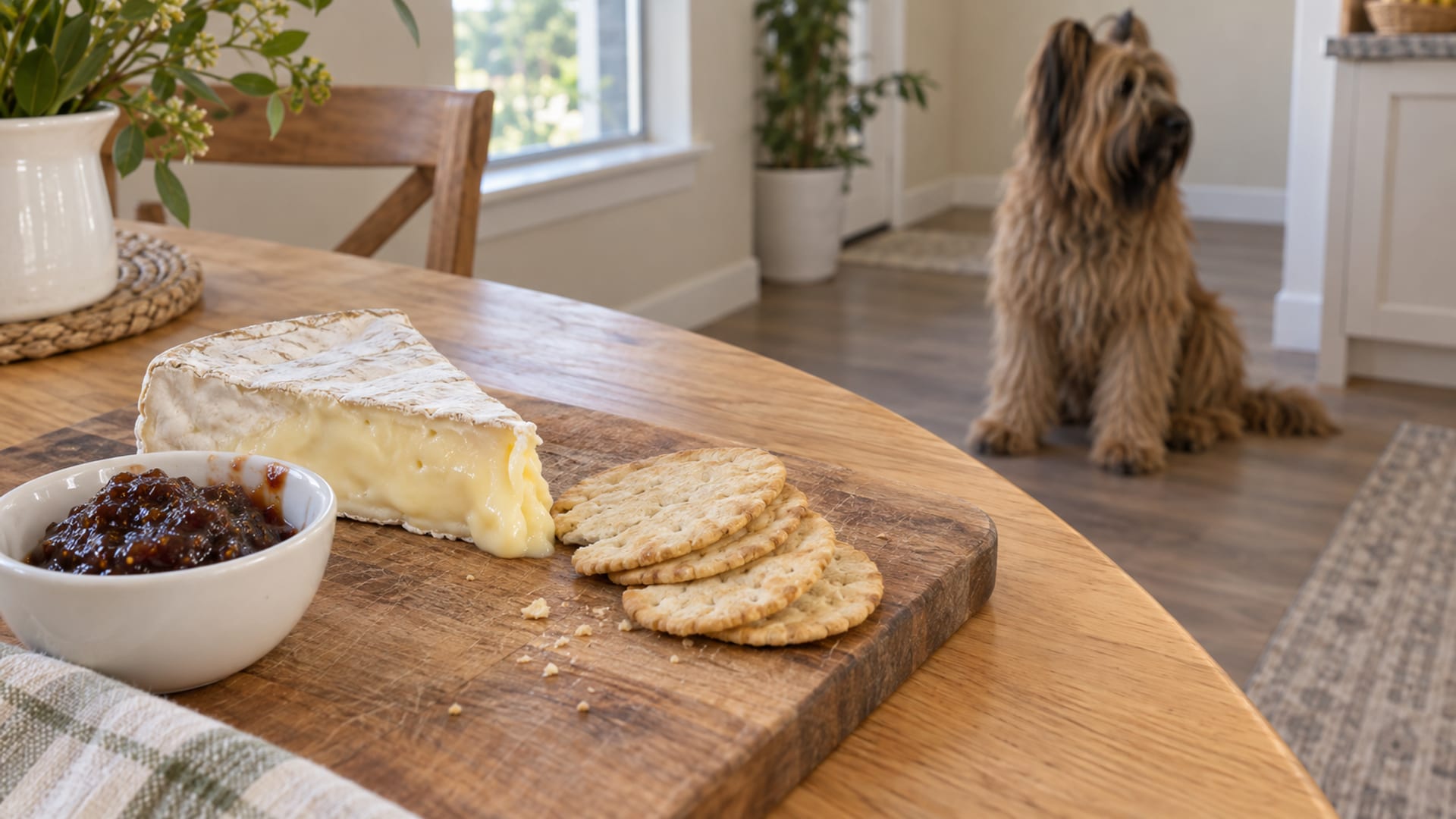
A tiny piece of plain Brie is usually fine for a healthy dog that handles dairy, but Brie is a very fatty cheese, and a big helping can bring on vomiting, diarrhea or pancreatitis. It isn't a dog poison; the American Kennel Club says dogs can have cheese in small amounts and warns that high-fat cheeses can lead to weight gain and pancreatitis.
If your dog already got into it, four things decide how serious it is: whether the Brie was plain or flavored, roughly how much went down, whether any wrapper went with it, and whether your dog has ever had pancreatitis. A lick or a crumb of plain Brie usually means keeping an eye on your dog for a few days. A whole wedge, a baked Brie with garlic or fruit on top, swallowed packaging, or a dog with a pancreatitis history means calling your vet today.
Key takeaways
Tap a card to bring it forward.
- Plain Brie is not a dog poison, but it is high-fat dairy, so only a tiny, occasional piece suits a healthy dog that handles dairy.
- Flavored Brie is a different question: garlic, onion, chives, wine, grapes, raisins, chocolate, macadamia nuts or xylitol can make it dangerous.
- Pancreatitis signs can show up 1 to 4 days after a fatty meal, so keep watching after the first evening looks normal.
- Call your vet for a large or unknown amount, a risky ingredient, swallowed packaging, a history of pancreatitis, or any signs of illness.
- Lower-fat cheeses such as cottage cheese or mozzarella make better treats than Brie.
What to do if your dog just ate Brie
Work through these in order; they also give your vet what they need if you call.
- Move the rest of the cheese board out of reach. A dog that got one bite often goes back for the crackers and jam, which can carry their own problems.
- Read the label or think back through the recipe. Garlic, onion and chives are toxic to dogs according to the AKC's list of human foods, and wine, grapes, raisins, chocolate, macadamia nuts and xylitol each bring a separate risk.
- Estimate how much your dog ate and note their size. The same piece gives a small dog far more fat for its body than a large one, and your vet will ask for both.
- Check for missing packaging. Foil, wax, plastic wrap or a big chunk of rind can cause choking or get stuck in the gut.
- Call your vet or a poison line if anything on the risk list applies. The ASPCA explains that poison-control staff look at your pet's age, health, what was eaten and how much, and its advice on when to seek help is to call promptly rather than wait for signs to get worse.
- If it was a little plain Brie and your dog is healthy, watch for the next few days. Keep the package in case signs show up later and someone asks what was in it.
If it were my dog and the answers were plain, small and nothing else missing, I'd keep the wrapper on the counter, feed dinner as usual, and watch appetite and stool for four days.
The rind, baked Brie and the other forms your dog finds
The cheese is the same fatty dairy in every form; what changes the risk is what's been added to it or wrapped around it.
Tap or hover a row to highlight it.
| Form | What decides the risk | What to do |
|---|---|---|
| FormPlain Brie, soft center | What decides the riskHigh fat and dairy | What to doA tiny piece is usually fine for a dairy-tolerant dog; watch after a larger amount |
| FormWhite rind | What decides the riskSame fat caution as the cheese; a large chunk can be hard to swallow | What to doTreat it like the cheese; call if a big piece went down whole |
| FormBaked or melted Brie, plain | What decides the riskCooking leaves all the fat in | What to doSame as plain Brie, but a warm wheel is easy to eat a lot of |
| FormBaked Brie with toppings or pastry | What decides the riskGarlic, onion, herbs, wine, nuts, jam, grapes or raisins | What to doCheck the recipe; call if any toxic ingredient was on it |
| FormSpoiled or moldy Brie past its date | What decides the riskCan cause stomach and gut illness | What to doWatch closely and call if signs start |
| FormDried cheese chews | What decides the riskA different product, denser in calories | What to doUse dog-made chews only, counted as treats |
Baked Brie is where people get caught out, because the topping often holds garlic, onion or chives. If yours had any of those, see our entries on Garlic and Onions, and call your vet. The same goes for jam made with grapes and raisins, Brie baked with wine (Alcohol), or a topping of nuts or chocolate.
Sharing a small piece, and when the amount becomes a concern
For a healthy dog that handles dairy and isn't on a special diet, a tiny piece of plain Brie now and then is reasonable. The AKC keeps cheese to an occasional treat and says "a small cube or a few shreds is usually enough." It also points owners toward lower-fat cheeses such as cottage cheese or mozzarella, so if cheese is your go-to reward, start with our Cottage cheese entry.
Count the Brie as part of your dog's treats for the day. Pet Poison Helpline cites the general veterinary guideline that treats should stay within 10% of daily calories, and the right amount depends on your dog's weight and health. Serve it plain, with no topping, cracker or wrapper.
Some dogs should skip Brie altogether:
- Dogs that have had pancreatitis.
- Dogs with high blood fat levels (hypertriglyceridemia), obesity or diabetes. The Merck Veterinary Manual notes that diabetes can follow long-term pancreatitis.
- Dogs on a prescribed low-fat diet or with a known food sensitivity.
- Breeds prone to pancreatitis or high blood fats. A review in the Journal of Veterinary Internal Medicine names Miniature Schnauzers among several predisposed breeds.
As for how much is too much, nobody has published a per-pound amount of Brie known to cause harm. The USDA's nutrient data shows Brie is a high-fat cheese, and the risk climbs with the amount, the dog's size and its health history. Rather than guess, call your vet with your dog's weight, what they ate and roughly how much, and let them say whether to come in or watch at home.
Signs to watch for over the next few days
Two kinds of trouble can follow Brie, on different timelines. The first is stomach upset from the dairy and fat. The AKC's page on milk lists gas, loose stool, vomiting, belly discomfort and diarrhea as signs a dog isn't handling dairy well. Mild upset like this may settle once the food has passed through.
The second is pancreatitis, and it can take longer to appear. Pet Poison Helpline says signs after a fatty meal may be delayed 1 to 4 days, and describes vomiting, belly pain, diarrhea, a drop in appetite and low energy. In severe cases the Merck Veterinary Manual adds weakness and dehydration, and describes how severe pancreatitis can lead to organ failure and death. That's uncommon after a small piece of plain Brie, and it's why a large amount deserves a call.
Call your vet promptly if you see:
- Vomiting, or diarrhea that keeps coming back
- Signs of belly pain
- Marked tiredness or weakness
- Refusing food
- Signs of dehydration
- Collapse, choking or trouble breathing
Keep watching for the full four days, even if the first evening looks normal.
My dog ate Brie before and was fine
Plenty of dogs have snagged a corner of Brie and gone on with their night. If that happened with yours, it really did happen; it just can't tell you what happens next time, or with another dog.
The piece may have been small for the dog's size, or plain with nothing toxic on it. Some dogs handle dairy better than others, and one bite's fat may not have been enough to set off pancreatitis. Signs can also show up days later, as Pet Poison Helpline notes, so a dog that vomited on Tuesday may never have been connected to the Brie on Saturday.
Individual dogs differ too. The Journal of Veterinary Internal Medicine review links some breeds to higher pancreatitis risk and says dietary fat is only one factor, so the same slice can pass through one dog and put another in the clinic.
Brie bites, charcuterie boards and names that sound alike
The ingredient list, more than the name on the box, tells you plain cheese from a prepared food.
- Baked Brie and Brie en croute. Often wrapped in pastry and topped with garlic, herbs, jam, nuts or dried fruit, and sometimes baked with wine.
- Brie bites and stuffed appetizers. Fillings and wrappers vary, and a small dog can swallow one whole.
- Charcuterie boards. Besides the cheese, a board may hold grapes, dried fruit, nuts and deli meats such as Salami and Prosciutto. If your dog cleared a board, think through everything that was on it, since the grapes may matter more than the Brie.
- Camembert and other soft, white-rind cheeses. Ask the same questions: plain or flavored, how much, and your dog's health history. Our Cheese entry covers cheese in general, and Cream cheese has its own page.
- Briard and "Chien de Brie." If you searched "Brie dog," you may have meant the breed. The AKC's Briard page covers the herding breed whose old French name ties it to the Brie region.
Check what you learned
Three quick questions to test the key points.
Quick check
Questions about dogs and Brie
These come up after the main question is answered.
Can puppies eat Brie?
A puppy that handles dairy can have a tiny taste, just like an adult dog. The AKC guidance on cheese doesn't set a separate puppy amount, and a puppy gets nothing from Brie that its food doesn't already supply. If your puppy ate a larger amount, call your vet with its weight and how much it ate.
My dog only licked the wedge. Do I need to do anything?
A lick of plain Brie is a very small amount of fat for most dogs. Put the cheese away and carry on with your evening, keeping an eye on appetite and stool. If the wedge was flavored with garlic, onion or herbs, or your dog has had pancreatitis, give your vet a quick call anyway.
Is Brie a problem for cats too?
Brie is the same high-fat dairy for a cat, and the Merck Veterinary Manual covers pancreatitis in both dogs and cats. Anything said about a safe amount for a dog shouldn't be carried over to a cat. Ask your vet before sharing any with your cat.
Does it matter if the Brie was double or triple cream?
These versions have extra cream added, which makes them even richer than regular Brie. The same steps apply, but if your dog ate a lot of a triple cream, lean toward calling your vet rather than waiting it out.
Sources
Checked September 25, 2026.
- American Kennel Club, Can Dogs Eat Cheese?
- American Kennel Club, Which Human Foods Can Dogs Eat and Which Are Dangerous?
- American Kennel Club, Can Dogs Drink Milk? Is Milk Bad for Dogs?
- American Kennel Club, Briard Dog Breed Information
- Pet Poison Helpline, Is Table Food Poisonous for Dogs?
- Pet Poison Helpline, Pet Safe Seal of Approval Dog Recipes
- Merck Veterinary Manual, Pancreatitis in Dogs and Cats
- ASPCA, Emergency Care for Your Pet
- ASPCA, My Pet Ate Something! When Should I Seek Help?
- Journal of Veterinary Internal Medicine, New insights into the etiology, risk factors, and pathogenesis of pancreatitis in dogs
- U.S. Department of Agriculture, Cheese, Brie