
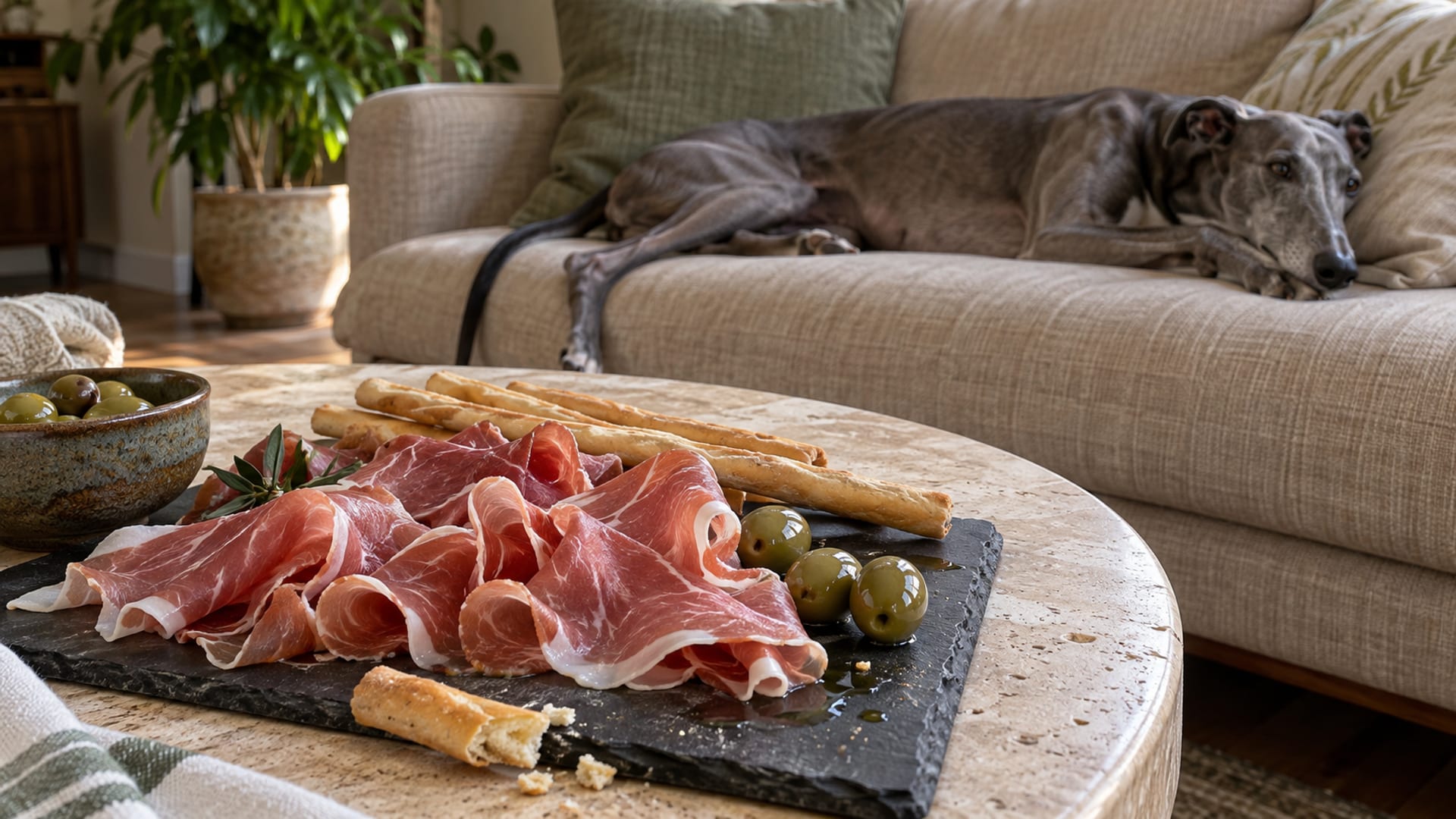
A thin slice of prosciutto is unlikely to cause salt poisoning in a healthy dog, but it is not something to hand over on purpose. Prosciutto is a dry-cured ham, as the USDA Food Safety and Inspection Service describes it, and dry curing uses salt and draws out moisture, which leaves a salty, concentrated meat.
If your dog just cleared part of a charcuterie board, look at what else was on it. The prosciutto can be the smaller worry next to grapes, raisins, onions or a skewer. Then estimate how many slices are gone and check your dog's water bowl.
Key takeaways
Tap a card to bring it forward.
- A slice of prosciutto is a low-risk slip for most healthy dogs.
- Salt is the main danger, and fat adds a pancreatitis risk.
- Cooking prosciutto does not remove its salt or fat.
- Prosciutto-wrapped foods can hide grapes, raisins, onion, garlic or a skewer.
- Vomiting, heavy thirst, stumbling, tremors or seizures need a vet quickly.
My dog ate prosciutto: sorting out the next step
You can usually watch at home when a healthy, medium or large dog ate a slice or two of plain prosciutto, has water, and is acting normally. Keep an eye on them for the rest of the day.
Call your vet or a pet poison line when a small dog ate several slices, you cannot tell how much is gone, your dog could not reach water, or the prosciutto came wrapped around something else or seasoned. Have the package and your dog's weight ready.
Go to an emergency vet now for vomiting that will not stop, stumbling, confusion, tremors, seizures, collapse or trouble breathing.
When a pet may have eaten something toxic, Pet Poison Helpline says to call them or get veterinary care right away. Do not try to treat salt poisoning at home. The Merck Veterinary Manual explains that the fix is a vet's job: checking hydration and electrolytes and bringing sodium down slowly.
Crudo, cotto or wrapped around something: which prosciutto matters
Tap or hover a row to highlight it.
| What your dog got | For dogs | Why |
|---|---|---|
| What your dog gotProsciutto crudo, the thin dry-cured slices | For dogsAvoid sharing | WhySalt is drawn in and moisture drawn out during curing |
| What your dog gotProsciutto cotto, the cooked ham | For dogsAvoid sharing | WhyCooking leaves the salt and fat in place |
| What your dog gotProsciutto baked into a dish | For dogsAvoid | WhyHeat does not take out the salt or fat |
| What your dog gotFat and rind | For dogsAvoid | WhyExtra fat raises the chance of an upset stomach or pancreatitis |
| What your dog gotHard rind, bone or a big unchewed piece | For dogsWatch closely | WhyCan choke a dog or block the gut |
| What your dog gotBroth, drippings or prosciutto powder | For dogsCall your vet | WhySalt and fat are concentrated |
| What your dog gotProsciutto wrapped around fruit, cheese or other bites | For dogsCheck what was inside | WhyThe filling may be the bigger danger |
| What your dog gotSpoiled or moldy prosciutto | For dogsCall your vet | WhyThe risk depends on what grew on it |
Wrapped appetizers are where a small theft can turn serious. Grapes and raisins are an emergency for dogs on their own, as can dogs eat grapes? explains, and onion or garlic in a sauce or filling can damage red blood cells. Cheese adds fat. Toothpicks and skewers are a hazard of their own if swallowed.
How salty is too salty?
The only published danger figures are for salt itself. Merck puts the first signs of salt poisoning in dogs at about 2 to 3 grams of salt for every kilogram of body weight, and a lethal dose at roughly 4 grams per kilogram. Those numbers do not turn into a count of prosciutto slices, because each product's salt content differs and your dog's weight and water access change the picture. That calculation belongs with your vet.
What owners can use is the direction of the risk:
- Size. A few slices mean much more to a 12-pound dog than to a 90-pound one.
- Water. Merck ties salt poisoning closely to too much sodium when water is limited.
- Kidney disease. Dogs with weaker kidneys may cope less well with fluid and salt shifts, so call sooner.
- Pancreatitis history. A 2025 review in the Journal of the American Veterinary Medical Association found that the evidence linking dietary fat to pancreatitis is not definitive, but it supports lower fat and fewer rich treats for dogs that keep getting pancreatitis.
The American Kennel Club calls feeding ham "not advisable" while allowing that a little sliver once in a while probably will not hurt. Its list of human foods says the same about a small piece and flags the sodium and fat. Neither gives a gram amount. Dry curing concentrates the salt in prosciutto, so the safer habit is to keep it off your dog's plate.
Signs to watch for after prosciutto
Tap or hover a row to highlight it.
| When | What you may see | What it can mean |
|---|---|---|
| WhenWithin several hours | What you may seeVomiting, thirst, peeing more | What it can meanToo much salt. Call your vet if the amount was large. |
| WhenUsually within 12 hours | What you may seeDiarrhea, weakness, dullness, stumbling | What it can meanSalt poisoning developing. Call your vet now. |
| WhenAfter a large amount | What you may seeDisorientation, tremors, seizures, collapse | What it can meanEmergency. Go to a vet now. |
| WhenIn the days after a fatty helping | What you may seeVomiting, belly pain, not eating | What it can meanPossible pancreatitis. Call your vet. |
Merck notes that vomiting can begin within several hours of eating too much salt and can progress to weakness, diarrhea, tremors and seizures. The ASPCA says signs of excess salt usually appear within 12 hours, and that dogs who recover generally do so within 24 to 72 hours. Pet Poison Helpline's list of sodium symptoms adds heavy thirst, peeing more and low energy.
"Our dog gets a scrap of prosciutto every holiday and loves it"
A scrap every holiday may well have caused no trouble at all, and it is easy to see why: one thin slice in a big dog with water close by is not much salt. Here is why that does not stretch to every dog or every board:
- How much. One slice and a whole package sit far apart on the salt scale.
- Who ate it. The same slice is a much larger dose for a small dog.
- What else was there. Prosciutto around grapes or cheese is a different exposure.
- Water. A dog in a warm room without water handles salt worse.
- Health. Kidney disease or past pancreatitis changes the math.
- Timing. Signs can start hours later, so a dog that looks fine at the party may not be fine that night.
If the holiday scrap is tradition, keep it to one thin, plain slice for a healthy dog, with nothing wrapped inside. For a dog with kidney disease or pancreatitis, skip it.
Prosciutto, Parma ham, serrano and other cured hams
- Prosciutto di Parma and San Daniele: named Italian dry-cured hams. Same salt concern.
- Jamón serrano and jamón ibérico: Spanish cured hams, often called prosciutto at home. Treat them the same.
- Country ham: another dry-cured ham, with the same salt concern.
- Deli ham: often wet-cured, with its own salt level. See can dogs eat ham?
- Fresh ham and pork leg: uncured pork that needs cooking. See can dogs eat pork?
- Parmesan: a cheese that shares the Parma name. Dishes that pair it with prosciutto add the cheese's fat too. See can dogs eat cheese?
- Bacon and pancetta: other cured pork. See can dogs eat bacon?
Check what you learned
Quick check
Questions about dogs and prosciutto
Can dogs eat a small piece of prosciutto?
A small accidental piece is unlikely to reach a toxic salt level in a healthy dog. It is still a poor treat, since prosciutto is salty and often fatty.
What if my dog ate several slices?
Call your vet or a pet poison line, especially for a small dog, an unknown amount, a dog without water access, or any symptoms. The salt per kilogram of your dog is what matters, not the slice count alone.
Can dogs eat prosciutto crudo?
Prosciutto crudo is the dry-cured kind usually sold in thin slices. The curing leaves it salty, so it belongs in the same avoid category as cooked prosciutto.
Is cooked or crispy prosciutto better for dogs?
Cooking or crisping it does not take out the salt or fat, so it carries the same concern.
Can puppies have prosciutto?
A puppy's small body turns each slice into a bigger salt dose, so skip it and call your vet if a puppy ate more than a scrap.
Is prosciutto dangerous for cats as well?
Cats can also get salt poisoning, according to Pet Poison Helpline, so keep the board out of reach of both.
Sources
Checked September 24, 2026.
- USDA Food Safety and Inspection Service, Hams and Food Safety
- Merck Veterinary Manual, Salt Toxicosis in Animals
- ASPCA, People Foods to Avoid Feeding Your Pets
- Pet Poison Helpline, Salt
- Pet Poison Helpline, Sodium Toxicity Symptoms in Pets
- American Kennel Club, Can Dogs Eat Ham?
- American Kennel Club, Which Human Foods Can Dogs Eat and Which Are Dangerous?
- Journal of the American Veterinary Medical Association, High fat, high risk? Evaluating the strength of evidence linking dietary fat and pancreatitis in dogs