
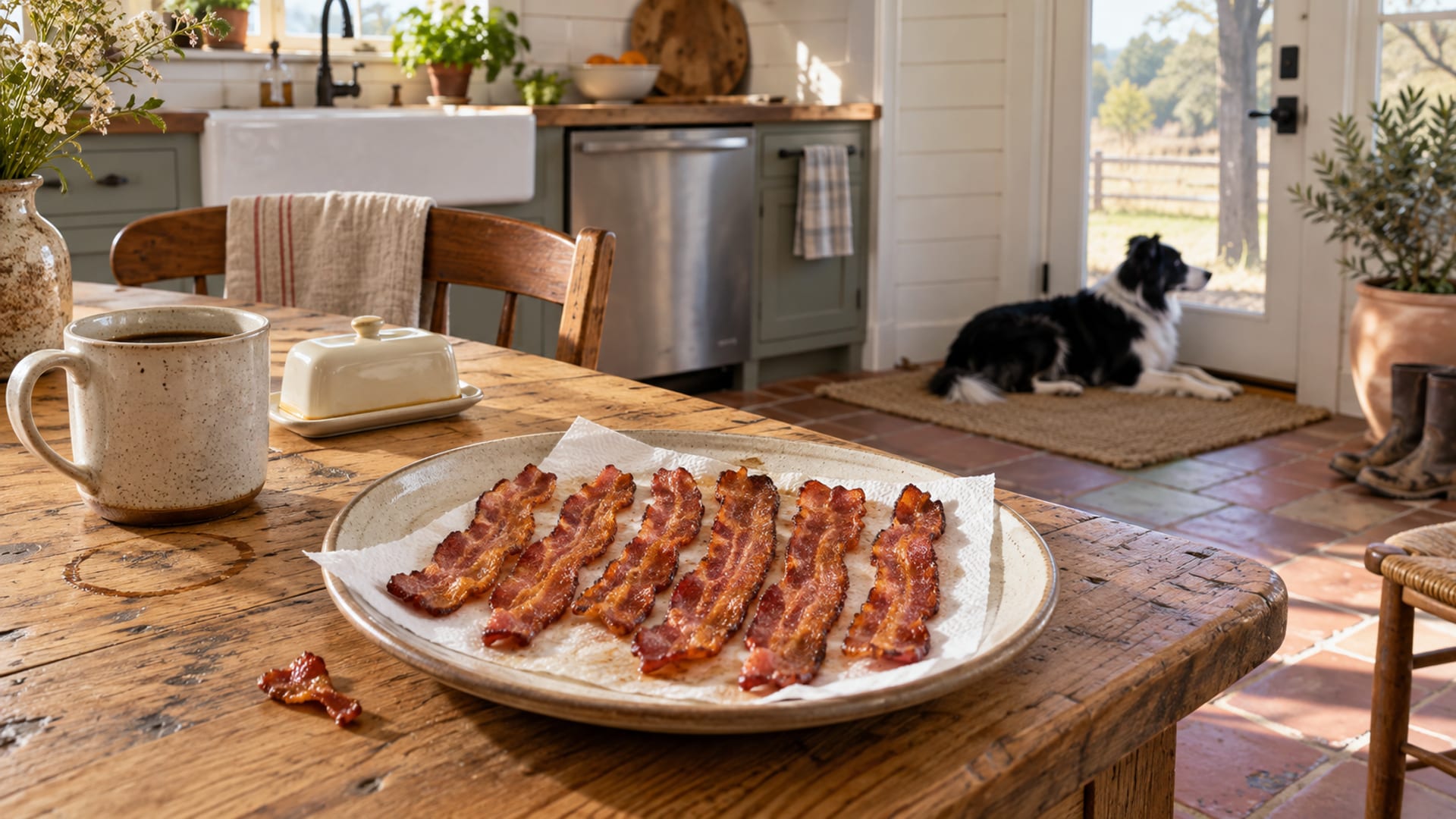
Bacon is better kept off your dog's plate. A strip that fell on the floor is not usually a poisoning, but the American Kennel Club answers "no" to bacon because it is so fatty and salty, and warns that a large amount can cause pancreatitis.
If your dog just helped themselves to the breakfast plate, count the strips, check whether the grease or the packaging went too, and note the time. The time matters because, according to Pet Poison Helpline, vomiting after a fatty meal can start anywhere from 1 to 4 days later.
Key takeaways
Tap a card to bring it forward.
- A small piece of bacon is not usually poisoning, but it is still a poor treat.
- Fat is the main danger, and it can lead to pancreatitis that is sometimes severe.
- Bacon grease and drippings are a bigger risk than the meat.
- Signs can show up 1 to 4 days after the meal, so a dog that seems fine is not yet in the clear.
- A large amount, grease, a small dog or a pancreatitis history means a call to your vet.
Dog ate bacon? What to do today
- Stop the buffet. Put the plate, pan and packaging out of reach.
- Work out what was eaten. How many strips, cooked or raw, and whether grease, seasoning or plastic went with them.
- Note the time and your dog's weight. Your vet will ask for both.
- Call your vet or a pet poison line after a large or unknown amount, any grease, a small dog, a dog that has had pancreatitis, or any vomiting, diarrhea or belly pain.
- Keep watching for several days. A normal evening does not rule out trouble later in the week.
The ASPCA advises calling a vet, an emergency hospital or its poison center after a potentially hazardous meal even when no signs have appeared yet. It sends seizures, trouble breathing, unconsciousness and bleeding straight to a veterinary hospital. Pet Poison Helpline also warns against giving any home antidotes.
Strips, grease, raw or bits: which bacon matters
Tap or hover a row to highlight it.
| What your dog got | How concerned to be | Why |
|---|---|---|
| What your dog gotA bite of cooked bacon | How concerned to beLow for a healthy dog | WhyFatty and salty, but a small amount |
| What your dog gotSeveral strips or a whole plate | How concerned to beCall your vet | WhyA large fatty meal is the pancreatitis setup |
| What your dog gotBacon grease, drippings or fat trimmings | How concerned to beCall your vet | WhyConcentrated fat, the highest-risk part |
| What your dog gotRaw bacon | How concerned to beCall your vet | WhySame fat and salt, plus the germ risk of raw pork |
| What your dog gotBurnt or very crispy bacon | How concerned to beSame as cooked | WhyCharring does not remove the fat or salt |
| What your dog gotBacon bits or crumbles | How concerned to beRead the label | WhySome are imitation and may carry onion or garlic |
| What your dog gotBacon-wrapped food | How concerned to beCheck the filling | WhyThe food inside may bring bones, onion, garlic or a skewer |
| What your dog gotPackaging, plastic film or skewers | How concerned to beCall your vet | WhyCan choke a dog or block the gut |
Grease is the part people underestimate. If your dog licked the pan or drank from the grease jar, read can dogs eat bacon grease? for that situation. Seasoned bacon and bacon-wrapped dishes can add onion or garlic, which can dogs eat onions? and can dogs eat garlic? cover.
Why bacon is hard on dogs
Fat. Pet Poison Helpline explains that fatty table foods like bacon are not usually a classic poisoning. What they can cause is stomach trouble ranging from mild vomiting and diarrhea to severe, sometimes fatal, pancreatitis. The Merck Veterinary Manual counts eating things a dog should not, such as scraps and rich food, among the common suspected causes, and reports that pancreatitis turns up more often in Miniature Schnauzers, Yorkshire Terriers, Cocker Spaniels, Dachshunds, Poodles and sled dogs.
Not every dog that eats bacon gets pancreatitis. A 2025 review by Yamka and colleagues in the Journal of the American Veterinary Medical Association describes the disease as having several causes that combine differently in each dog, which is part of why one dog shrugs off a fatty meal and another ends up in the hospital. There is no bacon amount that predicts it.
Salt. Bacon is cured, and salt adds a second, smaller concern. The Merck Veterinary Manual's salt chapter puts the first signs of salt poisoning at around 2 to 3 grams of salt per kilogram of body weight, and a fatal dose near 4 grams per kilogram. Those are salt figures, and bacon's salt varies by brand and cut, so they cannot be turned into a strip count.
Who needs a call sooner: small dogs, since each strip is a bigger dose for them; dogs that have had pancreatitis before; and dogs with diabetes, high blood fats or kidney disease.
Signs to watch for, including the late ones
Tap or hover a row to highlight it.
| When | What you may see | What to do |
|---|---|---|
| WhenRight away | What you may seeGagging, retching, pawing at the mouth | What to doA piece or wrapper may be stuck. Go to a vet now. |
| WhenSame day | What you may seeVomiting, diarrhea, thirst | What to doCall your vet, sooner for a small dog |
| When1 to 4 days later | What you may seeVomiting, belly pain, diarrhea that may have blood, not eating, tiredness | What to doPossible pancreatitis. Call your vet today. |
| WhenAny time | What you may seeWeakness, dehydration, tremors, seizures, collapse, trouble breathing | What to doEmergency vet now |
Merck notes that mild pancreatitis can cause vague signs or none at all, while severe cases may need a hospital stay. Merck's owner guide adds that the worst cases can lead to organ failure. A dog that turns down breakfast or seems sore two days after a bacon theft deserves a phone call.
"Our farm dog had bacon every Sunday morning"
That dog was real, and so was the bacon. Many dogs eat a scrap now and then and never have a problem. It just does not settle the question for the dog in front of you:
- Amount. A scrap and a pound of bacon are very different meals.
- Size. The same strip is a much bigger dose for a small dog.
- Form. Meat, grease, raw bacon and seasoned bacon differ in fat, salt and ingredients.
- The individual dog. Breed and health change the pancreatitis risk, and Miniature Schnauzers stand out.
- Delay. Signs can take 1 to 4 days, so a problem may not get linked back to the bacon.
- Many causes. Pancreatitis comes from a mix of factors, and that mix differs from dog to dog.
So, the Sunday scrap for one dog is no promise for another. If your dog begs at breakfast, a treat made for dogs is the easier swap.
Turkey bacon, bacon bits and other bacon look-alikes
- Turkey or chicken bacon: fat and salt differ by product, and it is still cured and seasoned. Read the label.
- Canadian bacon or back bacon: a leaner cured pork loin, still salty. See can dogs eat ham? for cured pork in general.
- Pancetta and prosciutto: other cured pork. See can dogs eat prosciutto?
- Imitation bacon bits: may contain soy, smoke flavor, salt, onion or garlic.
- Vegan or plant-based bacon: no pork fat, but can be salty and seasoned.
- Bacon-flavored dog treats: the flavor name does not mean real bacon, or bacon's fat. Judge the whole label.
- Sausages and hot dogs: similar fat and salt questions. See can dogs eat hot dogs?
Check what you learned
Quick check
Questions about dogs and bacon
Can dogs eat a small piece of bacon?
A small piece dropped by accident is not usually a poisoning. It is still fatty and salty, so do not make it a treat, and watch for stomach trouble over the next few days.
What if my dog ate a lot of bacon?
Call your vet or a pet poison line, even if your dog looks normal. A large or greasy meal can cause vomiting, diarrhea, belly pain, poor appetite, tiredness and pancreatitis, and the signs may be delayed.
Can bacon cause pancreatitis in dogs?
It can contribute. Merck counts eating inappropriate food among the common suspected causes, but pancreatitis has many causes, and not every dog that eats bacon gets it.
How long after eating bacon can a dog get sick?
Pet Poison Helpline reports vomiting and other signs 1 to 4 days after a fatty meal. Keep watching for several days, not just the first evening.
Can dogs eat turkey bacon?
Turkey bacon differs from pork bacon in fat and salt, but it is still a cured, seasoned meat and may contain onion or garlic. It is not a good treat either.
Is bacon grease worse than bacon?
Yes. Grease and drippings are concentrated fat. Can dogs eat bacon grease? covers what to do.
Sources
Checked September 24, 2026.
- American Kennel Club, Can Dogs Eat Pork?
- Pet Poison Helpline, Table Food Dogs Should Not Eat
- Pet Poison Helpline, 24/7 Animal Poison Control Center
- ASPCA, My Pet Ate Something! When Should I Seek Help?
- Merck Veterinary Manual, Pancreatitis in Dogs and Cats
- Merck Veterinary Manual, Pancreatitis and Other Disorders of the Pancreas in Dogs
- Merck Veterinary Manual, Salt Toxicosis in Animals
- Yamka and others, Journal of the American Veterinary Medical Association, High fat, high risk? Evaluating the strength of evidence linking dietary fat and pancreatitis in dogs