
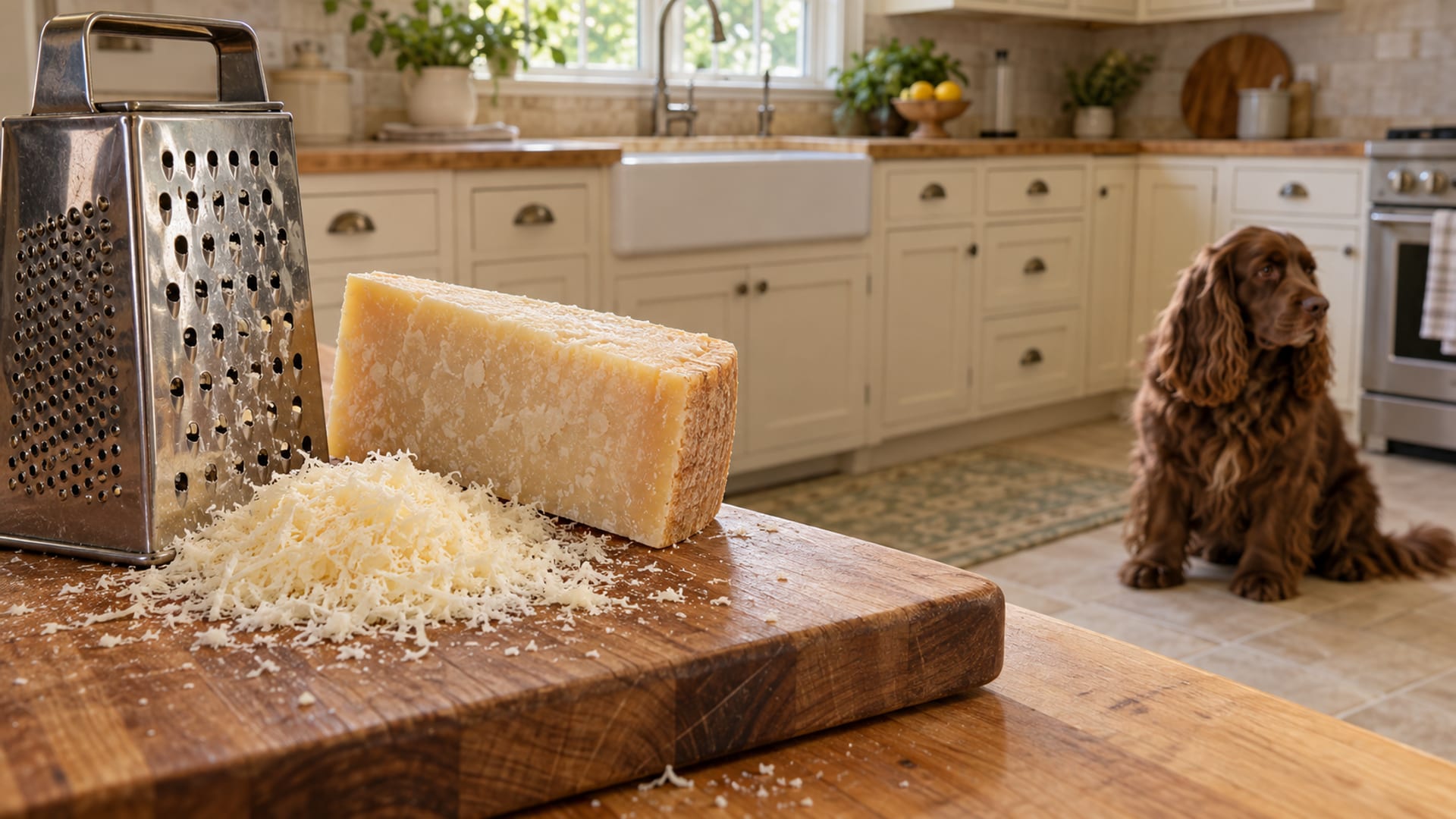
Yes, in small amounts. A few shreds of plain Parmesan are generally low risk for a healthy dog, but it is a salty, fatty, concentrated cheese, so the amount, the form and whatever it was mixed with decide how much it matters. If your dog just cleaned a pasta plate or got into the shaker, put fresh water down first, then check what was actually in the dish and how much is gone.
Parmesan is not on the standard dog poison lists. The AKC says dogs can have cheese now and then, and warns that too much fat can add up to weight gain and pancreatitis. The part that deserves your attention is the salt. The Merck Veterinary Manual describes salt toxicosis in dogs after a large enough salt exposure, and a hard, dry cheese like Parmesan carries a lot of salt in a small space.
Key takeaways
Tap a card to bring it forward.
- A few shreds of plain Parmesan once in a while are generally low risk for a healthy dog.
- Salt and fat are the concern, so a whole tub, Parmesan powder or Parmesan crisps count for far more than a sprinkle.
- Garlic Parmesan and pasta sauces made with onion or garlic carry their own separate danger.
- A swallowed rind or big hard chunk can cause choking or a blockage.
- Keep fresh water available, and call your vet for a large or unknown amount, a very small dog, or vomiting, heavy thirst, stumbling or tremors.
What to do if your dog just ate Parmesan
Work through these in order; they also give your vet what they need if you call.
- Put out fresh water and leave it there. The Merck Veterinary Manual links salt toxicosis especially to extra sodium when water is limited, so keep the bowl easy to reach.
- Find out exactly what it ate. Plain shreds from a shaker are one thing; garlic Parmesan, a sauce made with onion or garlic, Parmesan powder, seasoning or crisps are another, because added ingredients are separate hazards that the ASPCA Animal Poison Control Center assesses on their own.
- Estimate how much and when. Note how full the container was, the time and your dog's weight, since a vet decides from the amount, the product and the dog's size.
- Check for a missing rind or large hard piece. A swallowed rind can cause choking or a blockage, so call even if your dog seems fine.
- Never use salt or salt water to make your dog vomit. Pet Poison Helpline warns that doing so carries a high risk of causing salt poisoning. Skip hydrogen peroxide, medicine and other home treatments unless a vet tells you to use them.
- Call now if any of these apply. A large or unknown amount, concentrated powder or seasoning, a whole rind, a product with garlic or onion, a very small dog, no access to water, or any signs at all. Have the package or ingredient list, the amount, the time, your dog's weight and any symptoms ready.
A tiny amount of plain Parmesan in an otherwise healthy dog generally does not call for a poison line. Keep water out, watch your dog for the rest of the day, and call if anything changes.
Which kinds of Parmesan matter most
The cheese itself is the same whether it comes grated, shredded or in a wedge. What changes is how much a dog can get down, how concentrated it is, and what came with it.
Tap or hover a row to highlight it.
| Form | How much it matters | Why |
|---|---|---|
| FormA few shreds of plain grated or shredded Parmesan | How much it mattersLower | WhyA small amount of salt and fat |
| FormA tub or shaker of grated Parmesan | How much it mattersHigher | WhyEasy to eat fast and in large amounts |
| FormA wedge or big chunk | How much it mattersDepends on the amount | WhySame cheese, more of it, plus a choking risk if swallowed whole |
| FormRind | How much it mattersHigher | WhyHard enough to cause choking or a blockage |
| FormParmesan powder or seasoning | How much it mattersHigher | WhyDrying it concentrates the sodium, and products vary |
| FormParmesan crisps | How much it mattersHigher | WhyDried, concentrated cheese |
| FormGarlic Parmesan, Alfredo, pasta with onion or garlic | How much it mattersHigher | WhyGarlic, onion and chives are toxic to dogs on their own |
| FormVegan Parmesan | How much it mattersCheck the label | WhyMay contain cashew, nutritional yeast, garlic, onion or salt |
Cooking does not take the salt or fat out of Parmesan, so a baked dish or cheese sauce counts as a whole, often with extra butter, cream and seasonings.
How much Parmesan is safe to share, and how much is a concern
If you want to share, keep it small. The AKC says a small cube or a few shreds is usually enough as a reward, and recommends cheese only as an occasional treat. For a healthy dog, that means a pinch of plain Parmesan now and then. A bowlful, a rind, a spoonful of seasoning or a daily topping on the kibble all go past that, and Parmesan should never stand in for a balanced diet.
Some dogs should skip it unless your vet says otherwise. That includes dogs that have had pancreatitis before, dogs that are overweight, dogs with high blood fats or food sensitivities, and dogs on a prescribed low-fat diet. Dogs with kidney disease may need their sodium kept down, so ask before adding a salty cheese. A 2026 review in the Journal of the American Veterinary Medical Association found the evidence that dietary fat alone causes pancreatitis in dogs uncertain, but still treats limiting fat as reasonable for dogs with repeat episodes. A small dog also gets a much bigger dose per pound from the same shreds.
When it comes to how much is too much, there is no published toxic amount of Parmesan for dogs. The figures that do exist are for salt itself:
Tap or hover a row to highlight it.
| Salt (sodium chloride) eaten | What Merck reports |
|---|---|
| Salt (sodium chloride) eatenAbout 2 to 3 g per kg of body weight | What Merck reportsSigns of salt toxicosis can appear |
| Salt (sodium chloride) eatenAbout 4 g per kg of body weight | What Merck reportsAcute oral lethal dose |
Those numbers are for salt, and they cannot be turned into a safe amount of cheese without the sodium content of that exact product. Instead of doing math from a label, call your vet with your dog's weight, the product and your best guess at how much is gone.
Signs to watch for over the next several hours
After a small amount, most dogs show nothing at all. A dog that does not handle cheese well may get vomiting, diarrhea, gas, a sore belly or loose stool, and the AKC suggests watching for that kind of upset in dogs that are not used to cheese.
Salt is the one to take seriously after a big amount. The Merck Veterinary Manual says vomiting can start within several hours, followed by weakness, diarrhea, poor coordination, muscle tremors, confusion, seizures and collapse, and severe cases can be fatal. Pet Poison Helpline lists much the same for salt overdose: stomach upset, stumbling, disorientation, tremors, seizures and collapse.
A large, fatty helping can also be followed by pancreatitis, which shows up as vomiting, belly pain, low energy and not wanting to eat. Its timing cannot be predicted from the cheese alone, so keep watching after the first few hours pass.
Call right away if you see any of these:
- Repeated vomiting, or vomiting up water
- Diarrhea along with weakness
- Heavy, unusual thirst
- Low energy, stumbling or seeming confused
- Tremors or seizures
- Collapse or trouble breathing
- Belly pain
My dog ate Parmesan before and was fine
That probably happened just the way you remember it. Plenty of dogs lick a plate and never show a thing. It still does not hold for every dog or every time:
- The amount. A few shreds may not carry enough salt or fat to cause signs, while a tub or a bag of crisps can.
- The size of the dog. The same amount means a much bigger dose for a small dog than for a large one.
- The form. Plain aged cheese is different from powder, seasoning, crisps or a dish made with garlic or onion.
- Water. The Merck Veterinary Manual ties salt toxicosis especially to extra sodium when water is short.
- The individual dog. The AKC notes that some dogs handle cheese fine while others have lactose intolerance or food sensitivities.
- Health history. Past pancreatitis or extra weight can change how a dog reacts.
- Later signs. Stomach or pancreas trouble hours afterward may never get tied to the cheese.
Your dog's good experience was real. It just does not tell you how this dog, this amount and this product will go today.
Parmesan products and names that get mixed up
A lot of what dogs get into is not plain Parmesan at all:
- Parmigiano-Reggiano, "parm" and shaker Parmesan. Related cheeses that can differ in sodium, fat, moisture and additives. Brands vary, so go by the label you have.
- Garlic Parmesan and onion Parmesan. Garlic, onion and chives are toxic to dogs on their own; see our Garlic and Onions entries.
- Crackers, chips, popcorn and restaurant food with Parmesan. Check for onion, garlic, xylitol, alcohol and heavy salt; the AKC list of human foods dogs can and can't eat covers several of those ingredients. Our Popcorn entry covers the snack itself.
- Alfredo sauce and Parmesan pasta. Cream, butter and often garlic come along with the cheese; see our Alfredo Sauce and Mac and cheese entries.
- Vegan Parmesan. A different product, often made from cashews and nutritional yeast, and sometimes with garlic, onion or salt added.
For other cheeses, start with our Cheese entry, or go straight to Cottage cheese, Cream cheese or String cheese.
Check what you learned
Three quick questions to make sure the main points stuck.
Quick check
Questions about dogs and parmesan cheese
A few more questions owners ask about Parmesan and their dogs.
Can puppies have Parmesan cheese?
Puppies can be more easily upset by rich food, and a small puppy gets a bigger dose from the same shreds. If you want to use cheese as a training reward, ask your vet which kind and how much makes sense at your puppy's size.
Can I sprinkle Parmesan on my dog's food every day?
A daily topping goes past what the AKC suggests, which is cheese only as an occasional treat. Every day adds up in salt and calories.
Does my dog's breed matter?
Miniature Schnauzers and some other breeds can be prone to pancreatitis or problems handling fat. That does not make Parmesan poisonous for them, but it is a good reason to ask your vet before sharing rich, fatty treats.
Is Parmesan a problem for cats too?
Cats can also get salt toxicosis from too much sodium, according to Pet Poison Helpline, and cheese can upset some cats' stomachs. The same care applies if your cat gets into the shaker.
Sources
Checked September 25, 2026.
- American Kennel Club, Can Dogs Eat Cheese? Feeding Cheese to Your Dog
- American Kennel Club, Human Foods Dogs Can and Can't Eat
- Merck Veterinary Manual, Salt Toxicosis in Animals
- Pet Poison Helpline, Salt
- ASPCA, Animal Poison Control
- Journal of the American Veterinary Medical Association, High fat, high risk? Evaluating the strength of evidence linking dietary fat and pancreatitis in dogs