
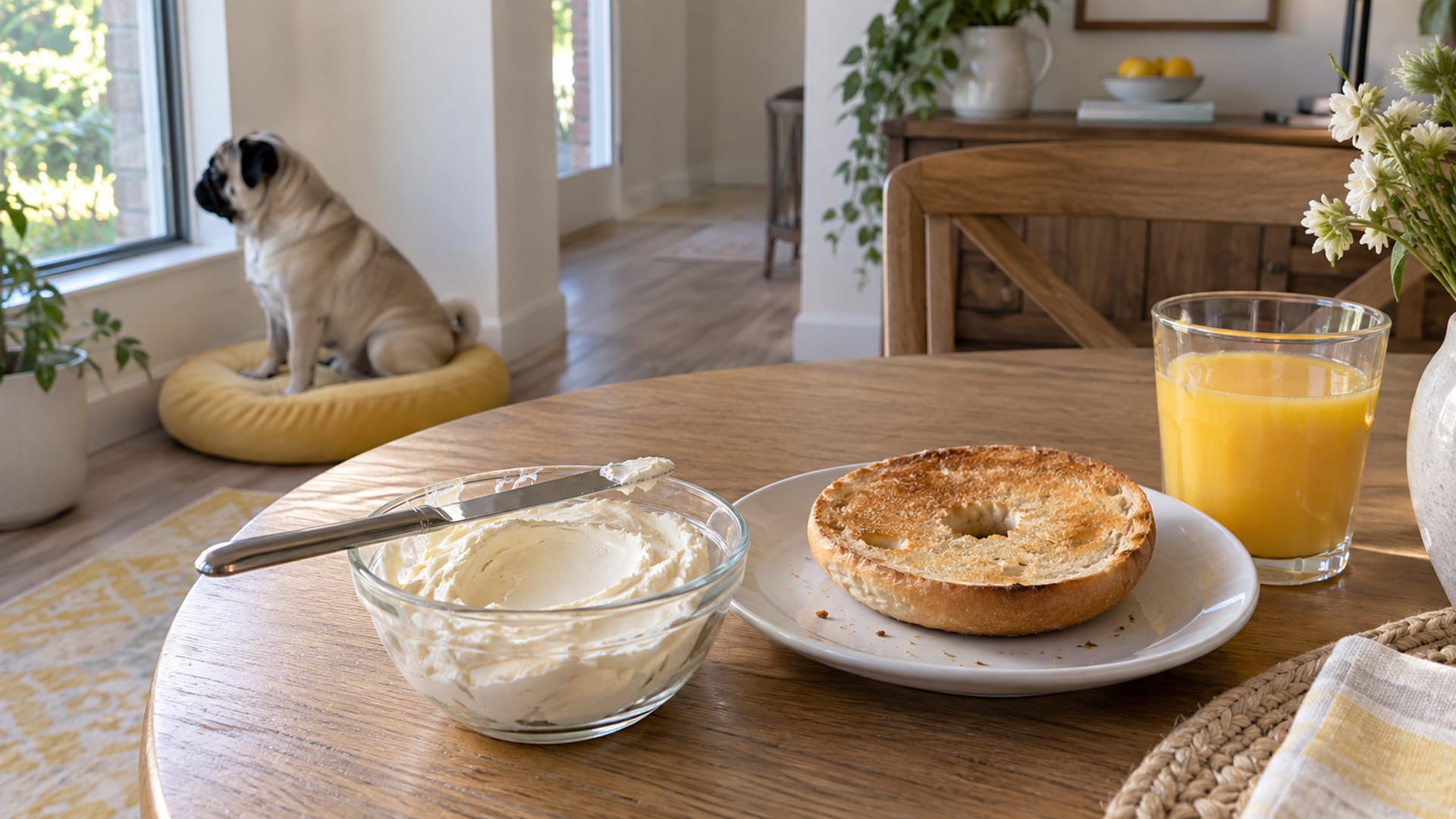
A little plain cream cheese is usually fine for a healthy dog. It is not a poison, but it is a rich, fatty dairy food. The ASPCA notes that pets do not have much of the enzyme that breaks down milk sugar, so dairy can bring on diarrhea and other stomach trouble. What matters most is which tub your dog got into.
If your dog licked a knife or ate a small smear of plain cream cheese and is acting normal, watch for loose stool or vomiting and leave it there. If it was an onion and chive, garlic and herb or other savory flavor, a sugar-free or "light" spread, or cheesecake or frosting, find the tub and call your vet or a poison line now, even if your dog looks fine.
Key takeaways
Tap a card to bring it forward.
- A lick or small dab of plain cream cheese is low risk for most healthy dogs.
- It is rich and fatty, so it stays a rare extra and never becomes a daily habit.
- Chive, onion, scallion and garlic flavors can damage red blood cells, and signs can take days to show.
- Sugar-free spreads and frostings need a check for xylitol, which is toxic to dogs.
- Dogs with pancreatitis, lactose trouble or a weight problem should skip it unless their vet agrees.
My dog ate cream cheese: what to do
Tap or hover a row to highlight it.
| What they ate | What to do |
|---|---|
| What they ateA lick or a small dab of plain cream cheese | What to doWatch for loose stool, gas or vomiting today and tomorrow. |
| What they ateMost of a tub of plain cream cheese | What to doCall your vet, especially for a small dog or one that has had pancreatitis. |
| What they ateChive, onion, scallion, garlic or herb cream cheese | What to doCall your vet or a poison line now, with the tub. |
| What they ateA sugar-free or "light" spread, or cream cheese frosting | What to doLook for xylitol on the label. Call now if you find it or the label is gone. |
| What they ateCheesecake or a dessert with chocolate, raisins or nuts | What to doCall now and name every ingredient you can. |
| What they ateA bagel with cream cheese | What to doCheck the bagel too. Onion, garlic and "everything" bagels need a call. |
| What they ateThe foil wrapper, lid or tub | What to doCall your vet and watch for gagging, vomiting or belly pain. |
The ASPCA's poisoning guidance is to keep your dog away from the rest of it, gather the packaging, and call even if your pet is acting normally, because many poisons act slowly. That fits flavored cream cheese well: onion and chive damage builds over days.
Plain, whipped, flavored: which cream cheese is okay
Tap or hover a row to highlight it.
| Type | For dogs? | What to know |
|---|---|---|
| TypePlain cream cheese | For dogs?A lick or small dab | What to knowHigh in fat; lactose can upset some dogs |
| TypeWhipped plain cream cheese | For dogs?Same small amount | What to knowFat and calories per spoon vary; read the label |
| TypeLight or reduced-fat | For dogs?Small amount, after a label check | What to knowSome sugar-free or "light" products may use sweeteners |
| TypeOnion and chive, scallion, garlic and herb, vegetable | For dogs?No | What to knowAllium ingredients damage red blood cells |
| TypeStrawberry, honey or other sweet flavors | For dogs?Not recommended | What to knowSugar, and sometimes xylitol; read the label |
| TypeCream cheese frosting | For dogs?No | What to knowSugar, and possibly xylitol, chocolate or other add-ins |
| TypeCheesecake | For dogs?No | What to knowFat and sugar, and it may hold chocolate, raisins, nuts or alcohol |
| TypePlant-based "cream cheese" | For dogs?Check the label | What to knowA different food with different ingredients |
| TypeMoldy cream cheese | For dogs?No | What to knowMold toxins; see Can dogs eat cheese? |
The savory flavors are the real concern. The ASPCA's page on chives lists them as toxic to dogs and cats and names the compound, N-propyl disulfide, which can break down red blood cells. Chives, onion, scallions, leeks and garlic all belong to the same Allium family, and on a label they can hide as "onion powder," "garlic powder," "dehydrated onion" or "spices." The Merck Veterinary Manual says raw, cooked, dried and powdered forms can all cause poisoning, and that cats are even more sensitive than dogs. Can dogs eat onions? and Can dogs eat garlic? go into the details.
"Sugar-free" or "no sugar added" on a spread or frosting does not tell you whether it is safe for a dog. Look for xylitol by name in the ingredient list.
How much plain cream cheese, and how to use it
A lick off a spoon, or a dab about the size of a fingertip, is plenty for a treat. The AKC's rule of thumb for cheese is "a small cube or a few shreds," and with a soft spread that works out to very little.
- Plain only. Check the tub for chives, onion, garlic, herbs and xylitol every time you buy a new kind.
- For hiding a pill, use the smallest smear that covers it.
- Keep it rare. Cream cheese is rich, and repeated servings add up.
- If your dog gets gas or loose stool after dairy, choose a different treat. Can dogs drink milk? explains why.
Merck's pancreatitis page names eating something rich or unusual as a common risk factor for pancreatitis in dogs, and lists high blood fats and diabetes among the conditions that matter. If your dog has had pancreatitis, is overweight, has food sensitivities or eats a prescribed diet, ask your vet before offering cream cheese at all. A lower-fat option such as cottage cheese may suit a pill pocket better.
Signs to watch for, and how soon
- Stomach upset from plain cream cheese: loose stool, diarrhea, vomiting, gas, a sore belly or going off food. This is the usual result of eating too much.
- Pancreatitis after a large amount: vomiting and belly pain are the signs Merck points to. It does not follow every fatty snack, but it can be severe, so call if these show up.
- Onion, chive or garlic poisoning: Merck says red blood cell damage begins within 24 hours, peaks around 72 hours, and the breakdown of red cells usually happens 3 to 5 days after the meal. Watch for weakness, pale gums, fast breathing, a racing heart, tiring quickly, yellow skin or eyes, and red or brown urine.
- Xylitol: can cause a dangerous drop in blood sugar and liver damage, according to the ASPCA. Do not wait for signs.
"My dog licks the cream cheese knife every morning"
That can be true, and a lick of plain cream cheese is about as small an exposure as it gets. Your dog may handle it without any problem.
What happened with your dog does not transfer to every tub or every dog. The Merck Veterinary Manual's introduction to poisoning explains that what a toxin does depends on how much was eaten and by which animal. A lick is not half a tub. The same spoonful is a much bigger dose for a Maltese than for a mastiff. A plain tub is a different food from onion and chive, and with onion the signs can arrive days after anyone was watching. Dogs also vary in how well they handle lactose and fat. A dog that did fine last month can react to a bigger helping or a different product this month.
Bagels, cheesecake and other cream cheese foods
- Bagels: onion, garlic and "everything" bagels carry Allium seasonings. Plain bread is covered in Can dogs eat bread?
- Cheesecake: rich and sweet, and some recipes add chocolate, raisins, nuts or liqueur.
- Cream cheese frosting: sugar-heavy, and a sugar-free version may carry xylitol.
- Dips and spreads: party dips made with cream cheese often add onion soup mix, garlic or herbs, plus salt. Treat a dip like the flavored tubs above.
- Other cheeses: American cheese, string cheese and mac and cheese have their own entries.
Check what you learned
Quick check
Questions about dogs and cream cheese
Can dogs eat plain cream cheese?
Yes, in a small amount now and then. Many healthy dogs handle a lick or a dab, but it is rich, and dairy upsets some stomachs.
My dog ate cream cheese with chives or onion. What should I do?
Call your vet or a poison line now, with the tub in hand. Chives and onion can damage red blood cells, and the signs can take several days to appear.
Can cream cheese cause pancreatitis in dogs?
A large or repeated fatty meal can contribute to pancreatitis, especially in dogs prone to it. A single lick is a very different exposure from half a tub.
Can dogs have flavored cream cheese?
Only after reading the whole ingredient list. Skip anything with onion, garlic, chives, scallions, leeks, xylitol, chocolate, raisins or alcohol.
Is cream cheese okay for hiding pills?
A tiny smear of plain cream cheese works for many healthy dogs. For a dog on a low-fat diet or with a history of pancreatitis, ask your vet for a different option.
Sources
Checked September 24, 2026.
- ASPCA, People Foods to Avoid Feeding Your Pets
- ASPCA, What to Do if Your Pet Is Poisoned
- ASPCA, Toxic and Non-Toxic Plants: Chives
- Merck Veterinary Manual, Garlic and Onion (Allium spp) Toxicosis in Animals
- Merck Veterinary Manual, Introduction to Poisoning
- Merck Veterinary Manual, Pancreatitis in Dogs and Cats
- American Kennel Club, Can Dogs Eat Cheese? Feeding Cheese to Your Dog