
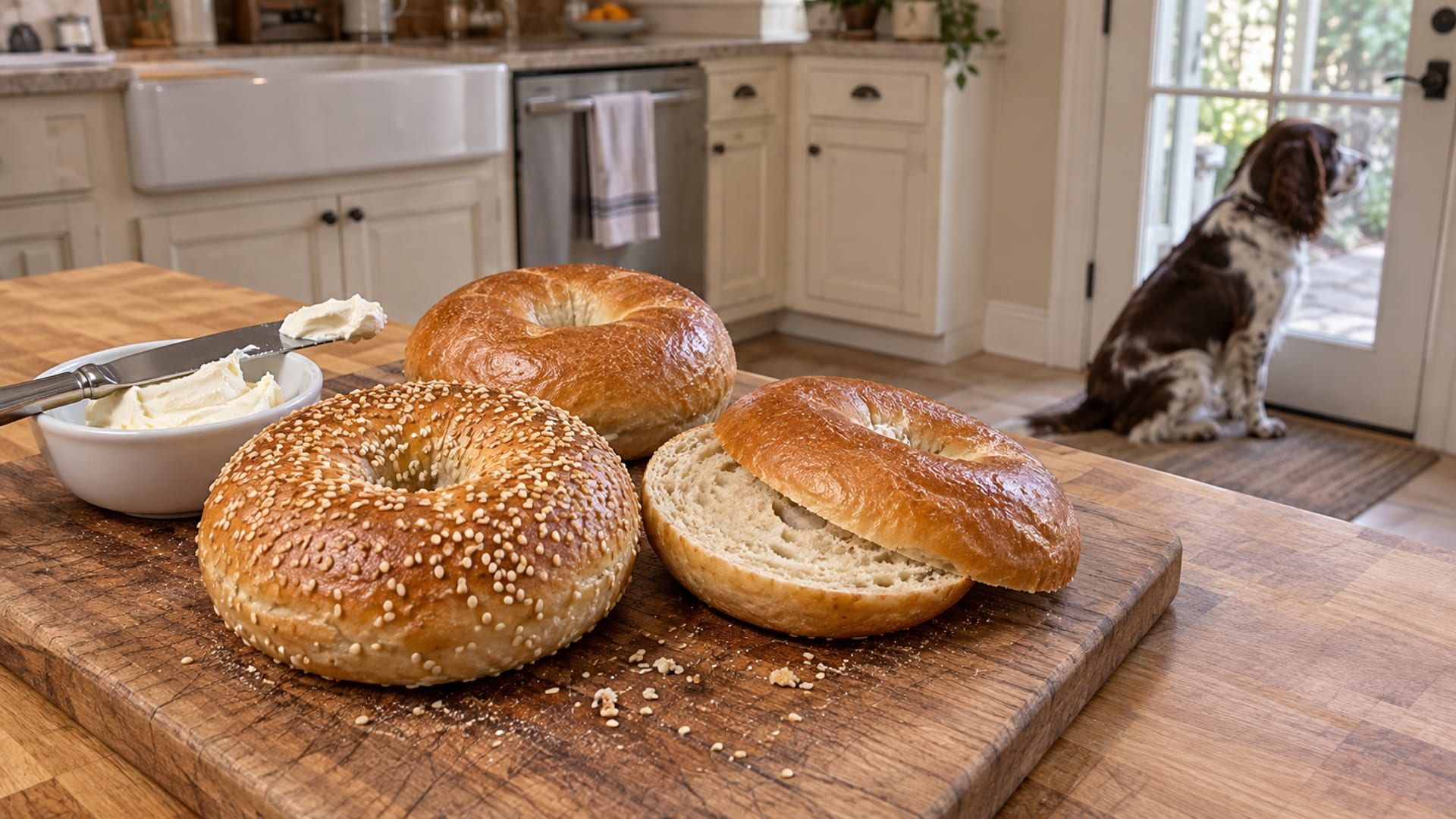
With caution. A small piece of plain, fully baked bagel is usually low concern for a healthy dog, and what turns a bagel into a real problem is the flavor, the topping or whatever was baked into the dough. If your dog just ate one, grab the bag or the label and look for onion, garlic, xylitol, raisins, chocolate or raw dough, then call your vet right away if any of those were in it or if your dog is choking, vomiting again and again, or acting weak.
Key takeaways
Tap a card to bring it forward.
- A small bite of plain, fully baked bagel usually means watching for an upset stomach or choking, and little else.
- Everything, onion and garlic bagels can damage red blood cells, and that damage often shows up 3 to 5 days later.
- Sugar-free and keto bagels may contain xylitol, which can start causing trouble within 10 to 60 minutes. Treat any xylitol as urgent.
- Cinnamon raisin, chocolate chip and raw bagel dough each carry a separate danger and call for a phone call to your vet.
- If you share a bagel on purpose, keep it to a very small piece of plain, fully baked bagel with nothing on it.
What to do if your dog already ate a bagel
The flavor decides almost everything, so start by finding out exactly what your dog got into.
- Pick up whatever is left and move your dog away from it. That stops a second helping, and the leftovers tell you what was in it.
- Read the label or think back to the flavor. Look for onion, garlic, chives, leeks, shallots, raisins, chocolate chips, and on sugar-free or keto bagels, xylitol, which can also be listed as birch sugar or wood sugar.
- Check what was spread on it or stuffed in it. Flavored cream cheese, pizza toppings and sandwich fillings can carry onion or garlic even when the bagel was plain.
- Guess how much was eaten and know your dog's weight. Half a bagel means much more to a small dog, and your vet will ask for both.
- Call now if the bagel had any of the risky ingredients, or if you can't tell what was in it. The FDA says to call your vet, an emergency clinic or an animal poison control center right away if you think your dog ate something with xylitol, and the same fast call fits onion, garlic, raisins, chocolate or raw dough.
- For plain, fully baked bagel, watch your dog. The usual trouble is gagging on a dry chunk, vomiting, diarrhea or a bloated belly.
If the bag is missing too, the FDA lists plastic and food bags as a suffocation and blockage hazard, which is its own reason to call.
Which bagels are low concern and which are not
A plain bagel has a lot in common with plain bread; the trouble comes from what bakers add to it. This table sorts the bagels and toppings people actually have at home.
Tap or hover a row to highlight it.
| Bagel or topping | Main concern | What to do |
|---|---|---|
| Bagel or toppingPlain, fully baked | Main concernUpset stomach, choking | What to doWatch your dog |
| Bagel or toppingEverything, onion, garlic | Main concernRed blood cell damage from onion and garlic | What to doCall your vet now |
| Bagel or toppingSugar-free or keto | Main concernMay contain xylitol | What to doCheck the label; call now if xylitol is listed |
| Bagel or toppingCinnamon raisin | Main concernRaisins | What to doCall your vet now |
| Bagel or toppingChocolate chip | Main concernChocolate | What to doCall your vet now |
| Bagel or toppingPoppy seed | Main concernPoppy plant compounds | What to doCheck the other toppings, watch, call if signs appear |
| Bagel or toppingCream cheese or other rich spreads | Main concernHigh fat, stomach upset, pancreatitis | What to doWatch; call if flavored with onion or chives |
| Bagel or toppingStale or rock-hard | Main concernChoking, blockage | What to doWatch for gagging or retching |
| Bagel or toppingRaw bagel dough | Main concernDough expanding in the stomach | What to doCall your vet promptly |
| Bagel or toppingThe plastic bag | Main concernSuffocation, blockage | What to doCall if any of it is missing |
Everything bagels deserve the closest look. The Merck Veterinary Manual explains that onion, garlic, chives, leeks and shallots carry sulfur compounds that damage red blood cells and can lead to anemia, and that raw, cooked, dried and powdered forms can all do it. Everything seasoning is often dried onion and garlic flakes, which pack more onion into less food. The Onions and Garlic entries cover both in more depth.
I would check sugar-free and keto bagels first, because the clock runs fastest. The FDA explains that xylitol makes a dog's body release a rush of insulin, which drops blood sugar and can lead to liver failure.
Raisins and chocolate bring their own separate dangers, covered in the Grapes and raisins and Chocolate entries. With a cinnamon raisin bagel, the raisins are the part to worry about.
Raw dough is a different problem from baked bagel. The FDA lists raw yeast dough as hazardous because it can expand in the stomach and cause a blockage.
Sharing a piece, and how much of a risky bagel matters
If you want to share, keep it rare and small. A bagel isn't something a dog needs, and a big chunk can bring extra calories, an upset stomach or a choking risk. The safest version is a very small piece of plain, fully baked bagel with no seasoning, no raisins or chips, and no spread. Skip stale bagels, since hard pieces are easier to choke on.
Cream cheese is where well-meant sharing goes sideways. The FDA warns that rich, fatty foods can lead to pancreatitis in pets, and chive or scallion cream cheese adds onion-family plants on top of the fat. The Cream cheese entry covers plain spreads.
For the risky flavors, the question becomes how much. This table holds only the figures the sources give.
Tap or hover a row to highlight it.
| Ingredient | What the source says | Source |
|---|---|---|
| IngredientRaw onion | What the source saysSigns have been seen in dogs after 15 to 30 g per kg of body weight; dried and powdered onion is more concentrated per bite | SourceMerck Veterinary Manual |
| IngredientXylitol | What the source saysPoisoning can start quickly and be life-threatening; call right away without working out a dose | SourceFDA |
| IngredientPoppy seed | What the source saysNo dog dose published; call with your dog's weight and the amount if you see signs | SourcePet Poison Helpline |
| IngredientPlain bagel | What the source saysNo toxic dose published; call if a small dog ate a lot, or if your dog has a health condition | SourceMerck Veterinary Manual, FDA |
The onion figure is for raw onion, so a slice of everything bagel can't be turned into a number at home. Give your vet your dog's weight, the flavor and your best guess of the amount, and let them do the math. According to Pet Poison Helpline, Japanese breeds such as Akitas and Shiba Inus are more sensitive to onion and garlic, which is worth mentioning on that call.
Signs to watch for, and for how long
How long you watch depends on the flavor, because each ingredient keeps its own schedule.
Plain bagel. Watch for gagging, vomiting, diarrhea or a swollen belly.
Xylitol. The FDA says signs can begin within 10 to 60 minutes, though serious effects can be delayed 12 to 24 hours in some dogs. Signs include vomiting, weakness, staggering, collapse and seizures, and it can go on to liver failure and bleeding problems. Please don't wait for signs before calling.
Onion and garlic. This is the slow one. The Merck Veterinary Manual says blood changes can start within 24 hours, while the breakdown of red blood cells typically happens 3 to 5 days after the meal. Through that stretch, watch for tiredness, weakness, pale or yellow gums, fast breathing, a racing heart, tiring out on walks, or dark or bloody urine. At its worst this becomes a life-threatening anemia with kidney damage.
Poppy seed. Pet Poison Helpline describes stomach upset, sleepiness and wobbly walking, with coma only after very large amounts of the plant.
With any bagel, call right away for choking, repeated vomiting, collapse, trembling, seizures, stumbling, a painful belly or trouble standing.
My dog ate a bagel before and was fine
That happens, and I believe it. Plenty of dogs have grabbed a bagel off a plate and gone on with their day. That one day just doesn't decide what happens next time, because a few things can change between two bagels.
A bite and a whole bagel are very different meals, and a small dog gets a far bigger dose per pound than a large one. A plain bagel last time and an everything bagel this time are two separate questions. Maybe the dog ate the bread and left the seasoned crust. Dogs also differ in sensitivity, and the Japanese breeds mentioned above are one known example.
The biggest reason is timing. The Merck Veterinary Manual notes that onion and garlic anemia may take several days to show, so a dog who seemed fine that evening may not have been fine by the weekend.
Bagel products and names to check
Each of these is really a list of ingredients to read.
- Everything bagel seasoning. The mix varies by brand and can include dried onion, dried garlic, salt, sesame and poppy seed.
- Bagel bites and pizza bagels. These add sauce, cheese and toppings, so read the label for onion and garlic the same way you would for pizza.
- Bagel sandwiches. Check the filling and any spread for onion, garlic and heavy fat.
- Sugar-free, keto or low-carb bagels. Look for xylitol, birch sugar or wood sugar in the ingredients.
- Flavored cream cheese. Chive, scallion, garlic and vegetable spreads can hold onion-family plants.
- Poppy seed bagels. The word "poppy" also covers the poppy plant itself, and Pet Poison Helpline notes that how harmful it is depends on the species.
- Raw bagel dough. Unbaked yeast dough from a home kitchen or a bakery tray carries the rising-dough hazard, so call your vet promptly.
Check what you learned
Three quick questions on what matters most when a bagel goes missing.
Quick check
Questions about dogs and bagels
These come up once the first scare has passed.
Can puppies have a bit of bagel?
The same flavor rules apply to puppies, and their small size means a bite counts for more. If a young or small puppy ate a large piece, give your vet a call with its weight and the amount, even if the bagel was plain.
My dog has diabetes or has had pancreatitis. Does that change anything?
It can. Dogs with diabetes may react more to the sugar and calories, and dogs with a history of pancreatitis are more likely to be bothered by fatty toppings like cream cheese or butter. Ask your vet before sharing any bagel with a dog on a special diet.
Is a bagel a good regular treat?
It works better as a rare bite than a habit. A daily bagel treat mostly adds calories, and it raises the odds that a flavored one ends up in the bowl by mistake.
Can my cat get sick from the same everything bagel?
Yes, and cats are more sensitive to onion and garlic than dogs are, according to the Merck Veterinary Manual. The FDA says xylitol appears less dangerous to cats, but it still belongs out of reach of every pet.
Sources
Checked September 25, 2026.
- Merck Veterinary Manual, Garlic and Onion (Allium spp) Toxicosis in Animals
- U.S. Food and Drug Administration, Paws Off Xylitol; It's Dangerous for Dogs
- U.S. Food and Drug Administration, Potentially Dangerous Items for Your Pet
- U.S. Food and Drug Administration, Keep Your Dogs and Cats Safe From Holiday Hazards
- Pet Poison Helpline, Onions Are Toxic To Dogs
- Pet Poison Helpline, Poppy