
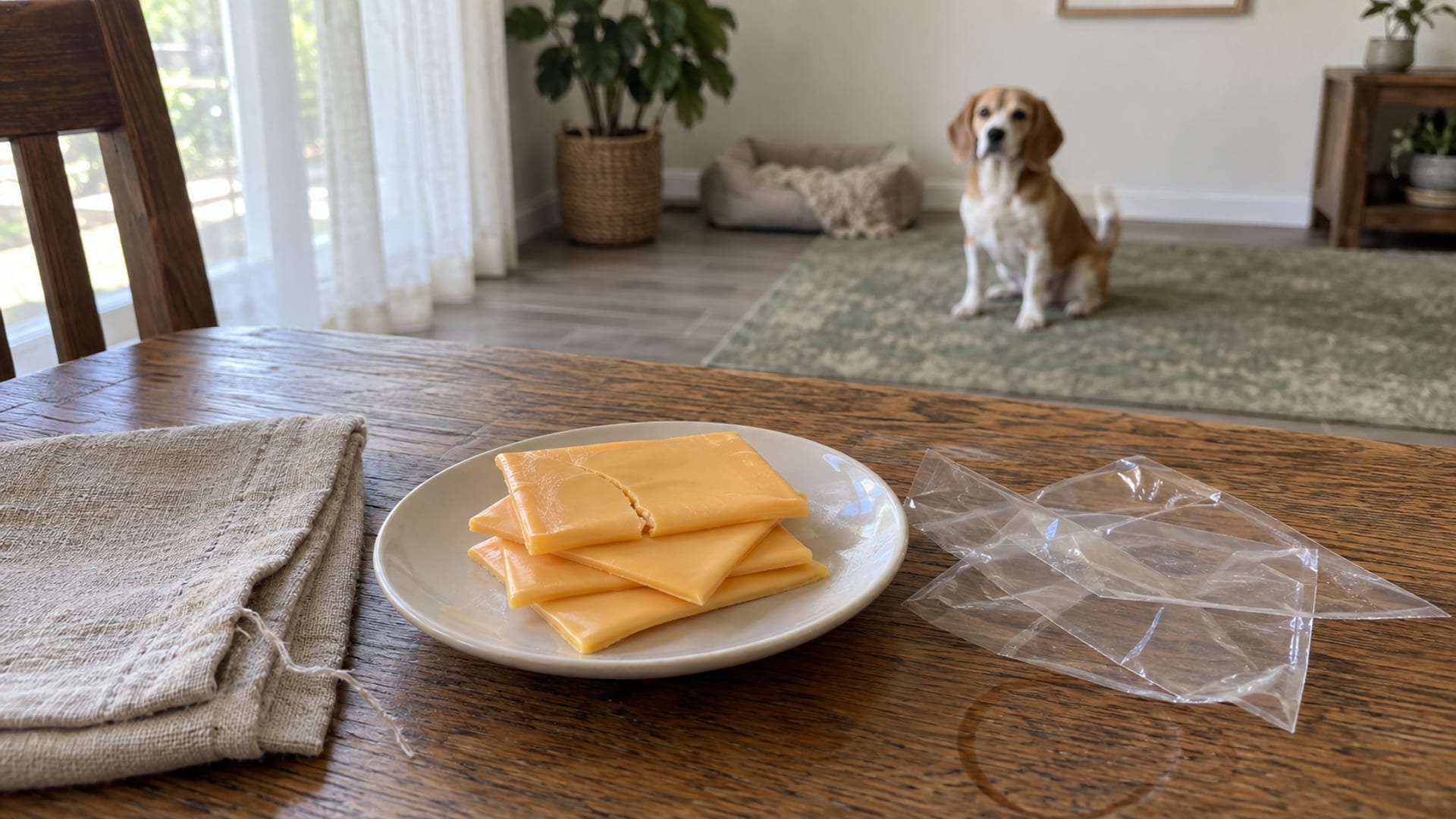
Yes, a small piece of plain American cheese is fine for most healthy dogs as an occasional treat. It is not a poison. The catch is what a processed slice carries: salt, fat and calories, plus lactose. The American Kennel Club advises keeping cheese to small amounts because many cheeses are high in fat and some dogs are lactose intolerant.
If your dog pulled one slice off the counter and is acting like themselves, you can watch them at home for the rest of the day. Call your vet or a poison line if they ate a stack of slices, swallowed the plastic sleeve, got into a burger or sandwich made with onion or garlic, or has had pancreatitis.
Key takeaways
Tap a card to bring it forward.
- A small piece of one plain slice is a low-risk treat for most healthy dogs.
- Processed slices bring more salt and fat than a dog needs, so plainer, lower-fat cheeses make a better habit.
- The plastic around each slice can choke a dog or block the gut if it gets swallowed.
- Burgers, grilled cheese and nachos often add onion, garlic and extra fat to the cheese.
- Dogs with pancreatitis, kidney disease or a prescribed diet should skip it unless their vet says yes.
My dog ate American cheese: what to do next
Tap or hover a row to highlight it.
| What they got | Next step |
|---|---|
| What they gotOne plain slice, or part of one | Next stepWatch for gas, loose stool or vomiting over the next day. |
| What they gotSeveral slices or most of a pack | Next stepCall your vet with the package and your dog's weight. This matters most for small dogs. |
| What they gotA slice still in its plastic sleeve | Next stepCall your vet. Watch for gagging, vomiting that repeats, belly pain or no stool. |
| What they gotA cheeseburger, grilled cheese, nachos or queso dip | Next stepFind out what else was in it. Onion, garlic or chives mean a call now. |
| What they gotAny amount, for a dog with pancreatitis or on a low-fat, low-sodium or kidney diet | Next stepCall your vet today, even if your dog looks fine. |
Before you pick up the phone, grab the package so you can read the ingredients out loud. Have a rough count of slices, the time it happened and your dog's weight ready too.
Salt is the part that can turn a big helping into more than a stomach upset. The ASPCA links too much salt to vomiting, diarrhea, tremors, seizures and, in bad cases, death, and says signs of salt overload usually show up within 12 hours. One slice is not that situation. A small dog that ate a whole pack is closer to it, which is why that dog needs a call.
Head straight to an emergency vet for stumbling, tremors, a seizure, collapse, or a dog that cannot keep water down.
Slices, melted, powdered: which forms matter
Tap or hover a row to highlight it.
| Form | For dogs? | What to watch |
|---|---|---|
| FormPlain slices or singles | For dogs?A small piece now and then | What to watchSalt, fat and calories add up fast |
| FormReduced-fat or fat-free slices | For dogs?The same small piece | What to watchLess fat can still mean plenty of salt |
| FormMelted onto plain food | For dogs?Same as a slice | What to watchHeat does not make it toxic; the food under it matters |
| FormCheese food, cheese product, loaves and spreads | For dogs?Read the label first | What to watchFat, salt and ingredients vary by product |
| FormCheese powder or dried cheese | For dogs?A lick at most | What to watchSaltier by weight than a slice |
| FormCheese with onion, garlic, chives or hot sauce | For dogs?No | What to watchOnion and garlic are unsafe for pets |
| FormIndividually wrapped slices | For dogs?Unwrap first | What to watchPlastic can cause choking or a blockage |
| FormMoldy or spoiled cheese | For dogs?No | What to watchSpoiled food brings its own risks |
Two packs that both say "American" on the front can differ a lot in salt and fat. The nutrition panel and ingredient list on the back tell you more than the name. If onion or garlic shows up anywhere in a cheesy dish, Can dogs eat onions? and Can dogs eat garlic? explain why cooked and powdered forms still count. For moldy cheese of any kind, see Can dogs eat cheese?
How much American cheese, and how to give it
The AKC's guideline for cheese in general is "a small cube or a few shreds," and that is usually enough as a reward. With a slice, tear off a small square and put the rest back in the fridge.
- Peel off the plastic first, every time.
- Break the piece into bite-size bits so it goes down easily.
- Keep it occasional. It is a treat and does not replace your dog's regular food.
- For a regular cheese treat, a lower-fat, lower-sodium kind is the better pick. Can dogs eat cottage cheese? covers one of the milder options.
Cornell University's College of Veterinary Medicine advises giving only small amounts of rich or fatty foods, especially to dogs with sensitive stomachs, and notes that dogs who survive pancreatitis often need a strict low-fat diet afterward.
Check with your vet before giving American cheese if your dog:
- has had pancreatitis or eats a prescribed low-fat food
- has kidney disease or is on a low-sodium diet
- gets gas or diarrhea after dairy (see Can dogs drink milk? for how lactose trouble works)
- has diabetes, which the Merck Veterinary Manual lists among the conditions that matter when a dog has pancreatitis
Signs to watch for, and how soon
- A dairy or fat upset: gas, loose stool, diarrhea, vomiting or a sore belly. This is the most likely result of eating too much.
- Too much salt: a lot of drinking and peeing, then vomiting within several hours, according to Merck's page on salt toxicosis. Severe cases move on to weakness, stumbling, tremors and seizures. The ASPCA says dogs that recover usually do so within 24 to 72 hours.
- Pancreatitis: vomiting, low energy, not eating, belly pain, diarrhea and fever. It does not follow every fatty snack, but these signs after a big helping need a vet.
- A swallowed wrapper: gagging, vomiting that keeps coming back, belly pain, or no stool.
"My dog has had American cheese for years"
That can be completely true. Plenty of dogs get a corner of a slice for years with no trouble, and yours may be one of them. It still does not make American cheese safe for every dog in every amount.
What your dog got matters: a corner of a slice is a different thing from half a pack or a cheeseburger with onion in it. Size matters too, because the same slice is a much bigger dose for a Chihuahua than for a Labrador. Merck notes that salt poisoning is closely tied to water and is unlikely when a dog can drink freely, so a dog with a full bowl nearby is better placed than one without. Dogs also differ in how well they handle lactose, and a dog that later develops pancreatitis or kidney disease is in a different spot than it was as a young dog.
Pancreatitis itself is not simple. A review in the Journal of the American Veterinary Medical Association found the evidence tying dietary fat to naturally occurring pancreatitis in dogs is weaker than often assumed. A rich snack can raise the odds for some dogs without guaranteeing trouble, which is exactly why one dog's good record cannot promise the same for the next.
Burgers, grilled cheese and other look-alikes
- Cheeseburgers: fatty meat, salt and often onion. Check what was on it.
- Grilled cheese: butter adds more fat, and garlic butter adds garlic.
- Nachos and queso dip: can carry onion, garlic, hot spices and a lot of salt.
- Mac and cheese: the sauce and seasoning packet are the concern. Can dogs eat mac and cheese? goes through it.
- Cheese-flavored dog treats and hard Himalayan chews: different products with different ingredients. Hard chews can crack teeth, choke a dog or block the gut.
- Other cheeses: string cheese and cream cheese each have their own entry.
Check what you learned
Quick check
Questions about dogs and American cheese
Can my dog have one slice of American cheese?
A small piece is usually fine for a healthy dog, and the AKC suggests keeping cheese to an occasional treat. A whole slice is a lot for a small dog, so tear off a bit and save the rest.
My dog ate several slices. What should I do?
Check the package, count what is missing, and weigh that against your dog's size. Call your vet or a poison line for a big or unknown amount, especially for a small dog or one that starts vomiting, has diarrhea or seems weak or wobbly.
Can dogs with pancreatitis eat American cheese?
Not unless the vet managing their care says so. Dogs that have had pancreatitis usually need a low-fat diet, and processed slices are rich.
Can American cheese give a dog diarrhea?
Yes. Lactose, fat or simply too much at once can cause gas, loose stool, vomiting or diarrhea in dogs that are sensitive to dairy.
What if my dog ate the wrapper too?
Call your vet for advice. The cheese is rarely the problem there. The plastic is, because it can cause choking or a blockage in the gut.
Can puppies eat American cheese?
Only a tiny bit, if any. Puppies are small, so a slice goes further in their bodies, and new foods upset their stomachs easily.
Sources
Checked September 24, 2026.
- American Kennel Club, Can Dogs Eat Cheese? Feeding Cheese to Your Dog
- ASPCA, People Foods to Avoid Feeding Your Pets
- Cornell University College of Veterinary Medicine, Re-evaluating your dog's diet
- Merck Veterinary Manual, Pancreatitis in Dogs and Cats
- Merck Veterinary Manual, Salt Toxicosis in Animals
- Yamka R and others, High fat, high risk? Evaluating the strength of evidence linking dietary fat and pancreatitis in dogs, Journal of the American Veterinary Medical Association