
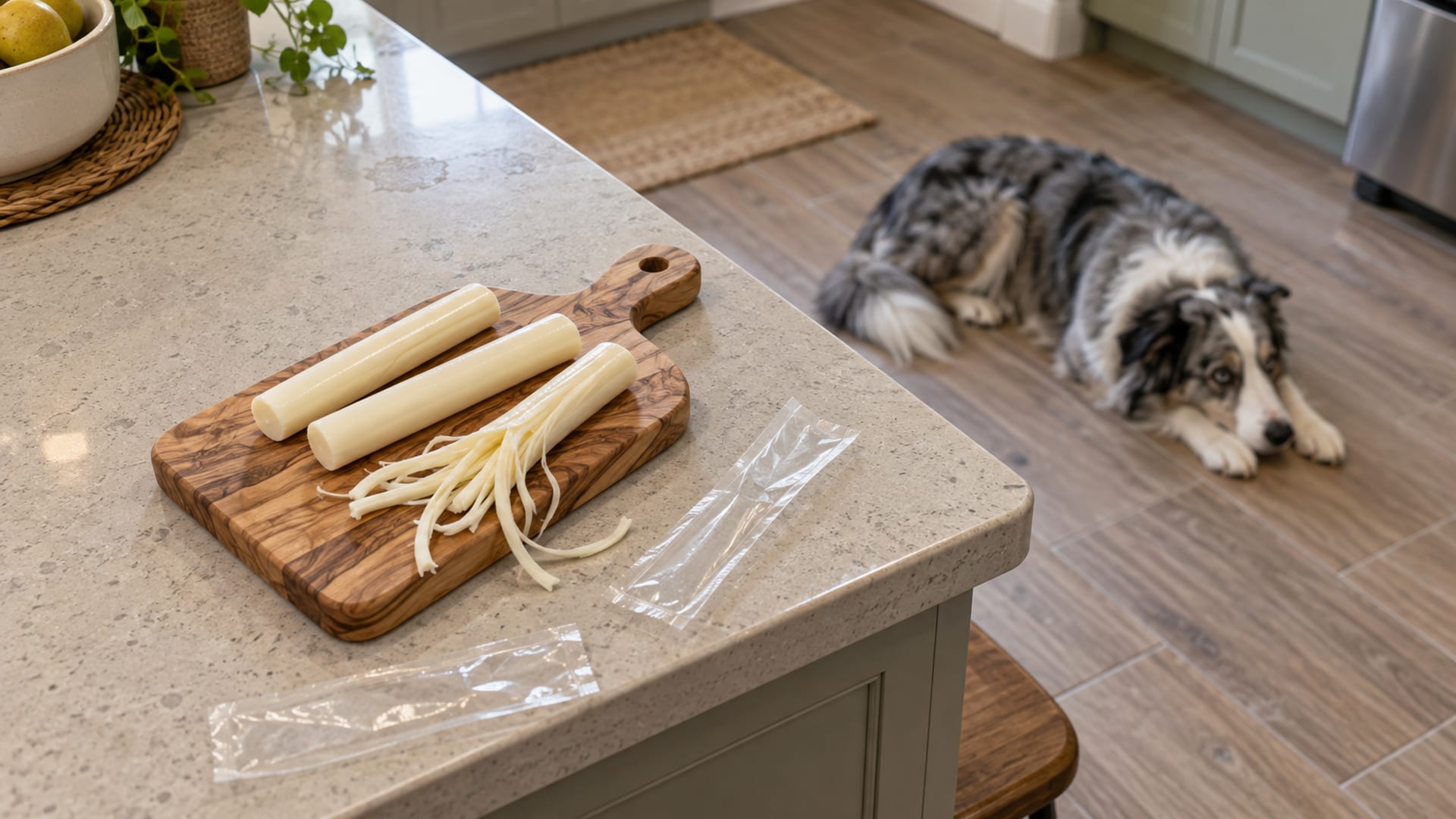
Yes. Plain string cheese is mozzarella, and a few small pieces are fine for most healthy dogs. The American Kennel Club says dogs can have cheese in small to moderate amounts, and it lists mozzarella among the lower-fat choices. It is still dairy with fat and salt in it, so it works best as a treat you break into bits.
If your dog swallowed one plain stick and is acting normal, keep an eye out for vomiting, diarrhea or a sore belly over the next few days. If the wrapper went down with it, if it was a flavored stick with garlic or onion, or if your dog gagged or struggled to breathe, call your vet now.
Key takeaways
Tap a card to bring it forward.
- Plain string cheese is a fine small treat for most healthy dogs.
- Tear it into pea-size bits. A whole stick gulped at once can lodge in the throat.
- The plastic wrapper can cause choking or a blockage if swallowed.
- Garlic, onion, chive or pepper-flavored sticks need a label check before any dog gets them.
- Hard yak or Himalayan "cheese sticks" are a different product with different risks.
My dog ate string cheese: what to do next
Tap or hover a row to highlight it.
| What they got | What to do |
|---|---|
| What they gotA few bits or one plain stick | What to doWatch for loose stool, gas or vomiting over the next few days. |
| What they gotSeveral sticks or a whole bag | What to doCall your vet, especially for a small dog or one that has had pancreatitis. |
| What they gotA stick with its wrapper | What to doCall your vet and watch for gagging, vomiting, belly pain or no stool. |
| What they gotA flavored stick (garlic, onion, chive, pepper jack) | What to doRead the label. Garlic, onion or chives mean a call now. |
| What they gotYour dog is coughing, gagging hard or struggling to breathe | What to doEmergency vet now. |
Fat is the slow part of this. Pet Poison Helpline explains that fatty table food is usually not a poison, but it can bring on stomach trouble or pancreatitis, and the vomiting can start 1 to 4 days after the meal. A dog that seems fine the same evening can still get sick later in the week, so keep watching.
Before calling, write down roughly how many sticks are gone, what time it happened and which kind it was. Keep the bag for the ingredient list.
Which cheese sticks are okay
Tap or hover a row to highlight it.
| Product | For dogs? | Why |
|---|---|---|
| ProductPlain mozzarella string cheese | For dogs?Yes, in small pieces | WhyOne of the lower-fat cheeses, according to the AKC |
| ProductLow-fat or part-skim sticks | For dogs?Yes, same small pieces | WhyLess fat; still has salt and lactose |
| ProductLactose-free sticks | For dogs?Often easier on the stomach | WhyFat, salt and calories stay the same |
| ProductCheddar, colby jack or pepper jack sticks | For dogs?A small bit, after a label check | WhyRicher, and pepper jack adds spice |
| ProductGarlic, onion, chive or herb sticks | For dogs?No | WhyGarlic, onion and chives are toxic to dogs |
| ProductSmoked or breaded mozzarella sticks | For dogs?No | WhyBreading, oil and seasoning add risk |
| ProductPlant-based cheese sticks | For dogs?Check the label | WhyIngredients vary a lot |
| ProductHard yak or Himalayan cheese chews | For dogs?A different product | WhyHard chunks can break teeth, choke a dog or block the gut |
The name on the package tells you less than the ingredient list. "Cheese stick" can mean plain mozzarella, cheddar, processed cheese or a seasoned snack, and salt and fat differ from brand to brand. For why garlic and onion are the ingredients that change the answer, see Can dogs eat garlic? and Can dogs eat onions?
How much string cheese, and how to use it for training
The AKC's guideline is "a small cube or a few shreds," and string cheese makes that easy because it pulls apart into strands. For training, one stick torn into tiny bits goes a long way. The AKC names string cheese as an example of a high-value training reward, the kind of treat a dog will work hard for.
- Peel it into strands or pinch off pea-size bits.
- Count those bits as part of the day's treats.
- Throw the wrapper away somewhere your dog cannot reach it.
- Stop if your dog gets gas or loose stool after dairy. Can dogs drink milk? explains why some dogs react to lactose.
Talk to your vet before using string cheese as a regular treat if your dog has had pancreatitis, is overweight, has diabetes or kidney disease, has food sensitivities, or eats a prescribed diet. Pet Poison Helpline also notes that Miniature Schnauzers are more likely than some breeds to develop pancreatitis. The Merck Veterinary Manual treats a low-fat diet as part of managing the disease.
Signs to watch for, and how soon
- Dairy upset: gas, bloating, loose stool, diarrhea or vomiting, which tends to come on sooner than fat-related trouble. Dogs with strong lactose intolerance may react to even a small amount, the AKC says.
- Pancreatitis after a big helping: vomiting, belly pain, diarrhea, not eating and low energy, which can show up 1 to 4 days later.
- Choking: gagging, pawing at the mouth, coughing or trouble breathing right after a gulped stick. This needs help now.
- A blockage from a wrapper or hard chunk: repeated vomiting, belly pain, not eating, tiredness or no stool. The AKC's guide to intestinal blockage lists these signs and says a blockage needs a vet.
"My dog gets string cheese every day and is fine"
I believe you. Plenty of dogs get a few strands a day in training without any trouble, and yours may be one of them. That experience is real. It just does not stretch to every dog.
A German Shepherd getting a few strands during a training session is taking in far less for its size than a Yorkie that grabs a whole stick from a lunchbox. A dog that handles lactose well will not react the way a sensitive one does. A plain stick is a different food from a garlic-herb one. And the fat-related trouble can arrive days after the snack, when nobody connects the two. If your dog's diet or health changes, or you switch brands, the old track record no longer covers it.
Mozzarella sticks, cheese chews and other look-alikes
- Fried mozzarella sticks: breaded, fried and often served with garlicky marinara. Keep them away.
- Yak or Himalayan cheese chews: made to be hard. The AKC warns that hard chews can break teeth and that swallowed chunks can cause choking or a blockage.
- Cheese curds: a different cheese with its own salt level. Treat them like any cheese: a small bit, plain.
- Other cheeses: cheese in general, American cheese, cream cheese and cottage cheese each have their own entry.
Check what you learned
Quick check
Questions about dogs and string cheese
Can dogs eat string cheese every day?
A few small bits a day is fine for many healthy dogs, as long as they count toward the day's treats. The AKC recommends moderation, since cheese carries fat and some dogs do not handle lactose.
My dog ate a whole string cheese. Is that bad?
One plain stick is usually not a poisoning emergency for a healthy dog. Check whether the wrapper is missing, and watch for vomiting, diarrhea, belly pain or low energy over the next few days.
Can puppies have string cheese?
Yes, in very small plain pieces. The AKC mentions cheese as a training reward for puppies too, but young stomachs upset easily, so go tiny.
Can dogs with pancreatitis eat string cheese?
Ask your vet first. Dogs that have had pancreatitis usually need a low-fat diet, and any cheese has to fit inside the plan their vet set.
Is a yak cheese stick the same as string cheese?
No. A yak or Himalayan chew is a hard dried product made for chewing. It can break teeth or cause a blockage if a big piece is swallowed, which regular string cheese does not.
Sources
Checked September 24, 2026.
- American Kennel Club, Can Dogs Eat Cheese? Feeding Cheese to Your Dog
- American Kennel Club, When Can I Phase Out Treats During Dog Training?
- American Kennel Club, Choosing Edible Dog Chews That Are Also Safe
- American Kennel Club, Intestinal Blockage in Dogs
- Pet Poison Helpline, Is Table Food Poisonous for Dogs?
- Merck Veterinary Manual, Pancreatitis in Dogs and Cats