
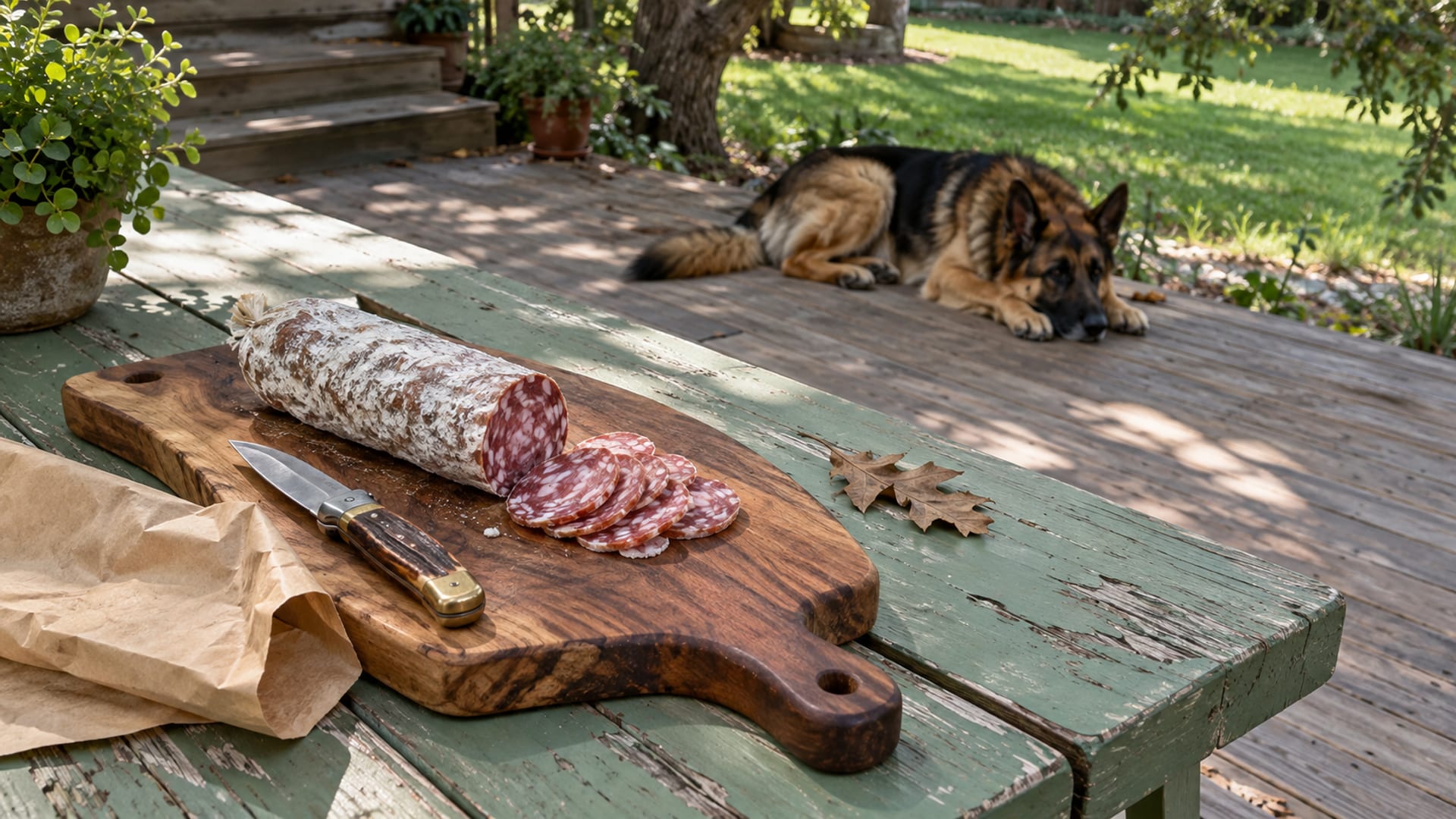
A bite of plain salami is not usually a poisoning, but salami makes a poor dog treat. Many products are high in salt and fat, and the ASPCA lists fatty foods, excess salt, and garlic and onion among the people foods that can harm pets. Garlic is the ingredient to look for first, because some salami recipes use it.
If your dog just took a slice off the cutting board, grab the package and read the ingredients. A slice or two of salami with no garlic or onion in a healthy, mid-sized dog is usually something to watch at home. A large amount, a small dog, a garlicky recipe, or a whole chunk swallowed is a reason to call your vet.
Key takeaways
Tap a card to bring it forward.
- A slice of plain salami is a low-risk accident for most healthy dogs.
- Salt and fat are the everyday concerns; fat can bring on pancreatitis.
- Garlic or onion in the recipe can damage red blood cells, and the signs may take days.
- A thick chunk or piece of casing can choke a dog or block the gut.
- Pale gums, dark urine, weakness, tremors or seizures need a vet right away.
My dog ate salami: read the label first
- Find the package. Look for garlic, onion, garlic powder, onion powder, or dehydrated garlic or onion. Also check for cheese, alcohol, raisins or xylitol in specialty products.
- Estimate the amount. A thin slice, a stack of slices and a whole stick are three different situations.
- Check your dog's size and health. Small dogs, and dogs with pancreatitis, diabetes or kidney problems, need a call sooner.
- Watch for choking. Gagging, pawing at the mouth or trouble breathing after a big piece is an emergency.
- Call your vet or a pet poison line for a large or unknown amount, any garlic or onion, a swallowed chunk or casing, a recalled product, or any signs of illness.
The ASPCA's garlic page tells owners to call its poison center or a local vet as soon as possible if they think a pet ate a toxic amount. Skip home treatments and medicines unless a vet or poison line tells you otherwise.
Dry, cooked, garlicky or pepperoni: which salami matters
Tap or hover a row to highlight it.
| What your dog ate | How concerned to be | Why |
|---|---|---|
| What your dog ateA slice of plain salami, no garlic or onion | How concerned to beLow for a healthy dog | WhySalty and fatty, but a small amount |
| What your dog ateSeveral slices or a whole stick | How concerned to beCall your vet | WhyThe salt and fat add up |
| What your dog ateSalami seasoned with garlic or onion | How concerned to beCall your vet | WhyGarlic and onion can damage red blood cells |
| What your dog ateDry or hard salami | How concerned to beWatch closely | WhyDrying concentrates the salt and fat |
| What your dog ateCooked salami, salame cotto | How concerned to beSame caution | WhyCooking lowers germ risk but leaves salt, fat and seasoning |
| What your dog ateA thick chunk or long casing | How concerned to beWatch closely; call if gagging | WhyCan block the airway or gut |
| What your dog atePepperoni, soppressata, summer sausage | How concerned to beTreat like salami | WhySimilar concerns with their own recipes |
| What your dog ateSalami with cheese, raisins or alcohol | How concerned to beCall your vet | WhyThe added ingredient brings its own hazard |
The Merck Veterinary Manual's garlic and onion chapter explains that raw, cooked, dried and powdered garlic and onion can all affect dogs, and that the concentrated dried forms are the ones most often linked to poisoning. The pages on garlic and onions go through the full picture.
There is also a germ angle. The CDC lists salami among the fermented and dry sausages that can be contaminated with *Listeria*, and the American Kennel Club notes that dogs can carry the bacteria without looking sick. That matters most during a recall of a product you have in the house.
When a salami snack turns into a vet call
Salami recipes vary too much for a toxic amount of salami itself. The numbers that exist are for its ingredients.
- Salt. Merck reports signs of salt poisoning in dogs at roughly 2 to 3 grams of salt per kilogram of body weight, with about 4 grams per kilogram as a lethal dose, according to its salt toxicosis chapter. A label lists sodium rather than salt, and the risk rises when water is short.
- Fat. The ASPCA's cookout guide warns that fatty foods can lead to pancreatitis. Merck names eating things a dog should not, along with very high blood fats, as risk factors, and says diabetes needs checking in dogs with pancreatitis.
- Garlic and onion. The amount in any one salami is unknown, so treat a garlicky salami as a reason to phone your vet.
Because every one of these is measured per kilogram, the same slice is a bigger deal for a Pomeranian than for a Newfoundland.
Signs to watch for, and the delayed garlic timeline
Tap or hover a row to highlight it.
| Timing | Signs | Likely cause and next step |
|---|---|---|
| TimingRight away | SignsChoking sounds, gagging, labored breathing | Likely cause and next stepA chunk or casing is lodged. Go to a vet now. |
| TimingWithin several hours | SignsVomiting, diarrhea, belly discomfort, heavy thirst | Likely cause and next stepSalt or fat. Call your vet. |
| TimingHours after a large amount | SignsWeakness, stumbling, tremors, seizures | Likely cause and next stepSalt poisoning. Emergency vet now. |
| Timing3 to 5 days after garlic or onion | SignsWeakness, pale or yellow gums, fast breathing, fast heartbeat, dark or red urine | Likely cause and next stepRed blood cell damage. Call your vet now. |
Merck explains that garlic and onion start injuring red blood cells within about 24 hours, but the breakdown of those cells usually shows up 3 to 5 days after the meal. So, a dog that ate garlic salami on Saturday and seems fine on Sunday still needs watching into the middle of the week.
"My dog always gets the salami ends and has never been sick"
That can be completely true. A small end piece of plain salami for a big dog with water nearby is a modest dose of salt and fat. Here is why it does not work as a rule:
- The amount. An end piece and half a stick are far apart.
- The dog's size. The same piece means much more to a small dog.
- The recipe. One salami has garlic and another does not, and salt and fat differ too.
- Delayed signs. Garlic damage can take days to show, so it may never get connected to the salami.
- The individual. Health conditions change how a dog handles salt and fat.
- Pancreatitis is not a sure thing. A fatty meal raises the risk without guaranteeing the illness, which is why one dog is fine and another is not.
If the salami ends are a habit, make sure the label has no garlic or onion, keep the piece small, and give it rarely.
Pepperoni, summer sausage and other salami cousins
- Pepperoni: a spicy dry sausage, often on pizza. Same fat and salt questions, different recipe.
- Soppressata, fuet, salchichón: regional dry sausages sold alongside salami. Read each label.
- Chorizo: Mexican chorizo is usually fresh and raw before cooking, while Spanish chorizo is usually cured. The label tells you which.
- Summer sausage: a related fermented sausage with its own seasoning.
- Charcuterie boards: the grapes and cheese can matter as much as the meat. See can dogs eat grapes? and can dogs eat prosciutto?
- Other sausages: see can dogs eat hot dogs? and can dogs eat kielbasa?
- Salami-flavored dog treats: a flavor name, with its own ingredient list.
Check what you learned
Quick check
Questions about dogs and salami
Can dogs eat a little salami?
A small bite of plain salami is not automatically toxic. It is still a poor treat, because salt, fat and seasonings vary from one product to the next.
My dog ate salami with garlic. Is that dangerous?
It can be. Garlic can damage a dog's red blood cells, and concentrated forms like garlic powder pack more of it into each bite. Call your vet with the label and the amount, and watch for weakness, pale gums or dark urine over the next several days.
How much salami is toxic to a dog?
There is no set amount of salami, because recipes differ so much. Your vet can use the label, your dog's weight and the ingredient figures for salt and garlic to judge the risk.
What signs should I watch for?
Vomiting, diarrhea, belly pain, tiredness, heavy thirst, weakness, pale or yellow gums, dark urine, tremors, seizures, trouble breathing and collapse all need attention. Garlic signs can be delayed for several days.
Can dogs eat pepperoni?
Pepperoni raises the same concerns as salami, often with more spice. Keep it off the treat list and call your vet if your dog ate a lot or the label lists garlic or onion.
Is garlic salami worse for cats?
Yes. Merck lists cats as the most sensitive species to garlic and onion, so a cat that eats garlicky salami needs a call to the vet.
Sources
Checked September 24, 2026.
- ASPCA, People Foods to Avoid Feeding Your Pets
- ASPCA, Be On the Lookout at Your Cookout
- ASPCA, Toxic and Non-toxic Plants: Garlic
- Merck Veterinary Manual, Garlic and Onion (Allium spp) Toxicosis in Animals
- Merck Veterinary Manual, Salt Toxicosis in Animals
- Merck Veterinary Manual, Pancreatitis in Dogs and Cats
- CDC, How Listeria Spread: Deli Foods and Prepared Meats
- American Kennel Club, Listeria and Dogs: What to Know About the 2024 Listeria Outbreak