
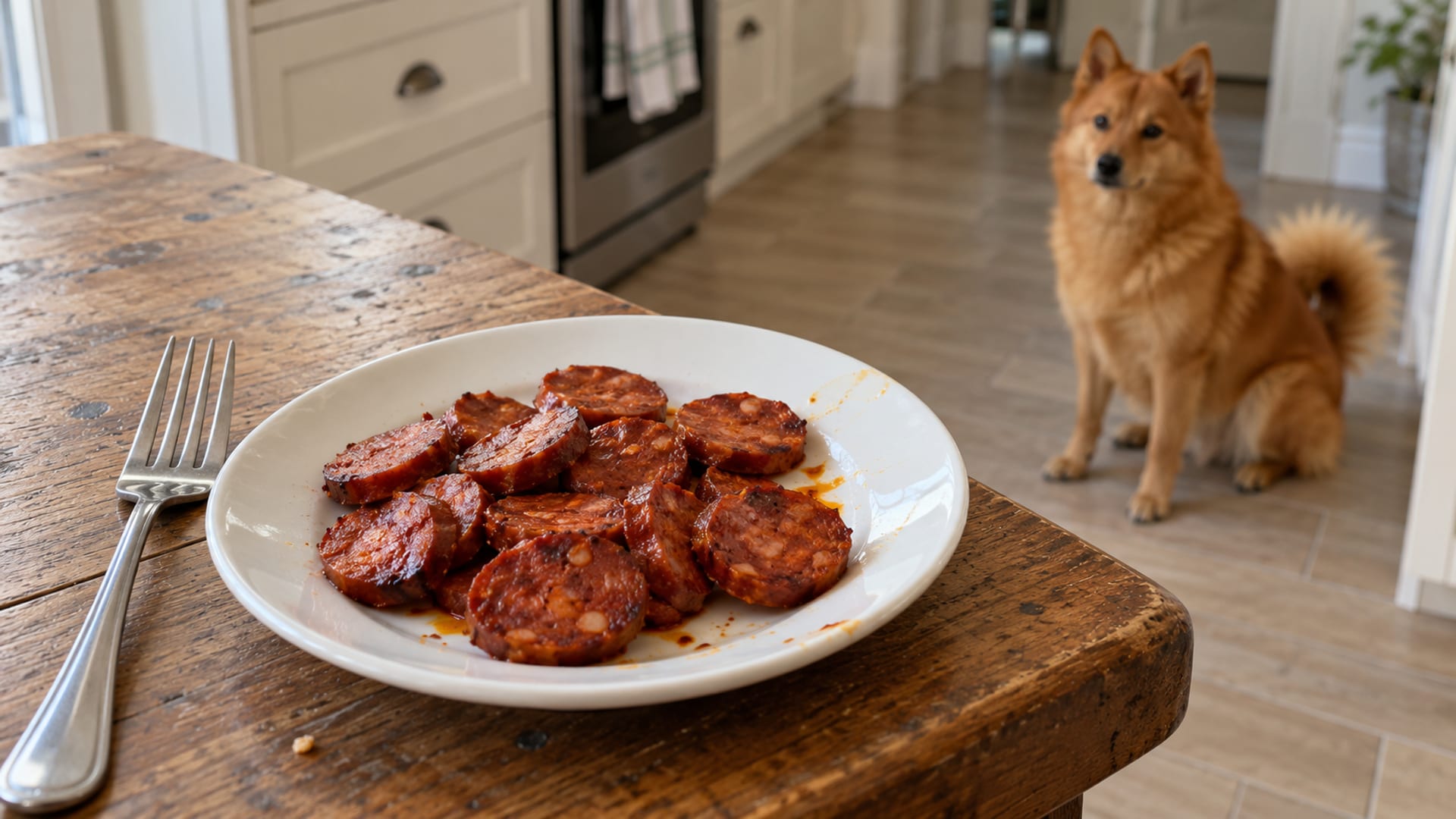
The answer for chorizo is caution. It is commonly fatty and salty, and some recipes contain onion or garlic. A tiny taste is not automatically an emergency, though, and how worried to be depends on how much your dog ate, how big your dog is, what kind of chorizo it was and what went into it.
If your dog got into it a few minutes ago, read the ingredient list before anything else. Onion or garlic on that list, a large amount, an amount you cannot pin down or any sign of illness means calling your vet or a pet poison line promptly. Onion and garlic can cause trouble days later, so waiting to see how your dog acts is not a plan.
Key takeaways
Tap a card to bring it forward.
- Skip chorizo as a treat. It is commonly high in fat and salt, and onion or garlic may be in the recipe.
- A tiny lick or bite of plain cooked chorizo may not need a call, but a large amount, an unknown amount or any illness signs do.
- Onion and garlic can damage red blood cells, and the effects can take 3 to 5 days to show.
- Have the label, the amount, the time and your dog's weight ready before you call.
What to do if your dog already ate chorizo
Work through these in order. Each takes a minute or two, and together they give whoever you call what they need.
- Pick up what is left. Clear away the chorizo, casing, packaging and any toothpick, skewer or bone. Those can choke a dog or block the gut whether or not the chorizo itself causes trouble.
- Read the label or ask who cooked it. Look for onion, garlic, chives and leeks first, then alcohol, grapes, raisins and xylitol. The Merck Veterinary Manual says raw, cooked, dehydrated and granulated onion and garlic can all lead to anemia in dogs, so a spice packet counts as much as fresh onion.
- Write down four things. The product and its form (raw, cooked or dried), how much your dog ate, the time, and your dog's weight. The same piece is a bigger dose for a small dog, and the person on the phone will ask for all four.
- Call promptly if any of these apply. The amount was large or unknown. The chorizo had onion, garlic, onion powder, garlic powder, chives or leeks. Your dog is small, a puppy, or has a history of pancreatitis or another serious condition, and ate more than a taste. Your dog swallowed casing, packaging, a bone, a toothpick or a skewer. Or you see vomiting, repeated diarrhea, belly pain, weakness, pale or yellow gums, dark urine, tremors, seizures, collapse, breathing changes, heavy thirst or severe tiredness. For a suspected toxic ingestion, the ASPCA says to call your veterinarian or its poison center as soon as possible.
- Hold off on food, oil and medication. Give your dog something only if your vet or the poison line says to.
- Keep watching for several days. A quiet first night does not settle it if the recipe had onion or garlic.
A single tiny lick of fully cooked chorizo with no onion, garlic or other dangerous ingredients may not need a call. I still can't tell you it is safe without knowing the product and your dog's size, so if you are unsure, call.
Which forms of chorizo carry which risks
Chorizo is a family of sausages, and a fresh one from a taco truck is a different product from a dried one sliced for a cheese board. The common forms line up like this.
Tap or hover a row to highlight it.
| Form | Main concern |
|---|---|
| FormFresh Mexican-style, raw | Main concernRaw pork can carry Salmonella and Listeria; also fat, salt, garlic, onion and spices |
| FormCooked chorizo | Main concernCooking may lower the germ risk but leaves the fat, salt, onion, garlic and seasonings |
| FormSpanish cured or dried | Main concernDrying concentrates the meat and salt; may still hold garlic and plenty of fat |
| FormChorizo powder or seasoning mix | Main concernPowdered garlic or onion is concentrated, so the risk per spoonful is higher |
| FormGrease, drippings, rendered fat | Main concernFatty food is linked to pancreatitis |
| FormCasing | Main concernNot a separate poison, but a large swallowed piece can choke a dog or block the gut |
| FormRecipe with onion, garlic, chives or leeks | Main concernHigher concern, because these can damage red blood cells |
| FormBones, toothpicks, skewers, packaging | Main concernChoking, puncture or blockage risks unrelated to the chorizo |
Four things drive most of the trouble. The first is fat: the ASPCA lists fatty foods such as hot dogs and greasy leftovers as a cause of pancreatitis in some pets. The second is salt, which the same ASPCA page says can cause heavy thirst and urination, vomiting, diarrhea, tremors, seizures and death in excess. The third is onion and garlic, which the Merck Veterinary Manual ties to oxidative damage to red blood cells. The fourth is germs: the FDA names Salmonella and Listeria monocytogenes as concerns in raw animal foods, which matters if the chorizo was fresh and uncooked.
How much chorizo is a concern
There is no safe amount of chorizo to aim for, so skip it as a treat. Recipes vary a lot in fat, sodium, onion, garlic and additives, which is why no single number fits every package.
Body weight still matters, because a slice that barely registers for a large dog is a much bigger dose for a small one. For the onion part, the Merck Veterinary Manual reports that clinical signs have occurred in dogs after 15 to 30 grams of raw onion per kilogram of body weight, and it describes garlic as roughly 3 to 5 times more toxic than onion. Those figures are for raw onion and cannot be turned into a chorizo dose.
When you call, give the weight and the amount and let the vet or poison line do the math. Small dogs, puppies and dogs that have had pancreatitis have the strongest reason to sit this one out. The Merck Veterinary Manual calls dietary indiscretion a common risk factor for pancreatitis in dogs and says low-fat feeding is central to managing it.
There is no lower-risk part of a chorizo to hand over. For a share at the table, pick something low in fat, unseasoned and free of onion, garlic, chives, leeks and heavy salt.
Signs to watch for and when they show up
Early signs usually look like an upset stomach: vomiting, diarrhea, belly discomfort, more thirst, more urination, tiredness and a poor appetite.
Pancreatitis from fat can bring vomiting, diarrhea, low energy, less interest in food and belly pain, and the Merck Veterinary Manual says severe cases can need hospital care. Salt problems can add tremors, seizures and coma, and tremors or seizures are an emergency.
Onion and garlic work on a slower clock. The Merck Veterinary Manual says the first changes in red blood cells begin within about 24 hours, peak at around 72 hours, and that red cells typically break down 3 to 5 days after the exposure. Then you may see weakness, pale or yellow gums, fast breathing, a racing heart, less stamina, dark or bloody urine or collapse. That delay is why I would call on the day it happened and not wait for the gums to change color.
Raw chorizo can bring stomach illness, fever or low spirits. Dogs can also carry Salmonella and shed it without looking sick, according to the FDA, so wash your hands and any surface the raw sausage touched.
My dog ate chorizo before and was fine
That probably happened just the way you remember it. Plenty of dogs have swallowed a piece off a breakfast plate and gone on with their day.
It still does not carry over to the next time or the next dog. The amount matters, since the same piece is a different dose in a small dog and a large one. The form matters, because raw, cooked, dried and powdered products differ in fat, salt and how concentrated the garlic and onion are. The recipe matters, because one chorizo has almost no onion and another is loaded with garlic powder. Individual dogs react differently, and a dog with a history of pancreatitis or another health problem is at more risk. And the anemia from onion and garlic may not show for several days, so "fine that night" does not always mean fine.
Chorizo, look-alikes and what it comes mixed into
The word covers a lot of ground, and the label matters more than the name.
Mexican chorizo usually means a fresh, soft, seasoned sausage sold raw and cooked at home. Spanish chorizo usually means a cured or dried sausage flavored with paprika and garlic, according to the Spanish Ministry of Agriculture. Pork, beef, soy and vegetarian chorizo are not interchangeable, since their fat, salt, onion, garlic and chili differ. Chorizo verde has green herbs and a different recipe from the red kind, and longaniza is a related sausage name that is not always the same product.
A chorizo spice mix or powder may hold concentrated garlic or onion powder and no sausage at all, so it belongs with the garlic and onion risks. Chorizo con huevos, frijoles charros, tacos, burritos and pizza can bring extra onion, garlic, salt, cheese, grease and alcohol, and the pizza entry covers that one.
The USDA points out that the word "sausage" alone does not say whether a product is cooked or cured, so look for wording such as uncooked, cook before eating or fully cooked. Its Sausages and Food Safety page adds that dry sausages are a concentrated form of meat.
Check what you learned
A short check.
Quick check
Questions about dogs and chorizo
Is a lick of chorizo grease a problem?
Rendered fat is the part most tied to pancreatitis, so do not spoon drippings over food as a topper. If your dog licked the pan, mention it if you call and watch for vomiting, diarrhea or low energy.
Can dogs eat soy or vegetarian chorizo?
Those are different recipes, and their onion, garlic, fat and salt content can vary a lot. Check the ingredient list for onion, garlic and heavy seasoning before you decide, or ask your vet.
What if there are cats in the house?
The Merck Veterinary Manual reports that cats are more susceptible than dogs to onion and garlic poisoning. Keep chorizo and its seasoning packets away from both, and call your vet if a cat got into any.
My dog has had pancreatitis. Is a small bite still okay?
A dog with a history of pancreatitis has a stronger reason to avoid fatty foods. Skip chorizo entirely and ask your vet before you add any human food.
Sources
Checked September 29, 2026.
- ASPCA, People Foods to Avoid Feeding Your Pets
- ASPCA, Garlic
- Merck Veterinary Manual, Garlic and Onion (Allium spp) Toxicosis in Animals
- Merck Veterinary Manual, Pancreatitis in Dogs and Cats
- FDA, Get the Facts! Raw Pet Food Diets can be Dangerous to You and Your Pet
- FDA, Think Food Safety and Be Salmonella Safe
- USDA Food Safety and Inspection Service, Sausages and Food Safety
- USDA Food Safety and Inspection Service, Product Names for Sausages That Have Been Cooked Or Cured
- Spanish Ministry of Agriculture, Fisheries and Food, El chorizo es