

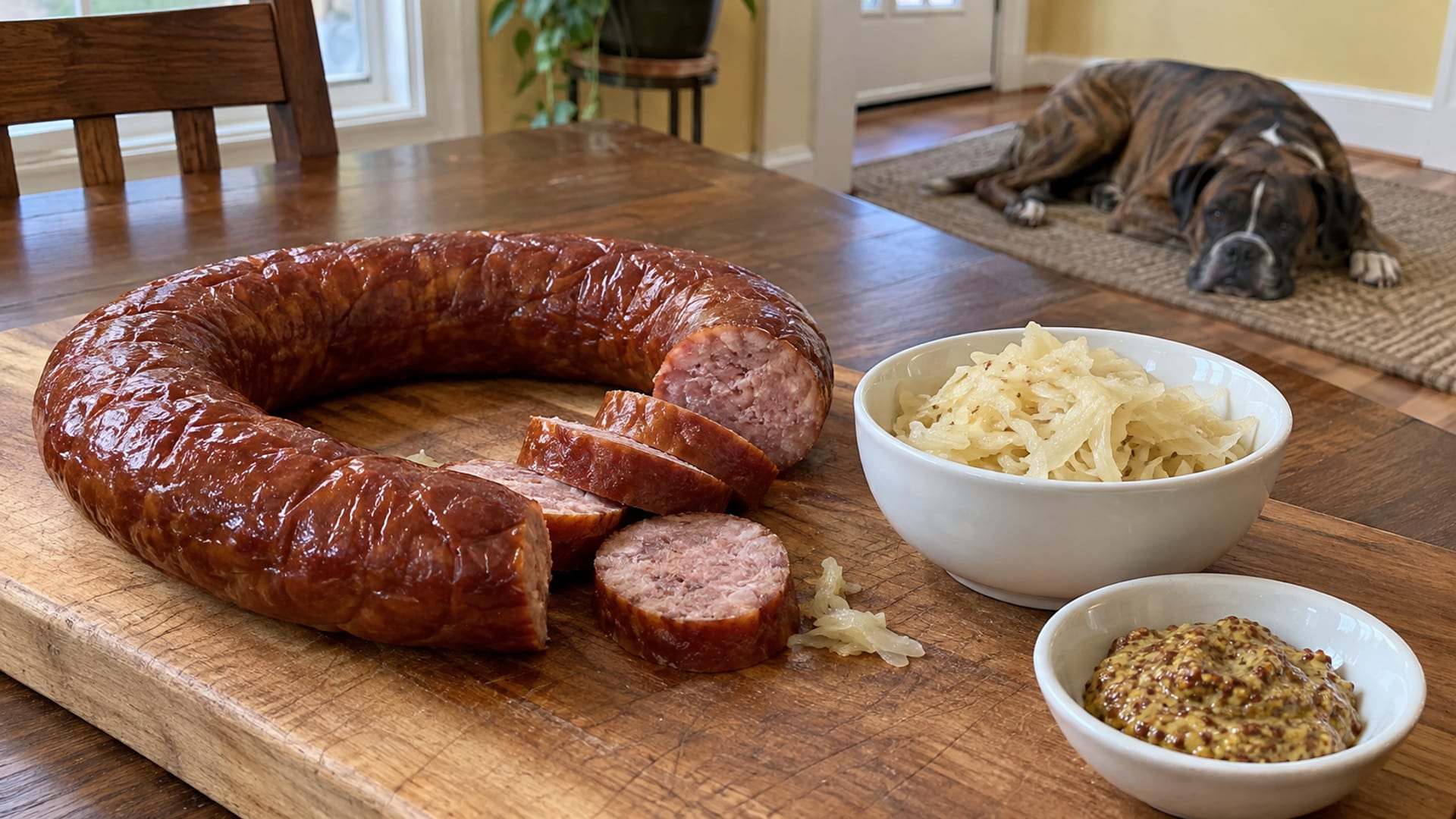
A coin of cooked kielbasa that rolled off the grill is usually a small problem for a healthy dog, but kielbasa should stay off the treat list. Pet Poison Helpline says sausages carry a lot of fat and salt, which can upset a dog's stomach and may lead to pancreatitis.
Found an empty plate and a guilty-looking dog? Work out how much is gone, whether it was raw or cooked, and what was on the label. A slice or two in a mid-sized or large dog is usually a matter of watching at home. A whole link, a small dog, raw sausage, the grease from the pan, or any vomiting is a reason to call your vet today.
Key takeaways
Tap a card to bring it forward.
- A slice of cooked kielbasa is a low-risk accident for most healthy dogs.
- Fat and salt are the main concerns; fat can bring on pancreatitis.
- Raw or fresh kielbasa can carry Salmonella and Listeria.
- A whole link, pan drippings, or a small or sick dog means a call to your vet.
- Stumbling, tremors, seizures, collapse or trouble breathing need an emergency vet.
Dog ate kielbasa? What to do first
Tap or hover a row to highlight it.
| What they got | What to do |
|---|---|
| What they gotOne or two slices of cooked kielbasa | What to doWatch them today and keep fresh water out. |
| What they gotA whole link, several links, or you cannot tell | What to doCall your vet or a pet poison line now. |
| What they gotRaw or fresh kielbasa | What to doCall your vet, and watch for vomiting and diarrhea. |
| What they gotGrease, drippings or fatty ends from the pan | What to doCall your vet today. Fat is the pancreatitis risk. |
| What they gotA sausage with onion, garlic, beer or an unusual additive | What to doCall and read the label out loud. |
| What they gotA long piece of casing or the plastic wrap | What to doCall your vet, and watch for gagging or retching. |
If you think your dog ate a risky food, the ASPCA wants you to write down the amount first and then reach a vet or poison control. Before you call, have the package, your dog's weight and a rough time of the theft.
Skip the kitchen-cabinet fixes. Pet Poison Helpline warns against home treatments such as salt, oil or grease, and asks owners to speak with a vet or the helpline before giving any medicine.
Smoked, fresh or dried: how the kind of kielbasa changes things
Tap or hover a row to highlight it.
| Form | For dogs | Why |
|---|---|---|
| FormSmoked or fully cooked kielbasa | For dogsAvoid sharing | WhyStill fatty and salty after heating |
| FormFresh or raw kielbasa | For dogsAvoid | WhyAdds germs such as Salmonella and Listeria |
| FormDried sausage like kabanos or hunter sausage | For dogsAvoid | WhyDrying concentrates calories and can concentrate salt |
| FormCasing | For dogsWatch for trouble | WhyA big swallowed piece can choke a small dog or cause a blockage |
| FormFat, grease and drippings | For dogsAvoid | WhyConcentrated fat, the main pancreatitis concern |
| FormGarlic- or onion-seasoned kielbasa | For dogsCall if a lot was eaten | WhyOnion and garlic can damage red blood cells |
| FormTurkey, chicken or beef kielbasa | For dogsSame caution | WhyFat, salt and seasoning vary by brand |
When kielbasa becomes a problem
Salt and fat are measured differently, so each has its own warning line.
Salt. The Merck Veterinary Manual reports that a dog can show signs of salt poisoning after roughly 2 to 3 grams of table salt per kilogram of its weight, and that about 4 grams per kilogram can be fatal. Merck also notes the danger climbs when a dog cannot get enough water. A package lists sodium, which is a different number, so leave the conversion to your vet. Because the math runs per kilogram, one link in a Yorkie is a very different event from one link in a German Shepherd.
Fat. Merck's guide to pancreatitis in dogs lists eating table scraps and other inappropriate food among the common risk factors. It also reports that pancreatitis turns up more often in Miniature Schnauzers, Yorkshire Terriers, Cocker Spaniels, Dachshunds, Poodles and sled dogs. Dogs that have had pancreatitis before, or that have diabetes or high blood fats, deserve a call after any real helping.
Signs to watch for after kielbasa
Tap or hover a row to highlight it.
| What you see | What it may point to | What to do |
|---|---|---|
| What you seeGagging, retching, pawing at the mouth | What it may point toA stuck piece or casing | What to doGo to a vet now |
| What you seeVomiting or diarrhea | What it may point toUpset stomach from fat, salt or spices | What to doCall your vet, sooner for a small dog |
| What you seeHeavy thirst and peeing more | What it may point toToo much salt | What to doCall your vet |
| What you seeBelly pain, weakness, not eating, dehydration | What it may point toPossible pancreatitis | What to doCall your vet today |
| What you seeStumbling, tremors, seizures, collapse | What it may point toSalt poisoning | What to doEmergency vet now |
The ASPCA lists vomiting, diarrhea, depression, tremors and seizures as signs of too much salt, and says the severity depends on the amount eaten. Merck adds that mild pancreatitis can look vague or show hardly any signs, so a dog that seems fine an hour later is not yet in the clear. Do not wait for symptoms after a large amount, because salt poisoning can get serious quickly.
"Our dog always gets a piece when we grill kielbasa"
That can be true, and it may have gone fine every time. A thin slice for a big, healthy dog with water nearby is a small dose of salt and fat. The story does not carry over to every dog or every sausage, though:
- The piece gets bigger. A slice is not a whole link or the pan scrapings.
- The dog is smaller. The same slice hits a Dachshund harder than a Lab.
- The sausage changes. Fresh, smoked, dried and garlicky kielbasa are different foods.
- Water is not always there. Merck ties salt poisoning closely to limited water.
- Pancreatitis is uneven. Not every fatty meal causes it, and some dogs are far more prone than others.
- Signs can come later. A dog that seems normal right away can still get sick afterward.
So, if the grill slice is a family ritual, keep it thin, fully cooked, free of onion and garlic, and rare. For a dog with a pancreatitis history, drop it.
Kielbasa, Polish sausage and other names on the package
- Kiełbasa in Polish: it simply means sausage, so the word covers many recipes.
- Polska kielbasa or Polish sausage: usually smoked and fully cooked, but still fatty and salty.
- Fresh kielbasa: may be sold raw and need cooking. Check the package.
- Kabanos and hunter sausage: thin, dry Polish sausages with the salt packed in tighter.
- "Low-fat," "uncured" or "reduced sodium": these words do not make a sausage safe for dogs.
- Chorizo, bratwurst, Italian sausage: different sausages with their own seasonings. Judge each by its label.
- Hot dogs and salami: see can dogs eat hot dogs? and can dogs eat salami?
Check what you learned
Quick check
Questions about dogs and kielbasa
Can dogs eat a small piece of cooked kielbasa?
A small piece is usually a low-risk accident for a healthy dog. It is still fatty and salty, so do not make it a habit, and watch for vomiting or diarrhea afterward.
What if my dog ate a whole kielbasa?
Call your vet or a pet poison line with your dog's weight, the package and the time it happened. A whole link is a large dose of fat and salt, and it can cause vomiting, pancreatitis or salt poisoning.
Is raw kielbasa worse than cooked?
Yes. Raw kielbasa has the same fat and salt, plus the germ risk the CDC describes for raw meat, including Salmonella and Listeria.
Can kielbasa cause pancreatitis in dogs?
It can add to the risk, because it is fatty and Merck counts table scraps among the common triggers. Not every dog that eats it gets pancreatitis, but some breeds and dogs with a history of it are more likely to.
How much salt is dangerous for a dog?
Merck puts the start of salt poisoning signs at about 2 to 3 grams of salt per kilogram of body weight, with about 4 grams per kilogram as a fatal dose. Those figures are for salt, not for sausage, so your vet has to work out what your dog's portion means.
Can dogs eat turkey kielbasa?
It carries the same concerns. Turkey versions can still be salty and seasoned, so read the label the same way you would for pork.
Sources
Checked September 24, 2026.
- ASPCA, People Foods to Avoid Feeding Your Pets
- CDC, About Pet Food Safety
- FDA, Get the Facts! Raw Pet Food Diets can be Dangerous to You and Your Pet
- Merck Veterinary Manual, Salt Toxicosis in Animals
- Merck Veterinary Manual, Pancreatitis and Other Disorders of the Pancreas in Dogs
- Pet Poison Helpline, Navigating Oktoberfest Foods with Your Furry Friend
- Pet Poison Helpline, Pet Poison First Aid Misconceptions