
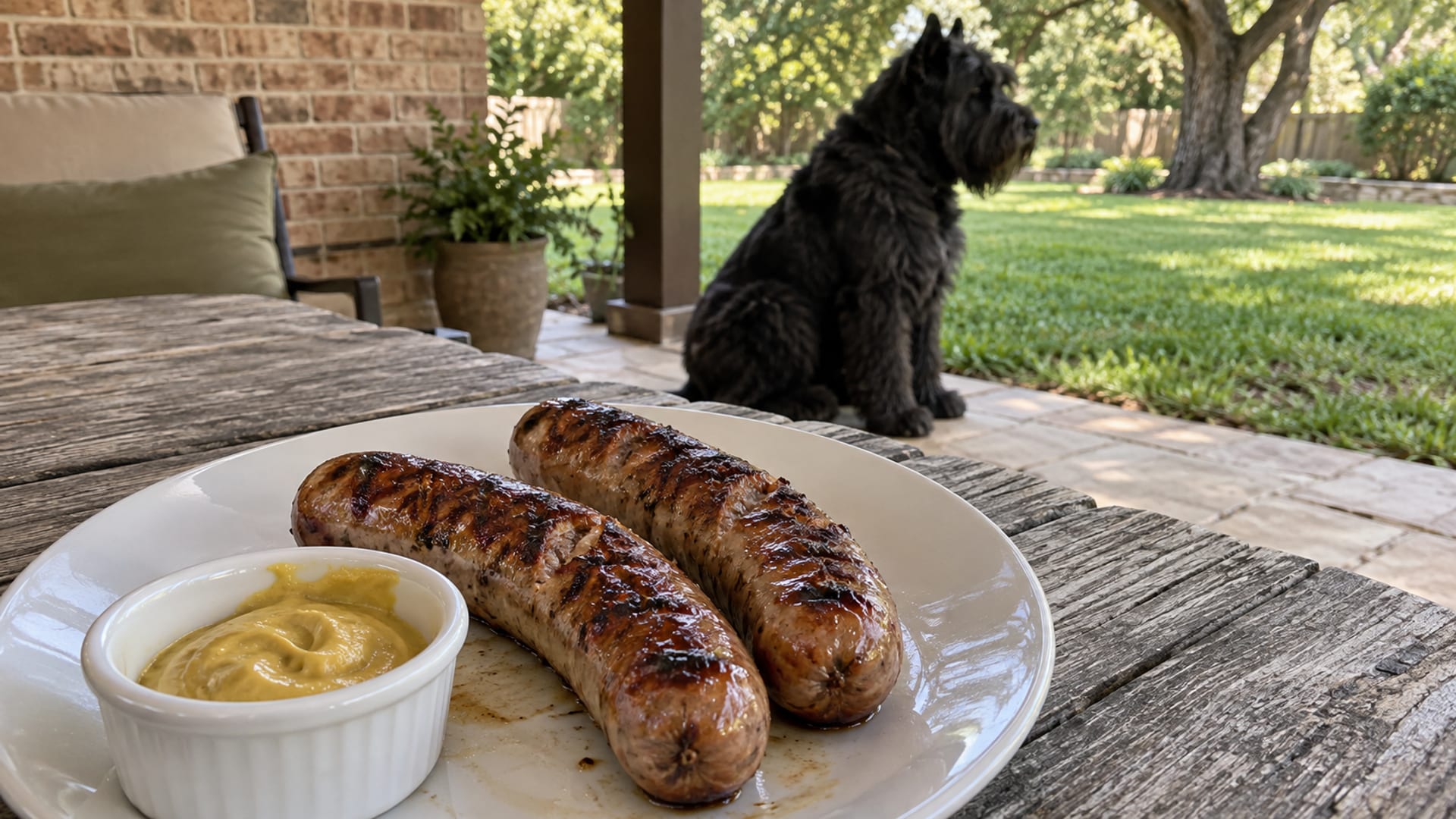
Bratwurst is best kept off your dog's plate, because it's a fatty, salty sausage that Pet Poison Helpline calls unsuitable as a pet treat. If your dog already grabbed some, a small bite of plain cooked brat is a lower-risk slip, while onion or garlic in the sausage or the toppings, a raw brat, a whole sausage or a big piece of casing are reasons to call your vet today.
A brat lifted off a game-day plate is a different case from one pulled raw out of the pack or simmered in beer and onions. Five questions sort it out: how much, raw or cooked, what was in it and on it, how big your dog is, and whether your dog has had pancreatitis.
Key takeaways
Tap a card to bring it forward.
- Bratwurst is high in fat and salt, so it isn't a food to share with your dog.
- One small bite of plain, fully cooked brat is a lower-risk exposure than a whole sausage or a raw one.
- Onion or garlic in the sausage, the seasoning or the toppings can damage red blood cells, and that anemia can take three to five days to show.
- Call your vet for onion or garlic, a beer or raw brat, a large or unknown amount, swallowed casing or a skewer, or a pancreatitis history.
- Repeated vomiting, belly pain, weakness, pale gums or dark urine in the following days mean call right away.
What to do if your dog just ate a brat
If it were my dog, I'd start with the leftovers and the package, because most of what your vet will ask is written on one or the other.
- Pick up what's left, including the bun, toppings, skewer and wrapper. Every extra bite adds fat and salt, and a skewer or packaging can block the gut.
- Check the label or ask whoever cooked. Look for onion, garlic or their powders, and ask whether the brats were simmered in beer or served with grilled onions. VCA Animal Hospitals notes that dried and powdered onion and garlic are more concentrated than fresh.
- Work out how much, and in what form. A bite and a whole sausage are very different amounts, and a raw brat brings germs a cooked one mostly doesn't.
- Note your dog's weight, age and health history. The same chunk is a bigger dose for a small dog, and the ASPCA says Poison Control will ask about breed, age, weight, health, current condition and what was eaten.
- Call your vet now for the higher-risk cases. That means onion or garlic, a beer brat, a raw brat, a large or unknown amount, swallowed casing, a skewer or packaging, or a dog with a pancreatitis history. The ASPCA's emergency care advice is to call your veterinarian or its Poison Control line whenever you suspect a toxic ingestion.
- For one small bite of plain cooked brat, keep watching for a few days. If you later learn the sausage had onion or garlic in it, call then, since that anemia shows up late.
Which brats, casings and toppings carry the most risk
Every brat brings fat and salt; how it was made, what came with it and how much went down move the risk up.
Tap or hover a row to highlight it.
| Form | What it adds | What to do |
|---|---|---|
| FormOne small bite, plain and fully cooked | What it addsFat and salt | What to doWatch for stomach upset |
| FormA whole cooked brat | What it addsMore fat and salt, and a pancreatitis concern | What to doCall your vet |
| FormRaw brat from the pack | What it addsFat and salt, plus Salmonella and Listeria | What to doCall your vet |
| FormBrat with onion or garlic, inside or on top | What it addsRed blood cell damage and anemia | What to doCall your vet |
| FormBeer brat | What it addsAlcohol if any remains, and often onions | What to doCall your vet |
| FormSmoked or dried sausage | What it addsMore concentrated salt, fat and dried onion or garlic | What to doCall your vet |
| FormCasing in a big piece, skewer or wrapper | What it addsChoking or a blocked gut | What to doCall your vet |
| FormChicken, veal or vegetarian brat | What it addsOnion, garlic, sodium, fat, xylitol or alcohol, varying by product | What to doRead the label, then call if any are listed |
The FDA names raw meat as a possible source of Salmonella and Listeria monocytogenes. Fresh brats are sold raw for the grill, so one taken from the pack carries that germ risk on top of the fat and salt. Cooking lowers the bacterial risk, but the fat, salt, onion and garlic stay put. The raw meat entry covers raw meat more broadly.
Onion, garlic, chives and leeks all belong to the Allium family, and the ASPCA's garlic page names N-propyl disulfide as garlic's toxic principle. These compounds can damage red blood cells and cause hemolytic anemia, meaning anemia from red cells being destroyed. The onions and garlic entries go further.
Alcohol is on the ASPCA's list of people foods to avoid, and how much survives simmering depends on the recipe and cooking time; see the beer entry. Casing is usually digestible, though a large piece swallowed whole can add to choking or a blockage.
Sharing at a cookout, and when the amount starts to matter
Brats don't have a dog-sized serving, so the simplest plan for the next cookout is to keep brats, buns and toppings out of reach and give your dog something of its own. The ASPCA's cookout advice flags fatty cookout foods like hot dogs and burgers as pancreatitis concerns and warns about onion and garlic products, and brats share the same grill.
- Give your dog its own chew before guests arrive, so the grill is less interesting.
- Keep the raw pack in the fridge or a closed cooler until it goes on the grate.
- Set plates and the topping tray out of reach, since grilled onions and sauces are where onion and garlic often hide.
- Put casings, skewers and wrappers in a lidded trash can.
- Ask guests, kids included, not to share. Five small bites add up to a lot of sausage for one dog.
When a brat does go missing, the amount that matters depends on what was in it.
Tap or hover a row to highlight it.
| Ingredient | What's reported | Source |
|---|---|---|
| IngredientRaw onion | What's reported15 to 30 g per kg of body weight has produced signs in dogs | SourceMerck Veterinary Manual |
| IngredientGarlic | What's reportedAbout three to five times more toxic than onion | SourceMerck Veterinary Manual |
| IngredientSalt | What's reportedRisk depends on total salt, body weight, water access and health | SourcePet Poison Helpline |
| IngredientFat | What's reportedNo single amount; prior pancreatic disease and the individual dog matter | SourceMerck Veterinary Manual |
The onion figure from the Merck Veterinary Manual is for raw onion itself, not the weight of the sausage, and it doesn't apply the same way to every dog. Salt in a brat is sodium chloride, the compound the Merck salt poisoning page covers. Recipes vary too much for a per-sausage number, so call with three facts: your dog's weight, how much sausage went down, and the ingredient list.
Signs to watch tonight and over the next five days
Early trouble usually looks like vomiting, diarrhea, belly discomfort, drooling, a smaller appetite, low energy, extra thirst or peeing more than usual.
Fat is the pancreatitis worry. The Merck Veterinary Manual's page for dog owners lists eating inappropriate food as a common risk factor, with signs such as vomiting, diarrhea, weakness, belly pain, dehydration and appetite loss. Severe pancreatitis can lead to organ failure and death. Salt looks different: Pet Poison Helpline's salt page describes vomiting, diarrhea, thirst, lethargy, stumbling, tremors, seizures, coma and death in serious cases.
Onion and garlic run on a slower clock. According to the Merck Veterinary Manual, red blood cell damage begins within about 24 hours, peaks around 72 hours, and the breakdown of those cells commonly shows three to five days after eating. Watch for weakness, pale gums, fast breathing, a fast heart rate, yellowing of the gums or eyes, dark or red urine, and collapse.
A raw brat can also bring Salmonella, which the FDA links to vomiting, diarrhea, fever, lethargy and appetite loss.
Call your vet right away for repeated vomiting or diarrhea, belly pain, weakness, pale gums, fast breathing, dark urine, heavy thirst, tremors, stumbling, seizures or collapse.
My dog ate a brat before and was fine
If your dog has stolen a brat before and was fine the next day, I believe you. That dog, on that day, came through it.
It just doesn't carry over to the next brat or the next dog. The amount may have been small for that dog's size, that sausage may have had little or no onion or garlic, and it was probably cooked, which lowers the germ risk. The dog may not have taken in enough fat or salt to set off a problem, dogs differ in how sensitive they are, and a mild upset can pass without anyone noticing.
Timing matters too. The Merck Veterinary Manual puts onion and garlic anemia at three to five days after exposure, so a dog that looks normal the evening of the cookout hasn't cleared a seasoned brat yet, and pancreatitis can follow a fatty meal later.
Sausages and toppings that get mixed up with bratwurst
Brat is the everyday American name for bratwurst. The mix-ups come from other sausages and from what gets piled on top.
- Other sausages. Breakfast sausage, Italian sausage, kielbasa, chorizo and hot dogs each have their own mix of fat, salt and spices; see the sausage, kielbasa and hot dogs entries.
- Fresh or precooked. Fresh brats are raw until cooked; precooked ones only need heating.
- Beer brats. Usually simmered in beer, often with onions, so check for both.
- Braunschweiger. A different sausage, often liver-based and sometimes spreadable.
- The bun and toppings. Plain bread isn't the main concern, but mustard, sauerkraut, onions, beer cheese and sauces each bring their own risk.
Check what you learned
A quick check on the parts that matter tonight.
Quick check
Questions about dogs and bratwurst
These come up once the immediate worry has passed.
Can my cat get sick from bratwurst too?
Cats face the same fat, salt, raw-meat and onion or garlic concerns. The ASPCA's garlic page and the Merck Veterinary Manual both describe cats as more sensitive to onion and garlic than dogs.
Are chicken or vegetarian brats safer for dogs?
The label decides. Chicken and plant-based brats can still carry onion, garlic, heavy sodium or high fat, and some may include xylitol or alcohol, both on the ASPCA's list of foods to keep from pets.
Are some dogs more likely to get pancreatitis from a brat?
The Merck Veterinary Manual reports that Miniature Schnauzers are dramatically overrepresented, with more cases also seen in Yorkshire Terriers, Cocker Spaniels, Dachshunds, Poodles and sled dogs. Past pancreatitis, high blood fats (hypertriglyceridemia), diabetes or obesity also add concern, so for those dogs even a modest amount is worth a call.
Is a raw brat riskier for a puppy or a pregnant dog?
It can be. The FDA's Salmonella page says puppies are more likely than healthy adult dogs to show Salmonella signs, and the FDA notes that pregnant, very young, very old or immunocompromised animals are more vulnerable to serious Listeria infection. Call your vet about any raw brat eaten by one of these dogs, even a small piece.
Sources
Checked September 25, 2026.
- Pet Poison Helpline, Navigating Oktoberfest Foods With Your Furry Friend
- VCA Animal Hospitals, Onion, Garlic, Chive, and Leek Toxicity in Dogs
- ASPCA, What to Do if Your Pet Is Poisoned
- ASPCA, Emergency Care for Your Pet
- FDA, Get the Facts! Raw Pet Food Diets Can Be Dangerous to You and Your Pet
- ASPCA, Garlic
- ASPCA, People Foods to Avoid Feeding Your Pets
- ASPCA, Be On the Lookout at Your Cookout
- Merck Veterinary Manual, Onion and Garlic Toxicosis in Animals
- Merck Veterinary Manual, Salt Poisoning
- Merck Veterinary Manual, Pancreatitis and Other Disorders of the Pancreas in Dogs
- Pet Poison Helpline, Salt Is Toxic To Pets
- FDA, Think Food Safety and Be Salmonella Safe
- Merck Veterinary Manual, Pancreatitis in Dogs and Cats
- FDA, FDA Cautions Pet Owners Not to Feed Performance Dog Raw Pet Food Due to Salmonella, Listeria monocytogenes