
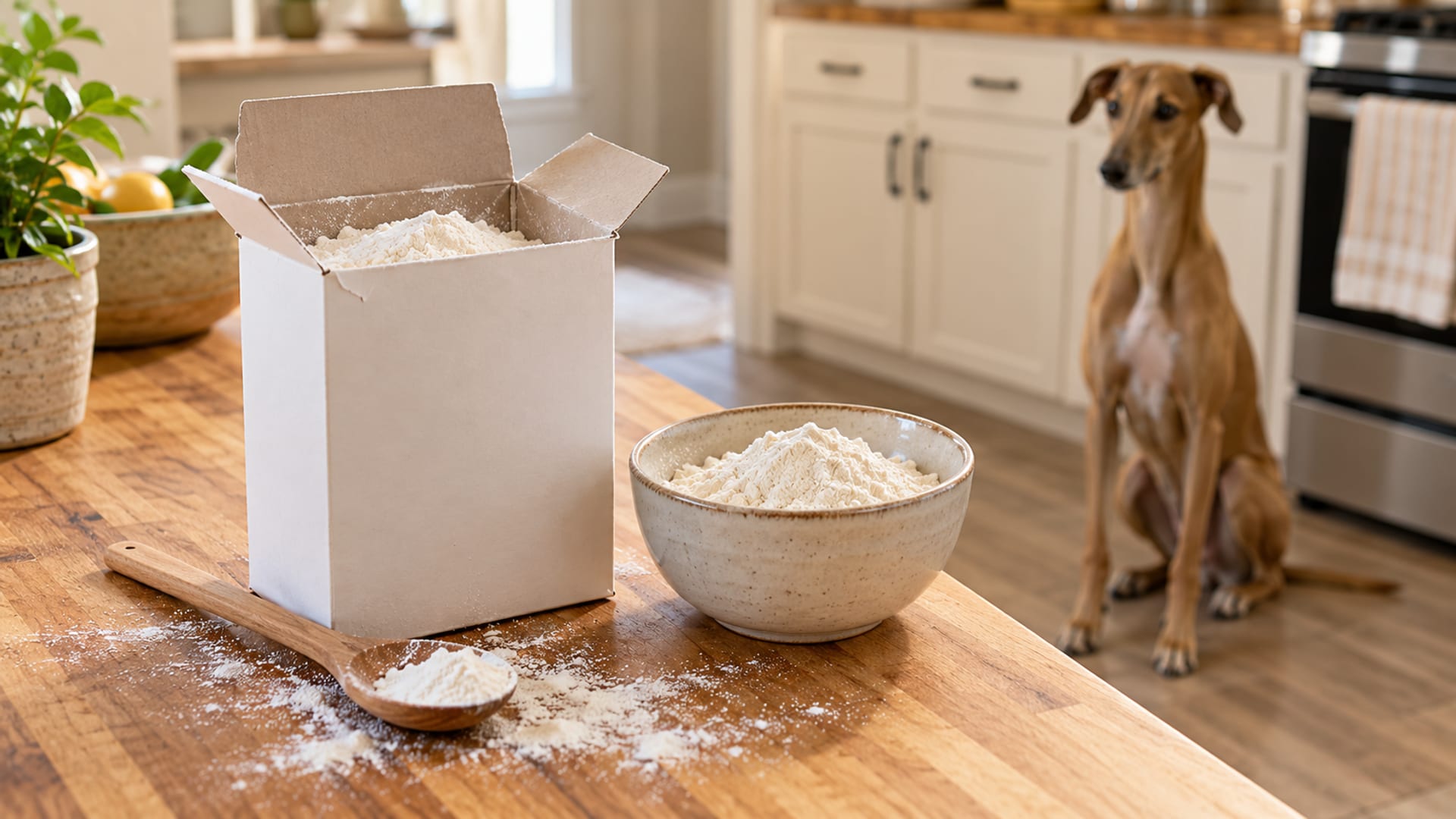
Yes. A small amount of plain cornstarch, like a lick off the counter or a puff from a spilled box, is low risk for a dog, and cooked cornstarch in a plain food is fine too. How worried to be depends on the whole product, because xylitol, chocolate and raisins are the real dangers, and they sometimes come packaged with cornstarch in candy, baked goods and mixes.
The Merck Veterinary Manual says dogs digest properly cooked starch with greater than 90% efficiency, which is why a little cooked cornstarch rarely bothers them. A big helping is a different story. The same manual explains that a heavy load of poorly digestible carbohydrate can cause gas and loose stool.
If your dog got into it a few minutes ago, read the label, note how much was eaten and when, and call your vet if the product could hold xylitol, the amount was large or unknown, or your dog seems off. The steps are right below.
Key takeaways
Tap a card to bring it forward.
- A small amount of plain cornstarch is low risk, and a large amount can cause gas or loose stool.
- Read the whole label when it came in a food. Xylitol, chocolate and raisins are the dangers to rule out.
- Call your vet right away if the product may hold xylitol, the amount is large or unknown, or your dog seems unwell.
- A corn cob is a separate problem, because it can cause choking and a blockage.
- Have the package, the amount, the time and your dog's weight ready when you call.
What to do if your dog already ate cornstarch
Most of these steps take a minute, and the order matters because the first one decides what comes next.
- Take the container or package away and read the label. Plain cornstarch and a cornstarch-containing product are very different situations, and the ingredient list tells you which one you have.
- Look for xylitol, which often sits in sugar-free candy and gum, and for chocolate, raisins, alcohol, a lot of salt or a lot of fat. The AKC says xylitol can cause dangerously low blood sugar, seizures and death in dogs, so any hint of it means you call right now.
- Work out how much and when. A rough guess is fine, such as a teaspoon or half the box, along with the time your dog got into it. The same amount is a bigger dose for a small dog, and the Pet Poison Helpline bases its assessment on the dog's weight, age, breed, health history and medications.
- Decide whether to call. Call when the product is not confirmed to be plain cornstarch, when it may hold a toxic ingredient, when the amount is large or unknown, when your dog is a puppy, very small or medically fragile, or when there is vomiting, diarrhea, weakness, collapse, tremors, seizures, breathing trouble, choking or belly pain. The ASPCA recommends contacting a vet or poison control even when a dog looks normal after a potentially hazardous ingestion, because some poisons act late.
- Hold off on home remedies. The Pet Poison Helpline says not to give home antidotes, so wait for a vet or the poison line to tell you what to do.
- Keep the package. When you call, give the ingredient list, the amount, the time and your dog's weight, age and health history.
If it was a small lick of plain cornstarch and your dog is acting like himself or herself, you can usually keep an eye on things at home. Watch for stomach upset over the hours that follow, and call if anything changes.
Which forms of cornstarch are fine and which are not
Cornstarch comes in more forms than the box in the pantry, and the risk moves with the form. This table sorts the common ones.
Tap or hover a row to highlight it.
| Form | Risk to a dog | What to do |
|---|---|---|
| FormSmall lick of plain dry cornstarch | Risk to a dogLow | What to doWatch your dog for stomach upset |
| FormLarge amount of plain dry cornstarch | Risk to a dogGas, loose stool, stomach upset | What to doCall your vet if the amount is large or unknown |
| FormCooked cornstarch in a plain food | Risk to a dogLow, because cooking makes starch easier to digest | What to doCheck the rest of the recipe |
| FormRaw cornstarch | Risk to a dogHarder to digest than cooked starch | What to doWatch for stomach upset after a larger amount |
| FormMarshmallows dusted with cornstarch | Risk to a dogThe coating is not the concern; xylitol can be | What to doRead the label, and call at once if it lists xylitol |
| FormCandy, frosting, baked goods and mixes | Risk to a dogDepends on the other ingredients | What to doCheck for xylitol, chocolate, raisins, salt and fat |
| FormCorn cob | Risk to a dogChoking and intestinal blockage | What to doCall your vet if any was swallowed |
| FormCornstarch on a groomer's or nail-trim powder | Risk to a dogA small licked residue is not known to be harmful | What to doGet veterinary care for bleeding that does not stop |
How much cornstarch is okay and how to serve it
There is no amount by body weight to aim for, and a dog has no need for cornstarch as a treat. It is simply an ingredient, and a little of it inside a cooked, plain dish does no harm. If it is part of a complete commercial diet or a plain cooked food, it should stay part of a balanced diet and never take the place of one.
For sharing, the dish matters more than the thickener. A gravy or sauce thickened with cornstarch can also hold onions, garlic, a lot of salt or a lot of fat, and the AKC points to plain preparation, moderation and avoiding unsafe added ingredients. If you want to share a bite, pick a plain portion from before the seasoning goes in, and keep it small.
If your dog has diabetes, pancreatitis or kidney disease, ask your vet before sharing thickened foods. Cornstarch is a carbohydrate, a fatty gravy is a bigger worry for a dog prone to pancreatitis, and some dogs on kidney diets have individual limits.
Signs to watch for after cornstarch and when they show up
After a large amount of cornstarch, the usual signs are vomiting, diarrhea, gas, nausea, a dip in appetite, drooling or belly discomfort, according to the Pet Poison Helpline. These are the stomach effects of a big carbohydrate load and do not point to a poison.
A few signs move this from watch-and-wait to call-now:
- Weakness, collapse, odd behavior or seizures, which can follow xylitol and call for emergency help right away.
- Repeated vomiting, a belly that hurts, loss of appetite, tiredness and dehydration, which the AKC ties to a swallowed cob or other foreign material. A blockage can take time to show itself, so keep watching after the first few hours.
- Choking, coughing or trouble breathing after a dry powder or a package was inhaled or swallowed.
My dog ate it before and was fine
That happens, and I believe it. Plenty of dogs have licked a spill in the kitchen or cleaned up a dusting of cornstarch and never had a problem. In that dog, on that day, it was fine.
It still does not work as a rule for the next dog, and the reasons are practical:
- Amount: a small lick may cause nothing, while a larger carbohydrate load can upset the stomach.
- Size: the same spoonful is a much bigger dose for a small dog than for a large one.
- Form: the Merck Veterinary Manual puts digestion of properly cooked starch above 90%, and raw starch is harder to digest than cooked.
- Product: plain cornstarch is one thing, and cornstarch mixed with xylitol, fat, salt, chocolate or raisins is another.
- Sensitivity: the AKC describes corn allergy in dogs as possible, though rare.
- Timing: the ASPCA notes that some poisons have delayed effects, so acting normal right after does not prove every product is safe.
So, the fair reading is that one good outcome is real but it is not a promise, and the label and the amount are what to check each time.
Cornstarch in products and look-alikes
Plenty of things on the pantry shelf share the name or hide the ingredient. This is how they sort out for a dog.
Marshmallows. They are often coated with cornstarch, but some contain xylitol. Our page on marshmallows goes through the label check.
Candy corn. It is confectionery, not cornstarch. The Pet Poison Helpline separates regular candy corn from sugar-free candy, which can contain xylitol. Halloween candy bowls tend to hold a mix, so see Halloween candy too.
Corn flour and cornmeal. They hold more of the kernel than purified cornstarch and are not the same product. Our pages on cornmeal and cornbread cover those.
Corn syrup, corn oil and corn gluten meal. Corn syrup is a sweetener, corn oil is a fat that matters more to a dog with pancreatitis, and corn gluten meal is a protein part of the corn. None of them is cornstarch.
Other starches. Potato starch, tapioca starch, arrowroot and rice starch are different starches with their own labels.
Maicena and Maizena. These Spanish names usually mean cornstarch, and Maizena is also a brand name. The box tells you whether you have plain cornstarch or a mix, since formulations differ by product.
Check what you learned
Quick check
Questions about dogs and cornstarch
More questions come up once the label has been read.
Can I use cornstarch on my dog's nail if it bleeds?
Cornstarch is a common grooming powder, and a small residue your dog licks off is not known to be harmful. It does not replace veterinary care, though, so bleeding that is heavy or will not stop needs a vet.
Is raw cornstarch worse than cooked?
Raw starch is harder to digest than cooked starch, so a large raw amount is more likely to upset the stomach. A cooked plain dish is easier on a dog, and the rest of the ingredients still need a check.
Can a dog be allergic to cornstarch?
An individual dog can react to corn, though the AKC calls corn allergy rare. Purified cornstarch is mostly starch and carries less corn protein than whole corn, and a dog with a known food allergy should get your vet's guidance first.
Is cornstarch safe for cats too?
The Merck Veterinary Manual says cats also digest properly cooked starch with greater than 90% efficiency, and a heavy load of poorly digestible carbohydrate can cause gas and loose stool in cats too. Cornstarch is not a cat-specific poison. The ingredients in a product and the amount still matter.
Sources
Checked September 30, 2026.
- Merck Veterinary Manual, Nutritional Requirements of Small Animals
- AKC, Can Dogs Eat Corn?
- AKC, Corn in Dog Food: What You Need to Know
- AKC, Can Dogs Eat Marshmallows?
- AKC, People Foods Dogs Can and Can't Eat
- ASPCA, My Pet Ate Something! When Should I Seek Help?
- Pet Poison Helpline, What to Expect When You Call PPH
- Pet Poison Helpline, Emergency Instructions
- Pet Poison Helpline, Signs and Symptoms of Pet Poisoning in Dogs and Cats
- Pet Poison Helpline, My Dog Ate Candy Corn. What Can Happen?