
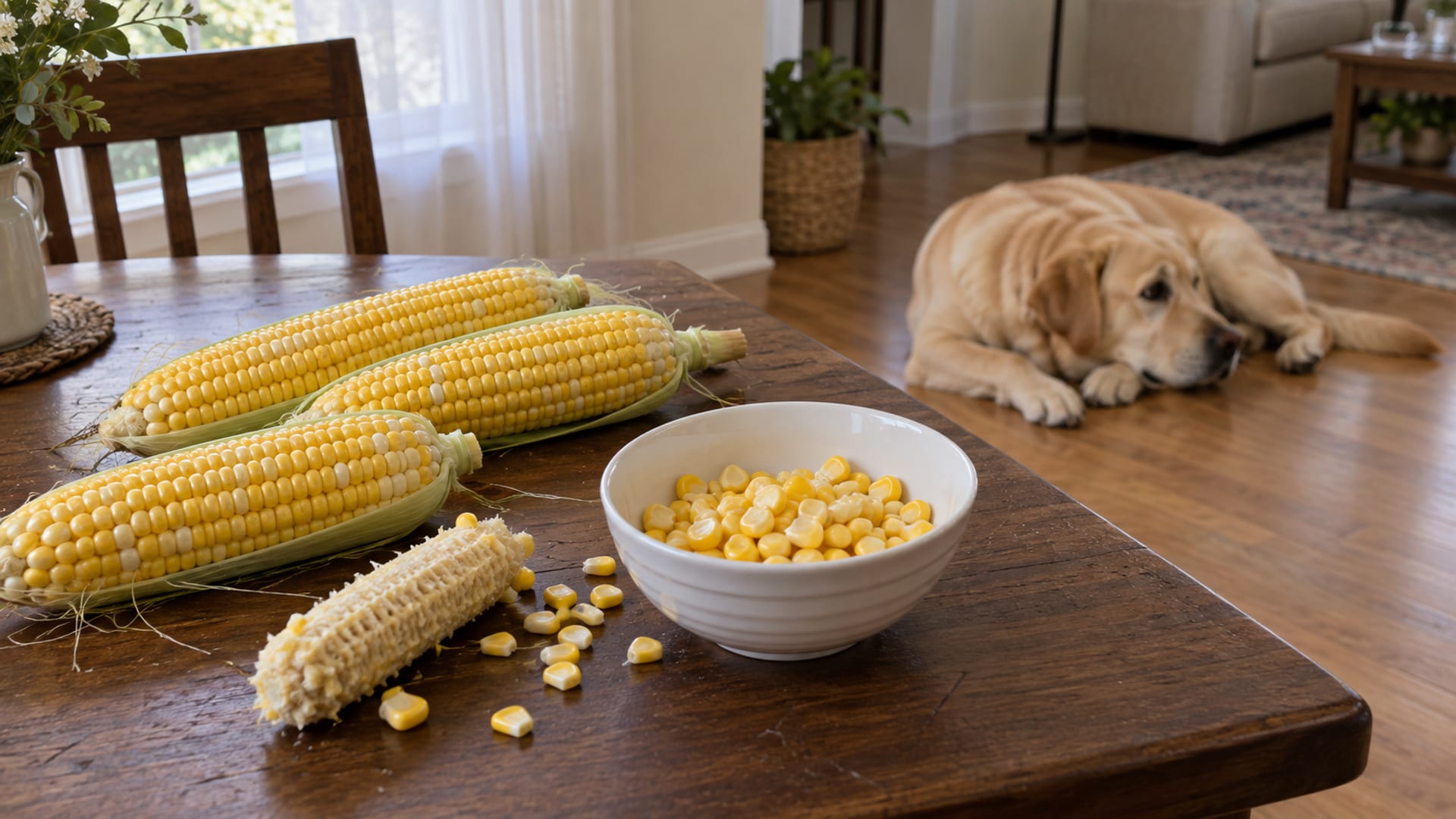
Yes. Plain corn kernels taken off the cob are safe for dogs in small amounts, according to the AKC, and the ASPCA counts corn as non-toxic. The cob is the danger. It is not poisonous, but a swallowed piece can get stuck in the intestines.
If your dog ate a spoonful of kernels, keep an eye out for an upset stomach and that is it. If they chewed up and swallowed any part of a cob or husk, call your vet now, before any signs appear.
Key takeaways
Tap a card to bring it forward.
- Plain kernels off the cob, cooked and unseasoned, are fine in small amounts.
- A swallowed cob or husk can block the intestines and may need surgery.
- Blockage signs can take a day or more to show, so call about a cob before anything happens.
- Butter, salt and seasonings add fat and other risks; moldy corn can harm the liver.
- The houseplant called "corn plant" is a different plant and is toxic to dogs.
My dog ate corn: what now
It comes down to one question: did any cob or husk go down?
Tap or hover a row to highlight it.
| What they ate | Next step |
|---|---|
| What they ateA few plain kernels, cooked, canned or raw | Next stepNothing. Watch for gas, loose stool or vomiting. |
| What they ateA whole cob, a chewed piece of cob, husk or stalk | Next stepCall your vet now, even if your dog acts normal. |
| What they ateButtered, salted or seasoned corn, elote or esquites | Next stepCheck for onion, garlic and heavy butter. Call if your dog has had pancreatitis or eats a lot. |
| What they ateMoldy corn, or corn from the trash that looked spoiled | Next stepCall your vet now. Mold on corn can make toxins that hurt the liver. |
| What they ateLeaves of a "corn plant" houseplant | Next stepCall your vet or a poison line. That plant is toxic. |
Pet Poison Helpline is blunt about it: "Never feed your dog corn on the cob." It explains that a cob can lodge in the intestines and need abdominal surgery. Waiting to see if it passes is a gamble, because a dog can look fine at first.
Tell the vet roughly how much cob your dog got, whether it was chewed into pieces, and when.
Kernels, cobs, popcorn: which corn is okay
Tap or hover a row to highlight it.
| Form | Okay? | Why |
|---|---|---|
| FormCooked kernels off the cob, plain | Okay?Yes, a little | WhyEasier to digest than raw |
| FormRaw kernels | Okay?Better cooked | WhyHarder to digest, more likely to upset the stomach |
| FormCanned or frozen corn | Okay?Plain and drained only | WhyWatch the salt and any butter or sauce |
| FormCorn on the cob | Okay?No | WhyThe cob can choke a dog or block the gut |
| FormHusk, silk, stalk | Okay?No | WhyTough plant fiber, same blockage risk |
| FormPlain air-popped popcorn | Okay?Now and then | WhyEvery kernel popped, no butter or salt |
| FormCorn nuts, toasted corn | Okay?Better not | WhyHard, and usually salted or fried |
| FormMoldy corn | Okay?No | WhyCan carry aflatoxins that damage the liver |
| FormCorn dogs, corn chips | Okay?Better not | WhyFat, salt and seasoning |
The AKC's guide to corn in dog food explains that cooked corn starch is easier for dogs to digest than raw. Corn is also a common dog food ingredient, often as cornmeal or corn gluten meal. For popcorn, Can dogs eat popcorn? goes through the details.
The houseplant sold as "corn plant," also called cornstalk plant or dragon tree (*Dracaena fragrans*), is not food corn. The ASPCA lists it as toxic to dogs and cats because of saponins.
How much corn, and how to serve it
The AKC recommends corn off the cob "in small amounts" and "in moderation," without giving a set number of kernels or spoonfuls. The AKC's general treat rule still applies: all extras together stay at about 10% of your dog's daily calories.
- Cook the kernels and cut them fully off the cob. Throw the cob in a lidded trash can.
- Serve them plain: no butter, oil, salt, onion, garlic or sauce.
- Start small, especially with a dog that has a sensitive stomach.
Some dogs are allergic to corn. A study of dogs with food allergy, published by Jackson and colleagues, found reactions to corn in some of them. If your dog reacts badly after eating corn, stop giving it and tell your vet.
Signs after a cob, and after moldy corn
A cob in the gut may cause nothing at first. In one published case, a dog that got into trash with a corn cob in it was tired first and started vomiting about 24 hours later, according to a report in the Journal of the American Veterinary Medical Association. Watch for:
- vomiting, especially again and again
- not eating
- tiredness or weakness
- a sore belly
- diarrhea, or straining with nothing coming out
- signs of dehydration
The Merck Veterinary Manual describes corncob blockages of the small intestine in dogs, and the AKC notes that Labrador Retrievers, Golden Retrievers and Bernese Mountain Dogs are often seen for swallowed-object blockages. Small dogs and puppies have less room for a piece of cob to pass.
Moldy corn is a separate problem. The FDA explains that the mold *Aspergillus flavus* can make aflatoxins, which damage the liver. Signs include not eating, sluggishness, vomiting, diarrhea, yellow gums or eyes, and unexplained bruising or bleeding. Liver damage can start before a dog looks sick, so the FDA says to contact your vet right away if you suspect it.
"My dog chewed a corn cob once and it passed"
That happens, and it is good news for that dog on that day. It is not a pattern to count on. A cob chewed into small bits by a big dog is a different event from a chunk swallowed by a small one, and a piece that passes once may lodge the next time. Early signs can also be slow and mild, a tired dog that seems a bit off, before the vomiting starts. The same goes for kernels: most dogs are fine with a few, while a dog with a corn allergy is not. Call about every cob.
Check what you learned
Quick check
Questions about dogs and corn
Can a dog eat cooked corn?
Yes, cooked is the better choice. Plain cooked kernels off the cob are easier to digest than raw ones. Leave off the butter and salt.
Can dogs eat corn on the cob?
No. The kernels are fine, but the cob can cause choking or a blockage that may need surgery. Cut the kernels off and put the cob where your dog cannot reach it.
What if my dog ate a corn cob?
Call your vet right away, even if your dog looks normal. Signs of a blockage can be delayed by a day or more.
Can dogs eat canned corn?
Plain canned corn, drained, is fine in a small amount. Skip cans with added salt, butter or sauce.
Can moldy corn make a dog sick?
Yes. Mold on corn can produce aflatoxins, which damage the liver and can be fatal. Throw moldy corn away where your dog cannot get it, and call your vet if they ate some.
Is corn in dog food bad for dogs?
Corn is a common dog food ingredient, and the AKC treats it as a source of carbohydrate, fiber and other nutrients. A dog with a diagnosed corn allergy needs a food without it.
Sources
Checked September 24, 2026.
- American Kennel Club, Can Dogs Eat Corn?
- American Kennel Club, Corn in Dog Food: What You Need to Know
- American Kennel Club, Intestinal Blockage in Dogs
- ASPCA, 5 Toxic Seasonal Plants You Don't Want Your Pet To Fall For!
- ASPCA Animal Poison Control Center, Corn Plant
- Pet Poison Helpline, Picnic Foods Toxic To Dogs
- Merck Veterinary Manual, Gastrointestinal Obstruction in Small Animals
- U.S. Food and Drug Administration, Aflatoxin Poisoning in Pets
- Yang and others, Segmental jejunal volvulus and hemoperitoneum secondary to small intestinal foreign material in a dog, Journal of the American Veterinary Medical Association
- Jackson HA and others, Clinical and allergen-specific IgE responses to oral challenge with cornstarch, corn, soy and a soy hydrolysate diet in dogs with spontaneous food allergy, Veterinary Dermatology, 2003