
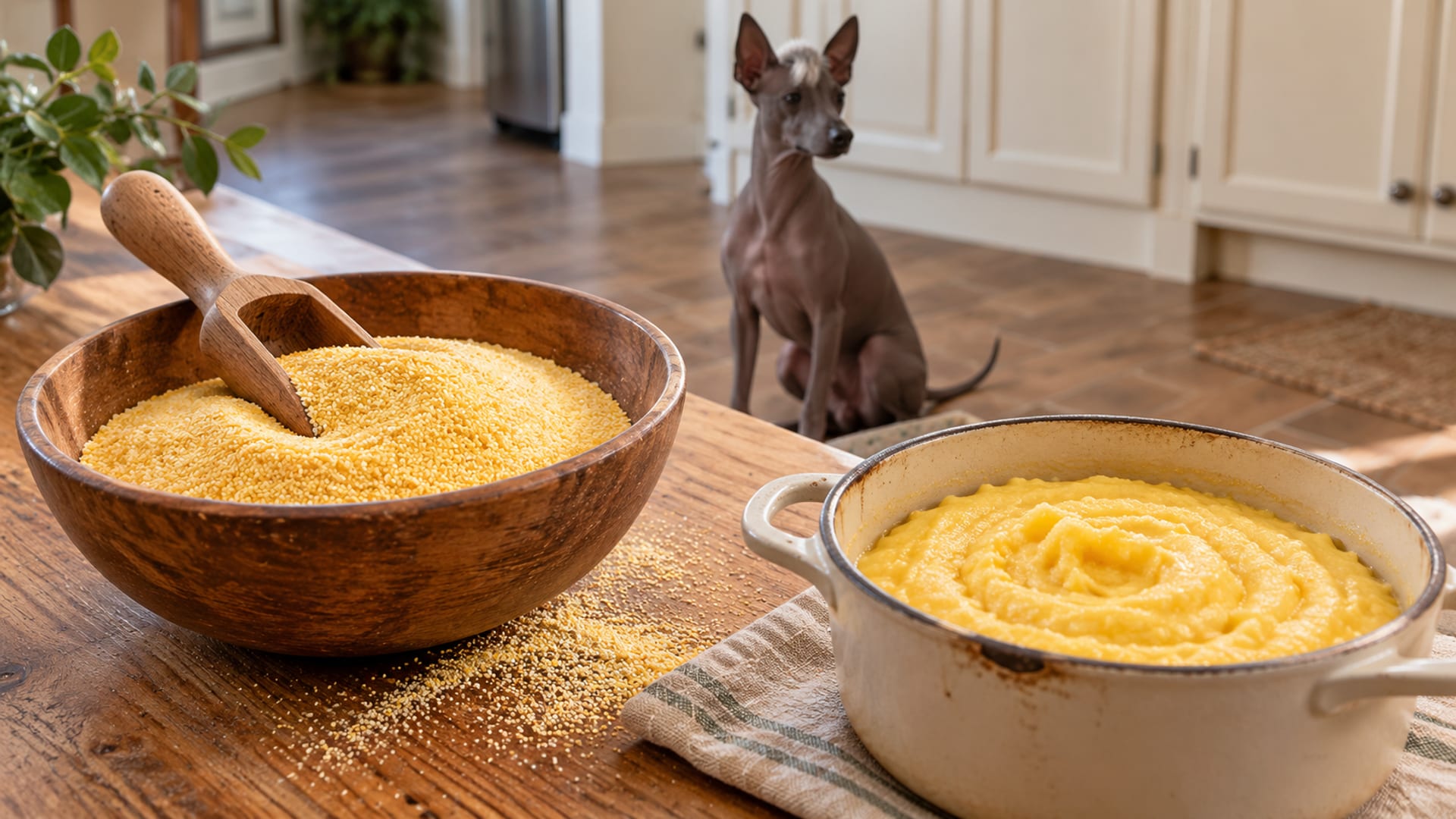
Yes. Plain cornmeal is generally safe for dogs in small amounts, and cooked cornmeal is easier to digest than dry. If your dog licked up a spill or ate a bit of cooked grits or cornbread, that is usually a non-event. What changes the answer is short: old or moldy meal, pieces of cob or husk, and whatever else went into the recipe.
The AKC says corn off the cob is safe for dogs in small amounts, and cornmeal is that same grain ground up. So, the questions that matter are about freshness and ingredients, and the section right below walks through them.
Key takeaways
Tap a card to bring it forward.
- A small amount of fresh, plain cornmeal is low risk, and cooked is easier on a dog's digestion than dry.
- Old or moldy cornmeal can carry aflatoxins, which harm the liver, so it is the one form to treat as serious.
- Cob and husk pieces can choke a dog or block the gut; cornmeal has none of that risk, but a cob-containing dish does.
- Cornbread, mixes and other prepared dishes are judged by their whole ingredient list.
- Serve cooked, plain and small; cornmeal is an occasional extra, and balanced dog food stays the meal.
What to do if your dog ate cornmeal
A few quick questions sort a harmless nibble from a call to the vet, and each one is something the vet or poison line would ask you anyway.
- Check how fresh the cornmeal was. A new bag, or one you use regularly, points one way; an old bag, or one that sat somewhere warm and damp, points the other.
- Look and smell for mold or an off odor, in the bag and in what your dog ate. Contaminated corn can carry aflatoxins even when no mold is visible, so an old, doubtful bag counts even if it looks fine.
- Work out how much. A lick or a spoonful is different from a torn-open bag.
- Read the label or think through the recipe. Plain meal is one thing; a mix with onion, garlic, raisins, chocolate or xylitol, or a lot of salt, butter or oil, is another.
- Look for cob or husk pieces. If any were swallowed, call your vet.
- Note any signs, such as repeated vomiting, lethargy, or a yellow tint to the gums, and keep the packaging for the call.
If the meal was fresh and plain, the amount small and your dog is acting normally, watching at home is reasonable. Call your vet or a pet poison service promptly if the meal may have been moldy or old, the product or recipe is uncertain, a large amount was eaten, cob or husk was swallowed, or any signs appear. The Pet Poison Helpline advises against giving any home antidote, so let the vet or poison line direct what happens next.
Which cornmeal is fine and which is not
The grain itself is not the problem; the spoilage, the plant parts and the recipe are. This table sorts the common forms, using the AKC and the Merck Veterinary Manual.
Tap or hover a row to highlight it.
| Form | Risk | What to do |
|---|---|---|
| FormPlain cooked cornmeal, polenta or grits | RiskLow in a small amount | What to doFine occasionally, if cooked without additions |
| FormPlain dry cornmeal, fresh | RiskNot a recognized poison; a large amount may upset the stomach; dry meal eaten fast can be a choking or breathing-in risk | What to doSmall amounts only; watch a dog that gulps |
| FormMoldy, spoiled or old cornmeal | RiskAflatoxins can cause severe liver injury and death | What to doCall your vet or a poison line |
| FormCorn cob, husk or large cob pieces | RiskChoking or a blocked intestine | What to doCall your vet if swallowed |
| FormCornbread, muffin mixes and other prepared dishes | RiskDepends on the whole recipe | What to doCheck for onion, garlic, chocolate, raisins, xylitol, salt and fat |
Aflatoxin comes from molds called *Aspergillus flavus* and *Aspergillus parasiticus* that grow on corn, according to the Merck Veterinary Manual. Warm, humid storage helps that mold grow, per the FDA. That is why a bag that sat damp or a long time is the one to throw out.
How much to give and how to serve it
There is no cornmeal serving chart by dog size to follow, so keep the portion small and occasional. Think of it as a spoonful stirred into a meal now and then.
Cooked is the better way to serve it. The AKC cites roughly 60 percent digestibility for raw starch against roughly 95 percent for cooked starch, so a cooked porridge, polenta or grits gives your dog far more of what it eats. Cook it plain, with no salt, butter, oil, onion, garlic, sugar, chocolate, raisins or xylitol. Added butter and oil bring fat that can upset the stomach.
Keep it as an extra beside a balanced dog food, not a replacement. Skip moldy meal, cob and husk, and dry clumps for a dog that gulps its food.
Small dogs get a bigger dose per kilogram from the same spoonful, so go smaller for them. If your dog has pancreatitis or another diet-sensitive condition, ask your vet before adding any fatty or seasoned corn dish.
Signs to watch for and when they show up
After a small amount of plain cornmeal, many dogs show nothing. Too much, or something unfamiliar, can cause vomiting, diarrhea, gas or belly discomfort that passes.
Aflatoxin illness is different, and it usually builds after repeated or substantial exposure. The FDA lists loss of appetite, lethargy, vomiting, diarrhea and jaundice, a yellow tint to the gums or skin. The Merck Veterinary Manual adds weakness, liver damage, bleeding, trouble breathing and sudden death. How long it takes depends on the dose, how contaminated the food was, and how long the dog ate it, and chronic exposure can progress over weeks.
Two published figures help with scale. Merck reports toxic concentrations above 60 micrograms per kilogram of feed, and lethal concentrations around 500 to 1,000 micrograms per kilogram. Those are levels of aflatoxin in contaminated feed; they are not grams of ordinary cornmeal, which is why the useful step is a call when the meal may have been bad.
A cob or a large indigestible piece is a different worry. It can block the intestine and need veterinary treatment or surgery, and signs include repeated vomiting and belly pain.
Call right away for repeated vomiting, severe diarrhea, lethargy, loss of appetite, a yellow tint to the gums, belly pain, trouble breathing, choking, collapse, bleeding or seizures.
My dog ate cornmeal before and was fine
That is very likely true, and one uneventful time is a reasonable thing to go by. It just isn't the rule for every bag, and here is why the outcome can differ next time.
- The amount may have been small.
- The meal may have been fresh instead of moldy.
- It may have been cooked instead of raw.
- The dog may not have swallowed a cob or other foreign material.
- The dog may not have taken in enough aflatoxin to get sick.
- Response varies with a dog's age, sex, nutrition, the amount and how long the exposure lasts, according to Merck, and young animals are especially susceptible.
- Toxins can build up when a pet eats the same contaminated food again and again, the FDA notes, and liver injury can show up later.
So, the bag that was fine last month may not be the bag you open in August, and a puppy is not the same as an adult.
Cornmeal, polenta, grits, masa and look-alikes
These names get mixed up, and a few of them are different products.
- Cornmeal, polenta and grits: related maize products that differ in grind and processing. Polenta is commonly cooked cornmeal or corn semolina, and the plain, cooked versions are fine in a small amount.
- Masa harina, Maseca and harina PAN: masa harina is generally maize flour treated with lime water. Brand products may be plain maize flour or may add salt, preservatives or other ingredients, so read the label.
- Cornbread and corn muffin mixes: the cornmeal may be fine, but the whole recipe counts. See cornbread, and check for onions, garlic, grapes and raisins, chocolate, xylitol, salt and fat.
- Corn on the cob and husks: these are plant parts with a choking and blockage risk that plain meal does not have. See corn for the whole cob.
- Popcorn: it has its own issues, such as unpopped kernels and toppings; see popcorn.
- Corn gluten meal: a protein-rich part of corn used in some dog foods. The AKC describes it as a plant protein source, and it is not ordinary cornmeal.
- Candy corn: a sugary candy, not a corn product, and the sugar and fat can upset a dog's stomach.
Check what you learned
Three quick questions on the parts that matter.
Quick check
Questions about dogs and cornmeal
These are the questions that come up after the first look at the bag.
Can dogs eat dry cornmeal?
A small amount of fresh, dry cornmeal is not a recognized poison. A large amount can upset the stomach, and a dog that gulps dry meal can choke or breathe some in, so watch how fast yours eats it.
Can dogs eat polenta or grits?
Plain cooked polenta and grits are generally fine in a small amount. Make sure no salt, onion, garlic or other add-ins went in.
Can dogs eat cornbread?
The cornmeal in it may be fine, but the whole recipe decides. Check for onion, garlic, raisins, chocolate, xylitol, extra fat and salt before sharing any.
What if my dog ate moldy cornmeal?
Treat it as potentially serious and call your vet or a pet poison service. Mold can make aflatoxins, which can damage the liver, and signs may not show right away.
Is cornmeal a good everyday food for my dog?
Corn is a common ingredient in dog food, according to the AKC. At home, keep cornmeal to an occasional cooked extra beside balanced dog food.
Sources
Checked September 29, 2026.
- American Kennel Club, Can Dogs Eat Corn?
- American Kennel Club, Corn in Dog Food: What You Need to Know
- FDA, Aflatoxin Poisoning in Pets
- FDA, Chemical Contaminants
- Merck Veterinary Manual, Aflatoxicosis in Animals
- Merck Veterinary Manual, Hepatotoxins in Small Animals
- Pet Poison Helpline, Emergency Instructions