

Can Dogs See in the Dark: How Dog Night Vision Works and When to Call the Vet
By Cal Hewitt · Published , updated
Health
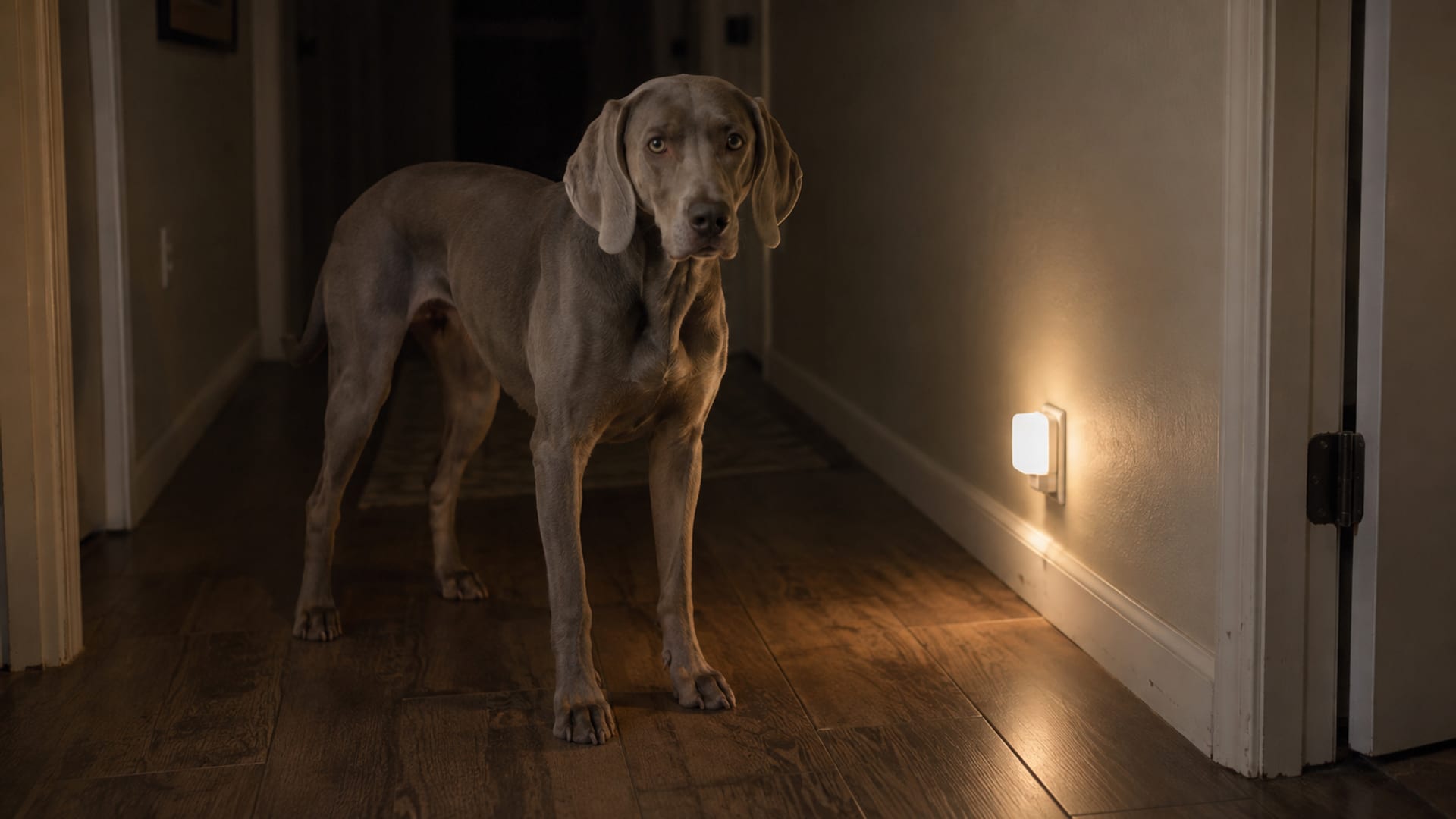
Dogs see better than people in dim light, but they cannot see in total darkness. Their pupils open wider, their retinas hold many rod cells built for low light, and most dogs have a reflective layer called the tapetum lucidum that sends light back through the eye for a second chance to catch it. They still need some light, and what they see at night is not sharp. If your dog used to handle the dark fine and now hesitates on stairs or bumps into things, I'd book an eye exam rather than write it off as fear. A night-light, furniture left where it is and a gate at the stairs lower the risk while you wait.
Key takeaways
Tap a card to bring it forward.
- Dogs see well in low light, but not in complete darkness; they need some light to reach the eye.
- Rods, wide pupils and the tapetum lucidum give dogs their low-light edge, at the cost of some sharpness.
- There is no proven "dogs see X times better" number; the often-quoted five times figure is one vet's qualified estimate.
- A night-light, a stable room layout, gates on stairs and a leash or fence outdoors make evenings safer.
- New bumping, stair hesitation, wide pupils that react poorly or a changed eyeshine are reasons to call your vet.
- Vision that disappears over a few days needs prompt veterinary attention.
Can dogs see in the dark, or only in low light?
Low light, not darkness. The Miller and Murphy review of canine vision describes dogs as adapted to dim light, and nothing in their eye lets them see where no light reaches it. Rods and the tapetum help a dog get more from the light that is there; they don't create sight from nothing.
That difference matters for tonight's decision. A bedroom with a streetlight glowing through the blinds or a yard under a half moon gives your dog something to work with. A windowless basement with the door shut may give them almost nothing. Low-light vision also isn't daytime vision with the brightness turned down; dogs lose detail and color at night too.
What lets dogs see in low light, and how much better than people?
Several parts of the dog's eye work together here. According to Miller and Murphy, the dog's pupil can open wider than ours and let in more light. The central 25 degrees of a dog's retina is mostly rods, while the center of the human retina is mostly cones. Rods are the cells that respond in dim conditions and pick up shapes and movement. Cones handle color and fine detail in good light.
Behind the retina sits the tapetum lucidum, a reflective layer. Light that passes through the retina without being absorbed bounces back through it, so the rods get a second try. The review puts the peak of the dog's rod pigment, rhodopsin, at about 506 to 510 nanometers, compared with about 496 in people, but the authors say that small difference does not explain the main advantage. The pupil, the rod-rich retina, the tapetum and other features of the lens and retina do most of the work.
How much better, then? The popular "five times better" line traces back to a 2007 University of Wisconsin-Madison article in which veterinary ophthalmologist Paul Miller said he suspected dogs could see in light about five times dimmer than people can. In the same piece he said the exact difference was uncertain, and that dogs are probably not as capable as cats in the dark. So, the fair reading is: dogs are clearly better than us in dim light, probably not as good as cats, and no one has pinned down a single multiplier that applies to every dog.
There's a trade-off, too. Miller explained that the tapetum scatters light as it reflects it, which blurs detail. The UW-Madison article gave his comparison as roughly 20/80 vision for dogs against 20/20 for people. The American College of Veterinary Ophthalmologists (ACVO) says behavioral studies put canine acuity around 20/75. Both figures describe sharpness, not how dim a light a dog can use. In practice, your dog may notice a cat moving across a dark yard before you do, yet still miss the edge of a step. Age, eye anatomy, breed and eye health also vary, so your dog's comfort in the dark may not match your neighbor's.
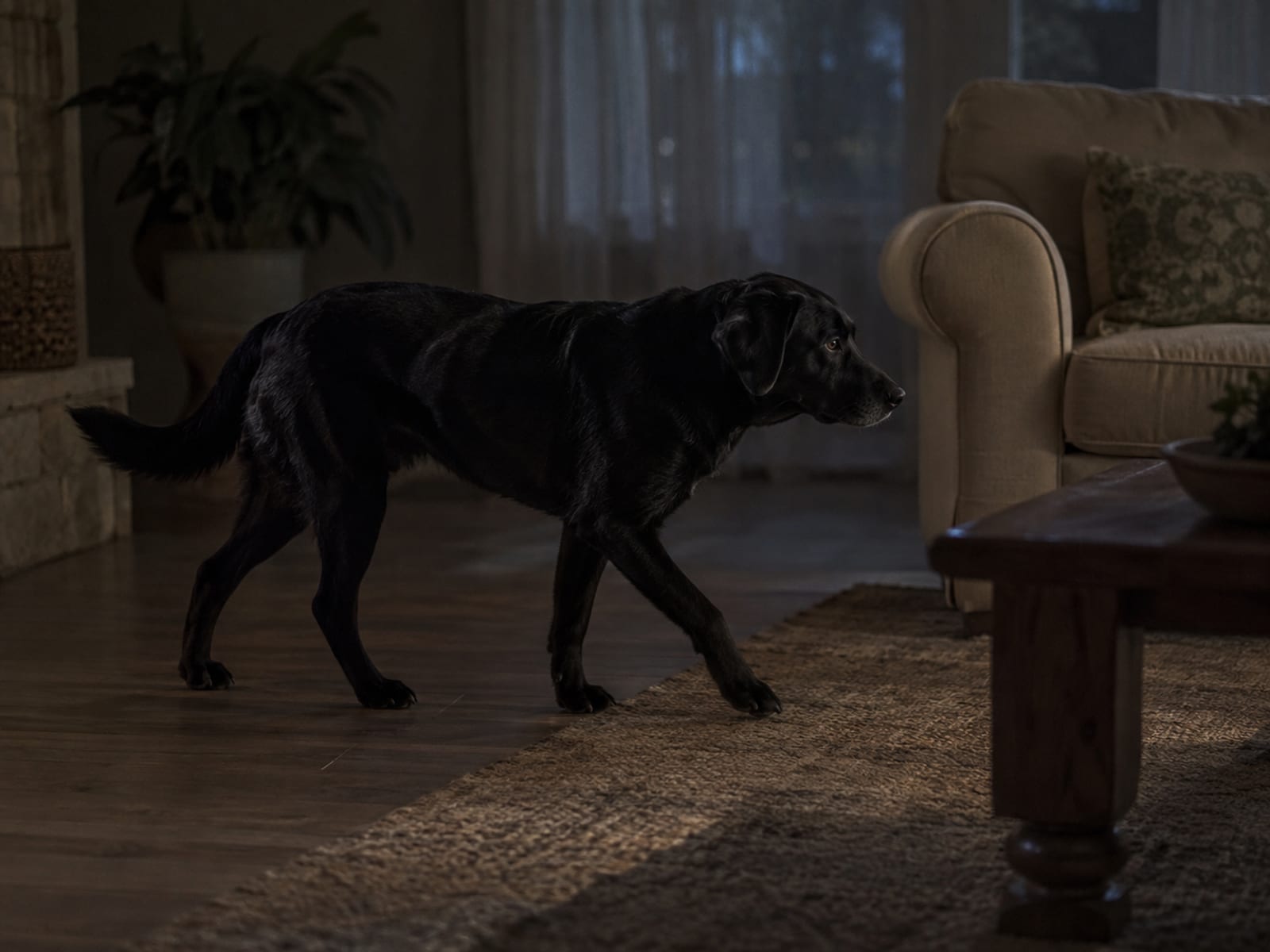
Why do dogs' eyes shine at night, and what does a changed shine mean?
That glow in headlights or a phone flash is the tapetum lucidum reflecting light back out of the eye. The ACVO explains eyeshine as the same reflection that gives the retina a second chance at the light. The color can look green, blue, orange or yellow, and it can shift with the dog's anatomy, the angle, the light source, age and changes early in life. Two healthy dogs in the same photo can shine different colors.
Some dogs have no visible tapetum. ACVO notes this is more common in dogs with blue eyes, and those dogs may show red-eye in photos because the blood vessels at the back of the eye show through instead.
What deserves attention is change. ACVO advises an exam if the reflection becomes duller or brighter over time, or if one eye shines differently from the other. That isn't a diagnosis on its own, but it's a reason to let a vet look, especially if your dog is also struggling in dim rooms.
What do dogs see at dusk: color and movement
Dogs are not limited to black and white. ACVO describes dogs as dichromatic, meaning they have two types of cones, one tuned to blue-violet and one to greenish-yellow. They see blues and yellows best and have trouble telling red from green, a bit like a person with red-green color blindness.
As light fades, what dogs keep is a good eye for motion. ACVO says the higher number of rods helps dogs pick up moving objects more easily than still ones. At dusk a dog can catch a squirrel darting along the fence, yet walk into a lawn chair sitting perfectly still. That pattern fits normal low-light vision. It becomes a concern when it's new, getting worse, or showing up in brighter light too.
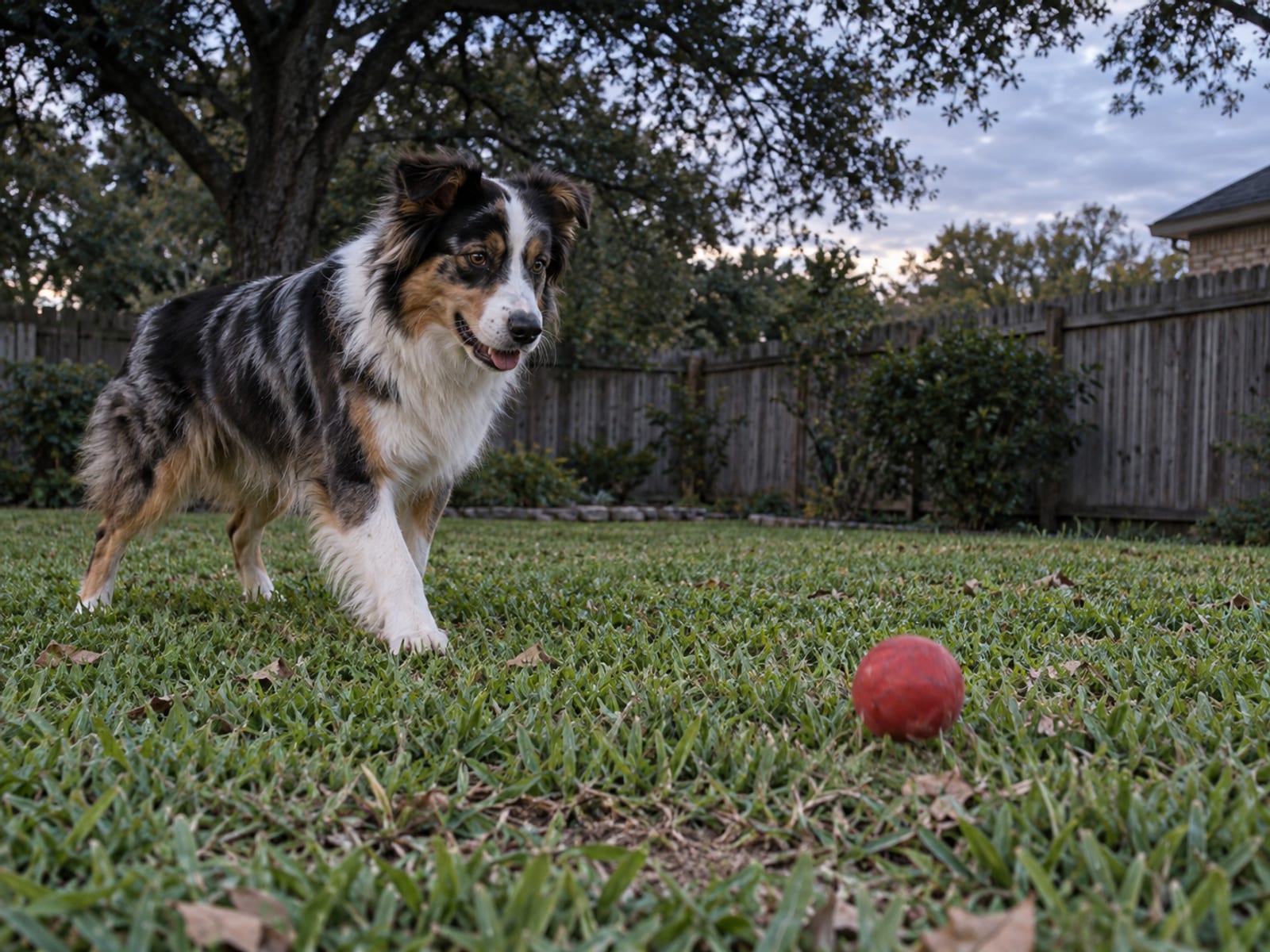
Should you leave a light on for your dog at night?
For many healthy adult dogs, a dark house with a little ambient light is fine. If your dog is hesitating or bumping into things in dim rooms, a night-light is a sensible, low-cost step. I'd put one where the trouble shows up: the stairs, the path to the water bowl, the back door.
A light helps, but when behavior has changed it doesn't replace an eye exam. A few other changes do as much as the light itself. The AVMA's senior pet brochure notes that dogs with poor sight can get around familiar spaces well and advises against rearranging or adding furniture that could become an obstacle. AAHA recommends gating stairs, and ACVO's blindness guidance adds gates for pools and says to keep outdoor time leashed or inside a solid fence.
For the dark yard, ask whether your dog can get hurt out there. A familiar fenced yard with a porch light is different from an unlit yard with a pool or a gap in the fence. If in doubt, go out together on a leash at night until you know what's going on. If you're reworking evening walks, my post on how often you should walk your dog covers pacing and timing, and a solid stay cue helps at doors and the top of the stairs.
When is trouble seeing at night a reason to call the vet?
Some hesitation in an unfamiliar, very dark place is normal for any dog. What I'd pay attention to is a change from what your dog used to do. The ACVO's page on vision difficulty lists hesitating on stairs, changed routines and reluctance on normal walks as possible signs that a dog is having trouble seeing. Dogs lean hard on smell and hearing, so vision loss can hide for a while, especially in a familiar house.
Signs to bring up with your vet
Tap a card to bring it forward.
- New hesitation on stairs, jumps or at the edge of dark rooms
- Bumping into objects or people, especially in dim light
- Avoiding night walks or dark rooms your dog used to use
- Pupils that stay unusually wide or react poorly to light
- Eyeshine that looks duller, brighter or different between the eyes
- Redness, cloudiness, discharge, rubbing or signs of eye pain
- Vision that seems to disappear over several days
Most of these call for a prompt appointment with your regular veterinarian. Vision lost over a few days, or a fast-changing eye problem, needs attention sooner; if your vet can't see your dog soon, an emergency veterinarian is the right call.
Night-time confusion in an older dog can also look a lot like poor vision, and the two can overlap, so neither is something to diagnose at home. My post on dog dementia covers the cognitive side, and signs of a healthy dog is a good baseline for what "normal" looked like.
A general vet can do the first exam and refer you to a board-certified veterinary ophthalmologist. According to the Merck Veterinary Manual, a specialist may do a dilated exam and, when it's called for, electroretinography (ERG), a test of how the retina responds to light.
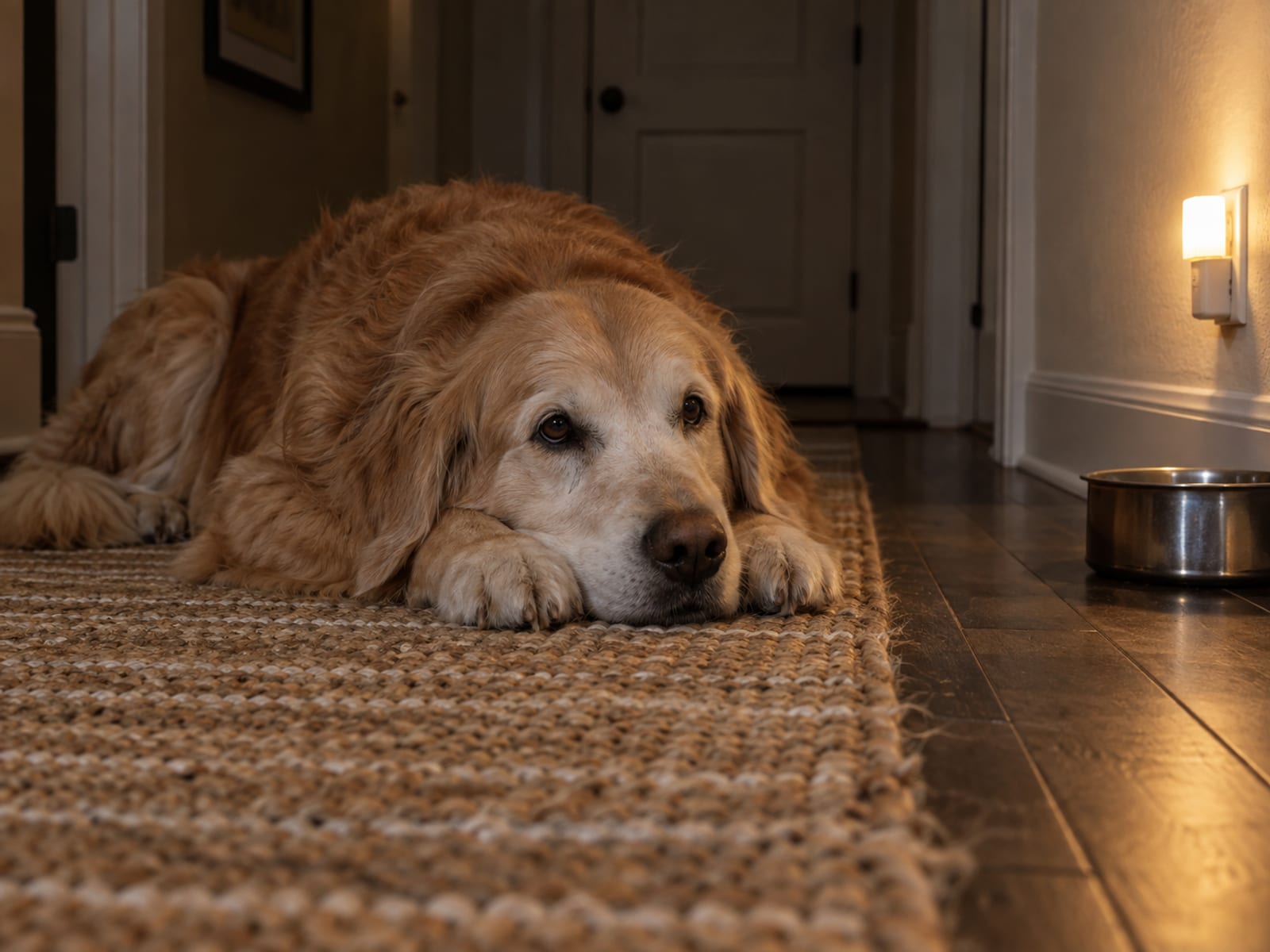
Which eye conditions affect night vision first: PRA, cataracts and SARDS
Three conditions come up again and again. Only an exam can tell you which, if any, applies to your dog.
Progressive retinal atrophy (PRA). PRA is a group of inherited diseases that slowly break down the retina. Merck says night blindness is typically noticed early, because many of these diseases damage the rods first. Vision can move from trouble in dim light to wider blindness over months or years. VCA also describes night blindness as the usual first sign owners notice.
Merck lists early-onset forms in Irish Setters, Collies, Norwegian Elkhounds, Miniature Schnauzers and Belgian Sheepdogs. Forms that show up around 3 to 5 years of age are reported in Miniature and Toy Poodles, American and English Cocker Spaniels, Labrador Retrievers, Tibetan Terriers, Tibetan Spaniels, Papillons, English Springer Spaniels, miniature long-haired Dachshunds, Akitas and Samoyeds. PRA is also reported as X-linked in Siberian Huskies and as autosomal dominant in Mastiffs and Bullmastiffs. That list isn't complete, so a dog of any breed with new night trouble deserves an exam.
Cataracts. A cataract can interfere with light entering the eye and impair vision. If you're wondering whether a dog with cataracts can see in the dark, my post on cataracts in dogs covers signs, causes and treatment, and your vet can tell you how much sight is affected.
Sudden acquired retinal degeneration syndrome (SARDS). SARDS causes vision loss that comes on fast, often over several days. Merck's SARDS page reports it more often in Dachshunds, Miniature Schnauzers, Pugs and Brittany Spaniels. It describes widely dilated pupils that respond poorly or not at all, with the back of the eye often looking fairly normal early on. VCA adds Bichons, Cocker Spaniels, Springer Spaniels, Shih Tzus, Beagles and Maltese as overrepresented breeds. A dog that seems to go blind over a few days needs a vet promptly.
What does a veterinary eye exam cost?
Costs depend on where you live, which tests your dog needs, whether sedation is involved and whether you start at an ER. The clearest dated numbers in my research come from the University of Wisconsin Veterinary Care ophthalmology service, with pricing stated as current in January 2024:
Tap or hover a row to highlight it.
| Service | Published range | Source and date |
|---|---|---|
| ServiceInitial ophthalmology exam | Published range$285 to $520, depending on exam type | Source and dateUW Veterinary Care, January 2024 |
| ServiceTypical outpatient eye evaluation | Published range$300 to $1,500 | Source and dateUW Veterinary Care, January 2024 |
These are examples from one university hospital, not national prices; a referral hospital near you may charge more or less. If your vet suggests a specialist, ask for an estimate before the visit.
How to help a dog that is losing its vision
If your dog's sight is fading, there's a lot you can do at home. The AAHA article on living with a blind or deaf pet, published August 7, 2025, quotes veterinarian Margot K. Vahrenwald: "These pets adapt very well and may need only some accommodations to prevent injury with blindness." AAHA also says the first step for a suspected new impairment is a definitive diagnosis from a vet, possibly a specialist.
After that, a handful of habits do most of the work:
- Keep the layout the same. Beds, bowls, furniture and walking paths stay put.
- Light the tricky spots. Night-lights where your dog hesitates, especially stairs and doorways.
- Block the drops. Gates at stairs and around pools. Add traction, like rugs or stair treads, on slick floors and steps.
- Use your voice. Speak before you touch your dog so they aren't startled, and teach short cues like "stop" and "step up." A trainer can help sharpen those cues.
- Add sound and scent markers. ACVO suggests bells, toys that make noise and scent markers to help a dog find its way.
- Keep a home base and a routine. A predictable schedule and a spot with bed, food and water give your dog a place to reset.
- Supervise outdoors. Leashed walks or time inside a solid fence, and nothing unsupervised in open areas.
If your dog ever slips out, my post on how to find a lost dog has the steps, and senior dog care covers broader home changes for older dogs.
Questions about dogs and night vision
Can dogs see with the lights off?
Usually a little, if any light leaks in from a window, a hallway or a device. Their rods and tapetum help them use that small amount of light far better than we can. In a room with no light at all, a dog can't see and relies on smell, hearing and memory of the layout.
Should I leave a light on for my dog at night?
A healthy adult dog in a familiar home often does fine with the ambient light most houses have. If your dog hesitates on stairs or bumps into things after dark, a night-light at those spots is a reasonable step. It supports your dog while you arrange an exam; it doesn't answer why the change happened.
Can dogs see in the dark like cats?
Probably not as well. In the UW-Madison article, Paul Miller said dogs are probably not as capable as cats in dim light, even though both beat people. Dogs are built for dim light, not for seeing in true darkness.
Is night blindness the first sign of PRA?
It often is. Merck and VCA both describe night blindness as commonly noticed early in progressive retinal atrophy, because the rods tend to be affected first. Only a veterinary exam, sometimes with an ERG test, can confirm whether PRA or something else is behind it.
Your next step tonight
If your dog is just a little cautious in a pitch-black room, turn on a small light and leave the furniture where it is. If the change is new or getting worse, or you've noticed bumping, stair trouble, wide pupils or a changed eyeshine, call your vet this week and describe what you've seen and when. If sight seems to be disappearing over a few days, call today, and use an emergency vet if your own can't fit you in. Meanwhile, gate the stairs, leash up after dark and talk to your dog as you move around the house.
Sources
- acvo.org: ACVO explains eyeshine
- acvo.org: ACVO's blindness guidance
- acvo.org: ACVO's page on vision difficulty
- acvo.org: American College of Veterinary Ophthalmologists (ACVO)
- American Animal Hospital Association: AAHA
- American Veterinary Medical Association: AVMA's senior pet brochure
- Merck Veterinary Manual: Merck Veterinary Manual
- Merck Veterinary Manual: Merck's SARDS page
- news.wisc.edu: 2007 University of Wisconsin-Madison article
- rctn.org: Miller and Murphy review of canine vision
- uwveterinarycare.wisc.edu: University of Wisconsin Veterinary Care ophthalmology service
- VCA Animal Hospitals: VCA
- VCA Animal Hospitals: VCA