

How to Find a Lost Dog: What to Do in the First Hour and the Days After
By Cal Hewitt · Published
Safety
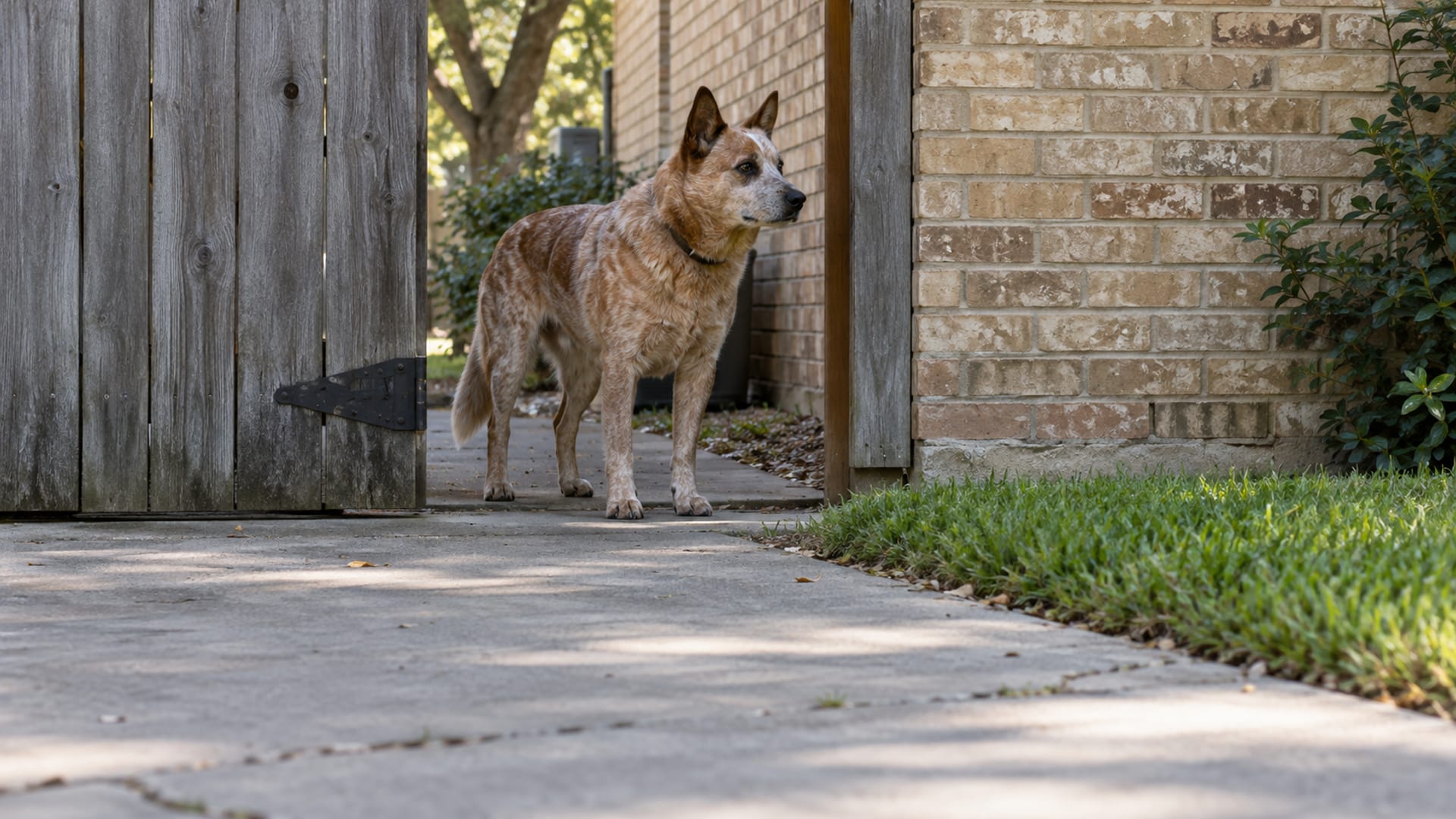
If your dog is missing right now, start here. Search the spot where you last saw your dog and check every nearby hiding place. Then call your local animal services, shelters and veterinary hospitals, and report the dog missing to the microchip registry. Put up clear flyers and online alerts, and visit shelters in person every day. If you see your dog and it looks frightened, do not chase or shout. Move slowly, or call animal control for help.
I'm Cal. If you are reading this with the gate still open behind you, the steps below are in the order you need them, starting with the next hour.
Key takeaways
Tap a card to bring it forward.
- Search the last-seen area first, quietly, and check under porches, cars, decks and bushes.
- Call animal services, every nearby shelter, and regular and emergency vet hospitals, then report the dog to the microchip registry.
- Use one clear flyer everywhere, online and on paper, and keep one identifying detail private.
- If someone sees your dog, do not chase, call or surround it. Note the place, time and direction.
- Visit shelters in person every day, because hold periods are set locally and can be short.
- Never pay a "finder" who will not send a current photo.
What to do in the first hour: search where your dog was last seen
Start with what you know. Write down, or say into your phone's notes, where you last saw your dog, which way it was headed, what time it was, and whether it had a collar or leash on. That becomes the starting point for everyone who helps you.
Then search close by, and do it quietly. The American Humane Society says to act quickly and to look in hiding places: under porches, inside garages, beneath vehicles and behind dense landscaping. Add decks, sheds, bushes and any open enclosed space nearby. A frightened dog may tuck itself into a spot a few yards away and stay silent, even when it hears you. Ask neighbors to check their yards and any doorbell or security cameras.
If you can, keep one person at home or at the last-seen spot. Leave something that smells like home there, such as the dog's bedding or a shirt you have worn. The ASPCA puts an immediate neighborhood search at the top of its advice, along with posters, online outreach and shelter checks from the first day.
Why start close? Lost dogs do not all behave the same way. Temperament, weather, age, terrain and whatever scared the dog all play a part. Material from the Missing Animal Response Network, reproduced by Pet FBI, describes a "flight" mode in which a frightened dog travels, avoids people and acts unlike itself, even around its own family. Nobody has a reliable rule for how far a lost dog goes, so work outward from the last-seen point and widen the search when sightings, roads or the escape itself suggest the dog has moved.
Who to call: animal services, shelters, vet hospitals and the microchip registry
Within that first hour, get on the phone. Call your city or county animal services, every open-intake shelter and humane society near you, the police non-emergency line, and nearby regular and emergency veterinary hospitals. Ask each one whether a dog matching your description has been brought in, found or hurt. Include agencies in the towns next to yours, since a found dog may be taken or reported outside your immediate neighborhood. Our directory lists shelters and animal services by city, so you can pull up the local numbers in one place.
Next, the microchip. Find your dog's chip number in your vet records, then enter it in the AAHA Universal Pet Microchip Lookup Tool. It tells you which participating registries are linked to that number and how to reach them. It does not show owner details, and it is not a registry itself. If the chip was never registered, the result may point to the manufacturer or distributor instead.
Contact every registry the lookup names. Check that your name, phone numbers, email, address and an emergency contact are all current, report the dog missing, and ask them to flag the record or alert shelters. This step matters more than people expect. In a shelter study summarized by the American Animal Hospital Association (Lord et al., 2009), microchipped dogs went back to their owners 52.2% of the time, compared with 21.9% for dogs without chips. For chipped dogs that did not go home, wrong or missing registry information was a major problem.
One more thing to keep straight: a microchip is an ID number, not GPS. AAHA says it cannot track your dog, and different chip frequencies and scanners mean it is not fail-safe. It helps once someone finds your dog and has it scanned, so the search itself still falls to you.

A flyer and an online post that people will notice
The ASPCA recommends local social-media networks, lost-pet groups, email and one consistent flyer design. Seeing the same clear message again and again helps people recognize your dog. Paper still counts, too; the American Humane Society notes that not everyone uses social media.
Put these on the flyer:
- "LOST DOG" in large type
- One recent, clear photo
- Your dog's name, sex, rough size, breed or mix, color and visible markings
- Where and when your dog was last seen
- A phone number you will answer
- "Do not chase" if your dog is scared or known to run
- Whether your dog is injured, has a medical need, or is wearing a collar
Leave some things off. The Better Business Bureau warns about scammers who go after owners of lost pets, so do not post every unique marking, the microchip number, full medical details, your home address or a reward amount. Keep at least one identifying detail to yourself so you can ask a caller to describe it.
Hand flyers to nearby businesses, veterinary clinics, groomers, dog walkers, postal workers and delivery drivers. Post the same photo and text in local lost-and-found groups, neighborhood apps, community pages and shelter found-dog listings. Petco Love Lost is one more place to post and search. Do not count on a single platform, and update your posts the moment your dog is home.
When someone sees your dog: how to approach without chasing
A sighting is good news, and it is also the moment things can go wrong. A dog that is normally friendly may run from its own family when it is panicked. Chasing, surrounding, shouting its name over and over, or sending a crowd toward it can push it farther away or into traffic. The American Humane Society warns that chasing can drive an animal into the road.
So, when a call comes in, treat it as location information. Get the exact place, the time, which way the dog was going and how it was acting. Ask the person who saw it not to follow it or call to it.
If you get close, stay calm. Move slowly, use a quiet voice, and turn your body sideways rather than facing the dog head-on. Offer food only if you can do it without causing the dog to bolt. Do not block its escape route unless you have a safe way to contain it, and do not leave doors or gates open in a way that creates a new way out. If your dog still will not come to you, keep the area quiet and call animal control, a humane society or an experienced recovery group for help. Our page on dog body language covers the fear, stress and avoidance signals that can tell you, from a distance, whether to hold still or back off.
How long shelters hold a found dog, and why you should go in person
Hold periods catch many owners off guard, because no single national rule exists. Texas is a good example. Texas Health and Safety Code §826.002 says stray dogs and cats are impounded for a period set by local ordinance or rule, and the Texas Department of State Health Services states that cities and counties decide how long strays are held. So, the answer changes from one place to the next. Kyle, Texas says unclaimed dogs and cats become shelter property after 72 hours, with an exception for animals under three months. Refugio County's animal control procedures hold animals without a collar or microchip for 72 hours, and animals under four months get no stray hold under that procedure.
Wherever you live, call your city or county animal services and ask four things: the current hold period, the intake location, what happens on weekends, and whether they list found animals online.
Then go. The ASPCA recommends checking shelters daily and visiting in person with photos of your dog. Online listings, breed labels and color descriptions can be incomplete or simply wrong, and a scared dog in a kennel may not look much like the dog in your photo. Staff may also recognize your dog from your photo even when the listing did not match. Walking the kennels yourself, every day, is how you catch what a listing misses.
Scams that target owners of lost dogs
It is hard to hear, but a lost-dog post can draw scammers. The Better Business Bureau and the FBI's El Paso field office describe patterns worth knowing:
- A text or call from someone who says they have your dog but makes excuses for not sending a current photo or a specific description
- Pressure to send a reward by gift card, wire transfer, cryptocurrency or a payment app before you see the dog
- Fake search services offering drones, tracking or search teams for an upfront fee
- A claim that your dog is hurt and at a vet, followed by an urgent demand for money
- Spoofed phone numbers, fake accounts in lost-pet groups asking for personal information, and threats to harm or sell the dog
To protect yourself, ask any caller for a current photo and a description of the detail you kept private. Get a callback number and check it on your own. Do not send money, gift cards, passwords, verification codes or account details to someone you have not verified. Meet in a public place or at an animal shelter. Look up any paid service on BBB.org and BBB Scam Tracker, report fraud to the FTC, the BBB and law enforcement, and report suspected theft to the police.

When the search goes past the first day
If the first night passes, you still have plenty to do. Keep searching the neighborhood again and again, including at quiet times when a hiding dog may be more willing to move. Keep visiting shelters and animal services in person, every day, and keep checking found-dog listings online. Answer unknown numbers, and check voicemail, email and social-media messages often.
Keep flyers fresh and widen the area as sightings come in. If your dog ran during fireworks, you have a lot of company: Shelter Animals Count data reported by the Pittsburgh Post-Gazette ranked July 5 as the highest stray-dog intake day nationwide from 2021 through 2024. That is one more reason to be at the shelter in the days after a holiday.
Some dogs call for a faster response. Puppies, seniors, toy breeds and dogs with chronic illness may get into trouble sooner from heat, cold, missed meals or dehydration. If your dog depends on insulin, seizure medication, heart medication or another time-sensitive treatment, treat the search as urgent and say so on your flyer and in every call. Flat-faced breeds and dogs with breathing problems may face more risk in hot weather. Puppies may also fall under different local hold rules, as the Kyle and Refugio County examples show.
It can help to know the wider numbers, with a caution attached. In an ASPCA survey of more than 1,000 pet-owning households, conducted in 2010 and published in 2012, 93% of lost dogs were eventually recovered. Nearly half, 49%, were found because their owners searched the neighborhood, 15% came back thanks to an ID tag or microchip, and 6% were found at a shelter. Those figures are self-reported and dated, and they cannot predict what happens to one dog. What they do show is that searching found more of those dogs than anything else.
When your dog comes home: signs it needs a vet now
Get your dog to an emergency vet right away if you see any of these:
- Trouble breathing
- Collapse, inability to stand, severe weakness, seizures, unresponsiveness or severe confusion
- Heavy bleeding, a possible broken bone, bite wounds or a major wound, or any chance it was hit by a car
- Pale, blue, gray or otherwise abnormal gums
- Heatstroke signs such as heavy panting, heavy drooling, weakness, vomiting, diarrhea, confusion or collapse
- Repeated vomiting, severe diarrhea, a swollen belly or retching
- Known or suspected eating of medication, poison, toxic food, chemicals or anything unknown
- Being unable to drink, severe dehydration or signs of shock
The American Animal Hospital Association calls suspected heatstroke a medical emergency and says to contact a veterinary hospital immediately. If your dog may have eaten something toxic, call your vet or an animal poison-control line. Do not make your dog vomit or give any treatment unless a veterinary professional tells you to, and then use only what they tell you.
If your dog seems stable but is limping, unusually quiet, coughing, dehydrated, has diarrhea or skin injuries, or has not eaten or drunk normally, book a vet exam soon. Costs vary by location, time of day, hospital and treatment, so ask the clinic when you call. Our directory lists emergency and regular vets by city, and our page on the signs of a healthy dog can help you compare how your dog acts now with how it normally acts. If you know your dog ate a specific food while it was gone, our Can My Dog Eat entries can tell you more, but a toxic or unknown substance is a call to the vet, not a lookup.
If you found a lost dog
Maybe you are on the other side of this, and a dog has turned up in your yard or on your street. Approach it slowly and calmly, keep your voice quiet, and do not chase it. The American Humane Society suggests using food to coax a frightened animal when it is safe, and says to call animal control or the police if you cannot approach it safely.
Once the dog is safe, have a veterinarian, shelter or animal-control facility scan it for a microchip. Then report the dog to your local animal services, since that is where its owner is most likely to call and visit.
Questions owners ask when a dog is missing
What is the best way to find a lost dog?
Use several methods at once rather than trusting one. The ASPCA pairs an immediate neighborhood search with posters, online outreach and daily shelter visits. Online posts alone miss neighbors who are not on social media, and they do not replace seeing the dogs at the shelter yourself.
Do lost dogs usually come back?
Most lost dogs in the ASPCA survey were recovered, but the study does not show how many came home entirely on their own. Its categories do not separate that out, so no one can honestly give you a "comes home by itself" percentage. Plan to go looking instead of waiting.
How far will a lost dog wander?
No reliable distance applies to every dog. A 2022 study of free-ranging dogs in Applied Animal Behaviour Science found that the strength of the dog-owner bond did not reliably predict how far dogs ranged from home, and it was not a lost-pet study. Check hiding spots close by first, then follow sightings outward.
How do I get a lost dog to come back home?
Make home and the last-seen spot easy to return to by keeping someone there and leaving bedding or worn clothing with your scent. If you see your dog, turn sideways, stay quiet and let it come to you instead of calling it over and over. If it still will not come, ask animal control or a humane society for help.
Your next step
If your dog is still out there, go back to the top: search the last-seen area quietly, then make your calls. Look up the shelters and animal services in your city in our directory, write down each one's hold period, and plan your first in-person visit for today. Post one clear flyer, keep one detail private, and keep at it every day until your dog is home.
Sources
- American Animal Hospital Association: AAHA Universal Pet Microchip Lookup Tool
- American Animal Hospital Association: AAHA
- American Animal Hospital Association: American Animal Hospital Association
- americanhumane.org: American Humane Society
- americanhumane.org: American Humane Society
- ASPCA: ASPCA survey
- ASPCA: ASPCA
- bbb.org: Better Business Bureau
- co.refugio.tx.us: Refugio County's animal control procedures
- d5tgtp2013y33.cloudfront.net: Pet FBI
- dshs.texas.gov: Texas Department of State Health Services
- ecode360.com: Kyle, Texas
- fbi.gov: FBI's El Paso field office
- post-gazette.com: Shelter Animals Count data reported by the Pittsburgh Post-Gazette
- sciencedirect.com: Applied Animal Behaviour Science
- statutes.capitol.texas.gov: Texas Health and Safety Code §826.002