
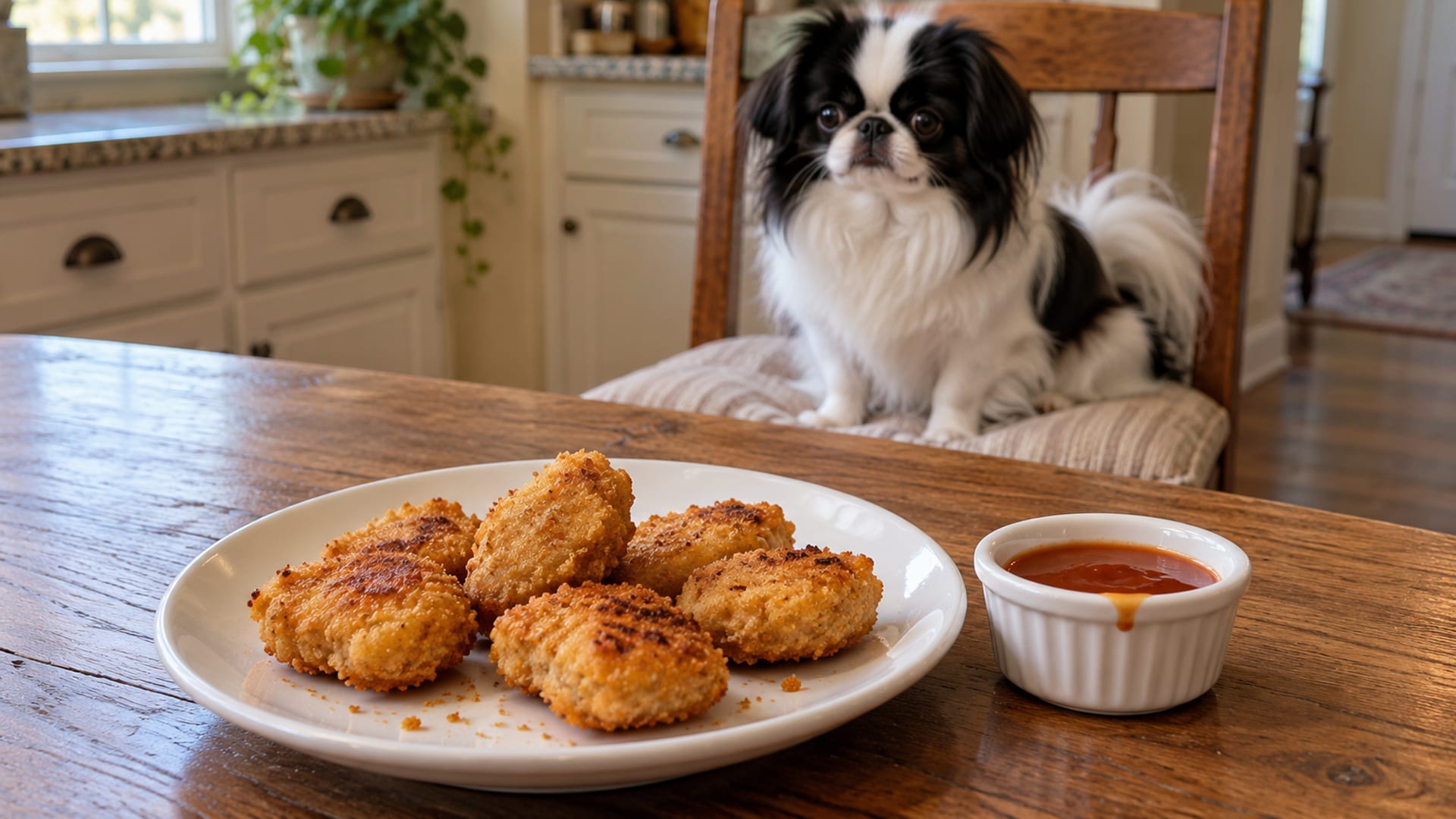
Chicken nuggets are a caution food for dogs. One small cooked nugget is usually not an emergency for a healthy dog, but the breading, frying fat, salt and seasoning change from one product to the next, so nuggets work best as a rare taste at most.
If your dog already got into them, grab the box or wrapper before it goes in the trash. How many went down, how big your dog is, and whether the label lists onion or garlic powder decide most of what happens next. A dipping sauce, a chewed wrapper, a raw frozen nugget, or a dog who has had pancreatitis are reasons to call your vet now.
Key takeaways
Tap a card to bring it forward.
- One small cooked nugget is usually not an emergency for a healthy dog; several nuggets or a small dog change that.
- Read the ingredient list for onion powder or garlic powder, and treat any dipping sauce as its own question.
- Call your vet for a large or unknown amount, a sauce, a wrapper or box, a raw nugget, or a dog with a history of pancreatitis.
- Stomach trouble from fatty food can show up one to four days later, so keep an eye on your dog after the first evening.
- If you want to share chicken, a small piece of plain, unseasoned cooked chicken is the lower-risk choice.
What to do if your dog just ate chicken nuggets
Work through these in order.
- Keep the box, bag or wrapper. A poison line can work out the risk from the actual product and amount, and the ingredient list is how they do it.
- Count what is missing. Nuggets, sauce cups and bits of wrapper all count, because amount and packaging change the advice more than anything else.
- Write down the time and your dog's weight. A small dog takes in far more per pound from one nugget, and the time tells your vet when delayed signs could start.
- Skip the home remedies. The Pet Poison Helpline warns against home fixes with salt, oil, grease or butter, and hydrogen peroxide or medicine should wait for a veterinary professional's say-so, since the wrong remedy adds a second problem.
- Call now if any of these fit. A large or unknown amount, onion or garlic on the label, any sauce, a swallowed wrapper, a raw nugget, or a dog with past pancreatitis, diabetes or poor access to water are the cases where waiting costs time.
- Otherwise, watch for a few days. Leave fresh water out, feed the usual meals and check for the signs below, because fatty-food trouble does not always show up the same night.
Which nuggets and extras carry the most risk
A nugget is chicken, breading, frying oil, salt and seasoning, often with a sauce and packaging on the side, and each part brings its own concern.
Tap or hover a row to highlight it.
| What your dog ate | What to do | Why it matters |
|---|---|---|
| What your dog ateOne small cooked nugget, healthy adult dog | What to doWatch at home for a few days | Why it mattersFat and salt vary, and upset can be delayed |
| What your dog ateSeveral nuggets, or any amount in a small dog | What to doCall your vet | Why it mattersMore fat and salt per pound of dog |
| What your dog ateNuggets with onion powder or garlic powder | What to doCall your vet | Why it mattersOnion and garlic can damage red blood cells |
| What your dog ateA dipping sauce | What to doCall your vet | Why it mattersSauces may contain onion, garlic, xylitol or a lot of salt |
| What your dog ateThe wrapper, box or a bone fragment | What to doCall your vet | Why it mattersChoking or a blockage in the gut |
| What your dog ateRaw or uncooked frozen nuggets | What to doCall your vet | Why it mattersRaw chicken can carry Salmonella, Campylobacter or Clostridium perfringens |
| What your dog atePlain cooked chicken with no breading | What to doFine as a small treat | Why it mattersThe lower-risk form |
Fat is the part people underestimate. The Pet Poison Helpline explains that fatty table foods are not poisons in the usual sense, but they can cause anything from a mild upset stomach to severe pancreatitis, and pancreatitis can be fatal. The Merck Veterinary Manual lists eating large amounts of table scraps among the risk factors for pancreatitis in dogs. The fried outside and any skin are the fattiest parts.
The coating may also hold wheat, dairy, egg, salt, and onion or garlic powder. The ASPCA names N-propyl disulfide as the toxic compound in garlic and notes it can irritate the stomach and damage red blood cells. If the box lists either one, see our pages on Onions and Garlic and give your vet a call with the amount.
Salt matters too. The FDA notes that packaged foods carry a lot of sodium and that the label shows how much. According to the Merck Veterinary Manual, salt poisoning comes from too much sodium chloride and is more likely when a dog cannot get enough water.
Raw nuggets are a different case. The CDC warns that raw chicken can carry Salmonella, Campylobacter and Clostridium perfringens, and uncooked breading may hold raw flour or egg. Boneless nuggets do not normally contain bones, but if you find a hard fragment, our Chicken bones page explains why cooked bone can splinter.
Sharing a nugget, and how much is too much
If you want to share something, the swap I would make is simple: set aside a small piece of plain chicken instead of a breaded nugget. The AKC recommends chicken that is roasted, poached, grilled or baked with no seasoning, and the CDC puts the safe cooking temperature for chicken at 165°F. Leave out the breading, the skin, the oil and any sauce.
Keep the portion small. The ASPCA suggests snacks make up no more than 5 percent of a dog's daily calories, people food included.
As for how many nuggets become a problem, nuggets differ too much in fat, sodium, seasoning and size for a dose chart, and pancreatitis has no single fat amount that predicts which dog gets sick. Call your vet or a poison line with your dog's weight, the product name and the number eaten, and let them run the numbers for that product.
Some dogs need a stricter line. The Merck Veterinary Manual notes that dogs with pancreatitis are managed with low-fat diets and treats, and lists Miniature Schnauzers, Yorkshire Terriers, Cocker Spaniels, Dachshunds, Poodles and sled dogs among the breeds where pancreatitis shows up more often. For dogs with high blood fats, diabetes or other ongoing illness, leave nuggets off the menu unless their vet says otherwise.
Signs to watch for over the next few days
When trouble comes, it usually starts in the stomach, and not always right away. The Pet Poison Helpline reports that vomiting after fatty food can be delayed one to four days, along with belly pain, diarrhea, a poor appetite and low energy.
Call your vet promptly if you see:
- Repeated vomiting or diarrhea
- Belly pain
- Lethargy, weakness or refusing food
- Unusual thirst
- Stumbling or poor coordination, tremors or seizures
- Trouble breathing or collapse
The thirst, stumbling and tremors point toward salt, which the Merck Veterinary Manual describes as affecting both the gut and the nervous system; severe cases can lead to seizures, coma or death. Onion and garlic work on a slower clock. The ASPCA describes anemia that can appear later, with weakness, a fast heart rate, panting or blood in the urine.
A mild upset stomach often settles on its own, but pancreatitis can need a hospital stay, and a quiet first evening does not rule it out.
My dog ate nuggets before and was fine
Plenty of people have watched a dog snag a nugget off a kid's plate with nothing happening afterward, and that really did happen. It just does not tell you how this time will go.
That dog may have eaten one nugget instead of five, may have been a Lab instead of a Chihuahua, or may have found a brand with less salt and no onion in the coating, with water close by. Dogs also differ on their own: the Merck Veterinary Manual links pancreatitis risk to breed and to other illness, and the CDC points out that germs from raw food do not make every animal sick every time.
Timing plays a part too. Because fatty-food signs can wait up to four days, a dog who looked fine that night may not have been in the clear yet. This dog still deserves its own look at the amount, the label and the next few days.
Tenders, strips, plant-based nuggets and other look-alikes
Chicken tenders, strips, fingers, bites, popcorn chicken and chicken fries can each carry different amounts of fat, sodium and seasoning, and fast-food, frozen grocery, restaurant and homemade nuggets differ as well. Read the label that came with the one your dog ate.
A few look-alikes need their own check:
- Raw or uncooked frozen nuggets. "Raw" can mean uncooked frozen breaded chicken, a raw pet-food product, or something sold as minimally processed. The package and its cooking instructions tell you which one you have, and the CDC recommends against raw pet food. See also Raw chicken.
- Plant-based nuggets. Meat-free nuggets are a separate food. They may contain onion, garlic, legumes, soy, wheat or high sodium, so the ingredient list matters as much as it does for chicken.
- Sauces and sides. Dipping cups, spice mixes and leftovers can hold onion, garlic, xylitol, raisins, alcohol or concentrated salt. See BBQ Sauce, and if the kids' meal came with a side, French fries too.
Check what you learned
Three quick questions to see what stuck.
Quick check
Questions about dogs and chicken nuggets
A few follow-up questions that come up once the first worry passes.
Can puppies eat chicken nuggets?
Skip them. One nugget is a bigger dose of fat and salt for a puppy's size, and the CDC notes that young animals can be more vulnerable to germs from raw food. If your puppy grabbed one, the same steps apply: keep the label, count what is missing and call if anything on the list fits.
Can I share nuggets with my cat as well?
Cats should not get them either, even if your dog handled one without trouble. The ASPCA says cats are more sensitive than dogs to the red blood cell damage from onion and garlic.
My dog has had pancreatitis before. Does one nugget matter?
It can. The Merck Veterinary Manual describes low-fat diets and low-fat treats as part of managing dogs who have had it, and a fried, breaded nugget is the opposite of that. Call your vet even for a single nugget and tell them which product it was.
What if my dog ate dried or freeze-dried chicken nuggets meant for people?
Check whether the product was cooked. If it is raw or not heat-treated, the CDC warning about raw food applies, and it is worth a call. If it was fully cooked, the concern shifts to how much fat, salt and seasoning is packed into each piece.
Sources
Checked September 25, 2026.
- Pet Poison Helpline, Is Table Food Poisonous for Dogs?
- Pet Poison Helpline, Pet Poison First Aid Misconceptions
- Merck Veterinary Manual, Pancreatitis and Other Disorders of the Pancreas in Dogs
- Merck Veterinary Manual, Salt Toxicosis in Animals
- Merck Veterinary Manual, Salt Poisoning
- ASPCA, Garlic
- ASPCA, People Foods to Avoid Feeding Your Pets
- ASPCA, Sharing is Caring: Foods You Can Safely Share with Your Pet
- American Kennel Club, Can Dogs Eat Chicken?
- CDC, Chicken and Food Poisoning
- CDC, About Pet Food Safety
- FDA, Sodium in Your Diet