
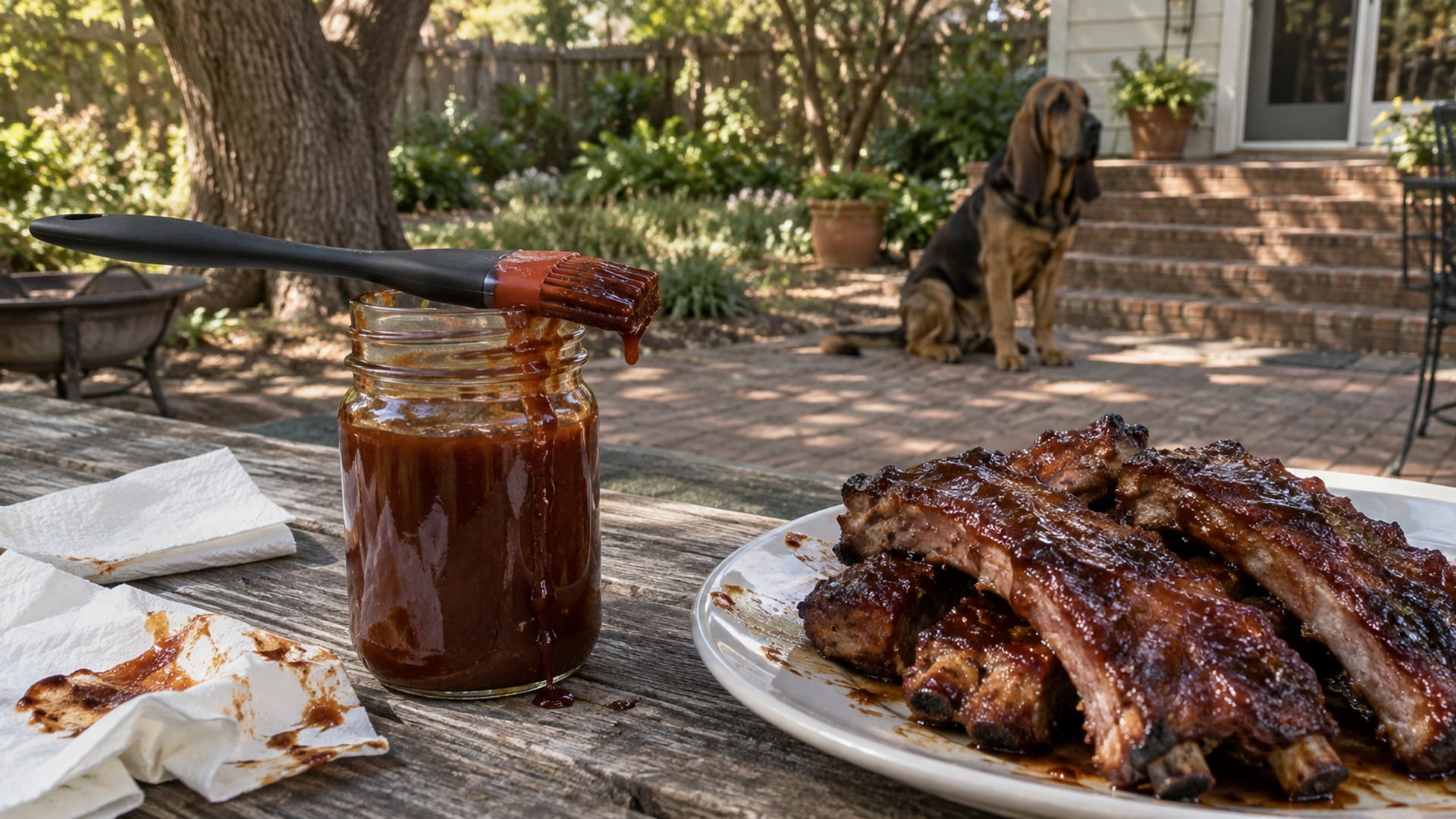
Barbecue sauce is one to keep away from your dog, and the label on the bottle decides how much a taste matters. A small lick of an ordinary sauce is unlikely to cause serious illness, but onion or garlic, xylitol in a sugar-free sauce, alcohol, cocoa or a lot of salt changes the answer.
If your dog already got into it, pick up the bottle or packet first. The ingredient list tells you whether tonight is a quiet watch at home or a call right now.
Key takeaways
Tap a card to bring it forward.
- Barbecue sauce has no single recipe, so the ingredient list on your bottle decides the risk.
- Xylitol, also listed as birch sugar or wood sugar, means call your vet or a pet poison line right away.
- Onion or garlic powder, alcohol, cocoa, or a large or unknown amount are also reasons to call now.
- Onion and garlic can take several days to harm red blood cells, so a dog that looks fine tonight still needs watching.
- Keep sauced ribs, bones and drippings off your dog's plate too.
What to do tonight with the bottle in your hand
Go through these in order.
- Move your dog away from the sauce and the plate. Every extra lick adds to the dose, and the ribs and bones are usually next.
- Read the label for xylitol first. Check sugar-free and keto sauces closely; the sweetener may be listed as birch sugar or wood sugar. The FDA says to call your vet, an emergency animal clinic or an animal poison control center if you think your dog ate a product with xylitol, so this one does not wait for signs.
- Look for onion, garlic, alcohol and cocoa. Powdered, dehydrated and granulated onion and garlic are concentrated, so a spoonful of sauce can carry more than you would expect.
- Estimate how much and when. A lick off a plate, one sauced rib and half a bottle are very different exposures, and xylitol and onion work on different clocks.
- Check for the packet, cap, foil seal or bones. A swallowed container or rib bone can block the gut whatever the sauce contains, so call if any of it is missing.
- Have the facts ready when you call. The ASPCA advises calling your vet or poison control right away when a pet may have eaten something toxic. Give them the product name, the ingredient list, the amount, the time and your dog's weight, and let them decide on any treatment.
Which sauces and ingredients change the answer
The ASPCA points out that barbecue sauces and marinades can contain garlic, onion, cocoa powder, coffee and tamarind.
Tap or hover a row to highlight it.
| On the label | Why it matters | What to do |
|---|---|---|
| On the labelXylitol, birch sugar, wood sugar | Why it mattersCan drop blood sugar fast and injure the liver | What to doCall right away |
| On the labelOnion or garlic powder, dehydrated or granulated | Why it mattersConcentrated forms that can damage red blood cells | What to doCall, above all for a small dog or more than a taste |
| On the labelFresh, cooked or roasted onion or garlic | Why it mattersCooking does not remove the risk | What to doCall if more than a taste or the amount is unknown |
| On the labelAlcohol | Why it mattersCan cause vomiting, poor coordination and trouble breathing | What to doCall |
| On the labelCocoa or chocolate | Why it mattersTheobromine and caffeine are toxic to dogs | What to doCall |
| On the labelOnly tomato, vinegar, sugar, spices and salt | Why it mattersMore likely to upset the stomach than to poison | What to doSmall lick: watch at home. Large amount: call |
| On the label"Natural flavors" or "spices" | Why it mattersMay include onion or garlic you cannot measure | What to doTreat as unknown if more than a lick |
The Merck Veterinary Manual says raw, cooked, dehydrated and granulated onion and garlic can all poison animals, and a 2009 review in Interdisciplinary Toxicology found that cooking, drying and processing do not get rid of the toxic compounds. The entries on Onions and Garlic cover each one alone.
Salt matters too. Merck's page on salt toxicosis says too much sodium can cause vomiting, diarrhea, weakness, tremors and seizures, and it is more dangerous when a dog has no water, so keep a full bowl out while you watch. For sauces with alcohol or cocoa, the Beer and Chocolate entries explain those risks.
Sharing sauced meat, and how much sauce is a concern
I wouldn't count any amount of barbecue sauce as a dog treat, since the recipe changes from bottle to bottle and no veterinary source gives a safe serving. If you want your dog included at the cookout, their usual treats in their own bowl do the job.
Wiping sauce off a rib does not help much, since the meat holds what it soaked up and leftovers often come with bones and fatty trimmings. The ASPCA's Labor Day barbecue tips flag onions, garlic, fatty foods and leftovers as grilling-season risks, and Merck's page on pancreatitis in dogs explains why a fatty meal can end in a hospital stay. The Pork rib bones and Bacon grease entries cover the bones and drippings.
On the risky side, no toxic dose exists for "barbecue sauce" itself, because labels do not say how much onion or garlic is inside; published figures cover only the ingredients. Merck reports signs in dogs after about 15 to 30 grams of raw onion per kilogram of body weight and rates garlic as 3 to 5 times more toxic than onion. The garlic and cooked onion rows below come from a 2000 garlic study and a 2008 onion study in dogs.
Tap or hover a row to highlight it.
| Ingredient | Amount reported | Source |
|---|---|---|
| IngredientRaw onion | Amount reportedSigns after about 15 to 30 g per kg of body weight | SourceMerck Veterinary Manual |
| IngredientGarlic | Amount reportedExtract equal to about 5 g of whole garlic per kg caused red blood cell changes | SourceLee et al., 2000 |
| IngredientCooked onion | Amount reported30 g per kg a day for two days, fed in a study of red blood cell damage | SourceTang, Xia and Yu, 2008 |
| IngredientXylitol | Amount reportedNo set amount for an unknown sauce; any known ingestion means call | SourceFDA |
These amounts are linked to harm and do not mark a safe line, and repeated smaller doses can add up. Since you can't tell how much onion powder sits in a spoonful of sauce, skip the math and call with your dog's weight and your best guess of how much is gone. The same spoonful is a much bigger dose for a small dog.
Signs to watch and when they show up
What to watch for depends on what was in the sauce.
Tap or hover a row to highlight it.
| Ingredient | Signs | Timing |
|---|---|---|
| IngredientXylitol | SignsVomiting, tiredness, weakness, staggering, collapse, tremors, seizures | TimingLow blood sugar can start in about 10 to 60 minutes; serious effects sometimes appear 12 to 24 hours later |
| IngredientOnion or garlic | SignsVomiting, diarrhea, belly pain, drooling, then weakness, pale or yellowish gums, fast breathing, dark urine, collapse | TimingBlood changes can begin within 24 hours; anemia commonly takes several days to show |
| IngredientSalt | SignsVomiting, then diarrhea, weakness, tremors, seizures | TimingVomiting can start within several hours |
Timing for xylitol comes from the FDA's consumer update, which also warns of liver failure and bleeding problems, and timing for onion and garlic comes from Merck. After a real amount of onion or garlic sauce, check gum color, energy and urine for several days, and call if the gums look pale or yellow or the urine turns dark.
After a small lick of a plain sauce, expect nothing or a short bout of vomiting or loose stool. Call if it keeps going.
My dog ate barbecue sauce before and was fine
That happens, and I believe it. One uneventful lick just can't tell you how the next one goes:
- The amount was probably small. A lick carries far less than a knocked-over bottle.
- Size changes the dose. The same spoonful means much more per kilogram to a small dog.
- The bottle was different. One brand may have no onion, garlic or xylitol, and the next may be full of garlic powder.
- Doses add up. Merck notes that repeated smaller onion or garlic exposures can matter.
- Some signs come late. Onion and garlic anemia can take days to show.
- Dogs differ. Two dogs can react differently to the same meal.
The earlier dog's story is real. It isn't a rule you can count on for this bottle and this dog.
Sauces, rubs and names that get mixed up
A few products and names get confused with barbecue sauce.
Sugar-free, keto and "no sugar added" sauces. "No sugar added" does not always mean xylitol, but it is the label to read twice.
Onion and garlic in other forms. Onion salt, garlic salt, roasted garlic, scallions, shallots, chives and Leeks belong to the same plant family, and the Pet Poison Helpline's food guide lists them among foods to keep from pets.
Spicy sauces. Chipotle, chili, cayenne and hot sauce can irritate the stomach, a separate problem from onion and garlic, and one sauce can have both.
Liquid smoke, rubs, marinades, steak sauce, teriyaki and Worcestershire. Garlic, onion, salt, alcohol and sweeteners vary by product, so each bottle needs its own check.
Ketchup and tomato sauce. These are different products, though ketchup can also contain onion powder, garlic, salt and sugar. The Tomatoes entry covers the fruit itself.
Check what you learned
Three quick questions to see what stuck.
Quick check
Questions about dogs and bbq sauce
These tend to come up once the first worry has passed.
Is homemade barbecue sauce any safer?
Only if it has none of the risky ingredients. You do know what went in and roughly how much, which makes the call to your vet quicker.
Is barbecue sauce dangerous for my cat too?
Yes, and possibly more so. Merck says cats are more sensitive than dogs to onion and garlic, above all concentrated forms like powders and flakes. Xylitol appears less dangerous to cats, but the sauce still isn't something to offer them.
My dog has diabetes or has had pancreatitis. Does that change anything?
It raises the stakes. Xylitol can cause severe low blood sugar and fatty barbecue food can set off pancreatitis, so mention the history when you call. Dogs with kidney disease may also cope less well with dehydration or red blood cell damage.
My puppy got a lick. Is a puppy at higher risk?
What matters most is size, since a small puppy gets a larger dose per kilogram from the same lick. Give your vet the puppy's weight along with the label, and they can judge it from there.
Sources
Checked September 25, 2026.
- ASPCA, What BBQ Staples are Dangerous to My Pet?
- ASPCA, Our Top Five Tips for Labor Day BBQ Safety
- Merck Veterinary Manual, Garlic and Onion (Allium spp) Toxicosis in Animals
- Merck Veterinary Manual, Salt Toxicosis in Animals
- Merck Veterinary Manual, Pancreatitis in Dogs and Cats
- U.S. Food and Drug Administration, Paws Off! Xylitol is Toxic to Dogs
- U.S. Food and Drug Administration, Paws Off! Xylitol is Toxic to Dogs (consumer update)
- Pet Poison Helpline, Toxic & Hazardous Food Guide for Pets
- Interdisciplinary Toxicology, Some Food Toxic for Pets (Kovalkovičová et al., 2009)
- American Journal of Veterinary Research, Hematologic changes associated with the appearance of eccentrocytes after intragastric administration of garlic extract to dogs (Lee et al., 2000)
- Journal of Veterinary Pharmacology and Therapeutics, An experimental study of hemolysis induced by onion (Allium cepa) poisoning in dogs (Tang, Xia and Yu, 2008)